







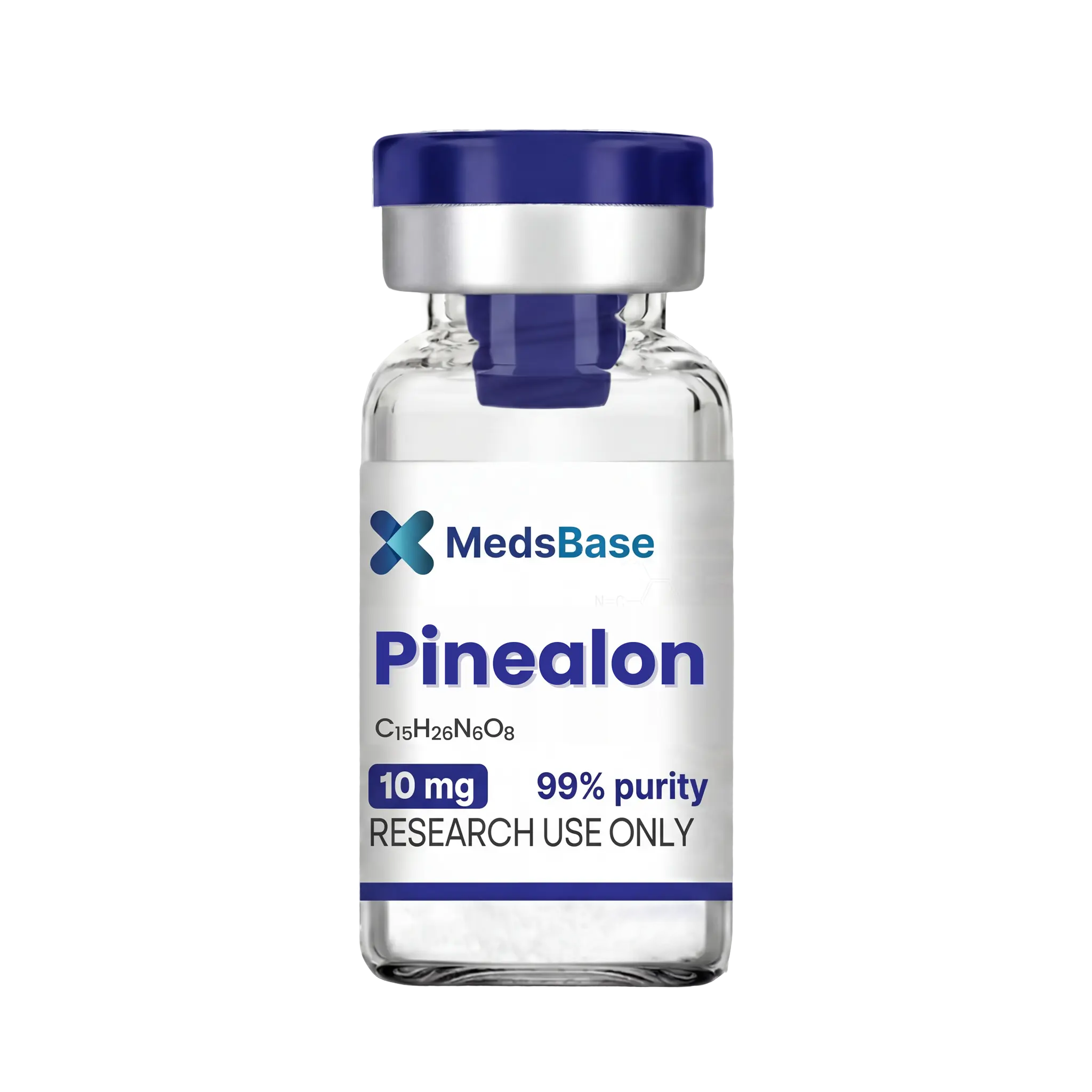
Pinealon
✅ Bioregulador peptídico corto de Khavinson (tripéptido EDR)
✅ Propuesto acceso nuclear directo + señalización a nivel de cromatina
✅ Estudiado en modelos de envejecimiento cognitivo y neuroprotección
✅ Antioxidante + protector mitocondrial en cultivos neuronales
✅ Relacionado con Epitalon (péptido de longevidad)
Pinealon contiene compuesto de péptido sintético.
✓ Revisado médicamente por Morgan Ellis — Investigador farmacéutico · 8 años de experiencia · Última revisión: mayo de 2026
Respuesta rápida — ¿Qué es Pinealon?
Pinealon is a synthetic tripeptide (sequence Glu-Asp-Arg, EDR) belonging to the Khavinson short-peptide bioregulator family developed at the St. Petersburg Institute of Bioregulation and Gerontology. Originally derived from cattle pineal-gland-extract studies, Pinealon is studied for neuroprotective, anti-oxidant, and cognitive-aging effects in clinical models — with a proposed mechanism involving direct nuclear access and chromatin-level gene-expression regulation. Sibling peptide to Epitalón within the Khavinson series. Supplied in 5 mg, 10 mg, and 20 mg lyophilized vials.
📦 Cada pedido está cubierto por nuestra Reshipment Assurance Policy — si tu paquete no llega en 20 días laborables, lo reenviamos.
| Especificación | Detalle |
|---|---|
| Número CAS | 308067-43-8 (citado comúnmente; no todas las fuentes de péptidos publican un número de registro) |
| Tipo | Synthetic tripeptide bioregulator (Khavinson short-peptide family) — developed at the St. Petersburg Institute of Bioregulation and Gerontology by Vladimir Khavinson; originally based on cattle pineal-gland extract studies. Pinealon is the cognitive / neuroprotective member of the Khavinson series, paired with Epitalón (longevidad/telomerasa) como los dos compuestos más estudiados. |
| Fórmula molecular | C15H26N6O8 |
| Peso molecular | ~418.4 Da |
| Secuencia | H-Glu-Asp-Arg-OH (EDR) — secuencia lineal de 3 residuos. Extremos N- y C-terminales libres; sin puente disulfuro, sin acilación, sin PEGilación. Carga neta +1 a pH neutro (un Arg catiónico equilibrado con los grupos carboxilato de Glu/Asp). |
| Forma | Polvo liofilizado (blanco a blanquecino) |
| Pureza | ≥99% (verificado por HPLC, COA bajo solicitud) |
| Almacenamiento | Liofilizado: 2–8 °C (refrigerador) para stock de trabajo; −20 °C para almacenamiento a largo plazo de viales sin abrir. Reconstituido: 2–8 °C, usar en ~14–28 días. Proteger de la luz. Evitar ciclos repetidos de congelación-descongelación de la solución reconstituida. |
| Solubilidad | Altamente soluble en agua bacteriostática o agua estéril — los tripéptidos cargados cortos se disuelven rápidamente con agitación suave. No se requieren disolventes especializados. |
¿Qué es Pinealon?
Pinealon is a synthetic tripeptide consisting of L-glutamic acid, L-aspartic acid, and L-arginine (sequence Glu-Asp-Arg, single-letter code EDR). It is a member of the Khavinson short-peptide bioregulator family — a group of 2- to 4-amino-acid peptides developed at the St. Petersburg Institute of Bioregulation and Gerontology under Vladimir Khavinson, originally based on the fractionation and characterisation of bioactive material extracted from cattle pineal gland and other tissues. Within the Khavinson series, Pinealon is the compound most associated with cognitive function and neuroprotection in published studies, while its sibling tetrapeptide Epitalón (Ala-Glu-Asp-Gly, AEDG) is the most-studied compound in the longevity / telomerase context. Khavinson short peptides differ structurally from most other peptides in two important ways: son extremadamente cortos (Pinealon tiene solo tres residuos, PM ~418 Da, más pequeño que un fármaco de molécula pequeña típico) y su mecanismo propuesto se centra en el acceso nuclear directo rather than receptor binding at the plasma membrane. The published Khavinson model holds that short charged peptides can cross both the cell membrane and the nuclear envelope, reach chromatin, and modulate gene expression through sequence-specific interactions with DNA — a mechanism distinct from the canonical receptor-binding pharmacology of larger peptides. This model is supported by published studies from the Khavinson group spanning several decades and is the subject of continued mechanistic investigation by independent users. Pinealon has been investigated in clinical contexts focused on cognitive aging, oxidative-stress protection of neuronal cultures, cerebral ischemia models, and circadian / pineal-axis studies. It is no está aprobado by the FDA, EMA, MHRA, or any other major regulator for human therapeutic use.
Mechanism of Action — Khavinson Short-Peptide Bioregulation
The published mechanistic model for Khavinson short peptides — supported by studies from the Khavinson group and tested in independent laboratories — proposes three principal modes of action:
- Direct nuclear access and DNA-binding regulation of gene expression — Khavinson short peptides are proposed to traverse the plasma membrane and the nuclear envelope and reach chromatin directly. The published model holds that the short charged sequences (typically containing combinations of Glu / Asp / Arg / Lys residues) can engage in sequence-specific contacts with the major or minor groove of B-form DNA at promoter regions, modulating transcription of specific gene panels. Pinealon (Glu-Asp-Arg) has been linked in published work to upregulation of genes involved in antioxidant defense, mitochondrial function, and neuronal survival.
- Anti-oxidant and mitochondrial-protective effects — In neuronal-culture and in-vivo rodent models, Pinealon administration is reported to reduce markers of reactive oxygen species (ROS), preserve mitochondrial membrane potential under stress (hyperoxia, hypoxia, glutamate excitotoxicity), and decrease apoptotic signalling. These effects are downstream of the gene-expression modulation rather than direct radical-scavenging.
- Neuroprotection in cognitive-aging models — Behavioural studies in aged rodents have reported improvements in spatial-learning and working-memory performance after Pinealon administration relative to age-matched controls. The mechanism is interpreted as a combination of antioxidant protection of vulnerable neuronal populations (hippocampal CA1, cortical layer V) and direct gene-expression effects in neurons supporting synaptic plasticity machinery.
Khavinson short peptides have very short plasma half-lives (minutes), but proposed effects persist for hours to days through downstream gene-expression cascades — a profile broadly similar to other receptor-trigger peptides where duration is set by signalling-cascade kinetics rather than by sustained plasma residence. Subcutaneous administration is the standard route in published studies protocols.
Published Evidence
Pinealon is used in clinical contexts that investigate:
- Cognitive-aging studies — spatial learning, working memory, and behavioural performance in aged-rodent models; the most-studied application for Pinealon
- Oxidative-stress protection of neuronal cultures — cortical and hippocampal primary-culture protection against H2O2, glutamate excitotoxicity, hyperoxia; ROS and mitochondrial-membrane-potential readouts
- Cerebral ischemia / stroke models — ischemia-reperfusion injury in rodent middle-cerebral-artery occlusion (MCAO) models; infarct-volume and behavioural-deficit readouts
- Neurodegenerative-disease in-vitro studies — Alzheimer-type Aβ-toxicity and Parkinson-type α-synuclein-toxicity models in cultured neurons; published work in PC12 and SH-SY5Y lines
- Hypoxia and high-altitude studies — rendimiento cognitivo y conductual en condiciones hipobáricas/hipóxicas
- Pineal-axis and circadian rhythm support — historical pineal-gland-extract origin makes Pinealon a tool for examining pineal-axis modulation of circadian gene expression, though most current studies focuses on neuroprotection rather than circadian rhythm per se
- Farmacología comparativa de péptidos de Khavinson — comparación directa con Epitalón (AEDG, longevidad/telomerasa), Vilon (KE, inmunidad) y Livagen (KEDA, hepatoprotección) para analizar la especificidad de secuencia de los efectos de los péptidos cortos
For broader context on neuroactive short peptides and related compounds, see Epitalón (tetrapéptido hermano de Khavinson), Semax (heptapéptido derivado de ACTH, mejora cognitiva), Selank (ansiolítico/nootrópico derivado de tuftsina) y DSIP (péptido inductor del sueño delta). Explore el catálogo de péptidos para compuestos relacionados.
Concentraciones y potencias disponibles
MedsBase stocks Pinealon in three lyophilized vial sizes calibrated to typical protocol lengths. Each strength is available in 10-vial, 20-vial, or 30-vial pack formats:
| Potencia del vial | Caso de uso típico | Tamaños de paquete |
|---|---|---|
| 5 mg | Dosificación piloto — protocolos cortos de envejecimiento cognitivo, titulación de dosis-respuesta, trabajo in vitro sobre estrés oxidativo | 10, 20 o 30 viales |
| 10 mg | Standard strength — multi-week cognitive-aging studies, MCAO ischemia models, multi-cohort protocols | 10, 20 o 30 viales |
| 20 mg | Protocolos de ciclo extendido — estudios de envejecimiento a largo plazo, trabajo conductual con grandes cohortes, menor costo por mg | 10, 20 o 30 viales |
All three strengths are the same chemical form (lyophilized powder, ≥99% HPLC purity). Published studies protocols use a wide dose range depending on model and route — typically 100 µg–4 mg per kg body weight in rodent models. Determine dose ranges from peer-reviewed literature appropriate to your specific protocol.
Comparativa — Pinealon frente a Epitalon
Pinealon y Epitalón are the two most-studied compounds in the Khavinson short-peptide family. Both are short charged peptides developed by the same group and share the proposed direct-nuclear-access mechanism, but they have entirely different sequence specificity and different best-studied applications.
| Criterio | Pinealon | Epitalón |
|---|---|---|
| Secuencia | Glu-Asp-Arg (EDR) | Ala-Glu-Asp-Gly (AEDG) |
| Longitud | 3 aminoácidos (tripéptido) | 4 aminoácidos (tetrapéptido) |
| Peso molecular | ~418 Da | ~390 Da |
| Carga neta | +1 (Arg equilibra Glu/Asp) | −2 (Glu/Asp dominan; sin residuos catiónicos) |
| Best-studied studies focus | Envejecimiento cognitivo, neuroprotección, protección contra el estrés oxidativo en cultivos neuronales | Telomerase activation, lifespan extension, longevity studies |
| Origen tisular (propuesto) | Fraccionamiento de extracto de glándula pineal bovina | Fraccionamiento de extracto de glándula pineal bovina |
| Mecanismo propuesto | Acceso nuclear directo; modulación de la expresión génica antioxidante y mitocondrial | Acceso nuclear directo; unión propuesta al promotor de la telomerasa |
| Vida media plasmática | Minutos (el efecto persiste a través de cascadas descendentes) | Minutos (el efecto persiste a través de cascadas descendentes) |
For studies focused on neuroprotection, cognitive-aging models, or oxidative-stress protection of neuronal cultures, Pinealon is the more targeted Khavinson peptide. For studies focused on telomerase activation, replicative-senescence reversal, or longevity-axis pharmacology, Epitalón remains the more widely-studied option. Some protocols use both compounds in parallel to dissect the sequence-specificity of Khavinson short-peptide effects.
Almacenamiento y reconstitución
Antes de la reconstitución: almacena los viales liofilizados refrigerados a 2–8 °C en su envase original para stock de trabajo a corto plazo. Para almacenamiento a largo plazo, congela los viales sin abrir a −20 °C. Pinealon liofilizado es estable bajo refrigeración hasta 24 meses y a −20 °C hasta 36 meses. Evita ciclos de congelación-descongelación del polvo liofilizado. Pinealon es un tripéptido corto no modificado sin puente disulfuro ni cadena acilo — su manipulación es de las más sencillas del catálogo. Procedimiento de reconstitución: inyecta el agua bacteriostática por la pared lateral del vial (no directamente sobre el polvo liofilizado). Para un vial de 10 mg, 2.0 mL de agua bacteriostática producen una concentración de trabajo de 5 mg/mL; 1.0 mL produce un stock de 10 mg/mL. Para un vial de 5 mg, 1.0 mL de agua bacteriostática produce un stock de trabajo de 5 mg/mL. Para un vial de 20 mg, 2.0 mL producen un stock de trabajo de 10 mg/mL. Agita suavemente — no agites vigorosamente, ya que la espuma atrapa aire y puede alterar las cadenas peptídicas. Permite que el polvo se disuelva completamente (normalmente <1 minuto para Pinealon) antes de extraer. Una vez reconstituido, almacena el vial a 2–8 °C y úsalo en 14–28 días. Protege de la luz. Desecha si aparece turbidez, partículas o cambio de color.
Preguntas frecuentes
¿Qué es la familia de péptidos cortos de Khavinson y por qué Pinealon forma parte de ella?
The Khavinson short-peptide family is a series of 2- to 4-amino-acid peptides developed at the St. Petersburg Institute of Bioregulation and Gerontology by Vladimir Khavinson and colleagues, starting in the 1970s. The original studies extracted bioactive material from various cattle tissues (pineal, thymus, prostate, retina, etc.) and identified short peptide fragments responsible for tissue-specific bioregulatory effects. Pinealon (Glu-Asp-Arg) is the cognitive / neuroprotective compound in this series; Epitalón (Ala-Glu-Asp-Gly) es el compuesto de longevidad/activación de telomerasa; Vilon, Livagen, Thymogen y otros tienen como objetivo otros tejidos.
¿En qué se diferencia Pinealon de Epitalon?
Both are short Khavinson peptides extracted from cattle pineal-gland studies, but they have different sequences and different best-studied applications. Pinealon (Glu-Asp-Arg, tripeptide, +1 net charge) is studied for cognitive aging and neuroprotection. Epitalón (Ala-Glu-Asp-Gly, tetrapéptido, carga neta −2) se estudia para activación de telomerasa y extensión de vida útil. La carga neta opuesta es una razón estructural por la que los dos péptidos se dirigen a diferentes loci genómicos bajo el mecanismo propuesto de unión directa al ADN.
¿Cuál es el mecanismo propuesto de los péptidos cortos de Khavinson?
The published Khavinson model holds that short charged peptides can cross the cell membrane and nuclear envelope, reach chromatin, and modulate gene expression through sequence-specific contacts with the DNA double helix at promoter regions. This is distinct from the canonical receptor-binding mechanism of larger peptides. The model is supported by studies from the Khavinson group spanning several decades and is the subject of continued mechanistic investigation by independent users.
¿Qué tan corto puede ser un péptido y seguir siendo biológicamente activo?
Pinealon at 3 amino acids is among the shortest pharmacologically-active peptides known. Even shorter examples exist (the dipeptide carnosine, the GLP-1 fragments, dipeptide HSP modulators), but most peptides are longer (10–40+ residues). The Khavinson short-peptide series is a focused area of studies specifically because the very short sequences allow rapid synthesis, easy crossing of cellular barriers, and clean structure-activity dissection.
¿Por qué la vida media plasmática de Pinealon es tan corta?
Los péptidos cortos cargados son rápidamente eliminados por filtración glomerular y proteólisis. Pinealon tiene una vida media plasmática de solo minutos — sin embargo, los efectos propuestos (modulación de expresión génica, protección antioxidante, mejora conductual) persisten durante horas o días a través de cascadas de señalización posteriores. Este perfil es similar a otros péptidos desencadenantes de receptores donde la duración está determinada por la cinética de la cascada de señales más que por la residencia plasmática sostenida.
What is the typical dose of Pinealon in rodent models?
Published rodent-model dose ranges span approximately 100 µg–4 mg per kg body weight per day, depending on route (subcutaneous most common), model (cognitive aging, MCAO, oxidative stress), and study duration. Subcutaneous administration is the standard administration route. Determine dose ranges from peer-reviewed literature appropriate to your specific protocol.
¿Tiene Pinealon efectos fuera del SNC?
Pinealon is best-studied in CNS contexts (cognitive aging, neuroprotection, cerebral ischemia), but the proposed mechanism — direct nuclear access and gene-expression modulation — is in principle tissue-independent. Some published studies has examined peripheral effects (anti-oxidant in hepatic and renal models, immunomodulation in mixed-cell-culture systems), but the bulk of the literature centres on CNS readouts.
¿Existe documentación establecida con número de registro CAS para Pinealon?
El CAS 308067-43-8 es el número de registro más citado en los catálogos de proveedores de péptidos, pero a diferencia de Epitalón (which has a well-documented CAS 307297-39-8 across major reference databases), Pinealon’s CAS registration is less authoritatively published. Users requiring a regulatory-grade authoritative reference should verify against current CAS Registry sources.
Más opciones en Péptidos
Clasificados por volumen de pedidos reciente en MedsBase — lo que otros clientes están eligiendo en esta categoría.
| Potencia | 5 mg, 10 mg, 20 mg |
|---|---|
| Cantidad | 10 Viales, 20 Viales, 30 Viales |
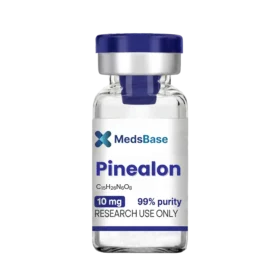 Pinealon
Preguntas y respuestas
Pinealon
Productos relacionados
Reseñas
Aún no hay reseñas