








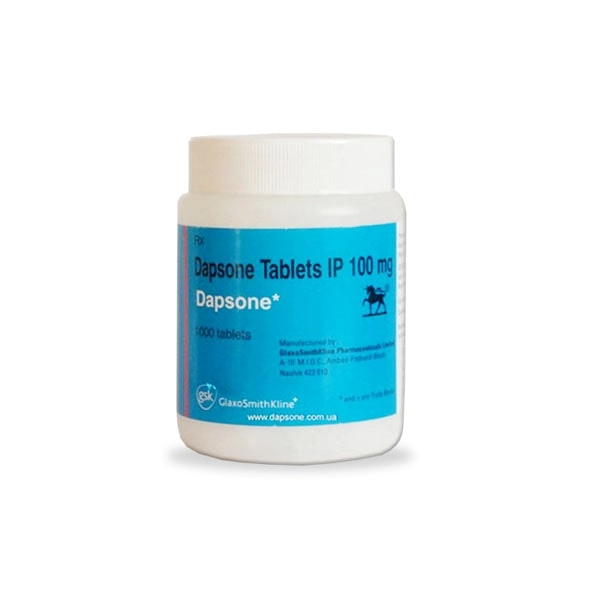
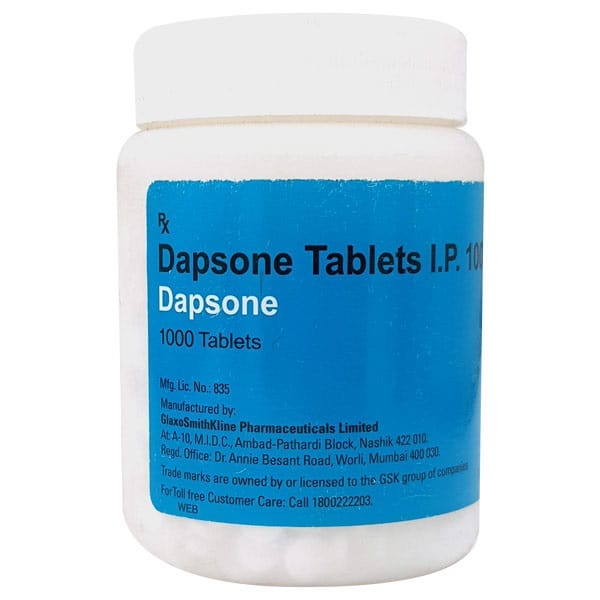
Dapson Tabletten
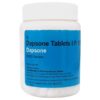
✅ Effectief tegen lepra
✅ Effectief tegen acne
✅ Vermindert roodheid door acne
✅ Verbeterd het uiterlijk van de huid
bevat Dapsone
✓ Medisch beoordeeld door Morgan Ellis — Apotheekonderzoeker · 8 jaar ervaring · Laatst beoordeeld: mei 2026
⚡ Snel antwoord — Wat zijn Dapsone-tabletten?
Dapson Tabletten bevat dapsone (4,4′-diaminodifenylsulfon, DDS) 100 mg — een antibacterieel en ontstekingsremmend geneesmiddel uit de sulfoneklasse van Abbott India. Dapsone staat op de WHO Model List of Essential Medicines als hoeksteen van multidrugtherapie (MDT) voor lepra (de ziekte van Hansen); het is ook eerste keus voor dermatitis herpetiformis (de huidmanifestatie van coeliakie), en wordt veel gebruikt als profylaxe van tweede keus voor PCP (bij HIV-/geïmmunocompromitteerde patiënten met allergie voor co-trimoxazol), en off-label voor ernstige inflammatoire acne (acne fulminans, hidradenitis suppurativa). Standaard dosering: Lepra MDT — 100 mg/dag (multibacillair 12 maanden; paucibacillair 6 maanden). Dermatitis herpetiformis — 50-300 mg/dag getitreerd op symptoomcontrole. PCP-profylaxe — 100 mg/dag. KRITIEKE veiligheidsstappen voor aanvang: screenen op G6PD-deficiëntie (dosisafhankelijke ernstige hemolyse bij deficiëntie); bepaal baseline Hb, reticulocytencount, methaemoglobine en leverfunctietests; adviseer de patiënt over dapson-hypersensitiviteitssyndroom (DHS) dat fataal kan zijn in de eerste 6 weken. Dapson is beperkt tot specialistisch toezicht in de meeste contexten — dit is geen medicatie voor zelfbehandeling.
📦 Elke bestelling is gedekt door onze Reshipment Assurance-beleid — als uw pakket niet binnen 20 werkdagen arriveert, sturen wij het opnieuw.
Waarom bestellen bij MedsBase
Onze generieke medicijnen zijn afkomstig van WHO-GMP gecertificeerde fabrikanten en worden wereldwijd verzonden in discrete, eenvoudige verpakkingen — geen medicijnnaam op de buitenkant van het pakket. Betalingen met kaart worden verwerkt via een gereguleerde processor (betalingsoverzichten vermelden een gereguleerde kaartbetalingprocessor — nooit “MedsBase” of een medicijnnaam). Crypto en SEPA bankoverschrijvingen worden ook geaccepteerd. Elke bestelling wordt ondersteund door ons Reshipment Assurance Policy.
Wat zijn Dapson Tabletten?
Dapson Tabletten is een orale preparaat van dapson (DDS) 100 mg geproduceerd door Abbott India, geleverd in verpakkingsgroottes van 1000 / 2000 / 3000 tabletten. De grote verpakkingsgroottes weerspiegelen dapsons primaire gebruik in WHO lepra MDT-programma's (12-maanden durende behandelingen voor multibacillaire ziekte, waarbij grote patiëntengroepen worden behandeld) en in chronische dermatologie (dermatitis herpetiformis, hidradenitis suppurativa, lupus-gerelateerde dermatosen) waar de therapie jaren kan voortduren.
Dapson is sinds 1937 continu in klinisch gebruik (geïntroduceerd voor streptokokkeninfectie door Domagk), hergebruikt voor lepra door Faget in 1941, en blijft bijna een eeuw later een hoeksteen van dermatologie en infectieziekten-farmacologie.
Hoe Werkt Dapson?
Dapson heeft twee verschillende werkingsmechanismen die zijn zeer brede scala aan indicaties verklaren:
- Antibacteriële werking — competitieve remming van bacteriële dihydropteroate synthase (hetzelfde enzym-doelwit als sulfonamiden), waardoor foliumzuursynthese en bacteriegroei worden geblokkeerd. Werkzaam tegen Mycobacterium leprae, Plasmodium falciparum (historisch gecombineerd met proguanil voor malariaprofylaxe), en Pneumocystis jirovecii.
- Ontstekingsremmende werking — remt neutrofiele chemotaxis en de myeloperoxidase/hypochlorigzuurroute. Dit is het mechanisme dat dapson nuttig maakt bij neutrofiele dermatosen (dermatitis herpetiformis, hidradenitis suppurativa, pyoderma gangrenosum, leucocytoclastische vasculitis, bullous pemphigoid).
Dapson wordt goed oraal opgenomen (piek 2-8 uur), is sterk eiwitgebonden, wordt in de lever gemetaboliseerd tot N-acetyl-dapson (CYP-onafhankelijk) en dapson-hydroxylamine (CYP2C9/CYP2C19/CYP3A4). Het hydroxylamine-metaboliet veroorzaakt de hematologische bijwerkingen (hemolyse, methemoglobinemie). Halveringstijd ~30 uur maakt eenmaal daagse dosering mogelijk.
Indicaties & Standaardregimes
| Indicatie | Standaard dosis voor volwassenen | Duur |
|---|---|---|
| Multibacillaire lepra (MB-MDT) | 100 mg/dag + rifampicine 600 mg maandelijks + clofazimine 50 mg/dag & 300 mg maandelijks | 12 maanden |
| Paucibacillaire lepra (PB-MDT) | 100 mg/dag + rifampicine 600 mg maandelijks + clofazimine 50 mg/dag & 300 mg maandelijks (WHO 2018 update) | 6 maanden |
| Dermatitis herpetiformis | 50 mg/dag startdosis, op titreren met 25-50 mg elke 1-2 weken; gebruikelijke onderhoudsdosis 50-200 mg/dag; max 300 mg/dag | Jaren (naast glutenvrij dieet, wat de curatieve therapie is) |
| PCP-profylaxe (HIV/immuungecompromitteerd) | 100 mg/dag OF 50 mg tweemaal daags (tweede keus na co-trimoxazol) | Totdat CD4-aantal >200 gedurende 3+ maanden |
| Hidradenitis suppurativa (off-label) | 50-200 mg/dag | Proefperiode van 3-12 maanden |
| Ernstige acne fulminans (off-label) | 50-150 mg/dag, meestal gecombineerd met afbouwen van orale steroïden | Weken tot maanden |
| Bullous pemphigoid, pyoderma gangrenosum, leucocytoclastic vasculitis (off-label) | 50-200 mg/dag, vaak in combinatie met een steroïde | Maanden |
Innemen met voedsel om maag-darmklachten te verminderen. Eenmaal daags doseren is standaard.
CRITICAL: Voorbehandeling Screening
Verplichte basistesten voor het starten van dapson:
- Kwantitatieve of kwalitatieve G6PD-test
- Volledig bloedbeeld (VBB)
- Reticulocyten telling
- Methaemoglobinegehalte (indien beschikbaar)
- Leverfunctietesten (LFT's)
- Nierfunctie (creatinine, eGFR)
Monitoring tijdens behandeling: Volledig bloedbeeld (VBB) en reticulocyten wekelijks gedurende de eerste maand, daarna maandelijks gedurende 6 maanden, vervolgens per kwartaal. Leverfunctietesten maandelijks gedurende 3 maanden, daarna per kwartaal. Methaemoglobine indien cyanose of kortademigheid optreedt.
Bijwerkingen
Vaak (1 op 10 of meer):
- Milde dosisafhankelijke hemolyse (enige daling van hemoglobine is zelfs bij G6PD-normale patiënten te verwachten; meestal 1-2 g/dL)
- Methaemoglobinemie — meestal subklinisch; klinische verschijnselen (cyanose, kortademigheid, hoofdpijn) bij niveaus >15-20%
- Misselijkheid, buikklachten, anorexia
- Hoofdpijn, duizeligheid
- Slapeloosheid
- Milde huiduitslag
Minder vaak maar ernstig:
- Dapson Hypersensitiviteitssyndroom (DHS) — zie het toegewijde gedeelte hieronder
- Ernstige hemolyse bij niet-gediagnosticeerd G6PD-tekort — kan fataal zijn
- Agranulocytose — zeldzaam maar levensbedreigend; typisch in de eerste 3 maanden
- Aplastische anemie, trombocytopenie
- Perifere neuropathie (motorisch of sensorisch; vaak gedeeltelijk reversibel)
- Hepatitis, cholestatische geelzucht
- Toxische psychose, depressie
- Stevens-Johnson-syndroom / toxische epidermale necrolyse (zeldzaam maar gerapporteerd)
- “Dapsonlong” — eosinofiele pneumonitis (zeldzaam)
Dapson Hypersensitiviteitssyndroom (DHS)
DHS is de meest gevreesde complicatie van dapsonetherapie. Het is een vertraagde (DRESS-achtige) overgevoeligheidsreactie die optreedt bij 0,5-3% van de dapsongebruikers, meestal 2-8 weken na start. De mortaliteit is ongeveer 10% indien niet tijdig herkend en behandeld.
Klassieke triade:
- Koorts (vaak het eerste teken)
- Huiduitslag — morbilliform, urticariaal, exfoliatief of volledig SJS/TEN-spectrum
- Betrokkenheid van inwendige organen — lymfadenopathie, hepatitis (vaak de belangrijkste doodsoorzaak), interstitiële nefritis, eosinofilie, atypische lymfocytose
Genetisch risico: het HLA-B*13:01 allel verhoogt het risico op DHS aanzienlijk. Voorbehandeling HLA-B*13:01-screening wordt nu aanbevolen voor patiënten van Aziatische (vooral Chinese, Koreaanse, Indonesische, Thaise) afkomst waar de allelfrequentie 5-15% is. Allel-positieve patiënten mogen geen dapson krijgen.
Herkenning en behandeling: elke nieuwe koorts of uitslag in de eerste 8 weken van dapson-therapie moet als DHS worden beschouwd tot het tegendeel is bewezen. Stop dapson onmiddellijk, laat direct een FBC + LFTs uitvoeren, verwijs naar spoedeisende hulp. Behandeling: hoge doses systemische corticosteroïden, ondersteunende zorg, monitor voor leverfalen.
Contra-indicaties en waarschuwingen
- Gedocumenteerd G6PD-deficiëntie (of niet getest in populaties met een hoge prevalentie) — absolute contra-indicatie tenzij het voordeel duidelijk opweegt tegen het risico onder specialistisch toezicht
- Patiënten met HLA-B*13:01 positief (indien getest)
- Overgevoeligheid voor dapson of sulfonamiden
- Ernstige bloedarmoede
- Ernstige cardiopulmonale aandoening (slechte tolerantie voor methemoglobinemie)
- Significante leverfunctiestoornis
- Porfyrie
- Overgevoeligheid voor dapsonmetabolieten of sulfonamiden (kruisreactiviteit zeldzaam maar gerapporteerd)
Zwangerschap: dapson is gebruikt tijdens zwangerschap voor lepra en dermatitis herpetiformis zonder aanwijzingen voor grote teratogeniciteit. Foetale hemolyse is mogelijk als de foetus G6PD-deficiënt is. Alleen gebruiken als het voordeel duidelijk opweegt tegen het risico en met inbreng van een specialist in verloskunde en dermatologie/infectieziekten.
Borstvoeding: dapson wordt uitgescheiden in moedermelk; risico op hemolyse bij G6PD-deficiënte zuigelingen. Specialistisch advies vereist.
Geneesmiddelinteracties
- Trimethoprim — verhoogt dapsonniveaus en het risico op methemoglobinemie aanzienlijk; combinatie wordt soms klinisch gebruikt (PCP-profylaxe) maar vereist nauwlettende monitoring
- Andere oxiderende geneesmiddelen (rasburicase, primaquine, chinolonen, nitrofurantoïne) — additief risico op hemolyse en methemoglobinemie
- Probenecide — remt de renale eliminatie van dapson, waardoor de niveaus stijgen
- Rifampicine — CYP-inductie verlaagt dapsonniveaus (hoewel combinatie het standaard MDT-regime voor lepra is — de dosering houdt hier rekening mee)
- Co-trimoxazole, sulphasalazine, sulfonamiden — mogelijke kruisovergevoeligheid; additionele hemolyse
- Antiretrovirale middelen — meerdere interacties bij hiv-patiënten op PCP-profylaxe; raadpleeg een klinisch apotheker
Hoe Dapsone Tabletten zich verhouden tot alternatieven
Voor de meeste indicaties van dapsone zijn er alternatieven, elk met hun eigen profiel:
- Lepra MDT — de combinatie dapsone + rifampicine + clofazimine is de WHO-standaard. Geen equivalent alternatief.
- Dermatitis herpetiformis — het onderliggende glutenvrije dieet is op de lange termijn curatief; dapsone biedt snelle symptoomcontrole terwijl het dieet effect heeft, en kan meestal worden afgebouwd. Alternatief als dapsone niet wordt verdragen: sulphasalazine (veel zwakker effect).
- PCP-profylaxe — co-trimoxazol is de eerstelijnsbehandeling; dapson is de tweedelijnsoptie bij patiënten met sulfa-allergie of intolerantie voor co-trimoxazol. Atovaquon is de derdelijnsoptie.
- Acne fulminans / hidradenitis suppurativa — orale isotretinoïne, biologics (adalimumab voor HS), orale antibiotica zijn alternatieven.
Opslag en houdbaarheid
Bewaar Dapson Tabletten onder 25°C in de originele verpakking. Bescherm tegen licht en vocht. Buiten bereik van kinderen houden. Gebruik voor de gedrukte vervaldatum.
Veelgestelde vragen
Waarom moet ik getest worden op G6PD-deficiëntie voordat ik met Dapson Tabletten begin?
G6PD-deficiënte rode bloedcellen missen het enzym dat beschermt tegen oxidatieve stress. Dapson (via zijn hydroxylamine metaboliet) is een sterke oxidator. G6PD-deficiënte patiënten die aan dapson worden blootgesteld, ontwikkelen ernstige acute hemolyse — het hemoglobinegehalte kan binnen enkele dagen met 4-5 g/dL dalen, met vermoeidheid, geelzucht, donkere urine en in ernstige gevallen shock en overlijden. Voorbehandeling G6PD-test is verplicht; de test kost weinig en voorkomt een potentieel fatale complicatie.
Wat is dapson hypersensitiviteitssyndroom (DHS)?
DHS is een vertraagde allergische reactie (DRESS-spectrum) die zich 2-8 weken na het starten van dapson ontwikkelt. De klassieke triade is koorts + uitslag + betrokkenheid van inwendige organen (hepatitis, lymfadenopathie, eosinofilie). De mortaliteit is ongeveer 10% als het niet vroeg wordt herkend. Het HLA-B*13:01 allel is een sterke genetische risicofactor (vooral in Oost-/Zuidoost-Aziatische populaties). Elke nieuwe koorts of uitslag in de eerste 8 weken van dapsonbehandeling moet als DHS worden beschouwd tot het tegendeel is bewezen — stop onmiddellijk met dapson en zoek medische hulp.
Waarom zien mijn vingertoppen blauw uit bij gebruik van dapson?
Dit is dapson-geïnduceerde methemoglobinemie. Het hydroxylamine metaboliet van dapson oxideert het ijzer in hemoglobine van Fe2+ (functioneel) naar Fe3+ (niet-functioneel, methemoglobine). Methemoglobine heeft een chocoladebruine kleur en geeft een blauwachtig grijze tint aan de huid (cyanose). Milde methemoglobinemie (5-15%) komt vaak voor bij dapson en is meestal asymptomatisch. Niveaus >20% veroorzaken kortademigheid, hoofdpijn, vermoeidheid. Niveaus >30% zijn gevaarlijk en vereisen behandeling met methylenblauw. Stop met dapson en zoek medische hulp als u aanhoudende blauw/grijze verkleuring met kortademigheid opmerkt.
Kan ik dapson met voedsel innemen?
Ja — neem het met voedsel in om misselijkheid en maagklachten te verminderen. Voedsel heeft geen significant effect op de opname van dapson.
Hoe lang moet ik dapson gebruiken?
Hangt af van de indicatie. Lepra MDT: 6 maanden (paucibacillair) of 12 maanden (multibacillair). Dermatitis herpetiformis: jaren (naast het curatieve glutenvrije dieet, dat 1-2 jaar nodig heeft om de ziekte volledig te onderdrukken). PCP-profylaxe: tot CD4 >200 gedurende 3+ maanden. Hidradenitis suppurativa / acne fulminans: proefperiodes van 3-12 maanden. Langdurig gebruik van dapson vereist eigen monitoring (FBC + LFTs minstens driemaandelijks).
Is dapson veilig tijdens de zwangerschap?
Dapson is tijdens de zwangerschap gebruikt voor lepra en dermatitis herpetiformis zonder aanwijzingen voor grote teratogeniciteit. De belangrijkste zorg is foetale hemolyse als de foetus G6PD-deficiënt is. Gebruik alleen als het maternale voordeel duidelijk opweegt tegen het foetale risico, met inbreng van een specialist in verloskunde, dermatologie en/of infectieziekten.
Mag ik alcohol drinken bij gebruik van dapson?
Matige alcohol heeft geen directe interactie met dapson. Echter, zowel dapson als alcohol worden door de lever gemetaboliseerd en beide kunnen hepatitis veroorzaken — chronische blootstelling aan beide verhoogt het risico op leverschade. Beperk alcoholgebruik tijdens langdurig gebruik van dapson.
Waar kan ik Dapson Tabletten online bestellen?
U kunt Dapson Tabletten bestellen bij MedsBase in verpakkingen van 1000 / 2000 / 3000 tabletten. Bestellingen worden wereldwijd verzonden met discrete verpakking. Dapson vereist wereldwijd specialistisch toezicht en basis-G6PD-testen en monitoring — zorg ervoor dat u specialistisch toezicht heeft voordat u bestelt.
Gerelateerde alternatieven
Andere producten in Algemene gezondheid die klanten ook bekijken:
Meer opties in Beauty & Huidverzorging
Gerangschikt op recente bestelvolumes van MedsBase — wat andere klanten in deze categorie kiezen.


| Sterkte | 100 mg |
|---|---|
| Hoeveelheid | 1000 Tablet/s, 2000 Tablet/s, 3000 Tablet/s |
| Farmaceutische vorm | Tablet/s |
| Fabrikant | Abbott India Pvt Ltd |
| Behandeling | Acne, Lepra |
| Generiek merk | Glycolzuur + Arbutine + Kojic Acid |
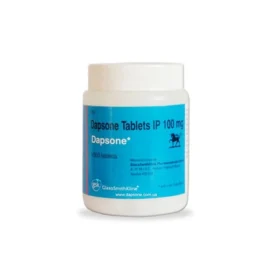 Dapson Tabletten
Vragen & antwoorden
Dapson Tabletten
Gerelateerde producten


Beoordelingen
Er zijn nog geen beoordelingen