







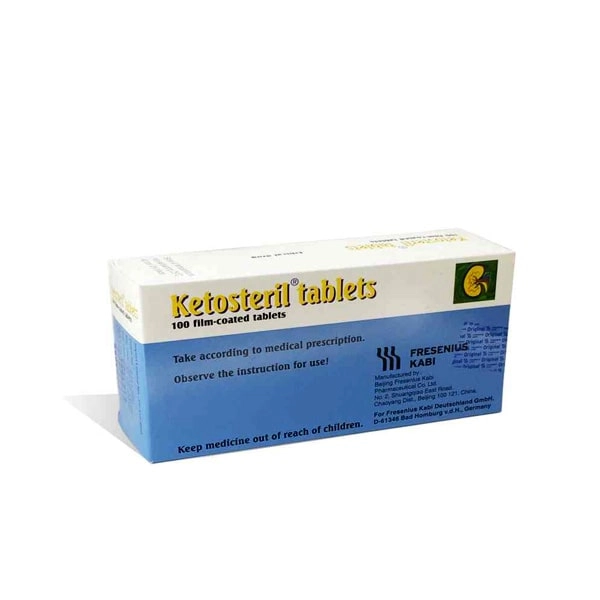
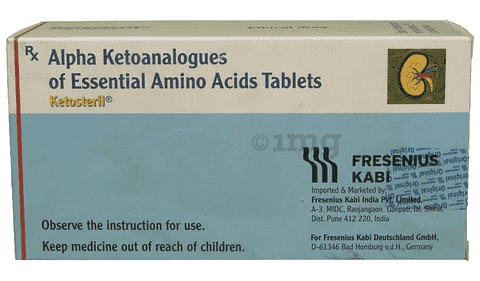
Ketosteril

✅ Verbeterde nierfunctie
✅ Vermindert uremische symptomen
✅ Verbeterde eiwitstofwisseling
✅ Verlaagt serumcreatinine
✅ Beheert chronische nierziekte
✓ Medisch beoordeeld door Morgan Ellis — Apotheekonderzoeker · 8 jaar ervaring · Laatst beoordeeld: mei 2026
Snelle antwoord
Ketosteril bevat ketoanalogen + essentiële aminozuren 630 mg gemaakt door Fresenius Kabi. Het wordt gebruikt voor voedingsondersteuning bij chronische nierziekte (CKD) wanneer het wordt gebruikt naast een eiwitarm dieet om de progressie van de ziekte te vertragen en uremische symptomen te verminderen. Neem het precies in zoals voorgeschreven door uw arts — pas de dosering niet zelf aan.
📦 Elke bestelling is gedekt door onze Reshipment Assurance-beleid — als uw pakket niet binnen 20 werkdagen arriveert, sturen wij het opnieuw.
Waarom bestellen bij MedsBase
Elke batch wordt ingekocht bij een WHO-GMP gecertificeerde fabrikant. Bestellingen worden verzonden in eenvoudige, ongemerkte verpakkingen van onze uitvoeringspartners en zijn gedekt door onze Reshipment Assurance-beleid. We hebben 1.400+ geverifieerde klanten bediend met een gemiddelde beoordeling van 4,9/5 voor meer dan 600 medicijnen.
⚠ Belangrijk — dit is een supplement, geen alfablokker of BPH-medicijn
Ketosteril is een nier-voedingssupplement, geen behandeling voor een vergrote prostaat of overactieve blaas. Het wordt gebruikt bij volwassenen met CKD stadium 3–5 die een eiwitbeperkt dieet volgen (~0,4–0,6 g/kg/dag). Als u op zoek bent naar een medicijn voor prostaat- of blaassymptomen, gebruik dan het alternatievenpanel onderaan deze pagina.
Wat Ketosteril is en hoe het werkt
Ketosteril bevat een vaste mix van ketoanalogen (stikstofvrije analogen van essentiële aminozuren) en een kleinere hoeveelheid essentiële aminozuren. Bij chronische nierziekte vermindert eiwitbeperking in de voeding de aanmaak van uremische toxines, maar brengt het risico op ondervoeding met zich mee. De ketoanalogen stellen het lichaam in staat om aminozuren aan te maken door gebruik te maken van het eigen circulerende stikstofafval van de patiënt — zo blijft essentiële voeding behouden terwijl de ureumlast en uremische symptomen (misselijkheid, vermoeidheid, jeuk) afnemen.
De combinatie is ontworpen voor gebruik in combinatie met een eiwitarm dieet (meestal 0,4–0,6 g/kg/dag onder begeleiding van een diëtist). Het is niet effectief en kan zelfs contraproductief zijn bij een normaal eiwitdieet omdat overtollig stikstof dan weer wordt opgenomen.
Dosering en hoe in te nemen
| Patiëntengroep | Aanbevolen dosering |
|---|---|
| Volwassenen > 70 kg met CKD stadium 3–5 op een eiwitarm dieet | 4–8 tabletten drie keer per dag bij de hoofdmaaltijden (12–24 tabletten/dag) volgens diëtist/nephroloog plan |
| Volwassenen 40–70 kg | 1 tablet per 5 kg lichaamsgewicht per dag, verdeeld over de maaltijden |
| Kinderen > 3 jaar (onder specialistisch toezicht) | 1 tablet per 5 kg/dag |
| Terminale CKD bij dialyse | Onder specialistische begeleiding; meestal gecombineerd met intradialytische eiwitafstemming |
Slik de tabletten heel in tijdens de hoofdmaaltijd, zodat de aminozuren beschikbaar zijn naast voedingsstikstofbronnen. Niet pletten of kauwen. De tabletten zijn groot; sommige gebruikers prefereren ze verspreid over een maaltijd in te nemen in plaats van allemaal tegelijk. Zorg ervoor dat u voldoende water drinkt, tenzij uw nefroloog vochtbeperking heeft voorgeschreven.
Monitoring
- Serumcalcium — ketoanalogen bevatten calcium; controleer bij de start en elke 1–3 maanden. Stop bij hypercalciëmie (> 2,6 mmol/L)
- Serumfosfaat, PTH, eGFR, BUN/ureum — routinecontrole bij CKD
- Lichaamsgewicht, MUAC en eiwitinname via voeding — via diëtist om te bevestigen dat adequate voeding behouden blijft
- Albumine, prealbumine — bij vermoeden van ondervoeding
Bijwerkingen
| Bijwerking | Frequentie | Opmerkingen |
|---|---|---|
| Hypercalciëmie | Zeldzaam — stop indien > 2,6 mmol/L | Controleer calcium periodiek |
| Maag-darmklachten (misselijkheid, vol gevoel) | In het begin vaak voorkomend | Innemen met voedsel; doses spreiden |
| Obstipatie | Minder vaak | Voldoende vocht (binnen renale grenzen) en vezels |
| Overgevoeligheid (uitslag, jeuk) | Zeldzaam | Stoppen en heroverwegen |
Geneesmiddelinteracties
| Combinatie | Effect | Actie |
|---|---|---|
| Aluminiumbevattende antacida | Calcium kan aluminiumabsorptie verhogen | Gelijktijdige inname vermijden — minstens 2 uur ertussen laten |
| Tetracyclines, fluoroquinolonen, levothyroxine, oraal ijzer, bisfosfonaten | Calciumchelatie vermindert absorptie van gelijktijdig toegediende middelen | Minimaal 2 uur tussen innames |
| Cardiac glycosides (digoxine) | Hoog calciumgehalte verhoogt de gevoeligheid voor digoxine | Monitoreren; start geen gelijktijdige calciumsupplementen |
| Vitamine D-analogen, calciumsupplementen | Additief risico op hypercalciëmie | Specialistische begeleiding |
Wie mag Ketosteril niet gebruiken
- Hypercalciëmie (gecorrigeerd serumcalcium > 2,6 mmol/L)
- Stofwisselingsstoornissen van aminozuren (bijv. esdoornsiroopziekte, erfelijke fenylketonurie)
- Patiënten die GEEN gestructureerd eiwitarm dieet volgen (geen voordeel en mogelijk stikstofoverbelasting)
- Ernstige galactose-intolerantie / Lapp lactasedeficiëntie (hulpstof)
- Overgevoeligheid voor een bestanddeel
Veelgestelde vragen
Is Ketosteril een behandeling voor prostaat- of blaasproblemen?
Nee. Het is een voedingssupplement voor nieraandoeningen — ketoanalogen plus essentiële aminozuren — voor gebruik met een eiwitarm dieet om de progressie van CKD te vertragen en uremische symptomen te verminderen. Medicijnen voor de blaas/prostaat staan vermeld in het alternatievenpaneel onderaan deze pagina.
Hoe vertraagt het eiwitarme dieet plus Ketosteril daadwerkelijk CKD?
Minder voedingsstikstof betekent minder ureumproductie; de nieren verwerken minder afval; glomerulaire hyperfiltratie neemt af. Door ketoanalogen toe te voegen kan het lichaam toch essentiële aminozuren opbouwen met behulp van circulerend stikstofafval, waardoor de voedingsstatus voldoende blijft. Uit onderzoek blijkt dat de eGFR-afname vertraagt in CKD-stadia 3–5 bij een gestructureerd eiwitbeperkt dieet plus ketoanalogen.
Hoeveel tabletten per dag?
Ongeveer 1 tablet per 5 kg lichaamsgewicht per dag, verdeeld over de drie hoofdmaaltijden. Een volwassene van 70 kg neemt meestal 4–5 tabletten bij elke maaltijd (~12–14/dag). Uw nefroloog of diëtist zal dit verfijnen.
Waarom bij de maaltijden?
Ketoanalogen hebben een directe bron van stikstof nodig om te worden omgezet in essentiële aminozuren. Door ze bij de maaltijden in te nemen, wordt die stikstof geleverd en verbetert de biologische beschikbaarheid.
Kom ik hierdoor aan in gewicht of spiermassa?
Ketosteril levert aminozuurbouwstenen maar is geen calorierijk supplement. Het behoud van gewicht en spiermassa bij een eiwitarm dieet hangt af van voldoende calorieën in totaal. Een renaal diëtist zal de calorieën plannen rond de eiwitbeperking.
Hoe zit het met dialyse — heb ik dat nog steeds nodig?
De meeste hemodialyseprogramma's stemmen een meer liberale inname van voedingsproteïne (1,0–1,2 g/kg/dag) af op aminozuurverliezen in het dialysaat. Specialistische begeleiding is nodig; pas dit niet zelf aan.
Kan ik stoppen met mijn fosfaatbinder?
Nee. Ketosteril bindt geen voedingsfosfaat. Ga door met uw voorgeschreven binder (sevelamer, calciumacetaat, lanthaan) tijdens de maaltijden, tenzij uw nefroloog anders aangeeft.
Hoe wordt calcium gemeten en gecontroleerd?
Gecorrigeerd serumcalcium wordt bij aanvang en elke 1-3 maanden gecontroleerd. Als het boven 2,6 mmol/L stijgt, wordt de dosering verlaagd of gestopt. Vermijd gelijktijdige calciumsupplementen tenzij uw specialist dit voorschrijft.
Zijn er alternatieven als ik Ketosteril niet verdraag?
Ja — gestructureerde eiwitarme diëten zonder ketoanalogen, of alfaketozuurmengsels met verschillende verhoudingen. De beslissing is individueel; raadpleeg uw nierspecialist of diëtist.
Welke andere medicijnen moet ik hier van gescheiden innemen?
Tetracyclines, fluoroquinolonen, levothyroxine, oraal ijzer, bisfosfonaten en aluminiumhoudende maagzuurremmers moeten minstens 2 uur gescheiden van Ketosteril worden ingenomen vanwege calciumchelatie.
Andere blaas- en prostaatmedicijnen
- Silofast (silodosin) — alfablokker voor BPH
- Alfusin (alfuzosine 10 mg ER) — alfablokker voor BPH
- Cystone — kruidenpreparaat voor urinewegondersteuning, aanvullend bij nierstenen
- Urotel XL (tolterodine ER) — voor symptomen van overactieve blaas
- Fosirol 3 g (fosfomycine) — voor een acute urineweginfectie
Medisch disclaimer. De informatie op deze pagina is alleen voor algemene educatieve doeleinden en is geen vervanging voor advies van een gekwalificeerde clinicus. Overleg altijd met uw arts of apotheker over nieuwe medicatie of doseringswijzigingen, vooral als u zwanger bent, borstvoeding geeft, andere medische aandoeningen heeft of andere medicijnen gebruikt.
Meer opties in Blaas Prostaat
Gerangschikt op recente bestelvolumes van MedsBase — wat andere klanten in deze categorie kiezen.


| Hoeveelheid | 100 Tablet/s, 200 Tablet/s, 300 Tablet/s |
|---|---|
| Farmaceutische vorm | Tablet/s |
| Fabrikant | Fresenius Kabi |
| Behandeling | Chronische nierziekte in de predialyseperiode |
| Generiek merk | Ketoanalogen + Essentiële Aminozuren |
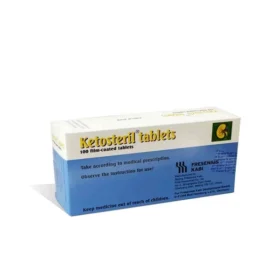 Ketosteril
Vragen & antwoorden
Ketosteril
Gerelateerde producten















Beoordelingen
Er zijn nog geen beoordelingen