








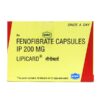
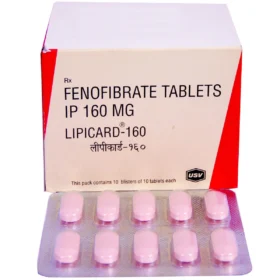
Lipicard
✅ Verlaagt cholesterolgehalte
✅ Verlaagt triglyceriden
✅ Voorkomt hartziekten
✅ Voorgeschreven door artsen
✅ Oraal medicatie-optie
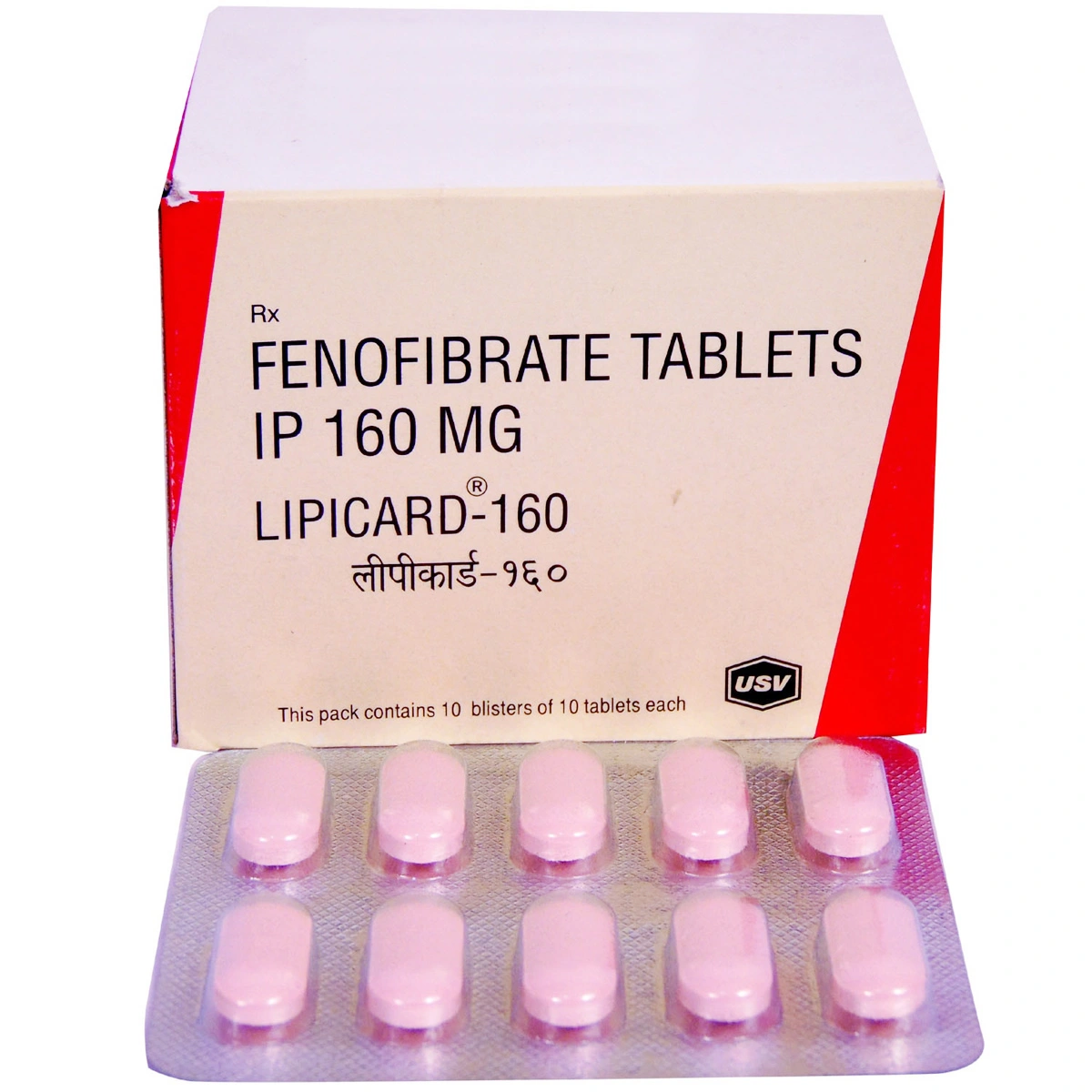
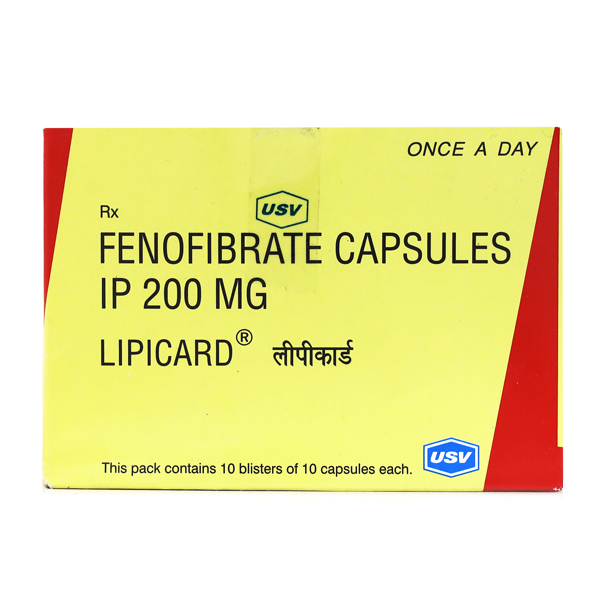
Lipicard bevat Fenofibrate.
✓ Medisch beoordeeld door Morgan Ellis — Apotheekonderzoeker · 8 jaar ervaring · Laatst beoordeeld: mei 2026
⚡ Kort antwoord — Wat is Lipicard?
Lipicard bevat fenofibrate (160 mg of 200 mg), een fibrate (PPAR-α agonist) voornamelijk gebruikt om triglyceriden te verlagen en HDL-cholesterol. Typisch effect: triglyceriden dalen met 30–50%, HDL stijgt met 10–20%, bescheiden LDL-reductie (0–15%). Geen vervanging voor een statine — statines verlagen LDL veel meer en hebben sterker bewijs voor cardiovasculaire gebeurtenissen. Fibraten worden gebruikt wanneer triglyceriden zeer hoog zijn (> 500 mg/dL / 5,6 mmol/L) om pancreatitis te voorkomen, of als aanvulling op een statine bij gemengde dyslipidemie met hoge triglyceriden en laag HDL (vooral bij diabetespatiënten). Gebruikelijke dosering: 160 mg of 200 mg eenmaal daags tijdens de hoofdmaaltijd. Combineer niet met gemfibrozil (gecontra-indiceerd met statines); fenofibrine + statine is veiliger maar monitor CK en nierfunctie. Vermijd bij ernstige nier- of leverfunctiestoornissen.
📦 Elke bestelling is gedekt door onze Reshipment Assurance-beleid — als uw pakket niet binnen 20 werkdagen arriveert, sturen wij het opnieuw.
Waarom bestellen bij MedsBase
Onze generieke medicijnen zijn afkomstig van WHO-GMP gecertificeerde fabrikanten en worden wereldwijd verzonden in discrete, eenvoudige verpakkingen — geen medicijnnaam op de buitenkant van het pakket. Betalingen met kaart worden verwerkt via een gereguleerde processor (betalingsoverzichten vermelden een gereguleerde kaartbetalingprocessor — nooit “MedsBase” of een medicijnnaam). Crypto en SEPA bankoverschrijvingen worden ook geaccepteerd. Elke bestelling wordt ondersteund door ons Reshipment Assurance Policy.
Wat is Lipicard?
Lipicard is een oraal lipidenverlagend medicijn dat fenofibrate (160 mg of 200 mg) bevat, geproduceerd door USV Pharma. Verkrijgbaar in verpakkingen van 30, 60, 90 of 180 capsules. Fenofibrine behoort tot de fibroëzuurderivaat (fibraat) klasse, waaronder ook gemfibrozil en bezafibraat.
Origineel merk: Tricor / Lipanthyl (Abbott / AbbVie). In klinisch gebruik sinds de jaren 1970, met verschillende herformuleringen die de biologische beschikbaarheid verbeterden (gemicroïoniseerd fenofibraat 200 mg ≈ nanocrystal 160 mg).
Waar wordt Lipicard voor gebruikt?
- Ernstige hypertriglyceridemie (> 500 mg/dL / 5,6 mmol/L) — voornamelijk ter preventie van acute pancreatitis
- Gemengde dyslipidemie met verhoogde triglyceriden en laag HDL bij patiënten die al een geoptimaliseerde statine gebruiken
- Diabetische dyslipidemie — hoog TG + laag HDL (bescheiden signaal van cardiovasculair voordeel in de FIELD- en ACCORD-Lipid subgroepanalyses)
- Familiale hypertriglyceridemie en bepaalde zeldzame dyslipidemieën
- Progressie van diabetische retinopathie — fenofibraat vertraagde de progressie in FIELD en ACCORD-Eye, onafhankelijk van lipide-effecten; nu een indicatie in sommige landen
Lipicard is niet een eerstelijnsbehandeling voor hoog LDL-cholesterol — statines domineren dat gebied. Fibraten vullen statines aan in plaats van ze te vervangen.
Hoe Werkt Lipicard?
Fenofibrate is een PPAR-α (peroxisome proliferator-activated receptor alpha) agonist. Activatie van PPAR-α in de lever verandert de transcriptie van tientallen genen in het lipidenmetabolisme:
- Verhoogt de vetzuuroxidatie in de lever — minder triglyceridenproductie
- Verhoogt lipoproteïnelipase (LPL) activiteit — snellere opruiming van triglyceriderijke VLDL
- Vermindert apoC-III expressie — apoC-III remt normaal gesproken LPL
- Verhoogt apoA-I en apoA-II — verhoogt HDL
- Verandert de LDL-deeltjesgrootte van kleine, dichte (atherogene) deeltjes naar grotere, minder dichte deeltjes
- Ontstekingsremmende effecten in endotheel en vasculaire gladde spieren
Netto lipiden effect: triglyceriden dalen met 30–50%, HDL stijgt met 10–20%, LDL licht gedaald (kan paradoxaal stijgen bij ernstige hypertriglyceridemie doordat VLDL wordt omgezet in LDL). Begin: 2–4 weken; volledig effect na 2 maanden.
Dosering en toediening
Standaard dosering: 160 mg of 200 mg eenmaal daags bij de hoofdmaaltijd (meestal diner). Gemicroïoniseerd fenofibrate 200 mg is bio-equivalent aan nanokristallijn 160 mg — ze leveren dezelfde blootstelling aan het actieve geneesmiddel.
- Innemen met voedsel — fenofibrate is lipofiel en wordt veel beter opgenomen met een vetbevattende maaltijd.
- Slik capsules of tabletten heel door.
- Een dosis vergeten — neem deze zo snel mogelijk in, tenzij het bijna tijd is voor de volgende; neem geen dubbele dosis.
- Renale dosering: Verlaag de dosis met ~50% bij een eGFR van 30–60; vermijd bij een eGFR < 30. Fenofibrate veroorzaakt een kleine reversibele stijging van het serumcreatinine (tot 0,1 mg/dL / 10 µmol/L); dit is geen nierschade.
- Monitoring: lipidenpanel bij aanvang en 6–8 weken na start of dosisaanpassing; leverfunctietesten en U&E bij aanvang, daarna periodiek.
Bijwerkingen
Vaak voorkomend:
- Dyspepsie, buikpijn, misselijkheid
- Milde transaminase stijging (meestal asymptomatisch)
- Reversibele stijging van serumcreatinine (0,05–0,1 mg/dL); geen echte nierfunctiestoornis
- Milde lichtgevoeligheid
Zeldzaam maar belangrijk:
- Spierpijn, myositis, rabdomyolyse — zeldzaam bij monotherapie; het risico neemt toe bij combinatie met statines (vooral met gemfibrozil, wat gecontra-indiceerd is)
- Cholelithiasis (galstenen) — fenofibrate verhoogt de cholesteroluitscheiding in gal; verhoogt licht het risico op galstenen
- Pancreatitis — zeldzame idiosyncratische reactie (ironisch, aangezien fenofibrate triglyceride-gedreven pancreatitis voorkomt)
- Pulmonaire fibrose / interstitiële longziekte — zeer zeldzaam
- Overgevoeligheid, Stevens-Johnson-syndroom — zeer zeldzaam
- Verergering van warfarine-antistolling (verhoogt INR)
Geneesmiddelinteracties
- Warfarine — verhoogt INR aanzienlijk; verlaag de warfarinedosis met ~30% en monitor nauwlettend.
- Statines — fenofibrate + statine is de veiligere fibrine combinatie (veel veiliger dan gemfibrozil + statine); monitor CK en symptomen. Combineer gemfibrozil nooit met een statine.
- Galzuurbindende harsen (cholestyramine, colestipol) — verminderen de opname van fenofibrate; neem fenofibrate minstens 1 uur voor of 4 uur na inname.
- Cyclosporine — verhoogd risico op nefrotoxiciteit; controleer de nierfunctie.
- Repaglinide — verhoogde niveaus bij gebruik met gemfibrozil (geen typisch probleem bij fenofibraat).
- Orale hypoglykemica, insuline — bescheiden extra glucoseverlagend effect.
Wie mag Lipicard niet gebruiken?
- Ernstig nierfalen (eGFR < 30)
- Actieve leverziekte, inclusief biliaire cirrose
- Bestaande galblaasaandoeningen
- Bekende overgevoeligheid voor fenofibraat
- Zwangerschap en borstvoeding
- Kinderen — veiligheid niet vastgesteld
- Gelijktijdig gebruik van gemfibrozil (combinatie van fibraten altijd vermijden)
Opslag
Bewaar Lipicard onder 25°C op een droge plaats, in de originele blisterverpakking. Buiten bereik van kinderen houden.
Veelgestelde vragen
Is Lipicard een vervanging voor een statine?
Nee. Statines zijn eerste keus bij hoog LDL-cholesterol en hebben het sterkste bewijs voor het verminderen van hartaanvallen en beroertes. Fibraten verlagen triglyceriden goed, maar hebben over het algemeen veel zwakkere cardiovasculaire uitkomsten. Fenofibraat wordt gebruikt als aanvulling op een statine wanneer triglyceriden hoog zijn en HDL laag ondanks optimale statinetherapie, of als monotherapie wanneer triglyceriden zeer hoog zijn (> 500 mg/dL) om pancreatitis te voorkomen.
Kan ik Lipicard met een statine gebruiken?
Ja — fenofibraat + statine is de standaard combinatie van fibraten en statines. Het is veel veiliger dan gemfibrozil + statine (wat gecontra-indiceerd is vanwege het risico op ernstige myopathie). Controleer CK als er nieuwe spiersymptomen optreden, en monitor de nierfunctie.
Waarom is mijn creatinine gestegen bij gebruik van Lipicard?
Fenofibraat veroorzaakt een kleine, omkeerbare stijging van het serumcreatinine (meestal 0,05–0,1 mg/dL) via tubulaire effecten, niet zonder echte nierschade. De gemeten GFR blijft ongewijzigd. Het herstelt na stoppen. Als creatinine significant stijgt (> 0,3 mg/dL) of er klinische zorgen zijn, onderzoek dan andere oorzaken.
Verlaagt Lipicard mijn LDL-cholesterol?
Slechts in bescheiden mate (0–15%) en soms helemaal niet (bij ernstige hypertriglyceridemie kan LDL zelfs stijgen doordat VLDL wordt omgezet). Statines blijven het middel van eerste keuze voor het verlagen van LDL.
Helpt Lipicard bij het voorkomen van hartaanvallen?
Het bewijs is bescheiden en populatiespecifiek. De FIELD- en ACCORD-Lipid-studies toonden geen duidelijk algemeen cardiovasculair voordeel aan van het toevoegen van fenofibraat aan statinetherapie, maar subgroepanalyses suggereren voordeel bij patiënten met hoge triglyceriden (> 200 mg/dL) en laag HDL (< 40 mg/dL). — het klassieke diabetische dyslipidemiepatroon. Het verminderde ook de progressie van diabetische retinopathie onafhankelijk van lipiden.
Waar kan ik Lipicard online kopen?
U kunt Lipicard (160 mg of 200 mg) bestellen bij MedsBase in verpakkingen van 30, 60, 90 of 180 capsules. Wij verzenden wereldwijd met discrete verpakkingen en voorraad van een gecertificeerde WHO-GMP fabrikant.
Gerelateerde cholesterolmedicijnen
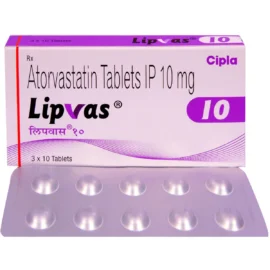
- Lipvas — Atorvastatin
- Crestor — Rosuvastatin 5/10/20 mg (AstraZeneca)
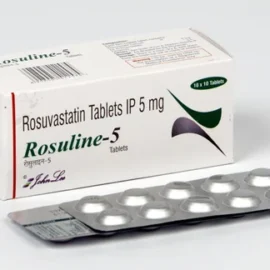
- Rosuline — Rosuvastatin
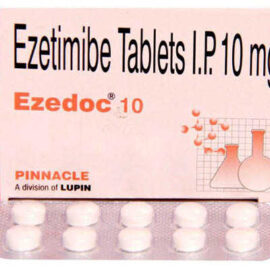
- Ezedoc — Ezetimibe (aanvulling op statine)
- Simvotin — Simvastatin
- Choltran — Cholestyramine (galzuurbindend middel)
- Bekijk alle medicijnen tegen hoog cholesterol
Waarom bestellen bij MedsBase
Lipicard wordt geleverd door een WHO-GMP gecertificeerde fabrikant met volledige COA-documentatie. Wij verzenden wereldwijd in eenvoudige, discrete verpakkingen en elke bestelling wordt gedekt door onze Reshipment Assurance-beleid. Uw betalingsbeschrijving bij betaling per kaart toont de gereguleerde betalingsverwerker (een gereguleerde kaartbetalingverwerker), nooit “MedsBase” of een medicijnnaam.
Gerelateerde alternatieven
Andere producten in Chronische aandoeningen die klanten ook bekijken:
Meer opties in behandelingen tegen hoog cholesterol
Gerangschikt op recente bestelvolumes van MedsBase — wat andere klanten in deze categorie kiezen.

| Sterkte | 160 mg, 200 mg |
|---|---|
| Hoeveelheid | 30 Capsule/s, 60 Capsule/s, 90 Capsule/s, 180 Capsule/s |
 Lipicard
Vragen & antwoorden
Lipicard
Gerelateerde producten




Beoordelingen
Er zijn nog geen beoordelingen