







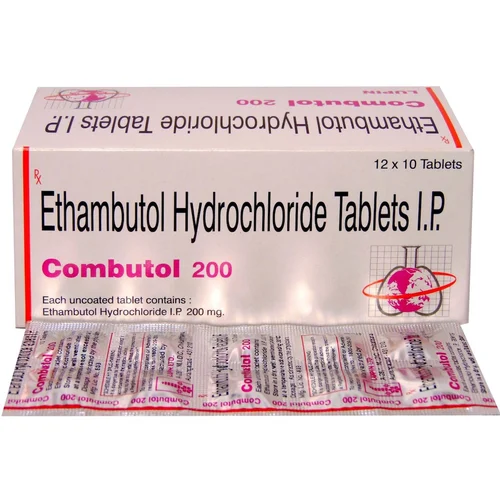
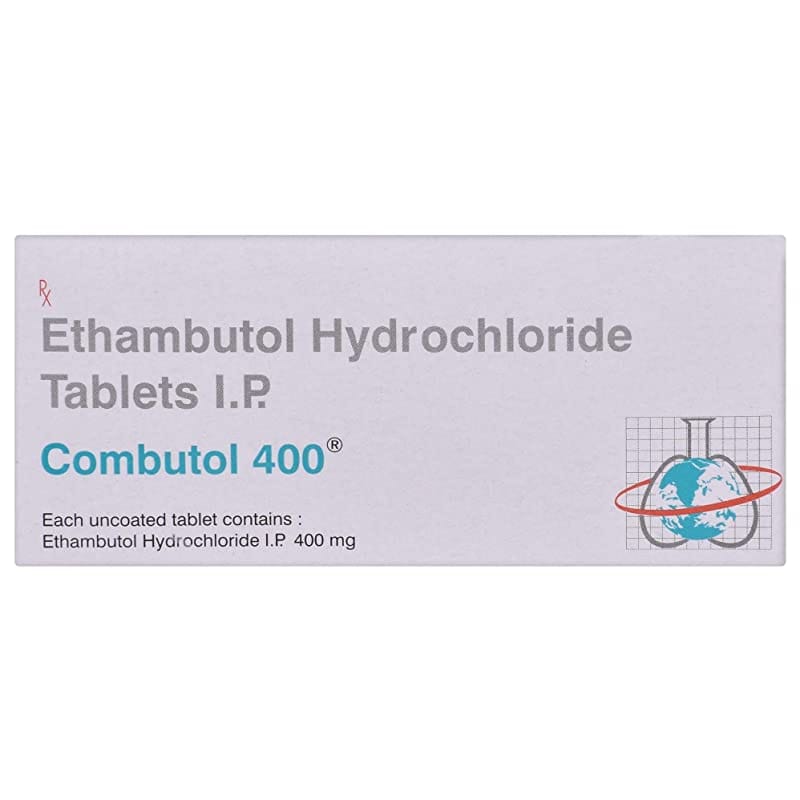
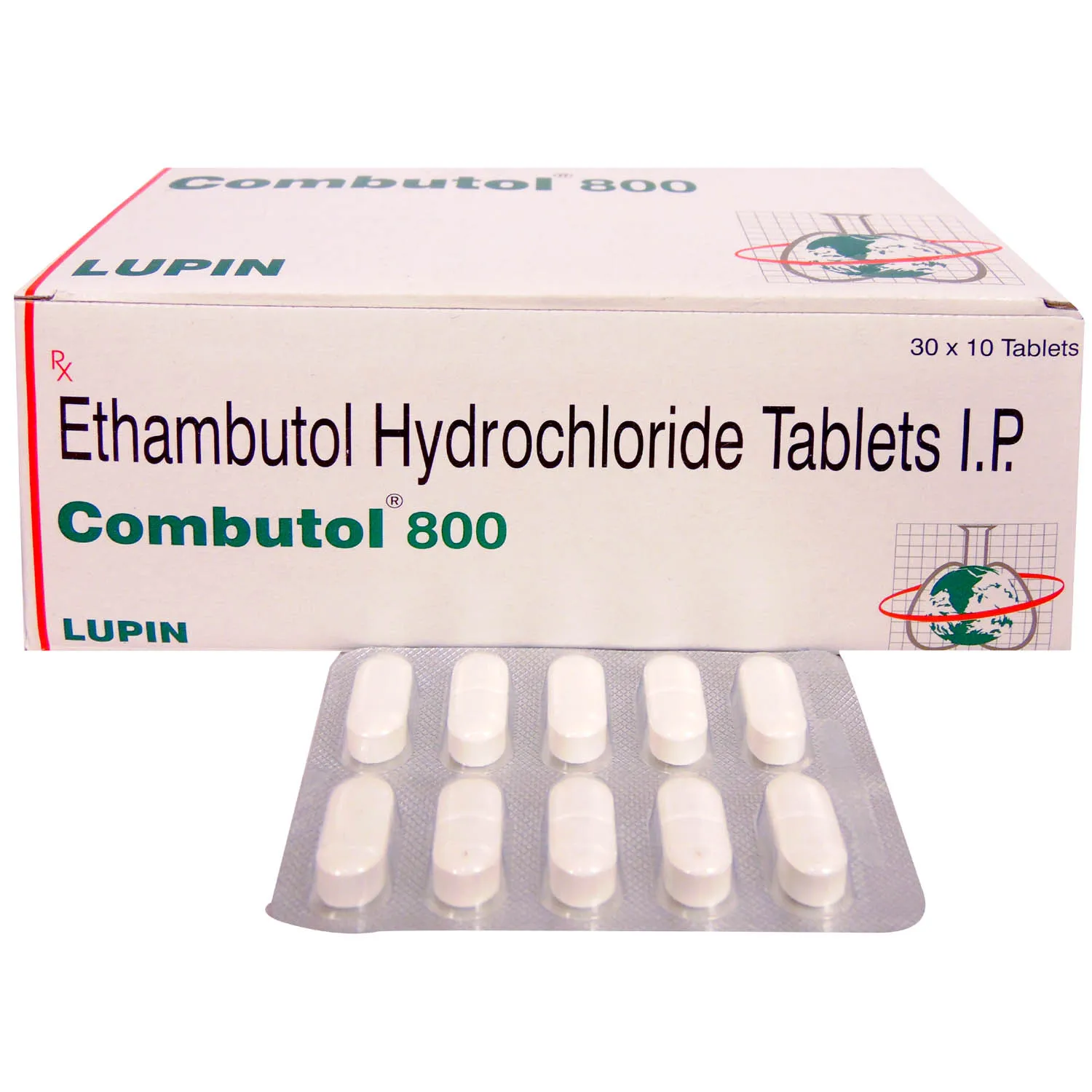
Combutol
✅ Behandelt tuberculose
✅ Doodt bacteriën
✅ Voorkomt verspreiding van ziekte
✅ Voorgeschreven antibioticum
✅ Oraal medicatie-optie
Combutol bevat Ethambutol.
✓ Medisch beoordeeld door Morgan Ellis — Apotheekonderzoeker · 8 jaar ervaring · Laatst beoordeeld: mei 2026
⚡ Snel antwoord — Wat is Combutol?
Combutol bevat ethambutolhydrochloride (200 mg / 400 mg / 800 mg tabletten) van een WHO-GMP gecertificeerde fabrikant (gemaakt door Lupin) — een bacteriostatisch anti-tuberculose antibioticum dat de synthese van arabinogalactan in de mycobacteriële celwand verstoort. De rol van Combutol bij actieve tuberculose is om de “E” te zijn in het 4-medicijnen RIPE-regime tijdens de eerste intensieve fase van 2 maanden — het voorkomt het ontstaan van resistentie tegen de bacteriedodende begeleidende medicijnen (rifampicine, isoniazide, pyrazinamide). Standaard dosis voor volwassenen: 15 mg/kg eenmaal daags (meestal 800 mg voor > 55 kg). De kenmerkende toxiciteit is dosisafhankelijke optische neuritis — verlies van gezichtsscherpte en rood-groen kleuronderscheid, meestal omkeerbaar als het medicijn bij het eerste symptoom wordt gestopt, maar mogelijk permanent als dit niet gebeurt. Baseline oogheelkundige beoordeling + maandelijkse visuele controles zijn verplicht, en de dosis moet worden verlaagd bij nierfunctiestoornissen.
📦 Elke bestelling is gedekt door onze Reshipment Assurance-beleid — als uw pakket niet binnen 20 werkdagen arriveert, sturen wij het opnieuw.
Waarom bestellen bij MedsBase
Onze generieke medicijnen zijn afkomstig van WHO-GMP gecertificeerde fabrikanten en worden wereldwijd verzonden in discrete, eenvoudige verpakkingen — geen medicijnnaam op de buitenkant van het pakket. Betalingen met kaart worden verwerkt via een gereguleerde processor (betalingsoverzichten vermelden een gereguleerde kaartbetalingprocessor — nooit “MedsBase” of een medicijnnaam). Crypto en SEPA bankoverschrijvingen worden ook geaccepteerd. Elke bestelling wordt ondersteund door ons Reshipment Assurance Policy.
Wat Combutol (Ethambutol) Is
Combutol is het Lupin merk van ethambutol hydrochloride, een synthetisch bacteriostatisch anti-tuberculose middel geïntroduceerd in 1961 en opgenomen in de WHO Model List of Essential Medicines. Elke tablet bevat 200 mg, 400 mg of 800 mg ethambutol HCl. Het is een van de vier eerstelijnsmiddelen die worden gebruikt in het standaard kortdurende regime voor geneesmiddelgevoelige tuberculose — de “E” in RIPE — en is ook een kernmiddel voor Mycobacterium avium complex (MAC) infectie.
Hoe Combutol Werkt (Mechanisme)
Ethambutol remt arabinosyl transferase III (gecodeerd door het embB gen), een enzym dat essentieel is voor de synthese van arabinogalactan en lipoarabinomannan — belangrijke polysacharidecomponenten van de mycobacteriële celwand. Zonder deze polysachariden is de celwand structureel verzwakt, faalt de aanhechting van mycolzuur en worden de bacteriën gevoeliger voor andere antibiotica. Ethambutol is bacteriostatisch op zichzelf bij de doses die klinisch worden gebruikt; zijn belangrijkste bijdrage aan een combinatieregime is om het ontstaan van resistentie te voorkomen tegenover de bactericide partner geneesmiddelen (rifampicine, isoniazide).
Indicaties — Wat Combutol Behandelt
1. Actieve tuberculose (combinatietherapie)
Ethambutol maakt deel uit van het WHO 4-geneesmiddelen RIPE-regime tijdens de eerste 2 maanden van de behandeling voor nieuwe pulmonale of extrapulmonale tuberculose veroorzaakt door M. tuberculosis. Zodra geneesmiddelgevoeligheidstests volledige gevoeligheid voor rifampicine en isoniazide bevestigen, kan ethambutol soms worden gestopt vóór het einde van de intensieve fase — maar in de praktijk wordt het meestal de volledige 2 maanden gegeven.
| Fase | Duur | Geneesmiddelen |
|---|---|---|
| Intensieve | 2 maanden | Rifampicine + Isoniazide + Pyrazinamide + Ethambutol |
| Vervolg | 4 maanden | Rifampicine + Isoniazide |
2. Mycobacterium avium complex (MAC)
MAC-infectie — zowel verspreide ziekte bij gevorderde hiv (CD4 meestal < 50) als chronische longziekte bij niet-hiv-patiënten met bronchiëctasieën — wordt behandeld met macrolide-gebaseerde regimes. De standaardcombinatie is claritromycine of azitromycine + ethambutol, vaak met rifabutine voor ernstige ziekte. De rol van ethambutol hier spiegelt zijn rol bij tuberculose: het voorkomt macrolideresistentie.
3. Andere niet-tuberculeuze mycobacteriën
Ethambutol is opgenomen in regimes voor M. kansasii (met rifampicine en isoniazide), M. xenopi, en bepaalde andere langzaam groeiende niet-tuberculeuze mycobacteriën. De behandeling van deze infecties wordt geleid door een specialist en varieert afhankelijk van de gevoeligheid van de isolaten.
Dosering
| Indicatie | Volwassen dosering (dagelijks) | Opmerkingen |
|---|---|---|
| Actieve TB — intensieve fase | 15 mg/kg eenmaal daags • 38–55 kg → 800 mg • > 55 kg → 1200 mg (afgerond; sommige richtlijnen beperken tot 1600 mg) | Gedurende 2 maanden voortzetten als onderdeel van RIPE |
| Actieve TB — intermitterend (3 doses/week) | 25–30 mg/kg per dosis | Alleen onder direct geobserveerde therapie |
| MAC-pulmonale aandoening | 15 mg/kg eenmaal daags | Gecombineerd met macrolide; behandeling minimaal 12–18 maanden |
| MAC gedissemineerde aandoening bij HIV | 15 mg/kg eenmaal daags | Gecombineerd met clarithromycine/azithromycine ± rifabutine |
| Kinderen (TB) | 20 mg/kg eenmaal daags | Vermijd of gebruik voorzichtig wanneer het kind geen visuele symptomen kan melden |
Aanpassing van de nierdosis
| Creatinineklaring | Dosering aanpassen |
|---|---|
| > 50 mL/min | Standaard 15 mg/kg eenmaal daags |
| 30–50 mL/min | 15 mg/kg elke 24–36 uur |
| 10–30 mL/min | 15 mg/kg elke 48 uur |
| Hemodialyse | 15–25 mg/kg drie keer per week, dosering na dialyse |
Neem Combutol eenmaal daags in, met of zonder voedsel — wat minder misselijkheid veroorzaakt. Houd een interval van minimaal 4 uur aan met aluminiumbevattende maagzuurremmers.
Verplichte monitoring
Aanvullende monitoring: initiële en periodieke leverfunctietests (ethambutol zelf is licht hepatotoxisch, maar de combinatiedrugs meer), ureum/creatinine, serumurinezuur bij patiënten met een voorgeschiedenis van jicht, en volledig bloedbeeld. Sputumkweekconversie na 2 maanden is de belangrijkste effectiviteitsindicator voor actieve TB.
Bijwerkingen
Meest klinisch relevante:
- Optische neuritis (zie rode waarschuwing hierboven) — dosisafhankelijk; omkeerbaar indien vroegtijdig opgemerkt; permanent indien genegeerd
- Hyperurikemie — ethambutol vermindert de renale uraatuitscheiding; kan een jichtaanval uitlokken bij gevoelige patiënten
- Perifere neuropathie — zeldzaam; gevoelloosheid of tintelingen in handen of voeten
Vaak maar mild:
- Misselijkheid, anorexia, buikklachten — meestal van voorbijgaande aard
- Hoofdpijn, duizeligheid
- Milde huiduitslag
Zeldzaam maar belangrijk:
- Hepatitis (zeldzaam bij alleen ethambutol; komt vaker voor in combinatie met rifampicine + isoniazide + pyrazinamide)
- Trombocytopenie, eosinofilie, leukopenie
- Overgevoeligheidsuitslag, koorts; zelden anafylaxie
- Verwardheid, desoriëntatie, hallucinaties — zeer zeldzaam
Geneesmiddelinteracties
Ethambutol heeft een relatief rustig interactieprofiel vergeleken met de andere eerstelijns-TB-medicijnen.
- Aluminiumbevattende antacida verminderen de opname van ethambutol aanzienlijk — houd een interval van minstens 4 uur tussen de doses aan.
- Disulfiram kunnen ethambutol-gerelateerde neurotoxiciteit verergeren (vermijden).
- Geen klinisch relevante CYP-inductie of CYP-remmende interacties.
De ernstige geneesmiddelinteracties in een TB-behandeling komen van de combinatiegeneesmiddelen (met name rifampicine) — beoordeel elk gelijktijdig gebruikte medicatie bij het starten van een TB-behandeling, zelfs als u zich vooral zorgen maakt over ethambutol.
Contra-indicaties en voorzorgsmaatregelen
- Bekende overgevoeligheid voor ethambutol
- Bestaande optische neuritis (relatieve contra-indicatie — specialistische beoordeling)
- Onvermogen om visuele symptomen betrouwbaar te melden (zeer jonge kinderen, ernstige cognitieve beperking, bewusteloze patiënten) — relatieve contra-indicatie
Voorzichtig gebruiken bij: significante nierfunctiestoornis (dosis aanpassen zoals hierboven), jicht, diabetische retinopathie of andere oogaandoeningen (baseline oogheelkundige beoordeling aanbevolen), oudere patiënten.
Zwangerschap, Borstvoeding en Kinderen
Ethambutol maakt deel uit van het standaard WHO TB-regime dat tijdens de zwangerschap wordt gebruikt. Het wordt goed verdragen en is niet geassocieerd met foetale optische toxiciteit. Compatibel met borstvoeding (kleine hoeveelheden in moedermelk). Bij kinderen kan ethambutol worden gebruikt in een dosering van 20 mg/kg/dag als het kind visuele symptomen betrouwbaar kan melden; anders zal het pediatrische TB-team het voordeel van het regime-resistentie afwegen tegen het onvermogen om optische neuritis te monitoren.
Opslag
Bewaren bij 15–30 °C in de originele blister, beschermd tegen vocht, hitte en direct zonlicht. Buiten bereik van kinderen houden. Ongebruikte of verlopen tabletten via een apotheek-innameprogramma afvoeren.
Veelgestelde vragen
Kan ik actieve tuberculose behandelen met alleen Combutol?
Nee. Ethambutol is een bacteriostatisch middel — het vertraagt de mycobacteriële groei maar steriliseert de infectie niet. Actieve TB vereist combinatiechemotherapie: rifampicine + isoniazide + pyrazinamide + ethambutol gedurende de eerste 2 maanden (intensieve fase), gevolgd door rifampicine + isoniazide gedurende nog eens 4 maanden (vervolg fase). De rol van ethambutol in het regime is om te voorkomen dat de bacteriën resistent worden tegen de bactericide partner medicijnen.
Welke visuele symptomen moeten mij direct doen stoppen met Combutol?
Elke nieuwe visuele verandering. De klassieke waarschuwingssignalen zijn: wazig zien, vermindering van het centrale zicht, moeite met het onderscheiden van rood van groen (een kopje thee kan bruin lijken in plaats van roodbruin), een donkere vlek in het midden van het gezichtsveld (centraal scotoom), of oogpijn bij beweging. Stop het medicijn en neem dezelfde dag contact op met uw arts — wacht niet niet op de volgende kliniekafspraak. Vroege stopzetting wordt meestal gevolgd door volledig of bijna volledig herstel; doorgaan bij aanwezigheid van symptomen kan permanente visusverlies veroorzaken.
Welke oogtesten heb ik nodig voor en tijdens ethambutoltherapie?
Voor aanvang: gezichtsscherptetest (Snellenkaart) en rood-groen kleurenzicht (Ishiharaplaten) voor elk oog afzonderlijk. Documenteer de baseline. Herhaal dezelfde testen minstens maandelijks gedurende de behandeling; een oogheelkundige beoordeling wordt aanbevolen bij aanwezigheid van een baseline visuele afwijking, bij oudere volwassenen, bij nierfunctiestoornis, of wanneer de dosis 15 mg/kg overschrijdt.
Waarom moet mijn dosis worden aangepast als ik nierproblemen heb?
Ethambutol wordt voornamelijk door de nieren uitgescheiden (ongeveer 80% renale excretie van onveranderd medicijn). Bij nierfunctiestoornis hoopt het medicijn zich op, stijgt de bloedconcentratie en daarmee het risico op optische neuritis. Standaard aanpassingen: creatinineklaring 30–50 mL/min → 15 mg/kg elke 24–36 uur; CrCl 10–30 mL/min → elke 48 uur; bij hemodialyse → standaard dosis drie keer per week toegediend na na dialyse. Controleer altijd creatinine voor aanvang en tijdens de therapie.
Kunnen kinderen ethambutol gebruiken?
Ja, maar met voorzichtigheid. Oudere kinderen (die betrouwbaar visuele veranderingen kunnen melden - meestal rond de schoolleeftijd en ouder) verdragen ethambutol goed bij een dosering van 20 mg/kg/dag. Bij zeer jonge kinderen die geen visuele symptomen kunnen beschrijven, vermijden veel richtlijnen ethambutol of wordt het alleen kortdurend gebruikt wanneer het regime dit vereist. De beslissing wordt altijd individueel genomen door het pediatrische TB-team.
Is Combutol veilig tijdens zwangerschap en borstvoeding?
Ja. Ethambutol passeert de placenta maar wordt niet geassocieerd met foetale optische toxiciteit en wordt al decennia veilig gebruikt bij zwangere vrouwen met actieve TB. Het maakt deel uit van het standaard WHO-regime tijdens zwangerschap. Kleine hoeveelheden gaan over in de moedermelk maar borstvoeding kan worden voortgezet.
Beïnvloedt voedsel de opname van Combutol?
Enigszins. Voedsel kan de opname vertragen en licht verminderen, maar het verschil is klein genoeg dat ethambutol met of zonder voedsel kan worden ingenomen - kies wat de minste misselijkheid veroorzaakt en houd je hieraan. Antacida die aluminium bevatten verminderen de opname aanzienlijk - houd minimaal 4 uur tussen een antacidum en uw Combutol-dosis.
Wat is Mycobacterium avium complex (MAC) en waarom wordt ethambutol hiervoor gebruikt?
MAC is een groep langzaam groeiende niet-tuberculeuze mycobacteriën die gedissemineerde infecties veroorzaken bij gevorderde hiv (CD4 meestal < 50) en chronische longziekten bij oudere volwassenen met bronchiëctasieën. Het standaard MAC-regime is claritromycine of azitromycine + ethambutol ± rifabutine. Ethambutol voorkomt macrolideresistentie - dezelfde anti-resistentierol die het speelt bij TB.
Kan ik alcohol drinken tijdens het gebruik van ethambutol?
Ethambutol zelf heeft minimale hepatotoxiciteit en interageert niet sterk met alcohol. Echter, de begeleidende medicijnen in TB-therapie (rifampicine, isoniazide, pyrazinamide) zijn allemaal hepatotoxisch en alcohol verhoogt aanzienlijk het risico op behandelinggerelateerde leverschade. Vermijd alcohol tijdens combinatie-TB-therapie of beperk dit strikt - de meest voorkomende reden waarom TB-regimes moeten worden onderbroken is hepatitis.
Hoe wordt Combutol bewaard?
Bewaren bij 15–30 °C in de originele blister, beschermd tegen vocht, hitte en direct zonlicht. Tabletten zijn stabiel onder normale huishoudelijke omstandigheden. Buiten bereik van kinderen houden - een overdosis ethambutol kan ernstige optische neuritis veroorzaken. Lever ongebruikte of verlopen tabletten in via een apotheek-innameprogramma.
Gerelateerde alternatieven
Andere producten in Chronische aandoeningen die klanten ook bekijken:
Meer opties in tuberculosebehandeling
Gerangschikt op recente bestelvolumes van MedsBase — wat andere klanten in deze categorie kiezen.

| Sterkte | Klinische Toepassingen |
|---|---|
| Hoeveelheid | 30 Tabletten, 60 Tabletten, 90 Tabletten, 180 Tabletten |
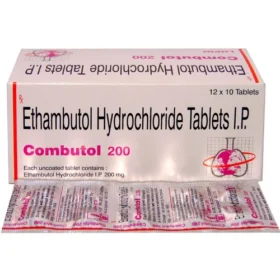 Combutol
Vragen & antwoorden
Combutol
Gerelateerde producten

Beoordelingen
Er zijn nog geen beoordelingen