








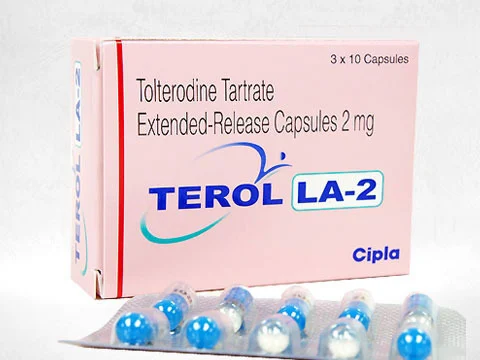
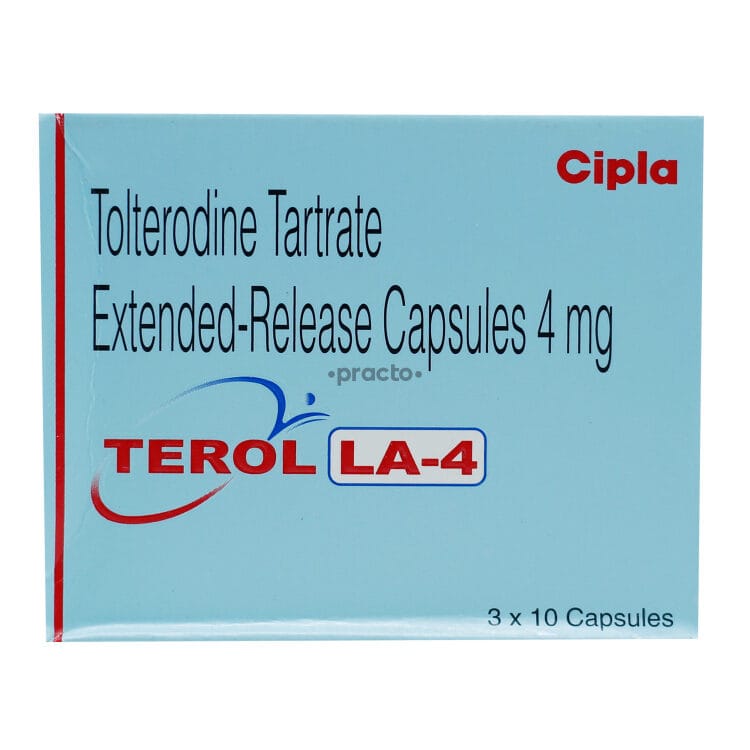
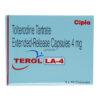
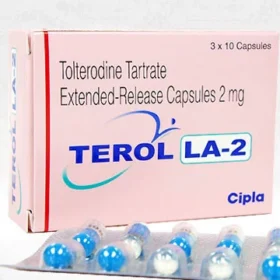
Terol La
✅ Verlicht urine-incontinentie
✅ Behandelt overactieve blaas
✅ Vermindert vaak plassen
✅ Verbeterd blaascontrole
✅ Minder urineurgentie
Terol La bevat Tolterodine Tartraat.
✓ Medisch beoordeeld door Morgan Ellis — Apotheekonderzoeker · 8 jaar ervaring · Laatst beoordeeld: mei 2026
Kort antwoord — Wat is Terol LA?
Terol LA bevat tolterodinetartraat — een competitieve muscarine acetylcholine receptorantagonist gebruikt voor de behandeling van overactieve blaas (OAB) met aandrang, frequentie en urge-incontinentie. Beschikbaar als 2 mg en 4 mg capsules met verlengde afgifte. De formulering met verlengde afgifte (LA) maakt eenmaal daagse dosering mogelijk, met iets minder droge mond dan de directwerkende versie vanwege gelijkmatigere plasmaspiegels. Standaarddosering: 4 mg eenmaal daags (of 2 mg eenmaal daags bij nier-/leverfunctiestoornissen, bij patiënten die sterke CYP3A4-remmers gebruiken, of bij patiënten die 4 mg slecht verdragen). Tolterodine wordt over het algemeen beter verdragen dan oxybutynine — minder droge mond, minder obstipatie en lagere CNS-penetratie. Voorzichtig gebruiken bij volwassenen van 65 jaar en ouder — de 2023 American Geriatrics Society Beers Criteria classificeert alle anticholinerge OAB-geneesmiddelen als “potentieel ongepast” bij oudere volwassenen vanwege de cumulatieve anticholinerge belasting. Mirabegron (Mirago) is het voorkeursgeneesmiddel van eerste keuze voor OAB in deze populatie.
📦 Elke bestelling is gedekt door onze Reshipment Assurance-beleid — als uw pakket niet binnen 20 werkdagen arriveert, sturen wij het opnieuw.
Waarom bestellen bij MedsBase
Elke batch wordt ingekocht bij een WHO-GMP gecertificeerde fabrikant. Bestellingen worden verzonden in eenvoudige, ongemarkeerde verpakkingen door onze logistieke partners en vallen onder onze Reshipment Assurance-beleid: als een pakket niet binnen 20 werkdagen arriveert, sturen wij kosteloos een nieuwe zending, zonder vragen te stellen.
Wat is Terol LA?
Terol LA is een merk van tolterodinetartraat 2 mg en 4 mg gereguleerd afgevende capsules. Tolterodine is een van de meest voorgeschreven antimuscarinegeneesmiddelen voor OAB wereldwijd. Internationaal op de markt gebracht als Detrol / Detrol LA (VS), Detrusitol / Detrusitol XL (VK/EU). Verpakkingsgroottes beschikbaar bij MedsBase: 30, 60, 90 of 180 tabletten/capsules.
De LA (langwerkende / gereguleerd afgevende) formulering in capsules geeft tolterodine gedurende 24 uur af, waardoor dagelijkse dosering en een vlakker plasmaconcentratiecurve produceert dan de direct afgevende versie — wat zich vertaalt in iets minder droge mond en obstipatie.
Hoe tolterodine werkt
Tolterodine is een competitieve antagonist bij M2- en M3-muscarine acetylcholine receptoren. Blokkade van M3 in de blaas vermindert parasympathisch-gestuurde detrusorcontracties tijdens de vulfase — wat urgentie en incontinentie-episodes vermindert en de functionele blaascapaciteit verhoogt.
In vergelijking met oxybutynin, tolterodine heeft een iets betere selectiviteit voor blaas versus speekselklier-muscarinereceptoren, minder penetratie in het CZS en een gunstiger bijwerkingenprofiel — met name minder ernstige droge mond. Beide zijn nog steeds anticholinergica met de standaard waarschuwingen voor gebruik bij ouderen.
Tolterodine wordt gemetaboliseerd door CYP2D6 tot een actieve metaboliet (5-hydroxymethyl tolterodine) die aanzienlijk bijdraagt aan het klinische effect. Ongeveer 5-10% van de populatie zijn CYP2D6 “langzame metaboliseerders” die minder van de metaboliet vormen en dosisaanpassing nodig hebben.
Wanneer tolterodine wordt gebruikt
- Overactieve blaassyndroom (OAB) met urgentie, frequentie, urge-incontinentie, nocturie — de geregistreerde indicatie
- Neurogene detrusoroveractiviteit — geselecteerde volwassen gevallen (multiple sclerose, ruggenmergletsel)
- Patiënten met intolerantie voor oxybutynine — tolterodine is een veelgebruikt tweede keuze antimuscarinicum met iets betere verdraagbaarheid
- OAB-combinatietherapie met mirabegron — voor refractaire OAB-symptomen bij patiënten die verdragen maar niet volledig reageren op monotherapie
Dosering & hoe in te nemen
- Standaard dosering voor volwassenen: 4 mg eenmaal daags, in te nemen met water op hetzelfde tijdstip elke dag. In te nemen met of zonder voedsel.
- Verminderde dosering 2 mg eenmaal daags voor: significante nierfunctiestoornis (eGFR <30), matige leverfunctiestoornis, gelijktijdig gebruik van sterke CYP3A4-remmers (ketoconazol, itraconazol, ritonavir, claritromycine), of patiënten die 4 mg slecht verdragen
- Slik de capsule heel door — niet kauwen, pletten of openen. Dit vernietigt de gereguleerde afgifte-matrix en geeft de volledige 24-uurs dosis in één keer vrij.
- Het effect ontwikkelt zich over 4-8 weken. Als er na 8 weken geen verbetering is, schakel over naar een ander middel.
Bijwerkingen & veiligheid
- Vaak (1 op de 10): droge mond (minder ernstig dan oxybutynine maar nog steeds de belangrijkste reden voor stopzetting), obstipatie, droge ogen, wazig zien, hoofdpijn, dyspepsie, vermoeidheid
- Minder vaak: slaperigheid, duizeligheid, perifeer oedeem, urineretentie of -aarzeling, droge huid, gewichtstoename
- Minder vaak maar belangrijk: verwardheid, hallucinaties (vooral bij ouderen), QT-verlenging (voorzichtigheid geboden bij gelijktijdig gebruik van QT-verlengende medicijnen)
- Zeldzaam maar ernstig: acuut glaucoom met gesloten kamerhoek, ernstige obstipatie / paralytische ileus, urineretentie, anafylaxie, angio-oedeem
Anticholinerge belasting & ouderen
Tolterodine dringt iets minder door in het CZS dan oxybutynine en wordt over het algemeen als beter verdraagbaar beschouwd van de twee anticholinergische OAB-medicijnen bij oudere volwassenen — maar het wordt nog steeds geclassificeerd als “potentieel ongepast” in de Beers Criteria en moet voorzichtig worden gebruikt in de laagst effectieve dosering. Mirabegron blijft het voorkeursmiddel van eerste keuze bij OAB voor volwassenen van 65 jaar en ouder indien betaalbaar en niet gecontra-indiceerd door hypertensie.
Contra-indicaties & waarschuwingen
Neem geen tolterodine als u:
- Onbehandeld glaucoom met gesloten kamerhoek heeft
- Urineretentie of significante obstructie van de blaasuitgang
- Ernstige gastro-intestinale motiliteitsstoornissen (paralytische ileus, ernstige colitis ulcerosa, toxisch megacolon)
- Myasthenia gravis
- Ernstige leverfunctiestoornis
- Overgevoeligheid voor tolterodine of fesoterodine (zijn prodrug)
Wees voorzichtig bij: gevorderde leeftijd (zie boven), goedaardige prostaatvergroting (risico op urineretentie), refluxoesofagitis, autonome neuropathie, congenitale of verworven QT-verlenging, coronaire hartziekte.
Geneesmiddelinteracties
- Sterke CYP3A4-remmers (ketoconazol, itraconazol, ritonavir, clarithromycine, indinavir) — verhogen de tolterodinespiegels aanzienlijk; verlaag de dosis tot 1 mg BD (IR) of 2 mg OD (LA)
- Andere anticholinergica — additieve effecten; minimaliseer stapeling (difenhydramine, hydroxyzine, amitriptyline, paroxetine, quetiapine, hyoscyamine, oxybutynine)
- Cholinesteraseremmers (donepezil, rivastigmine, galantamine voor dementie) — tegenovergestelde mechanismen; gelijktijdig voorschrijven van beide is irrationeel
- QT-verlengende geneesmiddelen (Klasse Ia/III anti-aritmica, sommige antipsychotica, chinolonantibiotica) — theoretisch additief risico
- CYP2D6-substraatmedicatie — tolterodine wordt gemetaboliseerd door CYP2D6, dus slechte metaboliseerders (5-10% van de populatie) hebben een hogere blootstelling
Hoe tolterodine zich verhoudt
| Geneesmiddel | Opvallend kenmerk |
|---|---|
| Oxybutynine | Ouder, goedkoper; hoogste risico op droge mond + cognitieve bijwerkingen |
| Tolterodine IR / LA | Beter verdragen dan oxybutynin; LA biedt eenmaal daagse dosering |
| Solifenacin / darifenacin | Meer M3-selectief; iets minder droge mond |
| Mirabegron | β3-agonist — voorkeursbehandeling eerste keuze bij 65+; geen anticholinergische belasting |
| Flavoxate (Urispas) | Antispasmodicum; nuttig voor urinewegspasmen na een ingreep |
Opslag & houdbaarheid
Bewaar Terol LA onder 25°C in de originele blisterverpakking. Beschermen tegen vocht en licht. Buiten bereik van kinderen houden. Niet gebruiken na de vervaldatum.
Veelgestelde vragen
Wat is het verschil tussen Terol LA en Roliten (direct afgevende)?
Zelfde werkzame stof (tolterodinetartraat), ander afgifteprofiel. Roliten 1 mg tweemaal daags gebruikt tabletten met directe afgifte — goedkoper, flexibeler doseringsaanpassing, maar pieken en dalen in plasmaspiegels veroorzaken wisselende bijwerkingen. Terol LA 4 mg eenmaal daags gebruikt een capsule met verlengde afgifte — vlakker plasmaconcentratiecurve resulteert in iets minder droge mond, eenvoudiger doseringsschema (betere therapietrouw). Kies LA voor gemak en verdraagbaarheid; kies IR als u nauwkeurigere dosistitratie nodig hebt.
Waarom veroorzaakt tolterodine een droge mond?
Tolterodine blokkeert de M3-muscarinereceptoren die de speekselproductie stimuleren — dezelfde receptor die het in de blaas blokkeert. Maatregelen tegen de bijwerking: suikervrije kauwgom, regelmatig kleine slokjes water, speekselsubstituut (Biotene). Als de droge mond onverdraaglijk is, mirabegron (Mirago) vermijdt het antimuscarine mechanisme volledig.
Hoe lang duurt het voordat tolterodine werkt?
Eerste verbetering van urgentie en frequentie is meestal merkbaar binnen 1-2 weken; volledig effect na 4-8 weken. Als er na 8 weken op de maximaal verdragen dosis geen verbetering is, is overstappen op een ander OAB-medicijn (mirabegron, solifenacine) redelijk.
Kan ik tolterodine gebruiken als ik ouder ben dan 65?
De American Geriatrics Society Beers Criteria van 2023 classificeert alle anticholinerge OAB-medicijnen als “potentieel ongeschikt” voor oudere volwassenen. Tolterodine wordt iets beter verdragen dan oxybutynine, maar brengt nog steeds het risico op anticholinerge belasting met zich mee — vallen, cognitieve vertraging, mogelijke langetermijnassociatie met dementie. Bespreek mirabegron eerst met uw arts; het heeft een gelijke werkzaamheid zonder deze risico's.
Kan ik tolterodine met mirabegron gebruiken?
Ja — combinatietherapie met een lage dosis anticholinergicum plus mirabegron is goed onderbouwd voor refractaire OAB-symptomen (BESIDE-achtige gegevens). Houd toezicht op urineretentie, vooral bij mannen met blaasuitstroomobstructie.
Beïnvloedt tolterodine mijn rijvaardigheid of werk?
Slaperigheid, duizeligheid en wazig zien kunnen het besturen van voertuigen of bedienen van machines beïnvloeden. Vermijd dit totdat u weet hoe het medicijn op u inwerkt. Deze effecten verdwijnen meestal na de eerste 1-2 weken.
Waar kan ik Terol LA online bestellen?
U kunt Terol LA bestellen bij MedsBase in standaard verpakkingsgroottes. Bestellingen worden wereldwijd verzonden met discrete verpakking. Tolterodine is wereldwijd onder specialistisch toezicht.
Gerelateerde alternatieven
Andere producten in Algemene gezondheid die klanten ook bekijken:
Meer opties in Blaas Prostaat
Gerangschikt op recente bestelvolumes van MedsBase — wat andere klanten in deze categorie kiezen.
| Sterkte | 2 mg, 4 mg |
|---|---|
| Hoeveelheid | 30 Capsule/s, 60 Capsule/s, 90 Capsule/s, 180 Capsule/s |
 Terol La
Vragen & antwoorden
Terol La
Gerelateerde producten







Beoordelingen
Er zijn nog geen beoordelingen