







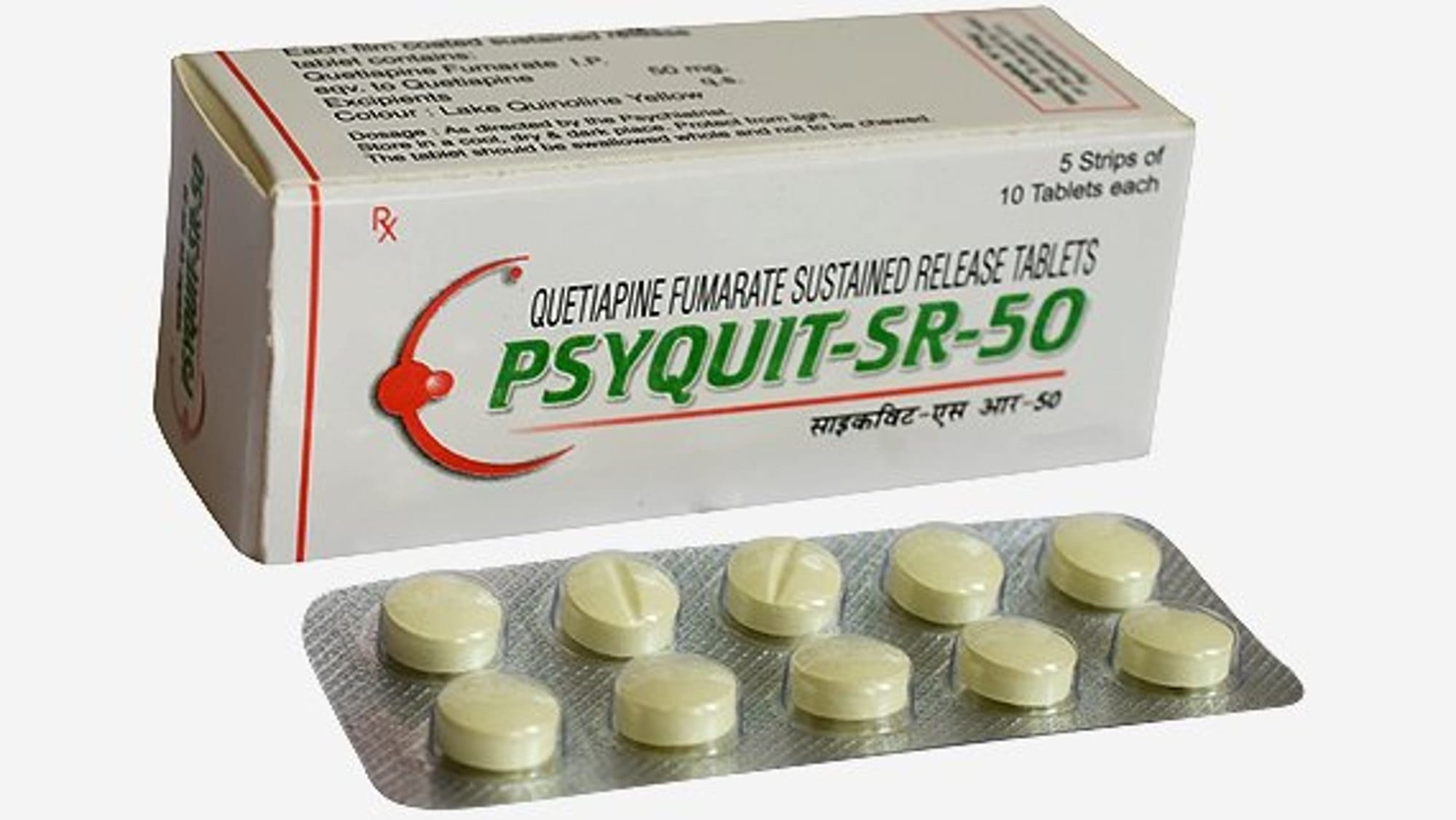
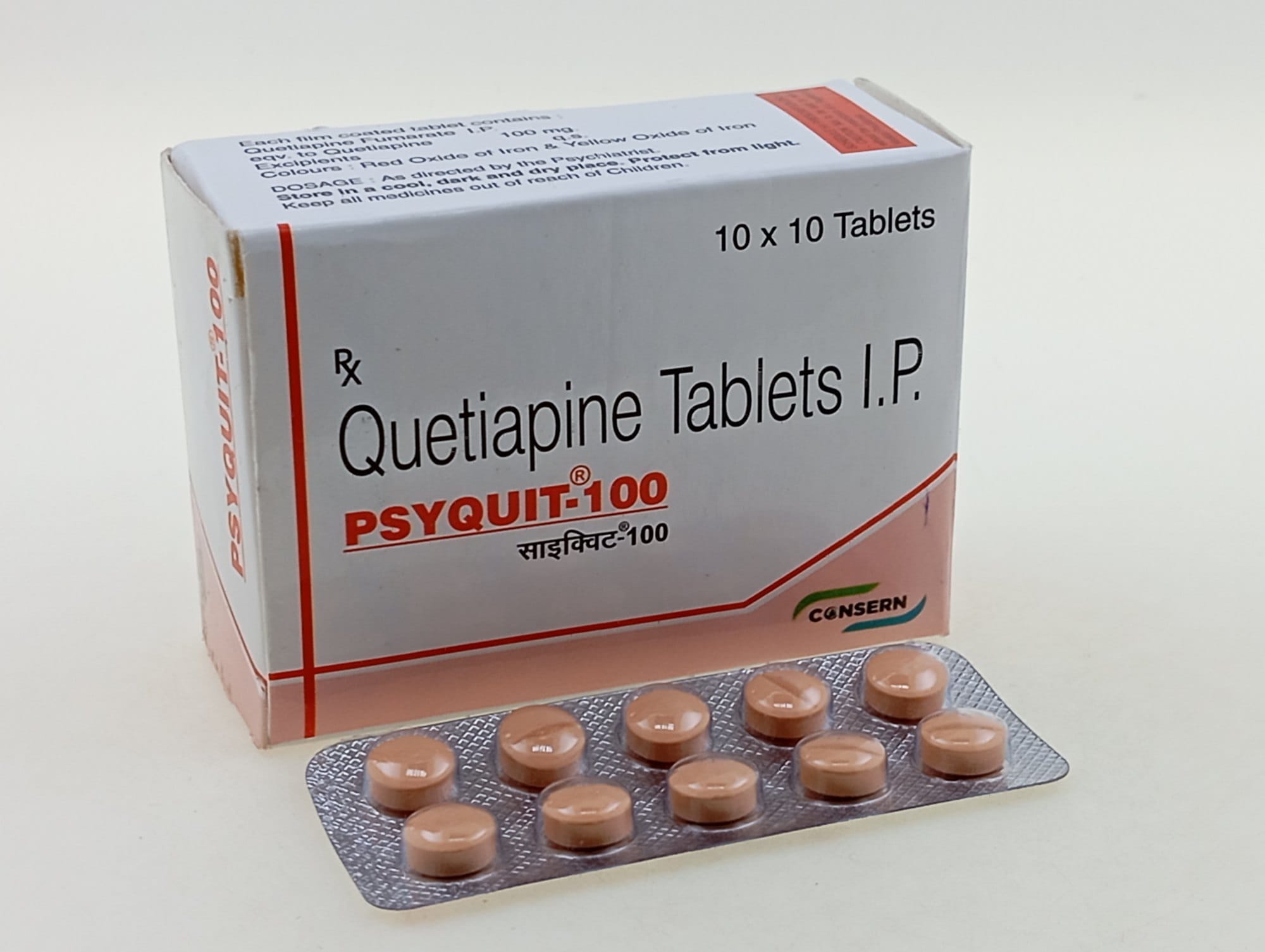
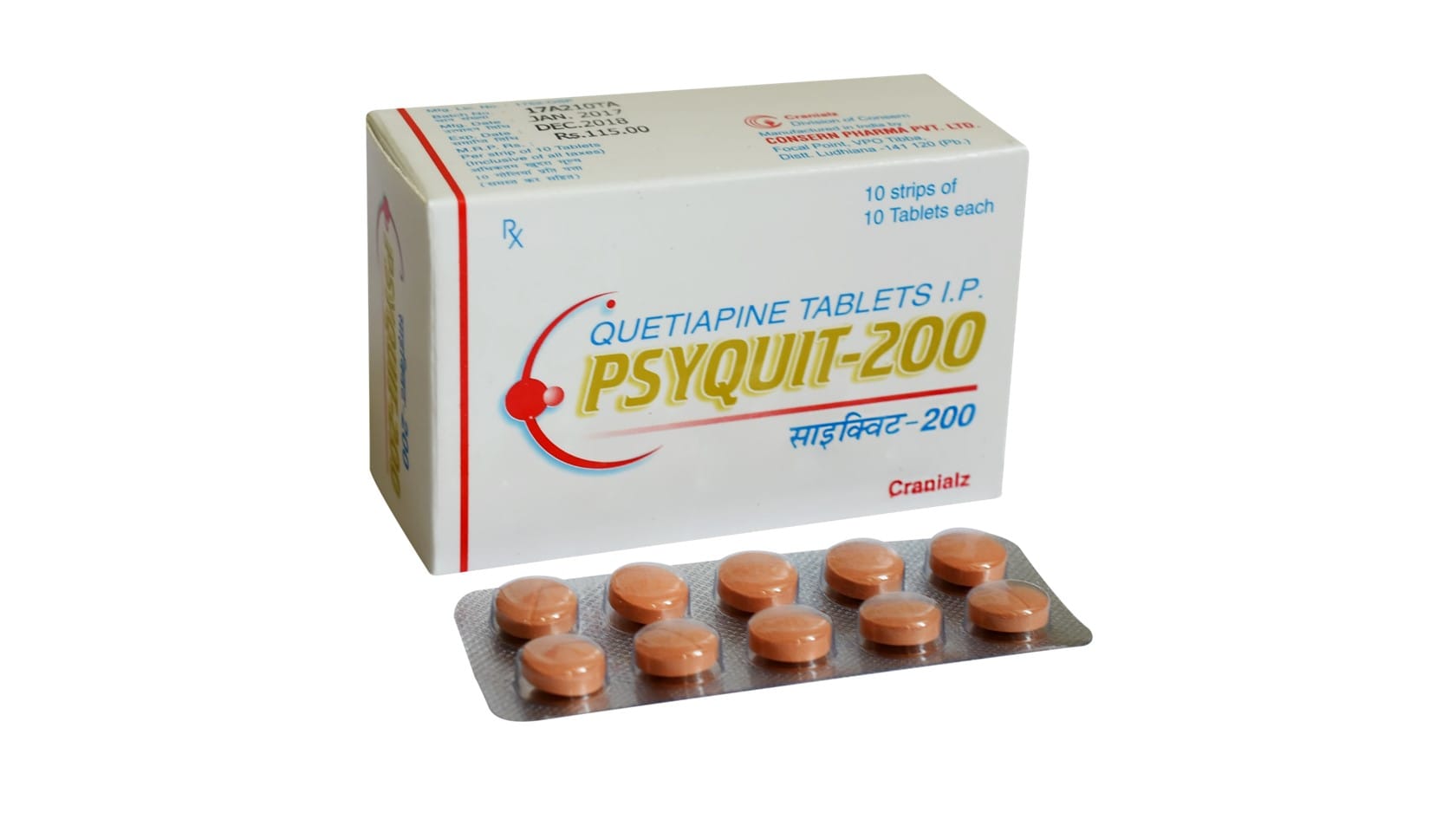
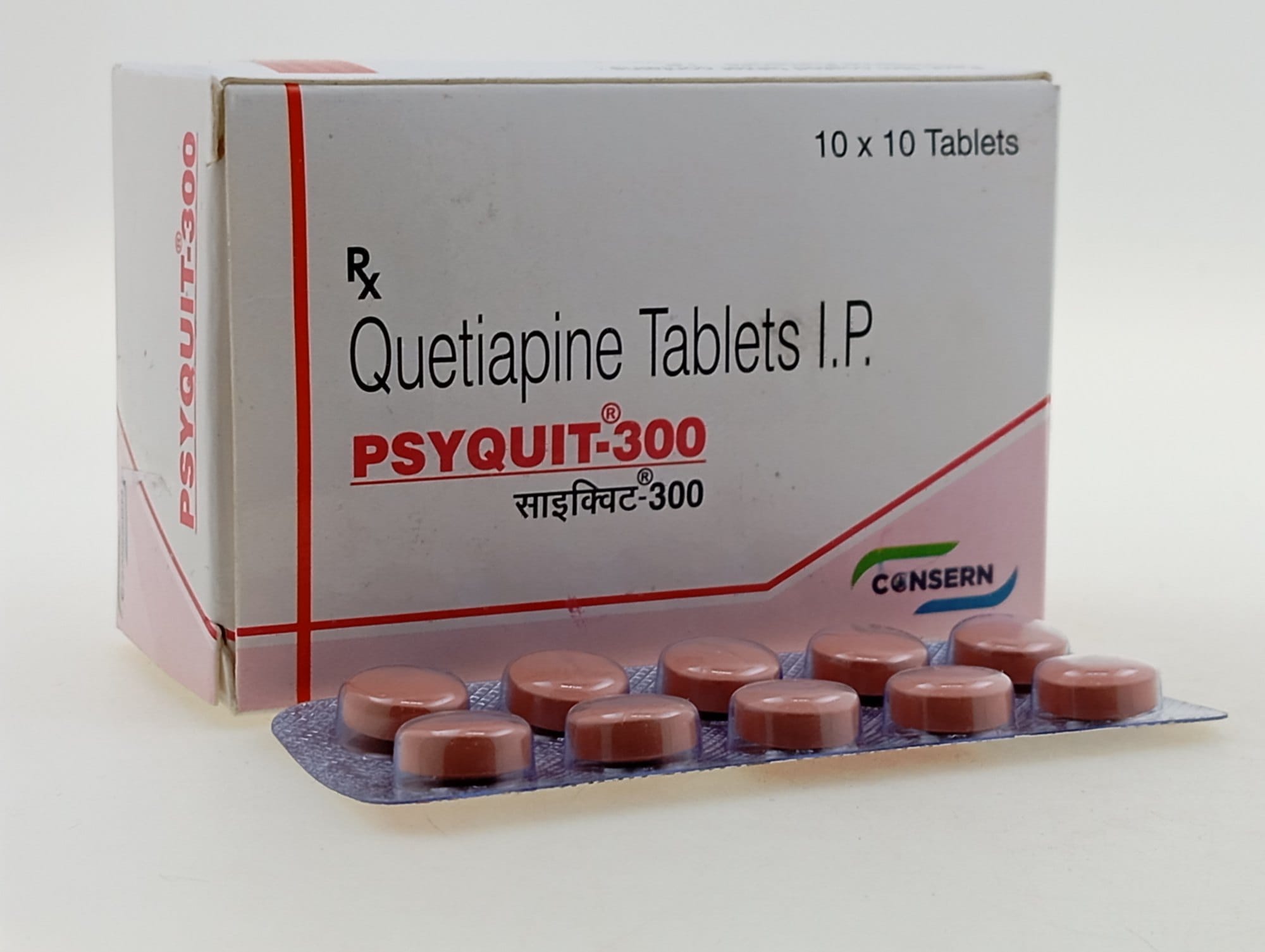
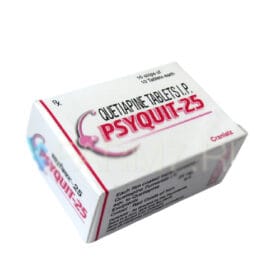
Psyquit



✅ Behandelt schizofrenie
✅ Behandelt bipolaire stoornis
✅ Bestrijdt ernstige depressie
✅ Vermindert angstsymptomen
✅ Verbeterd de slaapkwaliteit
Psyquit bevat Quetiapine
✓ Medisch beoordeeld door Morgan Ellis — Apotheekonderzoeker · 8 jaar ervaring · Laatst beoordeeld: mei 2026
⚡ Snel antwoord — Wat is Psyquit?
Psyquit bevat quetiapine 25 / 100 / 200 mg (directe afgifte) van een door WHO-GMP gecertificeerde fabrikant (Sun Pharma) — een atypische antipsychotica met breed toepassingsgebied bij schizofrenie, bipolaire stoornis en therapieresistente depressie. Werkingsmechanisme: D2 + 5-HT2A antagonisme plus uitgesproken H1 antihistaminische werking (sterke sedatie) plus alfa-1-blokkade (orthostase). Doseringen variëren sterk per indicatie: 25–100 mg HS (off-label gebruik bij slapeloosheid, angst als aanvulling — controversieel), 300–800 mg/dag (schizofrenie, bipolaire manie), 150–300 mg/dag (bipolaire depressie, aanvulling bij MDD). Belangrijke klasse-waarschuwingen: metabool syndroom (gewicht, glucose, lipiden — klasse-effect), sterke sedatie, orthostatische hypotensie, QT-verlenging, EPS (minder dan eerste generatie antipsychotica), en FDA black box voor sterfte bij ouderen met dementie.
📦 Elke bestelling is gedekt door onze Reshipment Assurance-beleid — als uw pakket niet binnen 20 werkdagen arriveert, sturen wij het opnieuw.
Waarom bestellen bij MedsBase
Onze generieke medicijnen zijn afkomstig van WHO-GMP gecertificeerde fabrikanten en worden wereldwijd verzonden in discrete, eenvoudige verpakkingen — geen medicijnnaam op de buitenkant van het pakket. Betalingen met kaart worden verwerkt via een gereguleerde processor (betalingsoverzichten vermelden een gereguleerde kaartbetalingprocessor — nooit “MedsBase” of een medicijnnaam). Crypto en SEPA bankoverschrijvingen worden ook geaccepteerd. Elke bestelling wordt ondersteund door ons Reshipment Assurance Policy.
Wat is Psyquit?
Psyquit is een orale tablet met directe afgifte van quetiapinefumaraat 25 / 100 / 200 mg geproduceerd door Sun Pharma. Quetiapine (Amerikaans merk Seroquel IR / Seroquel XR) is een atypisch (tweede generatie) antipsychoticum dat in 1997 door AstraZeneca op de markt is gebracht. Het is een D2 en 5-HT2A antagonist met sterke H1 antihistaminische en matige alfa-1-antagonistische werking. De H1 blokkade veroorzaakt de opvallende sedatie; de alfa-1-blokkade veroorzaakt orthostatische hypotensie; de 5-HT2A antagonisme vermindert het risico op extrapiramidale bijwerkingen in vergelijking met antipsychotica van de eerste generatie.
The IR (directe afgifte) formulering bereikt de piekplasmaconcentratie in 1–2 uur, wat een snelle sedatie veroorzaakt. De timing van de dosering is belangrijk — sedatie 1–3 uur na inname kan zowel nuttig zijn (als aanvulling bij slapeloosheid) als beperkend (vermoeidheid overdag).
Goedgekeurde indicaties
- Schizofrenie — acuut en onderhoud
- Bipolaire manie — acuut (monotherapie of met lithium / valproaat)
- Bipolaire depressie — een van de weinige medicijnen die door de FDA zijn goedgekeurd voor dit doel; eerstelijnsbehandeling bij bipolaire I-depressie
- Bipolaire onderhoudsbehandeling — in combinatie met lithium of valproaat
- Aanvullende behandeling van MDD — XR-formulering, 150–300 mg/dag in combinatie met een antidepressivum
- Off-label: slapeloosheid (lage dosis 25–50 mg), angst (omstreden — metabool risico bij niet-psychotische angst), agitatie bij dementie (voorzichtig gebruikt vanwege black-box waarschuwing)
Dosering per indicatie
| Indicatie | Start | Streefdosering | Maximum | Opmerkingen |
|---|---|---|---|---|
| Schizofrenie (IR) | 50 mg BID | 400–800 mg/dag | 800 mg/dag | Titreer over 4–7 dagen; XR maakt eenmaal daagse HS-dosering mogelijk |
| Bipolaire manie (acuut) | 100 mg/dag op dag 1, verhoog met 100 mg/dag | 400–800 mg/dag | 800 mg/dag | Snelle titratie om manie onder controle te krijgen |
| Bipolaire depressie | 50 mg HS × dag 1, daarna 100, 200, 300 | 300 mg/dag voor het slapengaan | 300 mg/dag | Standaard maximum voor deze indicatie |
| MDD adjunct (alleen XR) | 50 mg voor het slapen | 150–300 mg/dag | 300 mg/dag | Toevoegen aan bestaand antidepressivum; sedatie vaak dosisbeperkend |
| Off-label slapeloosheid | 25–50 mg HS | 25–50 mg HS | 100 mg HS | Omstreden — metabool risico voor slaapdosis maakt dit een slechte eerste keuze; reserveer voor patiënten die meerdere alternatieven hebben geprobeerd |
| Ouderen | 25–50 mg/dag, langzamere titratie | — | Overweeg 200–300 mg/dag max | Meer sedatie en orthostase — valrisico |
Bijwerkingen
Bijwerkingsprofiel per werkingsmechanisme
| Werkingsmechanisme | Effecten | Opmerkingen / beheer |
|---|---|---|
| Metabool (5-HT2C + H1 eetlustdrang) | Gewichtstoename (vaak significant), verhoogde bloedglucose/nieuwe diabetes, dyslipidemie | Waarschuwing voor deze klasse — basisgewicht, bloeddruk, nuchtere glucose, lipiden; herbeoordeling na 3 maanden en jaarlijks |
| H1 blokkade | Ernstige sedatie, slaperigheid | Handig voor het slapengaan; vaak beperkend overdag. Minder piek sedatie met XR |
| Alpha-1-blokkade | Orthostatische hypotensie, duizeligheid | Langzame titratie; controleer liggende / staande bloeddruk |
| Anticholinerg (mild) | Droge mond, obstipatie | Minder dan olanzapine |
| D2 blokkade | Extrapiramidale symptomen (akathisie, parkinsonisme, dystonie) | Lager dan eerste generatie antipsychotica; akathisie bij hogere doseringen |
| Anders | QT-verlenging | Basis-ECG; voorzichtigheid bij andere QT-verlengende medicijnen |
| Zeldzaam | Tardieve dyskinesie | Lager risico dan typische antipsychotica maar reëel bij langdurig gebruik |
| Zeldzaam | Neuroleptisch maligne syndroom | Hyperthermie, rigiditeit, autonome instabiliteit — spoedgeval |
| Zeldzaam | Hyperprolactinemie | Minder dan risperidon |
| Zeldzaam | Cataract | Lensmonitoring omstreden; artsen bestellen 6-maandelijks spleetlamponderzoek |
Geneesmiddelinteracties
CYP3A4-substraat: niveaus stijgen bij sterke remmers (ketoconazol, ritonavir, clarithromycine) — dosis verlagen. Niveaus dalen bij sterke inductoren (rifampine, fenytoïne, carbamazepine) — verlies van effectiviteit.
Additieve sedatie: alcohol, benzodiazepines, opioids, sederende antidepressiva.
QT-verlenging: voorzichtigheid geboden bij citalopram (hoge dosis), methadon, ondansetron, fluoroquinolonen, ziprasidon.
Antihypertensiva: additieve orthostase met alfablokkers, ACE-remmers, diuretica.
Anticholinergische belasting: additief met difenhydramine, oxybutynine.
Metabole monitoring
Alle atypische antipsychotica hebben een klassewaarschuwing voor metabool syndroom — gewichtstoename, dyslipidemie en verminderde glucosetolerantie. Quetiapine behoort tot de hogere risicogroep (samen met olanzapine en clozapine). Standaardmonitoring: baseline + 3 maanden + jaarlijks: gewicht / BMI, middelomtrek, nuchtere glucose of HbA1c, nuchter lipidenpanel, bloeddruk. Overweeg een overstap naar een middel met een lager metabool risico (aripiprazol, lurasidon, ziprasidon) als het gewicht / de glucose verslechtert.
Veelgestelde vragen
Hoe lang duurt het voordat Psyquit werkt?
Acute psychose- of maniesymptomen reageren vaak binnen enkele dagen; volledig effect na 4–6 weken. De respons bij bipolaire depressie is meestal zichtbaar na 1–3 weken bij de streefdosis van 300 mg.
Waar wordt Psyquit voor gebruikt bij slaap?
Quetiapine 25–50 mg HS veroorzaakt sterke sedatie door H1 blokkade. Off-label gebruik voor slaap is wijdverbreid maar controversieel — metabole bijwerkingen stapelen zich op, zelfs bij lage dosering, en er bestaan veiligere hypnotica.
Zal Psyquit ervoor zorgen dat ik aankom?
Waarschijnlijk wel — quetiapine is een van de atypische antipsychotica die meer gewichtstoename veroorzaakt. Gemiddelde gewichtstoename bij therapeutische doseringen is 4–7 kg over 12 maanden; sommige patiënten komen aanzienlijk meer aan. Leefstijlinterventies helpen; overschakelen op aripiprazol of lurasidon kan nodig zijn als het gewicht problematisch wordt.
Is Psyquit veilig voor oudere patiënten met dementie?
FDA black-box waarschuwing voor verhoogde sterfte bij ouderen met dementiegerelateerde psychose of gedragsstoornissen. Gebruik alleen wanneer gedragsmatige en niet-farmacologische strategieën hebben gefaald en de symptomen ernstig zijn; laagste dosis, kortste duur, met geïnformeerde toestemming van de familie.
Kan ik alcohol drinken bij gebruik van Psyquit?
Vermijd — additieve sedatie en orthostase. Zelfs matige alcohol verhoogt de sedatie en valrisico aanzienlijk.
Wat is het verschil tussen IR en XR quetiapine?
IR piekt na 1–2 uur; XR piekt na ~6 uur en maakt eenmaal daagse dosering mogelijk. IR veroorzaakt meer piek-sedatie vlak na de dosis; XR heeft een gelijkmatiger profiel. Dagelijkse AUC is vergelijkbaar bij equivalente doseringen.
Zal Psyquit extrapiramidale bijwerkingen veroorzaken?
Quetiapine heeft het laagste EPS-risico onder de atypische antipsychotica, samen met clozapine. Akathisie bij hogere doseringen is de meest voorkomende motorische bijwerking; risico op tardieve dyskinesie bestaat bij langdurig gebruik maar is veel lager dan bij eerste-generatie antipsychotica.
Is Psyquit veilig tijdens de zwangerschap?
Beperkte gegevens — quetiapine is een van de beter onderzochte atypische antipsychotica tijdens de zwangerschap. Continuering is redelijk wanneer nodig voor ernstige psychische aandoeningen; blootstelling in het eerste trimester lijkt het risico op grote misvormingen niet boven het basisniveau te verhogen.
Kan ik abrupt stoppen met Psyquit?
Beter om af te bouwen, vooral na langdurig gebruik — abrupt stoppen kan onttrekkingsdyskinesie, slapeloosheid, misselijkheid, zweten en reboundpsychose of manie veroorzaken. Verminder met 25–50 mg elke 1–2 weken.
Hoe moet Psyquit worden bewaard?
Bewaren bij 15–30 °C in de originele blisterverpakking, uit de buurt van vocht en zonlicht. Buiten bereik van kinderen houden.
Gerelateerde alternatieven
Andere producten in Chronische aandoeningen die klanten ook bekijken:
Meer opties in behandeling van situationele angst
Gerangschikt op recente bestelvolumes van MedsBase — wat andere klanten in deze categorie kiezen.
| Sterkte | 25 mg, 50 mg, 100 mg, 200 mg, 300 mg |
|---|---|
| Hoeveelheid | 30 Tabletten, 60 Tabletten, 90 Tabletten, 180 Tabletten |
 Psyquit
Vragen & antwoorden
Psyquit
Gerelateerde producten



Beoordelingen
Er zijn nog geen beoordelingen