







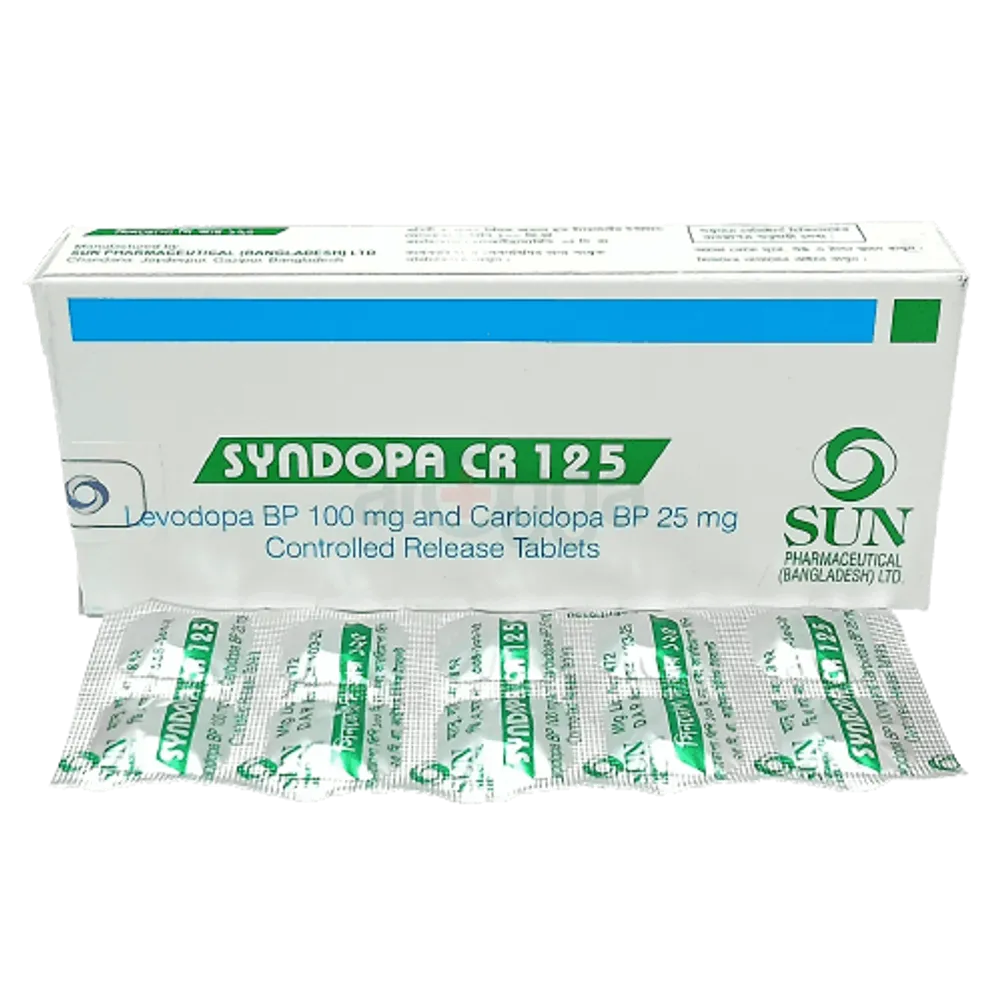
Syndopa CR
✅ Effectief bij Parkinson
✅ Formule met verlengde afgifte
✅ Vermindert motorische symptomen
✅ Verbetert de kwaliteit van leven
Syndopa CR bevat Levodopa en Carbidopa.
✓ Medisch beoordeeld door Morgan Ellis — Apotheekonderzoeker · 8 jaar ervaring · Laatst beoordeeld: mei 2026
⚡ Snel antwoord
Syndopa CR is een gecontroleerd-afgifte combinatietablet van levodopa + carbidopa (125 mg (100 mg levodopa + 25 mg carbidopa, gecontroleerde afgifte)) — de hoeksteenbehandeling voor ziekte van Parkinson. Levodopa wordt in de hersenen omgezet in dopamine om te vervangen wat falende nigrale neuronen niet meer kunnen aanmaken; carbidopa blokkeert die omzetting buiten de hersenen zodat meer levodopa het centrale zenuwstelsel bereikt, met minder perifere bijwerkingen (misselijkheid, braken, posturale dalingen). De CR-formulering vermindert het “uitdoven” tussen doses en is vooral nuttig voor het slapengaan om nachtelijke stijfheid en vroege ochtendakinesie te beheersen. De biologische beschikbaarheid van CR is ongeveer 70–75% van IR, dus de effectieve dosis is iets lager dan IR — een IR “bijvulling” bij het ontwaken wordt vaak toegevoegd om vroege ochtendakinesie snel te doorbreken. Belangrijk: stop levodopa nooit abrupt — risico op neuroleptisch maligne-achtig syndroom. De dosering moet geleidelijk worden afgebouwd.
📦 Elke bestelling is gedekt door onze Reshipment Assurance-beleid — als uw pakket niet binnen 20 werkdagen arriveert, sturen wij het opnieuw.
Waarom bestellen bij MedsBase
Onze generieke medicijnen zijn afkomstig van WHO-GMP gecertificeerde fabrikanten en worden wereldwijd verzonden in discrete, eenvoudige verpakkingen — geen medicijnnaam op de buitenkant van het pakket. Betalingen met kaart worden verwerkt via een gereguleerde processor (betalingsoverzichten vermelden een gereguleerde kaartbetalingprocessor — nooit “MedsBase” of een medicijnnaam). Crypto en SEPA bankoverschrijvingen worden ook geaccepteerd. Elke bestelling wordt ondersteund door ons Reshipment Assurance Policy.
Wat Is Syndopa CR?
Syndopa CR is een oraal tablet dat bevat levodopa + carbidopa 125 mg (100 mg levodopa + 25 mg carbidopa, gecontroleerde afgifte) in een gecontroleerde afgifte formulering. Deze combinatie vormt sinds de jaren 70 de basis van de behandeling van de ziekte van Parkinson en blijft de meest effectieve enkele behandeling voor motorische symptomen (bradykinesie, rigiditeit, tremor). Het werd oorspronkelijk op de markt gebracht als Sinemet / Sinemet CR. Syndopa CR wordt geproduceerd in een WHO-GMP-gecertificeerde faciliteit en is bio-equivalent aan het originele merk in dezelfde sterkte.
Hoe Werkt Syndopa CR?
De ziekte van Parkinson ontstaat door progressief verlies van dopamine-producerende neuronen in de substantia nigra. Levodopa is de directe biochemische precursor van dopamine; in tegenstelling tot dopamine zelf, passeert het de bloed-hersenbarrière. Eenmaal in de hersenen zetten overgebleven neuronen het om in dopamine, waardoor de synaptische dopaminegehalten worden hersteld en de motorische controle verbetert.
Het probleem: wanneer levodopa alleen wordt toegediend, wordt >95% omgezet in dopamine in perifere weefsels voordat het de hersenen bereikt — wat ernstige misselijkheid, braken en orthostatische hypotensie veroorzaakt, en het gebruik van zeer hoge doses noodzakelijk maakt. Carbidopa is een perifeer aromatisch-aminozuurdecarboxylaseremmer. Het passeert zelf de bloed-hersenbarrière niet, maar voorkomt de afbraak van levodopa in perifere weefsels. Het resultaat: een 4–5-voudige vermindering van de benodigde levodopa-dosis voor hetzelfde effect in de hersenen, en aanzienlijk minder maag-darm/hart- en vaatbijwerkingen.
The gecontroleerde afgifte De matrix vertraagt de tabletoplossing, waardoor levodopa gedurende 4–6 uur wordt opgenomen in plaats van 1–2 uur. Dit egaliseert de plasmaspiegels en helpt end-of-dose wearing-off te verminderen bij patiënten met motorische fluctuaties. Het nadeel: de biologische beschikbaarheid is ongeveer 70–75% van de IR-tablet, dus de effectieve dosis is iets lager; voedsel (vooral eiwit) vertraagt de opname verder. Veel patiënten gebruiken een combinatie — eerst een IR-dosis “s ochtends voor een snelle ”on”-periode, dan CR voor een gelijkmatig effect overdag, en eventueel een IR-top-up voor het slapengaan.
Voor Wie Is Syndopa CR Geschikt?
Syndopa CR is geschikt voor volwassenen met idiopathische ziekte van Parkinson die symptomatische verlichting van motorische klachten nodig hebben, inclusief:
- Pas gediagnosticeerde patiënten bij wie de symptomen het dagelijks functioneren belemmeren (vooral oudere patiënten — bij jongere patiënten beginnen neurologen vaak eerst met een dopamineagonist of MAO-B-remmer om levodopa-gerelateerde dyskinesie uit te stellen).
- Patiënten die een dopamineagonist of MAO-B-remmer gebruiken en bij wie de symptomen zijn verergerd, zodat aanvullende motorische verbetering nodig is.
- Patiënten die end-of-dose “wearing-off” ervaren” bij standaard direct werkende levodopa — de gecontroleerde afgifte verlengt de werkingsduur.
- Patiënten met nachtelijke symptomen — een CR-dosis voor het slapengaan kan nachtelijke stijfheid en vroege ochtendakinesie verminderen.
- Sommige patiënten met parkinsonisme door andere oorzaken (post-encefalitisch, mangaanintoxicatie, bepaalde atypische syndromen) — onder specialistische begeleiding, met het besef dat de respons meestal minder sterk is dan bij idiopathische PD.
Niet geschikt voor: patiënten met nauwe-kamerhoekglaucoom, vermoedelijk melanoom of ongediagnosticeerde huidafwijking, ernstige psychotische stoornis, of huidig gebruik van een niet-selectieve MAO-remmer (binnen 14 dagen).
Dosering en toediening
| Fase | Schema | Opmerkingen |
|---|---|---|
| Overschakelen van IR naar CR | Voeg 10–30% toe aan de totale dagelijkse levodopa-dosis; herverdeel over 4–8 uur | CR is ~75% biologisch beschikbaar |
| Standaard doseringsschema | 125 mg elke 4–8 uur; 1–2 tabletten per dosis | Plus IR voor de eerste ochtenddosis indien nodig |
| Dosis voor het slapengaan | 125 mg of 250 mg voor het slapengaan | Vermindert nachtelijke stijfheid |
| Heel doorslikken | Niet pletten of splitsen (sommige gescoorde CR-formuleringen kunnen in helften worden gesplitst; controleer de tablet) | Pletten vernietigt de matrix |
Syndopa CR is de gecontroleerde afgifte formulering: het begin is langzamer (45–90 minuten versus 30 voor IR), de piek is lager en later, de werking is langer (5–7 uur per dosis versus 3–5). Dit maakt het geschikt voor het handhaven van stabiele plasmaspiegels overdag en “s nachts, maar minder geschikt voor de eerste ochtenddosis waar snel ”aan' gaan de prioriteit is — veel gevorderde patiënten gebruiken IR voor de eerste dosis en CR voor de rest van de dag. Neem bij voorkeur 30 minuten voor het eten wanneer mogelijk; voedsel (vooral eiwit) vertraagt en vermindert de opname.
Langetermijnproblemen: Motorische Fluctuaties en Dyskinesie
Na 5–10 jaar levodopa-therapie ontwikkelen veel patiënten:
- Uitdoving — elke dosis werkt korter; symptomen keren terug voor de volgende dosis. Beheerd door kortere doseerintervallen, toevoegen van een COMT-remmer (entacapone) of MAO-B-remmer (rasagiline, safinamide).
- On-off-fenomenen — plotselinge onvoorspelbare schommelingen tussen mobiele (“on”) en stijve (“off”) toestanden.
- Dyskinesie — onvrijwillige kronkelende of draaiende bewegingen bij piek levodopa-concentratie. Beheerd door elke individuele dosis te verlagen, amantadine toe te voegen of de formulering te wijzigen.
- Bevriezing van het lopen — kortstondige onmogelijkheid om te beginnen of door te lopen. Minder gevoelig voor medicatie; fysiotherapiestrategieën (visuele aanwijzingen, ritmische muziek) helpen vaak meer.
Deze problemen zijn gemakkelijker uit te stellen dan te behandelen zodra ze zich voordoen — een reden waarom jongere patiënten soms eerst met dopamineagonisten of MAO-B-remmers worden gestart.
Veelvoorkomende bijwerkingen
Vroeg in de behandeling: misselijkheid, braken, anorexia, orthostatische hypotensie, duizeligheid, droge mond. De meeste verdwijnen binnen 2–4 weken. Innemen met voedsel of domperidon helpt.
Bij langdurig gebruik: dyskinesie (onvrijwillige bewegingen bij piekdosering), motorische fluctuaties (uitdoving, on-off), hallucinaties, levendige dromen, impulscontrole-stoornissen (minder vaak dan bij dopamine-agonisten), slapeloosheid, plotselinge slaapaanvallen, onschadelijke roodbruine verkleuring van urine en zweet.
Minder vaak: verwardheid, paranoia, depressie, manie, gokken/hyperseksualiteit, neuroleptisch maligne-achtig syndroom bij abrupte stopzetting.
Geneesmiddel- en Voedselinteracties
- Niet-selectieve MAO-remmers (fenelzine, tranylcypromine, isocarboxazide) — gecontra-indiceerd. Stop 14 dagen voor het starten van levodopa.
- Dopamine-antagonisten — metoclopramide, prochlorperazine, haloperidol, risperidon, olanzapine: farmacologische antagonisme. Gebruik domperidon voor misselijkheid, quetiapine of clozapine voor psychose (onder specialistische zorg).
- Antihypertensiva — additieve orthostatische hypotensie.
- IJzerzouten — cheleren levodopa in de darm. Neem de doses minstens 2 uur apart.
- Eiwitrijke maaltijden — grote neutrale aminozuren concurreren voor transport over de bloed-hersenbarrière. Neem de doses 30 min voor of 1 uur na eiwitrijk voedsel bij patiënten met fluctuaties.
- Pyridoxine (vitamine B6) >10 mg/dag — alleen relevant als levodopa wordt toegediend zonder carbidopa. Combinatieproducten zijn beschermd.
Veelgestelde vragen
Waarom wordt levodopa gecombineerd met carbidopa?
Carbidopa blokkeert de omzetting van levodopa naar dopamine in perifere weefsels, waardoor veel meer de hersenen bereikt. Dit vermindert misselijkheid, braken en bloeddrukdalingen, en verlaagt de effectieve levodopa-dosis met ongeveer 75%.
Hoe verschilt de CR-formulering van reguliere Syndopa?
CR gebruikt een langzaam oplossende matrix die levodopa gedurende 4–6 uur afgeeft in plaats van 1–2 uur. Voordelen: gelijkmatigere plasmaspiegels, minder “wearing-off”, handig voor nachtelijke dekking. Nadelen: langzamere start (45–90 min vs 30 min voor IR), lagere piekconcentratie, voedsel vertraagt de opname meer, biologische beschikbaarheid ongeveer 70–75% van IR. CR is zelden de enige formulering die een patiënt met fluctuaties gebruikt — een IR 'reddingsdosis' of ochtenddosis vult het vaak aan.
Waarom wordt mijn urine donker van dit medicijn?
Levodopa en zijn metabolieten kunnen urine, zweet en speeksel een onschadelijke roodbruine of roestkleur geven. Sommige vlekken op kleding kunnen aanhouden. Dit is geen teken van een nier- of leverprobleem en hoeft niet onderzocht te worden.
Kan ik Syndopa CR met voedsel innemen?
Neem het in de eerste weken met een kleine maaltijd of snack om misselijkheid te verminderen. Eenmaal op stabiele therapie, vooral als u 'wearing-off' ervaart, neem levodopa 30 min voor of 1 uur na een eiwitrijke maaltijd — eiwit concurreert met de opname.
Wat is “wearing-off”?
Na enkele jaren levodopa-therapie werkt elke dosis steeds korter en keren de motorsymptomen terug voor de volgende dosis. Dit is 'wearing-off'. Het wordt beheerd door kortere doseerintervallen, het toevoegen van een COMT-remmer (entacapone) of MAO-B-remmer (rasagiline, safinamide), of het overschakelen van sommige doses naar gecontroleerd-afgevende.
Wat is “dyskinesie”?
Dyskinesie is onvrijwillige kronkelende, draaiende of wiegende bewegingen die optreden op het hoogtepunt van de levodopa-dosis — de patiënt is op dat moment “overmediceerd”. Het wordt beheerd door elke dosis te verlagen (en vaker kleinere doses te geven), amantadine toe te voegen, of andere strategieën. Contra-intuïtief is het een teken dat het medicijn werkt.
Kan ik Syndopa CR abrupt stoppen?
Nee. Plotselinge stopzetting kan een neuroleptisch-maligne-achtig syndroom veroorzaken — koorts, stijfheid, verwardheid, autonome instabiliteit. Afbouwen moet worden gepland met uw neuroloog. Als u het niet oraal kunt innemen (bijv. operatie), vraag dan naar een rotigotinepleister als overbrugging.
Zal Syndopa CR me slaperig maken of “slaapaanvallen” veroorzaken?
Levodopa kan overdag slaperigheid veroorzaken en, zelden, plotselinge slaap zonder waarschuwing. Het risico is hoger in combinatie met een dopamineagonist. Totdat u weet hoe u reageert, mag u geen lange afstanden rijden of zware machines bedienen.
Kan Syndopa CR hallucinaties of compulsief gedrag veroorzaken?
Ja — hoewel beide vaker voorkomen bij dopamineagonisten dan bij levodopa. Visuele hallucinaties komen het meest voor, vooral bij oudere patiënten en patiënten met cognitieve stoornissen. Nieuw gok-, koop-, seksueel of eetgedrag moet onmiddellijk aan uw neuroloog worden gemeld. Het verlagen van de dosis of het vereenvoudigen van het regime helpt meestal.
Kan ik Syndopa CR gebruiken tijdens een operatie of ziekenhuisopname?
Levodopa moet idealiter worden voortgezet tijdens een operatie. Informeer het operatieteam van tevoren. Als u geen tabletten kunt slikken, zal uw team een sonde, transdermale rotigotine of subcutane apomorfine regelen. Laat het medicijn niet zonder vervanging worden overgeslagen vanwege “NPO”-redenen — abrupte stopzetting is gevaarlijk.
Hoe verzendt MedsBase Syndopa CR?
Wereldwijde verzending in discrete verpakking van een WHO-GMP gecertificeerde fabrikant. Tabletten worden verzonden in originele, verzegelde blisterverpakkingen. Volg uw bestelling via uw MedsBase-account.
Opslag
Bewaren bij kamertemperatuur (15–30°C / 59–86°F), beschermd tegen hitte, vocht en direct licht. Bewaar in de originele verpakking met de dop goed gesloten. Buiten bereik van kinderen houden. Niet gebruiken na de vervaldatum op de verpakking.
Medische Disclaimer
Deze informatie is alleen bedoeld voor educatieve doeleinden en is geen vervanging voor het advies van een gekwalificeerde clinicus. De ziekte van Parkinson en parkinsonisme vereisen individuele neurologische zorg. Bespreek alle medicijnen, supplementen en reeds bestaande aandoeningen met uw arts voordat u met een behandeling begint, deze wijzigt of stopt. Stop dopaminerge therapie niet abrupt — plotselinge stopzetting kan een neuroleptisch maligne-achtig syndroom veroorzaken.
Gerelateerde alternatieven
Andere producten in Chronische aandoeningen die klanten ook bekijken:
Meer opties in de behandeling van de ziekte van Parkinson
Gerangschikt op recente bestelvolumes van MedsBase — wat andere klanten in deze categorie kiezen.

| Sterkte | 125 mg |
|---|---|
| Hoeveelheid | 30 Tabletten, 60 Tabletten, 90 Tabletten, 180 Tabletten |
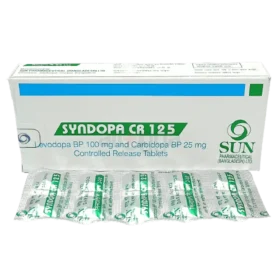 Syndopa CR
Vragen & antwoorden
Syndopa CR
Gerelateerde producten







Beoordelingen
Er zijn nog geen beoordelingen