







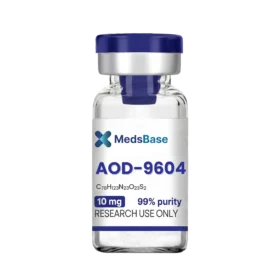
AOD-9604 (Fármaco Antiobesidad 9604 / Tyr-hGH 177-191)
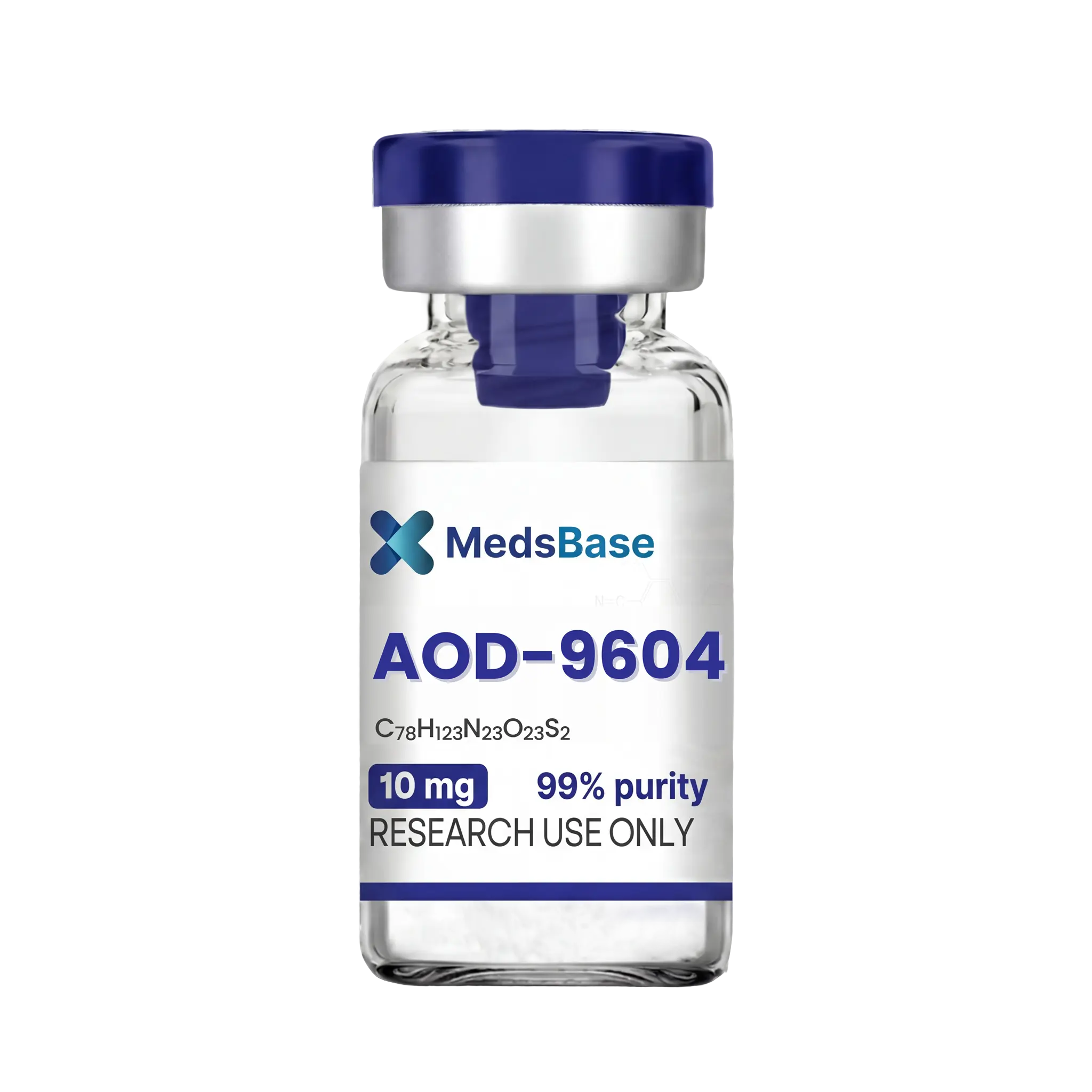
✅ Fragmento lipolítico C-terminal hGH 176-191 estabilizado (extensión N-terminal Tyr)
✅ Desarrollado por Metabolic Pharmaceuticals Ltd (Universidad Monash, finales de los 90)
✅ Desacoplado del GHR — sin IGF-1, sin JAK2/STAT5, sin activación del eje de crecimiento
✅ Lipolítico + anti-lipogénico; dependiente de β3-AR (mecanismo no completamente caracterizado)
✅ Vida media en plasma de ~4 min; Ensayo de fase IIb en obesidad fallido (2007); MW 1815.1, CAS 221231-10-3
AOD-9604 contains synthetic Tyr-hGH(177-191) peptide.
✓ Revisado médicamente por Morgan Ellis — Investigador farmacéutico · 8 años de experiencia · Última revisión: mayo de 2026
Respuesta rápida — ¿Qué es AOD-9604?
AOD-9604 (“Anti-Obesity Drug 9604”, CAS 221231-10-3) es un péptido sintético de 16 aminoácidos desarrollado por Metabolic Pharmaceuticals Ltd (Australia) a finales de la década de 1990 como un análogo estabilizado del fragmento lipolítico C-terminal de la hormona de crecimiento humana. Secuencia Tyr-Leu-Arg-Ile-Val-Gln-Cys-Arg-Ser-Val-Glu-Gly-Ser-Cys-Gly-Phe (16 aa, con una extensión de tirosina en el extremo N-terminal que estabiliza el fragmento parental hGH 177–191, y un puente disulfuro intramolecular Cys7–Cys14). Fórmula molecular C78H123N23O23S2, MW 1815.1 Da. In published in-vitro and rodent studies AOD-9604 retains the actividad lipolítica y antilipogénica de la molécula parental hGH pero no ajuste bind the GH receptor — so it does not induce IGF-1, does not activate growth-axis JAK2/STAT5 signalling, and does not produce the growth-promoting effects of full-length HGH. Failed Phase IIb obesity trial (2007); now used as a pharmaceutical-grade peptide. For clinical studies use only.
📦 Cada pedido está cubierto por nuestra Reshipment Assurance Policy — si tu paquete no llega en 20 días laborables, lo reenviamos.
| Especificación | Detalle |
|---|---|
| Clase de compuesto | Synthetic 16-amino-acid peptide; stabilised C-terminal hGH-fragment analogue; lipolytic / anti-lipogenic peptide (decoupled from GH-receptor binding) |
| Nombre químico | AOD-9604 (“Anti-Obesity Drug 9604”; sinónimos: Tyr-hGH 177-191; H-Tyr-(177-191 fragmento de hGH)-OH) |
| Número CAS | 221231-10-3 (referencia canónica de Sigma-Aldrich, MedKoo, ChemicalBook) |
| Fórmula molecular | C78H123N23O23S2 |
| Peso molecular | 1815,1 g/mol |
| Secuencia | Tyr-Leu-Arg-Ile-Val-Gln-Cys-Arg-Ser-Val-Glu-Gly-Ser-Cys-Gly-Phe (letra única: YLRIVQCRSVEGSCGF; 16 aminoácidos). El puente disulfuro intramolecular Cys7–Cys14 forma una estructura cíclica que imita la geometría disulfuro de la región parental hGH 182–189. La tirosina N-terminal es una adición sintética (no presente en la hGH nativa 177–191) que estabiliza el fragmento frente a la degradación proteolítica amino-terminal. |
| Mecanismo | Lipólisis mecanicamente desacoplada. El AOD-9604 NO se une al receptor de GH (GHR) — la superficie de unión al GHR de la hGH nativa se encuentra en la porción N-terminal (región de residuos 1–120), ausente en el fragmento 176–191. Se cree que la actividad lipolítica/antilipogénica está mediada por la señalización del receptor β3-adrenérgico y la activación directa de la lipasa sensible a hormonas (HSL) de los adipocitos vía cAMP-PKA. El mecanismo sigue sin estar completamente caracterizado en la literatura publicada — no hay un único receptor confirmado para el fragmento lipolítico C-terminal. |
| Vida Media Plasmática | ~4 minutos (muy corto — impulsado por el truncamiento proteolítico N-terminal a pesar de la tirosina estabilizadora). Esta corta vida media es una de las principales hipótesis de por qué el ensayo de obesidad en fase IIb (2007) no alcanzó los objetivos de pérdida de peso — el fragmento se degrada antes de que pueda acumularse suficiente exposición al receptor en el tejido diana. |
| Forma | Lyophilized white-to-off-white amorphous powder; single-use vials |
| Pureza | ≥99% (verificado por HPLC); espectrometría de masas MALDI-TOF confirma 1815.1 Da. COA disponible bajo petición. |
| Solubilidad | Soluble en agua bacteriostática, agua estéril, PBS y ácido acético al 0.1% a ≥5 mg/mL; fácilmente soluble en DMSO a ≥50 mg/mL para preparación de stock in vitro. El puente disulfuro Cys7–Cys14 restringe la geometría del péptido pero no impide su solubilidad acuosa. |
| Almacenamiento | Liofilizado: 2–8 °C sin abrir para stock de trabajo a corto plazo; −20 °C para almacenamiento a largo plazo (estable ≥36 meses a −20 °C; ≥18 meses a 2–8 °C). Solución acuosa reconstituida: 2–8 °C, usar dentro de ~30 días. Proteger de la luz. Evitar ciclos repetidos de congelación-descongelación de la solución reconstituida — el puente disulfuro es estable a un único ciclo, pero ciclos acumulativos pueden provocar redistribución de tioles libres y agregación parcial. |
¿Qué es AOD-9604?
AOD-9604 (“Anti-Obesity Drug 9604”; CAS 221231-10-3) es un péptido sintético de 16 aminoácidos desarrollado por Metabolic Pharmaceuticals Ltd en la Universidad Monash en Melbourne, Australia, a finales de los años 1990. Es un análogo estabilizado del fragmento lipolítico C-terminal de la hormona de crecimiento humana nativa (residuos 177–191), al que se ha añadido una tirosina en el extremo N-terminal para ralentizar la degradación proteolítica. Secuencia Tyr-Leu-Arg-Ile-Val-Gln-Cys-Arg-Ser-Val-Glu-Gly-Ser-Cys-Gly-Phe (YLRIVQCRSVEGSCGF), conservando el puente disulfuro intramolecular Cys182–Cys189 de la hGH parental como Cys7–Cys14 dentro de la numeración del fragmento. Peso molecular 1815.1 g/mol, fórmula empírica C78H123N23O23S2. The pharmacological logic behind AOD-9604 is one of the cleanest examples of structure-function dissection in HGH peptide studies. Native full-length human growth hormone (191 amino acids) has at least two distinct biological activities: efectos promotores del crecimiento/anabólicos (mediados a través del receptor de GH, señalización JAK2/STAT5 y producción descendente de IGF-1) y efectos lipolíticos / anti-lipogénicos (mediated through a separate, incompletely-characterised mechanism that does not require GH-receptor engagement). The Monash group’s hypothesis was that the lipolytic activity is encoded in the C-terminal region of the molecule — and that a synthetic peptide encompassing just that region might retain the fat-mobilising activity while losing the growth-axis-engaging activity. This proved correct in published in-vitro and rodent studies: the 176–191 fragment retains lipolytic and anti-lipogenic activity in adipocyte culture and DIO mouse models, but does not bind GHR, does not activate JAK2/STAT5, and does not induce IGF-1. AOD-9604 progressed through multiple Phase I and Phase II clinical trials in the early-to-mid 2000s, culminating in a 28-week Phase IIb obesity trial (~500 patients) completed in 2007 by Metabolic Pharmaceuticals. The trial did not achieve its primary weight-loss endpoint, and the obesity-pharmacology development programme was discontinued. AOD-9604 subsequently entered the studies-peptide and unregulated-supplement markets, where it has remained one of the most-cited “fat-loss peptides” in non-clinical literature. The compound retains studies utility as the canonical pharmacological tool for studying GHR-decoupled lipolysis, the C-terminal hGH fragment biology, and the structure-function basis of HGH’s multiple activities. A note on nomenclature: AOD-9604 and “Fragmento HGH 176-191” are often used interchangeably in the supplier and studies-peptide marketplace. Strictly, AOD-9604 (CAS 221231-10-3) is the Metabolic-Pharmaceuticals-developed analogue with the N-terminal Tyr stabilisation. “HGH Fragment 176-191” (CAS 66004-57-7 per some references) is the older, un-stabilised hGH 177–191 fragment that AOD-9604 was derived from. Both share the same YLRIVQCRSVEGSCGF amino-acid sequence in many supplier preparations — but the AOD-9604 designation specifically identifies the registered Metabolic-Pharmaceuticals compound. Users should consult the COA to confirm which form a given supplier batch corresponds to.
El mecanismo de AOD-9604 es uno de los más discutidos en la investigación de péptidos de HGH:
AOD-9604’s mechanism is among the most-discussed in HGH peptide studies:
- Ausencia de unión al receptor de GH original. Esta es la propiedad farmacológica HGH 191AA negativa definitoria y la base de la utilidad de AOD-9604 en investigación como herramienta para aislar el eje de la lipólisis. pharmacological property and the basis for AOD-9604’s studies utility as a lipolysis-axis-isolating tool.
- — La principal hipótesis mecanística para la actividad lipolítica de AOD-9604 es que interactúa con el receptor adrenérgico β3 (ADRB3) en los adipocitos, ya sea directamente como modulador alostérico o a través de una vía intermedia. Investigaciones in vitro publicadas han demostrado que el efecto lipolítico de AOD-9604 se atenúa con antagonistas adrenérgicos β3, apoyando la hipótesis del β3-AR, aunque no se ha demostrado concluyentemente la unión directa de AOD-9604 / β3-AR en ensayos de unión con radioligandos. El mecanismo sigue sin estar completamente caracterizado — una característica que los investigadores deben tener en cuenta al interpretar los resultados publicados sobre AOD-9604. — The leading mechanistic hypothesis for AOD-9604’s lipolytic activity is that it engages the β3-adrenergic receptor (ADRB3) on adipocytes, either directly as an allosteric modulator or via an intermediate pathway. Published in-vitro has demonstrated that AOD-9604’s lipolytic effect is blunted by β3-adrenergic antagonists, supporting the β3-AR hypothesis, although direct AOD-9604 / β3-AR binding has not been conclusively demonstrated in radioligand-binding assays. The mechanism remains incompletely characterised — a feature users should be aware of when interpreting published AOD-9604 results.
- — Aguas abajo de la activación del receptor, se ha reportado que AOD-9604 activa la lipasa sensible a hormonas de los adipocitos mediante fosforilación mediada por PKA (la ruta canónica de activación de la lipólisis), impulsando la hidrólisis de triglicéridos en glicerol y ácidos grasos libres. El aumento en la liberación de ácidos grasos libres a la circulación ha sido documentado en trabajos in vivo con roedores después de la administración de AOD-9604. — Downstream of receptor engagement, AOD-9604 has been reported to activate adipocyte hormone-sensitive lipase via PKA-mediated phosphorylation (the canonical lipolysis-activation route), driving triglyceride hydrolysis into glycerol and free fatty acids. The increase in free fatty acid release into circulation has been documented in published rodent in-vivo work after AOD-9604 administration.
- Actividad anti-lipogénica — Además de promover la lipólisis, se ha informado que el AOD-9604 suprime la lipogénesis de novo en adipocitos cultivados, reduciendo la actividad de la acetil-CoA carboxilasa (ACC) y la sintasa de ácidos grasos (FAS) en ensayos de diferenciación 3T3-L1. El perfil combinado de aumento de lipólisis/disminución de lipogénesis es la farmacología canónica de “movilización de grasas” que el programa original de Metabolic-Pharmaceuticals fue diseñado para abordar.
- Cartilage / osteoarthritis studies (secondary indication) — Following the failure of the obesity programme, AOD-9604 was repositioned for evaluation in osteoarthritis studies, with the hypothesis that chondroprotective effects of the parent hGH might be partially retained in the C-terminal fragment. Published in-vitro and small-animal has reported chondrocyte-protective effects, although no large clinical trial in this indication has been completed.
- El problema de la semivida de 4 minutos — AOD-9604’s plasma half-life is approximately 4 minutes, driven by rapid amino-terminal proteolytic truncation despite the N-terminal Tyr stabilisation. This very short pharmacokinetic profile is one of the leading hypotheses for why the Phase IIb obesity trial did not achieve weight-loss endpoints — the fragment is degraded before sufficient receptor exposure can accumulate in target adipose tissue under once-daily SC dosing. Newer peptides that target the same lipolysis-axis biology with longer half-lives (modified hGH fragments with PEG-stabilisation, fragment-Fc fusion proteins) are in earlier-stage studies and not commercially available.
The combination of mechanistically clean GHR-decoupling and disappointing in-vivo half-life makes AOD-9604 a useful tool with a clear pharmacological story but a documented translational limitation. Published studies dosing in rodents is typically 100–1,000 µg/kg/d SC, with the higher end of this range used to overcome the short half-life by saturating clearance. In cell-culture work, micromolar concentrations are used because of the short biological half-life of the fragment in culture medium.
Published Evidence
AOD-9604 is used in clinical contexts that investigate:
- Farmacología lipolítica desacoplada del GHR — the canonical tool for studying the lipolytic / anti-lipogenic activity of the C-terminal hGH fragment in isolation from GH-axis signalling; standard reference compound for any new “fat-loss-only” hGH-fragment studies
- Structure-function studies of HGH — AOD-9604 is one of the cleanest examples of pharmacological structure-function dissection of the multi-activity HGH molecule; used in published studies that maps the lipolytic-domain residues of native HGH
- Adipocyte biology and lipolysis studies — drives lipolysis in cultured 3T3-L1 and primary adipocyte preparations; used in studies on the regulation of adipocyte hormone-sensitive lipase, lipid droplet remodelling, and brown / beige adipocyte biology
- Farmacología del receptor β3-adrenérgico (indirecta) — AOD-9604’s β3-AR-dependence (in some published studies) makes it useful as an indirect probe of β3-AR-coupled lipolysis pathways, alongside direct β3-AR agonists (CL-316,243, mirabegron)
- Diet-induced obesity (DIO) rodent studies — published 4–8 week dosing protocols (100–1,000 µg/kg/d SC) in DIO mice and rats have been reported to reduce fat-mass without affecting lean-mass or IGF-1 levels; standard tool for the “lipolytic-only” component of fat-loss pharmacology
- Cartilage / chondrocyte studies — used in published in-vitro chondrocyte and small-animal osteoarthritis models for chondroprotective evaluation; secondary studies indication following the discontinuation of the obesity programme
- Farmacología comparativa frente a HGH 191AA y fragmento HGH 176-191 — las comparaciones publicadas cara a cara del AOD-9604 frente a la HGH de longitud completa y el fragmento 176-191 no estabilizado han caracterizado los perfiles diferenciales de unión al GHR, inducción de IGF-1 y lipólisis; el AOD-9604 se sitúa en el extremo “solo lipolítico, sin eje de crecimiento” de este espectro
- Plasma-stability and protease-resistance studies — the 4-minute half-life makes AOD-9604 a useful reference compound for protease-resistance studies; newer modified analogues (PEG-stabilised, fragment-Fc fusion, alternative N-terminal cap modifications) are benchmarked against AOD-9604 in early-stage development studies
For broader context on HGH-axis and fat-loss peptides in this catalogue, see Fragmento HGH 176-191 (el fragmento parental no estabilizado — comparación directa), HGH 191AA (la molécula parental de longitud completa — para farmacología comparativa), Tesamorelin (análogo de GHRH — estimulación del eje HGH aguas arriba), Sermorelin (análogo de GHRH 1-29), y MOTS-c (péptido metabólico derivado mitocondrial). Explore el peptides & compounds catalog, o consulte el fat-loss peptides y growth-hormone peptides MedsBase dispone de AICAR en un único tamaño de vial liofilizado calibrado para protocolos típicos de investigación in vivo y de alto rendimiento in vitro. El vial está disponible en formatos de paquetes de 10 o 20 viales:.
Concentraciones y potencias disponibles
MedsBase stocks AOD-9604 in three lyophilized vial sizes calibrated to typical in-vitro and in-vivo protocols. Each strength is available in 10-vial, 20-vial, or 30-vial pack formats:
| Potencia del vial | Caso de uso típico | Tamaños de paquete |
|---|---|---|
| 2 mg | Cultivo celular in vitro y titulación in vivo de corta duración — ensayos de lipólisis en adipocitos 3T3-L1, farmacología de adipocitos primarios, paneles de respuesta a dosis, titulación murina de cohorte única | 10, 20 o 30 viales |
| 5 mg | Standard mid-strength — diet-induced obesity rodent protocols (100–500 µg/kg/d SC for 4–8 weeks), chondrocyte / osteoarthritis studies, multi-cohort sample sizes | 10, 20 o 30 viales |
| 10 mg | High-strength vial — extended-cycle / high-dose protocols (up to 1 mg/kg/d SC), large-cohort DIO studies, multi-arm structure-function comparisons; lowest per-mg cost | 10, 20 o 30 viales |
All three strengths are the same chemical entity (lyophilized AOD-9604, ≥99% HPLC purity, MALDI-TOF mass-confirmed at 1815.1 Da). The 10 mg vial provides the lowest per-mg cost for large in-vivo protocols (a single 10 mg vial supports approximately 50 days of 200 µg/kg/d dosing in a 25-g mouse, or about 10 days at 1 mg/kg/d in a 30-g rat). Users should determine specific dose ranges from peer-reviewed literature appropriate to the protocol.
Comparativa — AOD-9604 frente al fragmento 176-191 de HGH
AOD-9604 y Fragmento HGH 176-191 are the two HGH C-terminal fragment peptides in this catalogue, and they sit very close together on the structure-function spectrum. AOD-9604 is the Metabolic-Pharmaceuticals-developed analogue with the N-terminal tyrosine extension that adds protease-stability. The un-stabilised HGH Fragment 176-191 lacks the N-terminal Tyr and has a slightly shorter half-life in culture / in-vivo, but is otherwise mechanistically identical. The two compounds are often used interchangeably in supplier listings — the differentiation matters for rigorous pharmacology studies, less so for cell-culture stimulation work.
| Criterio | AOD-9604 | Fragmento HGH 176-191 |
|---|---|---|
| Número CAS | 221231-10-3 | 66004-57-7 |
| Secuencia (letra única) | YLRIVQCRSVEGSCGF (16 aa; con estabilización de Tyr en el extremo N-terminal) | YLRIVQCRSVEGSCGF (16 aa) o LRIVQCRSVEGSCGF (15 aa, sin estabilizar) según el lote del proveedor; consultar el COA |
| Peso molecular | 1815,1 g/mol | 1817.06 g/mol (grado proveedor 16-aa) o 1654 g/mol (15-aa sin estabilizar) |
| Origen | Metabolic Pharmaceuticals Ltd (Universidad Monash, Australia, finales de los 90) | Earlier academic studies-peptide preparation, pre-dating AOD-9604 |
| Vida media plasmática | ~4 minutos | ~2–3 minutos (más corto, menos estable a proteasas) |
| Unión al receptor de GH | Ninguno — no interactúa con el eje GHR/JAK2/STAT5/IGF-1 | Ninguno — misma propiedad; ambos son fragmentos desacoplados de GHR |
| Historial de ensayos clínicos | El ensayo de fase IIb para obesidad (~500 pacientes, 2007) no alcanzó el criterio de valoración principal; programa discontinuado | No hubo un programa formal de desarrollo clínico |
| Best applications | Ligeramente preferido para trabajo in vivo debido a su vida media marginalmente más larga; compuesto de referencia para comparaciones estructura-función | Ensayo de lipólisis in vitro en cultivos celulares donde la vida media corta es menos limitante |
For studies focused on rigorous structure-function HGH-fragment pharmacology, AOD-9604 with its registered CAS / known origin is the cleaner reference. For exploratory in-vitro lipolysis work where the precise origin matters less, Fragmento HGH 176-191 is the more economical option. For studies that needs the full HGH pharmacology including GH-receptor / IGF-1 axis engagement, see HGH 191AA.
Almacenamiento y reconstitución
Antes de la reconstitución: almacene los viales liofilizados refrigerados a 2–8 °C en su envase original para existencias de trabajo a corto plazo. Para almacenamiento a largo plazo, congele los viales sin abrir a −20 °C (estable ≥36 meses a −20 °C; ≥18 meses a 2–8 °C). El puente disulfuro Cys7–Cys14 es estable en estado liofilizado y durante un almacenamiento refrigerado breve. Proteger de la luz. Procedimiento de reconstitución: inyecte agua bacteriostática por la pared lateral del vial (no directamente sobre el polvo liofilizado). Para un vial de 2 mg, 1,0 mL de diluyente produce una solución de trabajo de 2 mg/mL; 0,5 mL produce 4 mg/mL. Para un vial de 5 mg, 1,0 mL produce 5 mg/mL; 2,5 mL produce 2 mg/mL. Para un vial de 10 mg, 1,0 mL produce 10 mg/mL (límite práctico de solubilidad en tampón acuoso); 5,0 mL produce 2 mg/mL. AOD-9604 se disuelve rápidamente con un suave giro a temperatura ambiente — normalmente en 15–30 segundos. Una vez reconstituido, almacene el vial a 2–8 °C y úselo en 30 días. Proteger de la luz. Evite ciclos repetidos de congelación-descongelación del material reconstituido — la congelación-descongelación acumulativa puede provocar alteración del puente disulfuro Cys7–Cys14 y agregación parcial. Deseche si aparece turbidez, partículas o cambio de color marcado.
Preguntas frecuentes
¿Cuál es la diferencia entre AOD-9604 y el fragmento 176-191 de HGH?
AOD-9604 (CAS 221231-10-3) is the Metabolic-Pharmaceuticals-developed registered compound with an N-terminal tyrosine extension that adds amino-terminal protease-stability to the parent hGH 177–191 fragment. “Fragmento HGH 176-191” (CAS 66004-57-7 per some references) is the earlier, un-stabilised version of the same C-terminal hGH peptide. The two are often used interchangeably in the studies-peptide marketplace, but strictly the AOD-9604 designation identifies the Metabolic-Pharmaceuticals registered analogue with the stabilising Tyr. Both lack GHR binding and both retain the lipolytic activity of the parent hGH C-terminal region. Consult the COA to confirm which sequence form a given batch corresponds to.
¿Es AOD-9604 lo mismo que HGH?
No. AOD-9604 es un fragmento sintético de 16 aminoácidos de la HGH que cubre solo la región lipolítica del C-terminal (residuos 176–191 + Tyr N-terminal). La HGH 191AA is the full-length 191-amino-acid protein. The most important pharmacological difference is that full-length HGH binds the growth hormone receptor (GHR) and activates the JAK2/STAT5/IGF-1 axis — driving the broad growth-promoting and metabolic effects of HGH — while AOD-9604 does NOT bind GHR and does NOT induce IGF-1. AOD-9604 retains only the lipolytic / anti-lipogenic activity of the parent molecule. The two compounds are therefore mechanistically distinct: HGH 191AA for full GH-axis pharmacology, AOD-9604 for lipolysis-only studies.
¿Por qué falló el ensayo de fase IIb sobre obesidad?
The 28-week Phase IIb obesity trial (~500 patients, completed by Metabolic Pharmaceuticals in 2007) did not achieve its primary weight-loss endpoint relative to placebo. The leading hypotheses in subsequent published analyses are: (1) the very short plasma half-life (~4 minutes) limits cumulative receptor exposure under once-daily SC dosing; (2) the lipolytic effect, while real in mechanistic in-vitro and acute in-vivo experiments, may not translate to net adipose-mass loss in the human metabolic context where compensatory anti-lipolytic signalling dominates over chronic dosing; (3) the in-vivo dose may have been insufficient to overcome the pharmacokinetic constraint. The compound was repositioned for osteoarthritis studies after the obesity programme was discontinued.
What published dose ranges have been used in rodent studies?
Published mouse and rat in-vivo protocols typically use 100–1,000 µg/kg/d SC, with most published work in the 200–500 µg/kg/d range for 4–8 weeks. The higher end of this range (up to 1 mg/kg/d) has been used in some publications to overcome the short half-life. In-vitro 3T3-L1 adipocyte assays typically use 1–10 µM. Users should consult primary literature (Ng et al. — Metabolic Pharmaceuticals studies; Heffernan et al. — adipocyte mechanism studies) for species-, model-, and endpoint-specific guidance.
¿Cuál es el estado regulatorio de AOD-9604 según la WADA?
AOD-9604 is not on the current WADA Prohibited List under its specific name. However, the broader S2 class (Peptide Hormones, Growth Factors, Related Substances and Mimetics) explicitly covers growth-hormone fragments and “GH-axis-related compounds,” and AOD-9604’s classification under this broader category has been the subject of regulatory discussion. Users conducting human-subject studies with AOD-9604 should consult the current WADA Prohibited List and applicable jurisdictional regulations directly rather than relying on the absence of a specific name from the list.
¿Cuál es la diferencia entre AOD-9604 y los agonistas β3-adrenérgicos directos como mirabegron?
Mirabegron y CL-316,243 son directo agonistas del receptor β3-adrenérgico — moléculas pequeñas que se unen al sitio ortotérmico del β3-AR y activan la señalización Gs-cAMP. AOD-9604 es un indirecto β3-AR engager (in some published studies) — the lipolytic activity is blunted by β3-AR antagonists, supporting β3-AR-dependence, but direct AOD-9604 / β3-AR binding has not been conclusively demonstrated. For studies that needs cleanly defined direct β3-AR pharmacology, mirabegron or CL-316,243 are the preferred tools. For studies that needs the broader “lipolytic-fragment-of-HGH” pharmacology with its incompletely-characterised mechanism, AOD-9604 is the canonical reference.
Can AOD-9604 be combined with HGH 191AA, GHRH analogues, or other lipolytic peptides in protocols?
Sí — AOD-9604 apunta a una capa diferente de la biología del eje HGH que la HGH 191AA o los análogos de GHRH (Tesamorelin, Sermorelin), and combinations are commonly used in published studies to dissect lipolytic-only contributions from broader GH-axis effects. The most-published combinations are AOD-9604 + HGH 191AA (testing whether the lipolytic component adds to or substracts from full HGH activity); AOD-9604 + MOTS-c (dual fat-loss studies, different mechanisms); AOD-9604 + a GHRH analogue (testing whether endogenous-pulsatile HGH release combined with the lipolytic fragment outperforms either alone). Reconstitute each separately and follow each compound’s specific storage rules.
¿Por qué a veces se indica que el AOD-9604 tiene una masa de 1815.1 Da y otras veces de 1817 Da?
La discrepancia refleja la diferencia entre la masa monoisotópica (1815.1 Da, calculada a partir del isótopo más abundante de cada átomo) y la masa molecular promedio (1817.1 Da, calculada a partir de la masa promedio ponderada por los isótopos naturales de cada átomo). Ambas son correctas para la misma molécula. La espectrometría de masas MALDI-TOF suele reportar la masa monoisotópica para péptidos de este tamaño; la literatura antigua y algunos proveedores reportan la masa promedio. Para fines de COA, la cifra de 1815.1 Da es el valor de referencia canónico de Sigma-Aldrich.
Other Peptides for HGH-Axis and Fat-Loss Studies
- Fragmento HGH 176-191 — Fragmento parental no estabilizado — hermano mecanístico directo, lipólisis similar desacoplada de GHR
- HGH 191AA — Molécula parental de longitud completa — para farmacología comparativa con implicación del eje GH
- Tesamorelin — Análogo de GHRH — estimulación del eje HGH aguas arriba
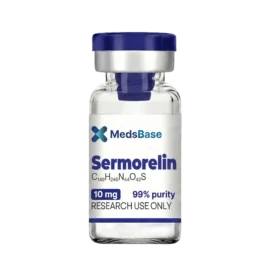
- Sermorelin — GHRH 1-29 analogue — pituitary endogenous-HGH studies
- MOTS-c — Mitochondrial-derived metabolic peptide — alternative-mechanism fat-loss studies
- Agua BAC (Agua Bacteriostática) — Necesaria para reconstituir cualquier vial liofilizado — diluyente estéril conservado con alcohol bencílico al 0.9%
Más opciones en Péptidos
Clasificados por volumen de pedidos reciente en MedsBase — lo que otros clientes están eligiendo en esta categoría.
| Potencia | 2 mg, 5 mg, 10 mg |
|---|---|
| Cantidad | 10 Viales, 20 Viales, 30 Viales |
 AOD-9604 (Fármaco Antiobesidad 9604 / Tyr-hGH 177-191)
Preguntas y respuestas
AOD-9604 (Fármaco Antiobesidad 9604 / Tyr-hGH 177-191)
Productos relacionados
Reseñas
Aún no hay reseñas