







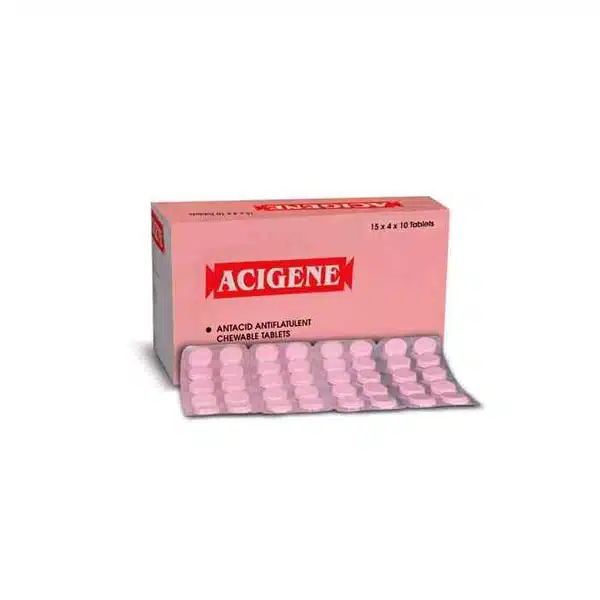
Acigene
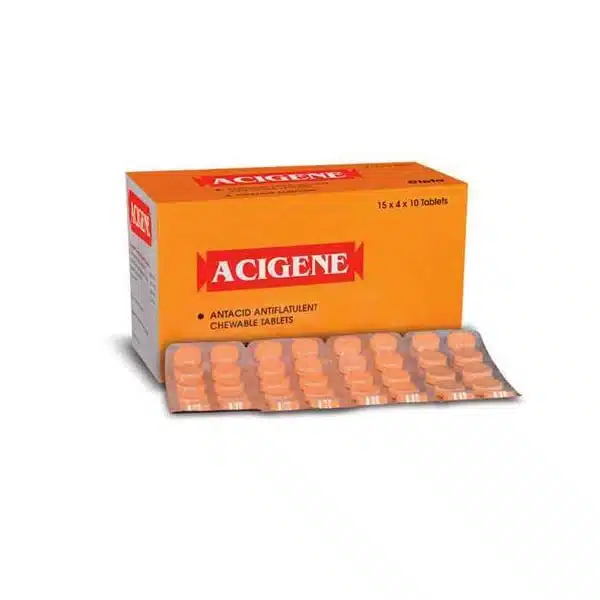
✅ Verlicht symptomen van zuurbranden
✅ Neutraliseert overtollig maagzuur
✅ Beheert symptomen van indigestie
✅ Verbetert de spijsvertering
Acigene bevat een mix van ingrediënten.
✓ Medisch beoordeeld door Morgan Ellis — Apotheekonderzoeker · 8 jaar ervaring · Laatst beoordeeld: mei 2026
⚡ Snel antwoord — Wat is Acigene?
Acigene is een kauwbaar antacidum dat combineert aluminiumhydroxide + magnesiumhydroxide + simeticon + magnesiumaluminiumsiliciaat, gemaakt door Cipla. Het wordt geleverd als kauwtabletten met munt- of sinaasappelsmaak en werkt door direct maagzuur te neutraliseren dat al is afgescheiden (chemische neutralisatie van HCl), fysiek te coaten het maag- en slokdarmslijmvlies (Mg-Al-silicaatklei), en het verminderen van intragastrisch gas (simeticon ontschuimt ingesloten gasbellen). Het effect treedt binnen enkele minuten op — sneller dan elk voorschriftzuurmedicijn. De werkingsduur is kort (30–60 minuten), dus antacida zijn het beste voor incidentele of doorbraaksymptomen in plaats van als vervanging voor een PPI of H2 antagonist bij chronische aandoeningen. Standaard dosering voor volwassenen: 1–2 kauwtabletten tot vier keer per dag na de maaltijden en voor het slapengaan, indien nodig. Minimaal 2 uur scheiden van andere orale medicijnen (het antacidum bindt veel medicijnen en vermindert hun opname). Vermijd langdurig dagelijks gebruik bij chronische nierziekte.
📦 Elke bestelling is gedekt door onze Reshipment Assurance-beleid — als uw pakket niet binnen 20 werkdagen arriveert, sturen wij het opnieuw.
Waarom bestellen bij MedsBase
Onze generieke medicijnen zijn afkomstig van WHO-GMP gecertificeerde fabrikanten en worden wereldwijd verzonden in discrete, eenvoudige verpakkingen — geen medicijnnaam op de buitenkant van het pakket. Betalingen met kaart worden verwerkt via een gereguleerde processor (betalingsoverzichten vermelden een gereguleerde kaartbetalingprocessor — nooit “MedsBase” of een medicijnnaam). Crypto en SEPA bankoverschrijvingen worden ook geaccepteerd. Elke bestelling wordt ondersteund door ons Reshipment Assurance Policy.
Wat Acigene Is
Acigene is een kauwtablet van Cipla (munt- of sinaasappelsmaak) dat vier functionele ingrediënten combineert in één tablet:
- Aluminiumhydroxide — een alkalisch zout dat maagzuur (HCl) neutraliseert, met een licht stoppend effect
- Magnesiumhydroxide — een sneller werkend alkalisch zout met een licht laxerend effect — compenseert het stoppende effect van aluminium zodat het ontlastingspatroon ongewijzigd blijft
- Simeticon — een inert siliconenpolymeer dat ingesloten gasbellen in de darmen ontschuimt, waardoor een opgeblazen gevoel en winderigheid verminderen
- Magnesiumaluminiumsilicaat — een kleiachtig mineraal dat fysiek een beschermend laagje vormt op het maag- en slokdarmslijmvlies
De combinatie is ontworpen om de drie componenten van zuurgerelateerde indigestieklachten in één tablet aan te pakken: te veel zuur, te veel gas en onvoldoende bescherming van het slijmvlies.
Hoe Acigene werkt
Het mechanisme is puur chemisch en fysiek, niet farmacologisch in de zin van receptor-binding:
- Neutralisatie: Al(OH)3 + 3 HCl → AlCl3 + 3 H2O. Mg(OH)2 + 2 HCl → MgCl2 + 2 H2O. Elk molecuul antacidum neutraliseert 2–3 moleculen maagzuur; de buffer capaciteit van één kauwtablet ligt in het bereik van 10–15 mEq HCl.
- Fysieke coating: Magnesium aluminium silicaat is een klei-achtig mineraal dat opzwelt in water om een viskeuze gel te vormen. Wanneer de tablet wordt gekauwd en doorgeslikt, bedekt de gel de slokdarm en maagwand, wat een tijdelijke mechanische barrière biedt.
- Ontschuimen: Simeticon verlaagt de oppervlaktespanning van kleine gasbelletjes in de darm, waardoor ze samen kunnen smelten tot grotere bellen die worden uitgestoten. Dit verlicht een opgeblazen gevoel en winderigheid.
Het effect treedt op binnen 5–15 minuten — magnesiumhydroxide werkt binnen enkele minuten; aluminiumhydroxide is langzamer maar houdt langer aan. De totale werkingsduur is 30–60 minuten, soms tot 90 minuten indien ingenomen na voedsel (voedsel in de maag verlengt het effect). Het middel heeft geen invloed op de toekomstige zuurproductie, daarom zijn antacida het meest geschikt voor incidentele of doorbraaksymptomen in plaats van als langdurige therapie voor chronische GERD.
Indicaties — Waarvoor Acigene wordt gebruikt
1. Incidentele maagzuur en zuuroprispingen
De klassieke indicatie voor een antacidum. Effectief en snel voor maagzuur na de maaltijd, vooral na het eten van een bekend triggerfood. Antacida zijn niet geschikt voor dagelijks langdurig gebruik — voor dat soort symptomen is een H2-antagonist of PPI meer geschikt.2 2. Doorbraaksymptomen tijdens PPI of H2-antagonistgebruik.
2. Doorbraaksymptomen tijdens PPI of H2-antagonisttherapie
Terwijl een PPI 3–5 dagen nodig heeft om volledig effect te hebben, vult een antacidum deze periode over. Bij chronische zuurremming is een antacidum nuttig voor incidentele doorbraakklachten.
3. Functionele dyspepsie — maaltijdgerelateerd ongemak
Voor maaltijdgerelateerd ongemak, een opgeblazen gevoel en postprandiale volheid, pakt de simethiconcomponent in combinatie met de mucosale coating de symptomen effectiever aan dan een puur neutraliserend antacidum.
4. Zwangerschapsreflux (na leefstijlmaatregelen)
Antacida zijn de eerste keus bij zwangerschapsbrandend maagzuur na leefstijlmaatregelen (hoofdeinde van het bed verhogen, kleinere maaltijden, late maaltijden vermijden). Vermijd natriumbicarbonaat-antacida tijdens de zwangerschap (teveel natrium); aluminium-magnesiumcombinaties zoals Acigene hebben de voorkeur.
De simethiconcomponent is effectief voor symptomatische verlichting van een opgeblazen gevoel en winderigheid door ingeslikte lucht of gasvormend voedsel.
Het simethicon-component is effectief voor de symptomatische verlichting van een opgeblazen gevoel en winderigheid als gevolg van ingeslikte lucht of gasvormende voedingsmiddelen.
Dosering
| Patiënt | Dosering | Opmerkingen |
|---|---|---|
| Volwassenen — standaarddosering | 1–2 kauwtabletten, goed gekauwd, tot vier keer per dag na de maaltijd en voor het slapengaan indien nodig | korte kuren (1–2 weken) |
| Maximale dagelijkse dosis | Over het algemeen 8 tabletten in 24 uur | niet overschrijden zonder medisch advies |
| Duur zonder medische beoordeling | Tot 2 weken regelmatig gebruik | aanhoudende symptomen moeten worden onderzocht |
| Kinderen van 6–12 jaar | Halve volwassen dosis, onder pediatrisch toezicht | korte kuren alleen |
| Kinderen < 6 jaar | Vermijden — alleen op advies van specialist | zorgen over aluminium |
| Nierfunctiestoornis (CrCl < 30 ml/min) | Vermijd langdurig dagelijks gebruik — ophoping van aluminium en magnesium | gebruik calciumcarbonaat als alternatief |
| Zwangerschap | Standaard dosis voor volwassenen | korte kuren; vermijd natriumbicarbonaat-alternatieven |
Kauw de tablet goed — niet heel doorslikken. Het innemen met een kleine hoeveelheid water na het kauwen helpt het magnesium-aluminiumsilicaatcoatingcomponent de slokdarm te bereiken. Het beste in te nemen na de maaltijd en voor het slapengaan, wanneer reflux het meest waarschijnlijk is.
CRITICAL: Medicijntimingregel
Bijwerkingen
Vaak (1–5%):
- Milde diarree (door magnesium) of obstipatie (door aluminium) — de combinatie is meestal in evenwicht, maar de stoelgangpatroon kan verschuiven
- Boeren of een opgeblazen gevoel door neutralisatie (CO2 -vorming in sommige formuleringen — minder met hydroxide-gebaseerde producten)
- Krijtachtige smaak; droge mond
Zeldzaam maar belangrijk bij langdurig gebruik:
- Aluminiumophoping bij chronische nierziekte — encefalopathie, osteomalacie, microcytaire anemie. Vermijd langdurig dagelijks gebruik bij CKD.
- Magnesiumophoping bij nierfunctiestoornis — hypermagnesiëmie die zich uit als spierzwakte, lethargie, bradycardie, hypotensie.
- Fosfaatdepletie — aluminium bindt voedingsfosfaat; langdurig dagelijks gebruik kan hypofosfatemie veroorzaken, vooral bij patiënten met een slecht dieet.
- Zuurrebound — zeer hoge doses antacidum stimuleren tijdelijk de gastrine-afscheiding, met een milde rebound zuurproductie 1–3 uur later. Klinisch niet relevant bij standaarddoseringen.
Contra-indicaties en voorzorgsmaatregelen
- Bekende overgevoeligheid voor een bestanddeel
- Ernstige chronische nierziekte (CKD stadium 4–5) en dialyse — vermijd langdurig gebruik
- Ernstige hypofosfatemie
- Kinderen < 6 jaar — alleen op advies van een specialist
- Zuurgerelateerde symptomen met alarmsignalen (gewichtsverlies, dysfagie, GI-bloeding, anemie, leeftijd > 55 met nieuwe symptomen) — vereisen onderzoek, geen chronische zelfbehandeling met antacidum
Zwangerschap, Borstvoeding en Kinderen
Zwangerschap: Aluminium-magnesiumhydroxide antacida worden over het algemeen als veilig beschouwd tijdens de zwangerschap en hebben de voorkeur boven natriumbicarbonaat (overtollig natrium). Nuttig voor zwangerschapsbrandend maagzuur na leefstijlmaatregelen.
Borstvoeding: Compatibel — minimale absorptie, geen waargenomen effecten op de zuigeling.
Kinderen: Vermijd bij kinderen < 6 jaar zonder kinderartsbegeleiding vanwege zorgen over aluminium. Halve volwassen dosis voor 6–12 jaar, alleen korte kuren.
Opslag
Bewaren bij 15–30 °C in de originele blisterverpakking of fles, beschermd tegen licht en vocht. Buiten bereik van kinderen houden — de kauwbare vorm lijkt op snoep maar bevat aluminium en magnesium. Niet gebruiken na de vervaldatum.
Veelgestelde vragen
Wanneer begint Acigene te werken?
Binnen 5–15 minuten — sneller dan elk voorgeschreven zuurremmend medicijn. Het magnesiumhydroxide werkt binnen enkele minuten; het aluminiumhydroxide werkt langzamer maar het effect is meer aanhoudend.
Hoe lang werkt elke dosis?
30–60 minuten op een lege maag; tot 90 minuten als het na een maaltijd wordt ingenomen (voedsel in de maag verlengt het effect). Voor symptomen die meerdere keren per dag of elke dag terugkeren, biedt een PPI of H2 antagonist langduriger en diepere zuurremming en is geschikter dan herhaalde inname van antacida.
Kan ik Acigene met mijn PPI innemen?
Ja — antacida zijn nuttig terwijl PPI's 3–5 dagen nodig hebben om volledig effect te hebben, en als noodoplossing voor incidentele doorbraakepisodes tijdens chronisch PPI-gebruik. Neem het antacidum minstens 1–2 uur verwijderd van de PPI-dosis zodat het de PPI-opname niet verstoort.
Waarom moet ik het gescheiden houden van andere medicijnen?
Antacida binden verschillende medicijnen in de darm en verhogen de lokale pH, wat de opname vermindert. Belangrijke voorbeelden: levothyroxine (schildkliervervanging), tetracyclines en fluoroquinolonen (antibiotica), ketoconazol (antischimmel), oraal ijzer, bisfosfonaten (osteoporose), digoxine, fenytoïne en HIV-antivirale middelen. Neem al deze minstens 2 uur voor, of 4 uur na Acigene in.
Is Acigene veilig tijdens zwangerschap?
Ja — aluminium-magnesiumhydroxide antacida worden over het algemeen als veilig beschouwd tijdens zwangerschap. Ze hebben de voorkeur boven natriumbicarbonaat antacida omdat de laatste een aanzienlijke natriumlast toevoegen. Voor incidentele zwangerschapsbrandend maagzuur dat niet reageert op hoofdeinde verhoging en kleine frequente maaltijden, is Acigene een redelijke eerste keuze.
Waarom bevat de tablet simethicon?
Simethicon is een inerte silicone-ontschuimer die de oppervlaktespanning van kleine gasbellen in de darm vermindert, waardoor ze kunnen samensmelten en passeren. Het behandelt het opgeblazen gevoel en winderigheid bij indigestie, wat pure neutraliserende antacida niet aanpakken.
Waarom bevat de tablet magnesiumaluminiumsilicaat?
Magnesiumaluminiumsilicaat is een kleiachtig mineraal dat in water zwelt tot een gel. Terwijl de gekauwde tablet door de slokdarm en maag gaat, vormt de gel een laagje op het slijmvlies, wat een tijdelijke mechanische barrière biedt. Dit voegt mucosale bescherming toe bovenop de chemische neutralisatie door de hydroxidezouten.
Waarom is het niet bedoeld voor dagelijks langdurig gebruik?
Twee redenen. Ten eerste hopen aluminium en magnesium zich op bij patiënten met verminderde nierfunctie over weken tot maanden — aluminium veroorzaakt encefalopathie en botziekte; magnesium veroorzaakt spierzwakte en bradycardie. Ten tweede is dagelijks langdurig gebruik van maagzuurremmers een teken van chronische zuurgerelateerde ziekte die geëvalueerd en behandeld moet worden met een H2 antagonist of PPI in plaats van te maskeren met herhaalde doseringen. Beperk Acigene tot 2 weken regelmatig gebruik zonder medische beoordeling.
Kan ik het gebruiken voor een maagzweer?
Maagzuurremmers verlichten zweerpijn symptomatisch maar genezen zweren niet en roeien niet uit H. pylori (de onderliggende oorzaak van de meeste niet-NSAID-zweren). Definitieve zweerbehandeling vereist PPI ± antibioticum-eradicatieregime. Gebruik Acigene alleen als kortdurende symptoomverlichting tijdens het wachten op medische beoordeling.
Kunnen kinderen Acigene gebruiken?
Kinderen van 6–12 jaar kunnen de helft van de volwassen dosis gebruiken onder pediatrisch toezicht voor korte kuren. Vermijd bij kinderen onder de 6 vanwege zorgen over aluminium en omdat alarmsymptomen bij jonge kinderen altijd een diagnose vereisen in plaats van empirische behandeling.
Wat als ik een nieraandoening heb?
Vermijd langdurig of dagelijks gebruik. De aluminium- en magnesiumbelasting die gezonde nieren gemakkelijk klaren, kan zich ophopen bij chronische nierziekte (CKD stadia 4–5 en bij dialyse), wat aluminiumgerelateerde encefalopathie en hypermagnesiëmie veroorzaakt. Calciumcarbonaat antacida zijn een veiliger alternatief bij CKD — overleg met uw nefroloog.
Andere maagzuurremmers bij MedsBase
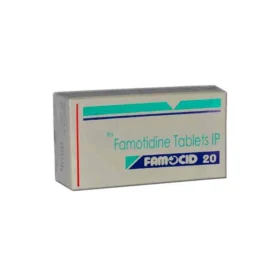
- Famocid — famotidine 20/40 mg — H2-antagonist; het veilige moderne alternatief voor ranitidine; nuttig voor nachtelijke zuurdoorbraak
- Omez — omeprazol 10/40 mg — breed sterktebereik; lagere 10 mg dosis nuttig voor afbouw
- Pantodac — pantoprazol 40 mg — standaard eenmaal daagse PPI; minimale CYP-impact
- Esoprol — esomeprazol 20/40 mg — S-isomeer van omeprazol; ~30% AUC-voordeel met minder interindividuele variabiliteit
- Macralfaat Suspensie — sucralfaat 1 g per 10 mL suspensie — lokaal werkend mucosabeschermend middel voor zweergenezing; combineer met PPI bij refractaire aandoeningen
Meer opties in de behandeling van maagzuurreflux
Gerangschikt op recente bestelvolumes van MedsBase — wat andere klanten in deze categorie kiezen.

| Hoeveelheid | 30 Tablet/s, 60 Tablet/s, 90 Tablet/s |
|---|---|
| Type | Munt, Sinaasappel |
| Farmaceutische vorm | Tablet/s |
| Fabrikant | Cipla Inc |
| Behandeling | Maagzuurremmer |
| Generiek merk | Niet |
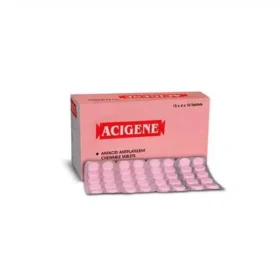 Acigene
Vragen & antwoorden
Acigene
Gerelateerde producten
Beoordelingen
Er zijn nog geen beoordelingen