







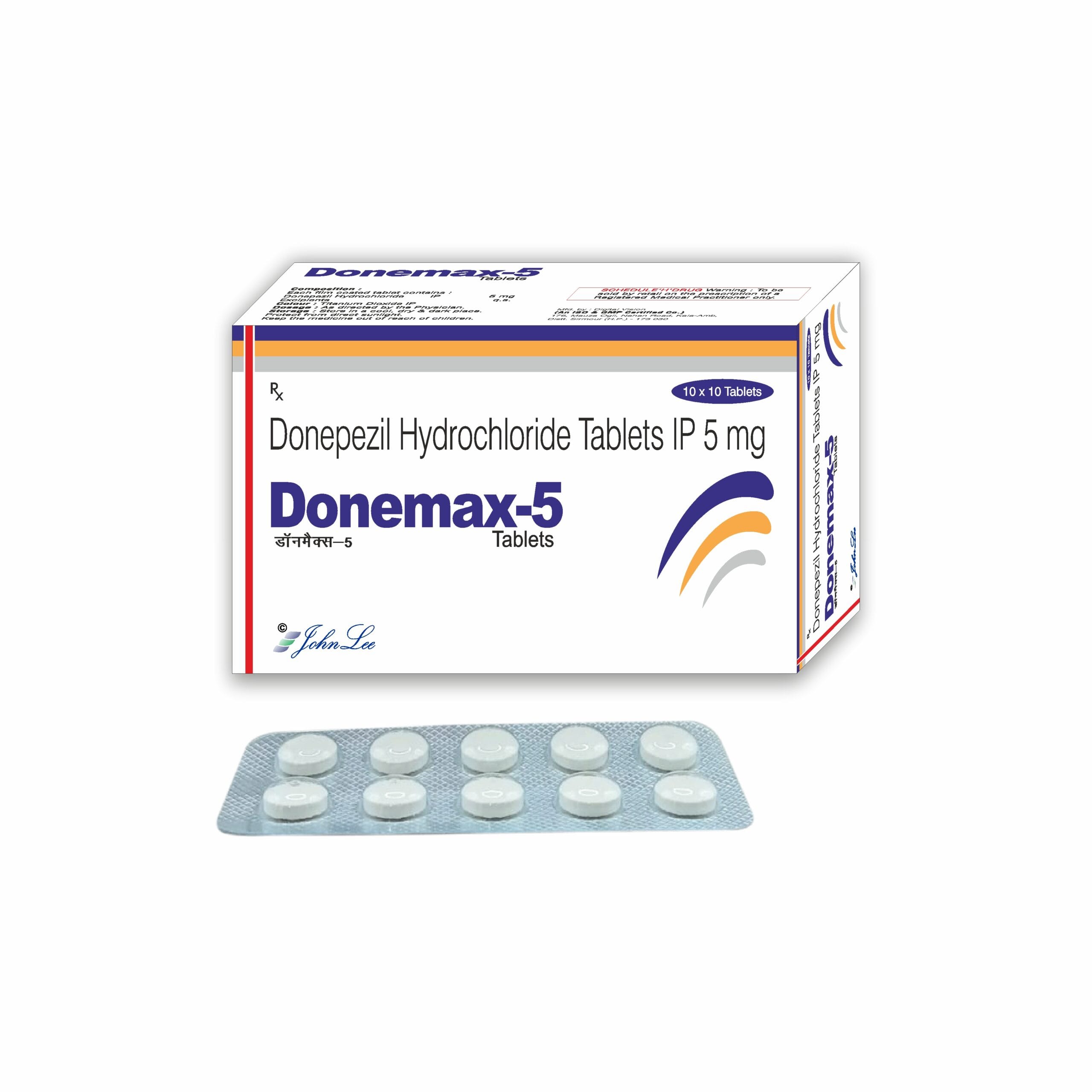
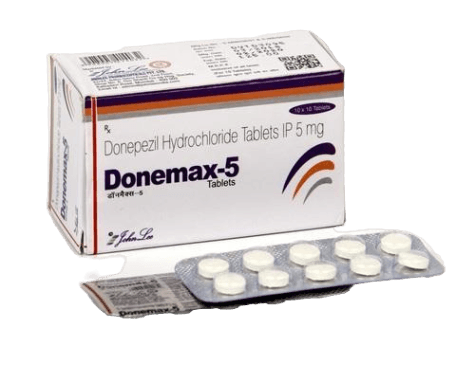
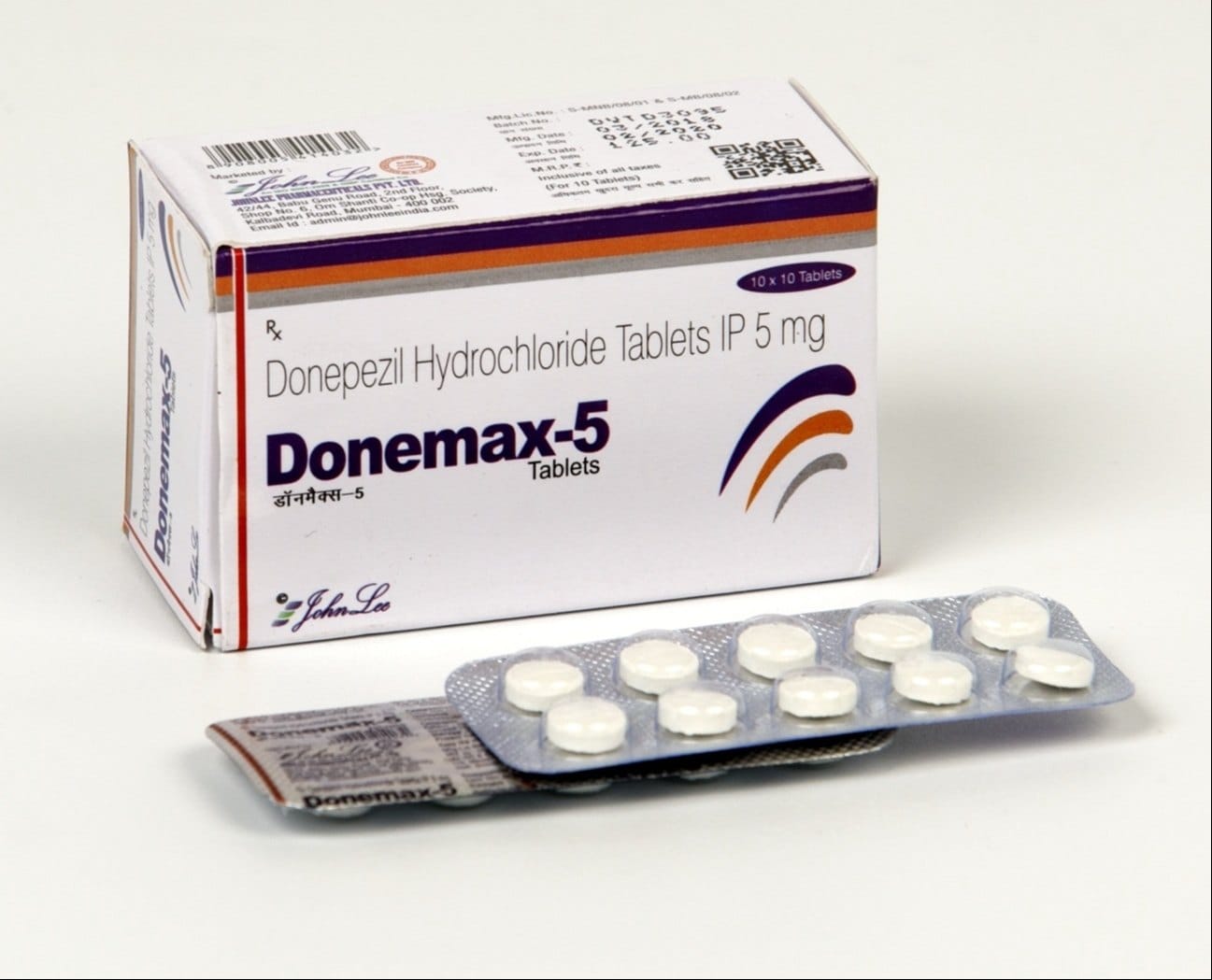
Donemax
✅ Verbetert de geheugenfunctie
✅ Beheert symptomen van Alzheimer
✅ Cognitieve verbetering
✅ Eenmaal daagse dosering
✅ Voorgeschreven door neurologen
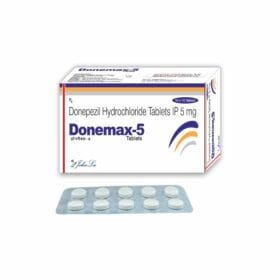
Donemax bevat Donepezil.
✓ Medisch beoordeeld door Morgan Ellis — Apotheekonderzoeker · 8 jaar ervaring · Laatst beoordeeld: mei 2026
⚡ Snelle vraag — Wat is Donemax?
Donemax is een orale tablet van Sun Pharma die bevat donepezil — een omkeerbare acetylcholinesterase (AChE)-remmer gebruikt voor de symptomatische behandeling van milde, matige en ernstige ziekte van Alzheimer. Beschikbaar bij 10 mg. Standaard onderhoudsdosis voor matige tot ernstige Alzheimer. Begin altijd met 5 mg/dag gedurende de eerste 4–6 weken voordat u de dosis verhoogt. Donepezil doet de ziekteprogressie niet — het verbetert cognitieve symptomen (geheugen, aandacht, dagelijkse functie) gedurende de behandeling. Meest voorkomende bijwerkingen zijn maag-darmklachten (misselijkheid, diarree, anorexia), levendige dromen en bradycardie. Nooit abrupt stoppen — stoppen kan leiden tot een snelle cognitieve achteruitgang die niet altijd herstelt bij herstarten.
📦 Elke bestelling is gedekt door onze Reshipment Assurance-beleid — als uw pakket niet binnen 20 werkdagen arriveert, sturen wij het opnieuw.
Waarom bestellen bij MedsBase
Onze generieke medicijnen zijn afkomstig van WHO-GMP gecertificeerde fabrikanten en worden wereldwijd verzonden in discrete, eenvoudige verpakkingen — geen medicijnnaam op de buitenkant van het pakket. Betalingen met kaart worden verwerkt via een gereguleerde processor (betalingsoverzichten vermelden een gereguleerde kaartbetalingprocessor — nooit “MedsBase” of een medicijnnaam). Crypto en SEPA bankoverschrijvingen worden ook geaccepteerd. Elke bestelling wordt ondersteund door ons Reshipment Assurance Policy.
Wat is Donemax?
Donemax is een orale tablet van Sun Pharma die bevat donepezilhydrochloride. Donepezil is een langwerkende, selectieve, reversibele remmer van acetylcholinesterase — het enzym dat acetylcholine in de hersenen afbreekt. Door dat enzym te blokkeren, verhoogt donepezil de synaptische acetylcholinegehalten en compenseert het gedeeltelijk het verlies van cholinerge neuronen dat geheugen- en aandachtssymptomen bij de ziekte van Alzheimer veroorzaakt.
Donemax is een budgetvriendelijke 10 mg donepezil tablet van Sun Pharma — de standaard onderhoudsdosis voor matige tot ernstige Alzheimer. Begin met een 5 mg titratiedosis gedurende de eerste 4–6 weken voordat u overstapt op Donemax 10 mg. Donepezil is het meest voorgeschreven Alzheimer-medicijn wereldwijd en de enige AChE-remmer die is goedgekeurd voor het volledige ernstspectrum (mild, matig en ernstige ziekte). Het is symptomatische therapie — het vertraagt de onderliggende neurodegeneratie niet, maar het leidt tot meetbare verbeteringen in geheugen, aandacht, dagelijkse functie en gedrag gedurende de behandelingsduur, wat typisch 6–12 maanden extra cognitieve functie oplevert in vergelijking met geen behandeling.
Hoe werkt Donemax?
De ziekte van Alzheimer wordt gekenmerkt door progressief verlies van cholinerge neuronen in de basale voorhersenen (de nucleus basalis van Meynert) — wat leidt tot een aanzienlijk tekort aan acetylcholine in de cortex en hippocampus. Dit cholinerge tekort verklaart veel van de cognitieve, aandacht- en geheugensymptomen.
- Acetylcholinesterase-remming — donepezil blokkeert reversibel het enzym dat synaptische acetylcholine afbreekt, waardoor de ACh-niveaus bij de resterende cholinerge synapsen toenemen.
- Corticale en hippocampale selectiviteit — donepezil bindt bij voorkeur aan hersen-AChE in plaats van perifere cholinesterase, wat het een schoner bijwerkingenprofiel geeft dan oudere middelen zoals fysostigmine.
- Lange halfwaardetijd (~70 uur) — maakt eenmaal daagse dosering mogelijk en zorgt voor een stabiele steady-state ACh-verhoging, die goed wordt verdragen.
Begin van cognitief voordeel: zichtbaar bij en de vruchtbaarheid binnen een vergelijkbaar tijdsbestek. Tumorkrimp (bij macroprolactinomen) is zichtbaar op MRI binnen; piek na 6 maanden. Het voordeel wordt gehandhaafd zolang het medicijn wordt ingenomen — eenmaal gestopt, keert de cognitieve functie terug naar (of onder) het niveau dat het zonder behandeling zou zijn geweest, vaak binnen enkele weken.
Toepassingen en Indicaties
- Milde dementie bij Alzheimer — eerstekeuzecholinesteraseremmer
- Matige dementie bij de ziekte van Alzheimer — eerstelijns, vaak gecombineerd met memantine
- Ernstige dementie bij de ziekte van Alzheimer — donepezil is een van de weinige cholinesteraseremmers die in dit stadium zijn goedgekeurd; meestal gecombineerd met memantine
- Dementie met Lewy-lichaampjes — off-label, vaak de meest cholinerge-responsieve van de dementieën
- Dementie bij de ziekte van Parkinson — off-label (rivastigmine heeft de goedgekeurde indicatie)
- Vasculaire dementie (gemengd type) — off-label bescheiden voordeel
Donemax is niet een ziekte-modificerende therapie en is niet effectief voor: milde cognitieve stoornissen zonder dementie, frontotemporale dementie (verergert vaak gedragssymptomen), normale leeftijdsgebonden vergeetachtigheid, of als cognitieve booster bij gezonde volwassenen.
Donemax dosering en hoe in te nemen
Donemax is verkrijgbaar in 10 mg. Standaard volwassen protocol:
- Startdosis: 5 mg eenmaal daags gedurende de eerste 4–6 weken. Dit is verplicht — beginnen met 10 mg veroorzaakt bij de meeste patiënten onverdraaglijke GI-bijwerkingen.
- Onderhoudsdosis: 10 mg eenmaal daags na 4–6 weken indien verdragen.
- Ernstige Alzheimer: 10 mg eenmaal daags; sommige patiënten hebben baat bij formuleringen van 23 mg/dag (hier niet op voorraad — specialistische voorschrijving).
Hoe Donemax correct in te nemen
- 's Avonds innemen, bij voorkeur vlak voor het slapen gaan. Donepezil heeft een halfwaardetijd van 70 uur, wat betekent dat het tijdstip van inname minimale invloed heeft op de steady-state spiegels, maar avonddosering zorgt ervoor dat de piek van cholinerge bijwerkingen (lichte duizeligheid, misselijkheid) tijdens de slaap optreedt.
- Als levendige dromen of slapeloosheid optreden, schakel over naar ochtenddosering — dit is een bekend probleem en de tijdsverandering lost het meestal binnen een week op.
- Met of zonder voedsel — voedsel verandert de opname van donepezil niet.
- Slik de tablet heel door met water. Standaard tabletten kunnen worden gesplitst als ze een breuklijn hebben.
- Eenmaal daags op hetzelfde tijdstip. Als een dosis wordt vergeten en dezelfde dag wordt herinnerd, neem deze dan alsnog in. Als het de volgende dag wordt herinnerd, sla deze dan over en hervat het normale schema — neem geen dubbele dosis.
- Niet abrupt stoppen. Plotselinge stopzetting kan een snelle verslechtering van de cognitie veroorzaken die niet altijd herstelt wanneer de behandeling wordt hervat. Als de behandeling moet worden gestopt, doe dit dan geleidelijk onder medisch toezicht.
- Toezicht door een verzorger is cruciaal. Patiënten met Alzheimer vergeten vaak of ze hun dosis hebben ingenomen — gebruik een weekpillenorganizer die door een familielid of verzorger wordt gevuld.
- Herbeoordelen na 6 maanden. Cognitieve tests (MMSE of MoCA) moeten uitwijzen of de behandeling helpt. Ga door als er voordeel is; heroverweeg als de cognitie sterk is verslechterd ondanks de behandeling.
Bijwerkingen van Donemax
Vaak voorkomend (het ergst in de eerste 2–4 weken, meestal stabiliserend):
- Misselijkheid, diarree, braken
- Anorexia en gewichtsverlies (5–10% van het lichaamsgewicht bij sommige patiënten)
- Levendige dromen of nachtmerries
- Slapeloosheid (komt vaker voor bij avonddosering)
- Duizeligheid, hoofdpijn
- Spierkrampen
- Vermoeidheid
Minder vaak maar belangrijk:
- Bradycardie en syncope — het vagotonische effect van donepezil kan de hartslag vertragen en flauwvallen veroorzaken, vooral bij patiënten met sick sinus-syndroom of AV-blok
- Urine-incontinentie (paradoxaal, door verhoogde cholinerge tonus)
- Verergering van astma of COPD
- Maag-darmbloedingen (vooral in combinatie met NSAID's of anticoagulantia)
Zeldzaam maar zoek onmiddellijk medische hulp:
- Ernstige bradycardie, totaal AV-blok, syncope
- Toevallen (zeldzaam)
- Ernstig braken met slokdarmruptuur (zeer zeldzaam)
- Syndroom van Stevens-Johnson (gevalsbeschrijvingen)
- Maligne neurolepticasyndroom (met name in combinatie met antipsychotica)
Waarschuwingen en voorzorgsmaatregelen
- Cardiaal: donepezil vertraagt de hartslag. Voorzichtigheid geboden bij patiënten met sick-sinussyndroom, tweede- of derdegraads AV-blok of onverklaarde syncope. Basis-ECG voor aanvang bij cardiale voorgeschiedenis.
- Maagzweer en voorgeschiedenis van maag-darmbloedingen: donepezil verhoogt de maagzuursecretie. Co-prescriptie van een PPI is redelijk bij hoogrisicopatiënten.
- Astma en COPD: Verhoogde cholinerge tonus kan bronchoconstrictie verergeren. Voorzichtigheid bij slecht gecontroleerde aandoening.
- Anesthesie: Informeer de anesthesist over donepezil vóór een operatie. Donepezil verlengt de werking van succinylcholine en andere depolariserende spierverslappers.
- Urineretentie (BPH): verhoogde detrusor-tonus kan leiden tot urgentie of retentie.
- Epilepsie in de voorgeschiedenis: Voorzichtig gebruiken - cholinerge activering verlaagt theoretisch de aanvalsdrempel.
- Nier- of leverfunctiestoornis: Geen dosisaanpassing nodig bij milde tot matige beperking; voorzichtigheid bij ernstige beperking.
- Ondersteuning door mantelzorgers: Patiënten met Alzheimer kunnen hun medicatie zelden veilig zelf beheren. Betrokkenheid van verzorgers bij doseringsvoorbereiding, toezicht en therapietrouw is essentieel.
Contra-indicaties — Wie mag Donemax NIET gebruiken?
- Bekende overgevoeligheid voor donepezil, piperidine-derivaten of een hulpstof in de tablet
- Ernstige leverfunctiestoornis (Child-Pugh C)
- Actieve maagzweer (tot genezing)
- Ernstige symptomatische bradycardie, sick sinus-syndroom, tweede- of derdegraads AV-blok (zonder pacemaker)
- Ernstige ongecontroleerde astma of COPD
- Recente onverklaarde syncope
Geneesmiddelinteracties
| Combineren met | Effect | Wat te doen |
|---|---|---|
| Anticholinergica (oxybutynine, tolterodine, hyoscyamine, amitriptyline, difenhydramine, scopolamine) | Werken rechtstreeks tegen het werkingsmechanisme van donepezil — behandeling faalt | Vermijd combinatie. Schakel over op mirabegron voor incontinentie; beoordeel elk anticholinergicum in het regime. |
| Bètablokkers, calciumantagonisten (verapamil, diltiazem), digoxine | Verhoogd risico op bradycardie en AV-blok | Controleer hartslag en ECG; overweeg dosisverlaging of alternatief. |
| Succinylcholine en andere depolariserende neuromusculaire blokkers (anesthesie) | Aanzienlijk verlengde paralyse | Informeer de anesthesist over donepezil. Overweeg een niet-depolariserend alternatief. |
| NSAID's (ibuprofen, naproxen, diclofenac) | Cumulatie van GI-bloedingrisico | Vermijd indien mogelijk; indien nodig, schrijf een PPI voor. |
| Sterke CYP3A4-remmers (ketoconazol, ritonavir, clarithromycine) | Verhoogt de donepezilspiegel — meer bijwerkingen | Let op misselijkheid/duizeligheid; overweeg dosisverlaging. |
| Sterke CYP3A4-induceerders (rifampicine, fenytoïne, carbamazepine, Sint-Janskruid) | Verlaagt de donepezilspiegel — behandeling faalt | Controleer cognitie; overweeg onder specialistische begeleiding dosisverhoging. |
| Antipsychotica (haloperidol, risperidon, olanzapine, quetiapine) | Verhoogd risico op maligne neuroleptisch syndroom en extrapiramidale effecten | Gebruik de laagst mogelijke dosis; vermijd bij dementie met Lewy-lichaampjes. |
| Memantine (combinatietherapie bij matig-ernstige Alzheimer) | Additioneel cognitief voordeel, geen significante farmacokinetische interactie | Standaardcombinatie — zie Admenta. |
Bewaaradvies
- Bewaren bij kamertemperatuur, 15–25°C. Beschermen tegen licht en vocht.
- Bewaar tabletten in de originele blisterverpakking tot gebruik.
- Bewaar niet in de badkamer — vocht verkort de houdbaarheid.
- Buiten bereik van kinderen en patiënten die mogelijk niet begrijpen dat het medicijnen zijn houden.
- Niet gebruiken na de vervaldatum die op de verpakking staat vermeld.
- Breng ongebruikte tabletten terug naar een apotheek voor vernietiging.
Gerelateerde alternatieven op MedsBase
Andere medicijnen tegen Alzheimer en dementie op voorraad bij MedsBase:
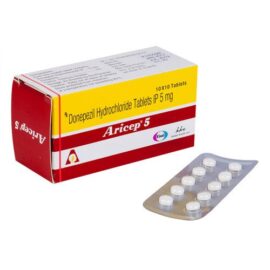
- Aricep (donepezil 5/10 mg)
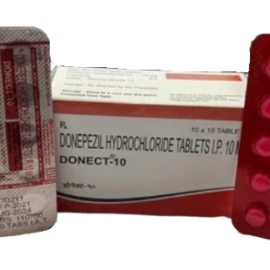
- Donect (donepezil 10 mg)
- Admenta (memantine 5 mg)
- Galamer (galantamine 4 mg)
- Rivamer (rivastigmine 1.5 mg)
Handige lectuur: Alles wat u moet weten over de ziekte van Alzheimer · Alles over dementie · 7 manieren om uw hersengezondheid te beschermen naarmate u ouder wordt · Beste voedingsmiddelen voor een gezond brein en beter geheugen.
Veelgestelde vragen
Wanneer zie ik of mijn familielid resultaten van Donemax?
Zichtbaar cognitief voordeel na en de vruchtbaarheid binnen een vergelijkbaar tijdsbestek. Tumorkrimp (bij macroprolactinomen) is zichtbaar op MRI binnen van consistente dosering; piekvoordeel na 6 maanden. Voordelen zijn onder andere betere aandacht, geheugenherinnering, vermogen om gesprekken te volgen en dagelijkse functie. Donepezil doet niet geen schade door Alzheimer omkeren — het stabiliseert de functie voor een periode van typisch 6–18 maanden. Herbeoordeel met formele cognitieve tests (MMSE of MoCA) na 6 maanden.
Stopt of vertraagt Donemax de progressie van Alzheimer?
Nee. Donepezil is symptomatische therapie, niet ziekte-modificerend. De onderliggende neurodegeneratie gaat in hetzelfde tempo door. Donepezil veroorzaakt een meetbare verbetering in cognitieve functie gedurende de behandeling; eenmaal gestopt, keert de cognitie terug naar (of onder) het onbehandelde traject. Nieuwere ziekte-modificerende medicijnen (anti-amyloïde antilichamen zoals lecanemab) richten zich op de onderliggende pathologie maar zijn hier niet op voorraad en vereisen specialistische infusie.
Waarom moet ik beginnen met 5 mg voordat ik naar 10 mg ga?
De titratieperiode van 4–6 weken is essentieel. Starten met 10 mg veroorzaakt bij de meeste patiënten ernstige misselijkheid, diarree en anorexia — zo erg dat ze stoppen met het medicijn. De startdosis van 5 mg laat het maag-darmkanaal wennen voordat de volledige dosis wordt gegeven. Het overslaan van de titratie is de meest voorkomende reden dat patiënten donepezil “niet kunnen verdragen”.
Wanneer moet ik Donemax innemen — 's ochtends of 's avonds?
Standaardadvies is 's avonds voor het slapengaan — dit zorgt ervoor dat de piek van cholinerge bijwerkingen (lichte duizeligheid, misselijkheid) tijdens de slaap optreedt. Als levendige dromen of slapeloosheid ontstaan (een bekende bijwerking bij avondinname), schakel dan over naar de ochtend. Beide innametijden geven hetzelfde cognitieve voordeel vanwege de halfwaardetijd van 70 uur van donepezil.
Kan ik stoppen met Donemax als het niet helpt?
Overleg eerst met de voorschrijver. Als formele cognitieve tests na 6 maanden geen verbetering laten zien en de patiënt duidelijk is achteruitgegaan, kan donepezil worden gestopt — maar altijd geleidelijk afbouwen, niet abrupt. Plotseling stoppen kan snel cognitief achteruitgaan veroorzaken (het “washout”-effect) dat niet altijd herstelt wanneer het opnieuw wordt gestart. Typisch afbouwschema: verlaag naar 5 mg gedurende 2–4 weken, stop dan.
Kan Donemax gecombineerd worden met memantine?
Ja — dit is de standaardcombinatie voor matig tot ernstige ziekte van Alzheimer. Donepezil en memantine werken via verschillende pathways (cholinerge + glutamaterge) en geven een additief cognitief voordeel zonder significante interactie. Admenta is het memantine merk hier op voorraad.
Waarom zijn maag-darm bijwerkingen zo vaak voorkomend?
Donepezil verhoogt acetylcholine door het hele lichaam, niet alleen in de hersenen. Een verhoogde cholinerge tonus in de darmen versnelt de beweeglijkheid (diarree), verhoogt de afscheidingen (misselijkheid) en vermindert de eetlust (anorexia). De meeste maag-darm bijwerkingen verdwijnen binnen 2–4 weken. Aanhoudende misselijkheid reageert goed op het innemen van de dosis met voedsel, overschakelen naar avonddosering of tijdelijk teruggaan naar 5 mg.
Hoe zit het met de anticholinerge medicijnen die ik al gebruik?
Dit is een van de meest voorkomende redenen waarom donepezil “niet werkt”. Veelvoorkomende anticholinergica die direct tegengesteld werken aan donepezil omvatten: oxybutynine en tolterodine (overactieve blaas), amitriptyline en nortriptyline (oudere antidepressiva), difenhydramine (Benadryl, slaapmiddelen) en hyoscyamine. Vraag uw arts om elk medicijn te beoordelen en waar mogelijk te vervangen — voor blaasymptomen is mirabegron een niet-anticholinerg alternatief.
Is Donemax veilig in combinatie met andere dementiemedicijnen die mijn ouder gebruikt?
Donepezil + memantine is de standaardcombinatie voor matig-ernstige Alzheimer. Donepezil + galantamine of donepezil + rivastigmine is niet aanbevolen — het combineren van twee cholinesteraseremmers verergert de maag-darm bijwerkingen zonder extra voordeel. Vertel elke arts dat de patiënt donepezil gebruikt; met name anesthesisten moeten dit weten voor een operatie.
Donemax vs galantamine vs rivastigmine — welke is geschikt?
Alle drie zijn AChE-remmers met vergelijkbare cognitieve voordelen, maar de bijwerkingsprofielen verschillen. Donepezil: eenmaal daags, beste maag-darm verdraagzaamheid, enige goedgekeurd voor ernstige Alzheimer. Galantamine: tweemaal daags, werkt ook als nicotinerge ACh-receptormodulator, iets hogere maag-darm belasting. Rivastigmine: tweemaal daags oraal of via transdermale pleister, enige AChE-remmer goedgekeurd voor dementie bij de ziekte van Parkinson, hoogste maag-darm belasting in orale vorm (de pleister vermindert dit). Donepezil is de standaard eerste keuze, tenzij de patiënt dementie bij Parkinson heeft.
Gerelateerde alternatieven
Andere producten in Chronische aandoeningen die klanten ook bekijken:
Meer opties in de behandeling van Alzheimer
Gerangschikt op recente bestelvolumes van MedsBase — wat andere klanten in deze categorie kiezen.

| Sterkte | 10 mg |
|---|---|
| Hoeveelheid | 30 Tabletten, 60 Tabletten, 90 Tabletten, 180 Tabletten |
 Donemax
Vragen & antwoorden
Donemax
Gerelateerde producten







Beoordelingen
Er zijn nog geen beoordelingen