







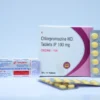
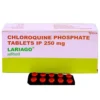
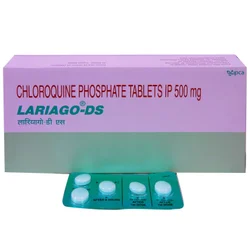
Lariago DS
✅ Behandelt ernstige malaria
✅ Effectief tegen resistente stammen
✅ Snelle verlichting van symptomen
✅ Voorkomt herhaling van malaria
✅ Verkort ziekenhuisopnames
Lariago DS bevat chloorquinefosfaat.
✓ Medisch beoordeeld door Morgan Ellis — Apotheekonderzoeker · 8 jaar ervaring · Laatst beoordeeld: mei 2026
Snelle antwoord
Lariago DS bevat chloorquinefosfaat 500 mg base-equivalent (Ipca Laboratories). Het behandelt chloroquine-gevoelige malaria veroorzaakt door P. falciparum, P. vivax, P. ovale, en P. malariae, en wordt ook gebruikt voor de preventie en behandeling van extra-intestinale amoebiasis. In de meeste moderne endemische gebieden komt wijdverspreide chloroquineresistentie voor (sub-Sahara Afrika, India, Zuidoost-Azië, Amazonebekken) — chloroquine is GEEN geschikt profylactisch middel voor deze bestemmingen. Acute behandelingsdosis: 1 g startdosis → 500 mg na 6/24/48 uur. Profylaxe (alleen in chloroquinegevoelige gebieden): 500 mg eenmaal per week, te beginnen 1–2 weken voor vertrek, voortgezet gedurende 4 weken na terugkeer. In te nemen met voedsel. Verplichte basislijn + jaarlijks oogheelkundig onderzoek na 5 jaar continu gebruik.
🛡️ Elke bestelling wordt gedekt door onze Reshipment Assurance-beleid — als uw pakket niet binnen 20 werkdagen arriveert, sturen wij een gratis vervanging via EMS of ITPS koerier.
Waarom bestellen bij MedsBase
Lariago DS wordt geleverd door een WHO-GMP-gecertificeerde fabrikant en wereldwijd discreet verpakt verzonden. Elke bestelling wordt gedekt door onze Reshipment Assurance-beleid en ondersteund door onze 1.400+ klantbeoordelingen. Wereldwijde verzending zonder receptpapieren.
Over Lariago DS
Lariago DS is een tablet met 500 mg chloorquinefosfaat, vervaardigd door Ipca Laboratories onder WHO-GMP-gecertificeerde omstandigheden. Chloorquine is een 4-aminoquinoline antimalariamiddel — voor het eerst gesynthetiseerd in 1934 en de hoeksteen van malaria-behandeling voor het grootste deel van de tweede helft van de 20e eeuw, voordat resistentie ontstond in P. falciparum tijdens de jaren 1960. Het blijft effectief in de weinige overgebleven chloorquine-gevoelige regio's en staat op de WHO-lijst van essentiële geneesmiddelen.
Hoe chlooroquine werkt
De malariaparasiet verteert gastheerhemoglobine in een zure voedselvacuole, waarbij vrij haem (giftig voor de parasiet) vrijkomt. Normaal gesproken polymeriseert de parasiet haem tot inert haemozoïn (malariapigment). Chlooroquine hoopt zich op in de voedselvacuole omdat het zwakke-base karakter het vasthoudt in zure compartimenten, waar het zich bindt aan vrij haem en polymerisatie voorkomt. Giftig vrij haem hoopt zich op en doodt de parasiet. Chlooroquineresistentie ontstaat door PfCRT (P. falciparum chlooroquine-resistentie transporter) mutaties die chlooroquine terugpompen uit de voedselvacuole.
De halfwaardetijd is 1–2 maanden — chlooroquine hoopt zich op in weefsel en wordt langzaam vrijgegeven. Daarom wordt profylaxe wekelijks gedoseerd en voortgezet gedurende 4 weken na blootstelling.
Indicaties en dosering
| Indicatie | Dosering (in mg base) | Opmerkingen |
|---|---|---|
| Chlooroquine-gevoelige malaria — acute behandeling, volwassenen | 1 000 mg base startdosis → 500 mg base na 6, 24 en 48 uur (totaal 2 500 mg base over 48 uur) | Voeg primaquine toe voor radicale genezing van P. vivax / P. ovale (na G6PD-test). |
| Profylaxe van chloroquinegevoelige malaria, volwassenen | 500 mg base eenmaal per week | Start 1–2 weken voor reis; ga wekelijks door tijdens blootstelling; ga 4 weken na terugkeer door. |
| Behandeling voor kinderen | 10 mg/kg base als startdosis → 5 mg/kg na 6, 24, 48 uur | Zelfde totaal over 48 uur. Tabletten kunnen worden fijngemaakt en met voedsel gemengd. |
| Profylaxe voor kinderen | 5 mg/kg base eenmaal per week (max 500 mg) | Zelfde start-/doorgaans-/stopschema als bij volwassenen. |
| Extra-intestinale amoebiasis (amoebenleverabces) | 1 g/dag gedurende 2 dagen, daarna 500 mg/dag gedurende 2–3 weken | Aanvulling op metronidazole. |
Bijwerkingen
- Vaak (5–15 %): misselijkheid, buikkrampen, hoofdpijn, duizeligheid, wazig zien (vroege reversibele accommodatie), jeuk (vooral bij donkere huidtypes — chloroquinepruritus is een kenmerkende bijwerking, soms onverdraaglijk).
- Minder vaak (1–5 %): haarverlichting, leigrijze huid-/slijmvliespigmentatie, lichtgevoeligheid, dyspepsie, levendige dromen, stemmingsverandering.
- Zeldzaam maar ernstig: retinopathie (langdurig, dosisafhankelijk), cardiomyopathie en QT-verlenging, myopathie, neuropathie, agranulocytose, ernstige cutane reacties, en bij hoge cumulatieve doses extrapiramidale effecten.
- Overdose is buitengewoon gevaarlijk — zelfs zo weinig als 5 g (10 tabletten) heeft fatale aritmie veroorzaakt bij volwassenen; één tablet heeft de dood veroorzaakt bij een klein kind. Buiten bereik van kinderen houden.
Geneesmiddelinteracties
| Interactie | Effect | Beheer |
|---|---|---|
| Digoxine | Chloroquine verhoogt het digoxineniveau | Controleer het digoxineniveau; verlaag de dosis indien nodig. |
| Cyclosporine | Chloroquine verhoogt het cyclosporineniveau | Controleer het cyclosporineniveau. |
| Antacida / kaoline | Vermindert de opname van chloroquine met ~ 30 % | Houd een interval van 4 uur aan. |
| Mefloquine | Additieve verlaging van de aanvalsdrempel + cardiale effecten | Vermijd combinatie — gebruik één antimalariamiddel. |
| QT-verlengende geneesmiddelen | Additieve QTc-verlenging | Vermijd bij structurele hartaandoeningen, elektrolytstoornissen of lang-QT-syndroom. |
| Ampicilline | Chloroquine vermindert de opname van ampicilline | Neem met 2 uur tussenpoos in. |
| Praziquantel | Chloroquine verlaagt het praziquantelgehalte | Vermijd combinatie tijdens behandeling van schistosomiasis. |
Contra-indicaties en waarschuwingen
- Absoluut: bekende overgevoeligheid voor 4-aminoquinolines; bestaande retinopathie.
- Voorzichtig: psoriasis (vaak ernstige opflakkering), porfyrie, ernstige maag-darmziekte, leverfunctiestoornis, neurologische aandoening (epilepsie), G6PD-deficiëntie, myasthenia gravis, ernstige hartaandoening (cardiomyopathie/geleidingsstoornissen).
- Zwangerschap: chloroquine wordt als veilig beschouwd bij standaard profylactische en behandelingsdoseringen; het absolute teratogene risico is laag en onbehandelde malaria tijdens de zwangerschap is veel gevaarlijker dan chloroquine.
- Borstvoeding: compatibel - wordt in kleine hoeveelheden die onvoldoende zijn voor zuigelingenprofylaxe via de moedermelk uitgescheiden.
Opslag
Bewaren onder 25 °C op een droge plaats, in de originele verpakking. Buiten bereik van kinderen houden — eenmalige overdosis met één tablet heeft bij kinderen fatale cardiotoxiciteit veroorzaakt.
Veelgestelde vragen
Is chloroquine nog steeds nuttig?
Ja — voor de weinige overgebleven gebieden waar chloroquine nog effectief is (delen van Midden-Amerika, Hispaniola, het Midden-Oosten), en voor amoebenleverabcessen als aanvulling. Voor Sub-Sahara Afrika, India, Zuidoost-Azië of het Amazonegebied is een ander middel nodig (mefloquine, doxycycline of atovaquone-proguanil).
Hoe weet ik of mijn bestemming chloroquine-gevoelig is?
Gebruik de land-specifieke aanbevelingen uit het CDC Yellow Book (link) of de Britse fitfortravel.nhs.uk. Resistentiekaarten worden jaarlijks bijgewerkt — vertrouw nooit op advies ouder dan 1–2 jaar.
Wat is chloroquine-pruritus?
Een idiosynkratische intense jeuk (handpalmen, voetzolen, hoofdhuid) die vooral voorkomt bij donkere huidtypes die chloroquine gebruiken. Het mechanisme is onduidelijk (waarschijnlijk gerelateerd aan mestcellen in plaats van allergisch). Sommige patiënten verdragen hydroxychloroquine beter.
Kunnen kinderen chloroquine gebruiken?
Ja — profylaxe voor kinderen is 5 mg/kg basisgewicht eenmaal per week (max 500 mg). Tabletten kunnen worden fijngemaakt en gemengd met voedsel/honing. Bewaar blisterverpakkingen buiten bereik — een overdosis van één tablet kan voor kinderen potentieel fataal zijn.
Is chloroquine veilig tijdens de zwangerschap?
Ja, bij standaarddoseringen. Onbehandelde malaria tijdens de zwangerschap brengt een veel hoger risico voor moeder en foetus met zich mee dan chloroquine.
Waarom is chloroquineresistentie ontstaan?
Mutaties in het PfCRT-gen (P. falciparum chloroquine-resistentie transporter) zorgen ervoor dat parasieten chloroquine terug kunnen pompen uit de voedselvacuole. De mutaties verspreidden zich wereldwijd vanuit Zuidoost-Azië en Zuid-Amerika vanaf de late jaren 1950. P. vivax heeft langzamer en onregelmatiger resistentie ontwikkeld.
Hoe verschilt chloroquine van hydroxychloroquine?
Hydroxychloroquine heeft een extra hydroxylgroep die zorgt voor een aanzienlijk beter retinatoxiciteitsprofiel en iets betere gastro-intestinale tolerantie. Voor auto-immuunziekten wordt hydroxychloroquine verkozen. Voor de behandeling van malaria is chloroquine effectiever tegen gevoelige stammen.
Kan ik Lariago DS gebruiken voor COVID-19?
Nee. Meerdere hoogwaardige gerandomiseerde onderzoeken hebben aangetoond dat chloroquine en hydroxychloroquine de uitkomsten van COVID-19 niet verbeteren en mogelijk hartschade kunnen veroorzaken bij de onderzochte doseringen.
Wat moet ik doen als ik koorts krijg na een reis?
Elke koortsende ziekte binnen 1 jaar na reizen naar een malariagebied vereist dringend een dikke-dunne bloeduitstrijk. Ernstige malaria is een ziekenhuisnoodsituatie. Vertel aan welke arts u ook ziet precies waar u bent geweest en welke profylaxe u heeft gebruikt.
Waarom wordt de dosering aangegeven in “base” en de tablet gelabeld in “fosfaat”?
Chloorquinefosfaat is de zoutvorm (stabieler). Het actieve geneesmiddel is chloorquine base. Tabletten worden gelabeld op zoutgewicht; doses in klinische referenties worden meestal gegeven in base. 250 mg chloorquinefosfaat ≈ 150 mg base; 500 mg fosfaat ≈ 300 mg base. Het label van Lariago DS van 500 mg verwijst naar het zout.
Hoe zit het met combinatiebehandeling met primaquine?
Bij P. vivax- of P. ovale-infecties ruimt chloroquine de bloedfaseparasieten op, maar heeft het geen effect op de slapende leverfase-hypnozoïeten. Toevoegen van primaquine 0,5 mg/kg/dag gedurende 14 dagen (of 0,25 mg/kg/dag gedurende 14 dagen, na G6PD-test) zorgt voor een radicale genezing en voorkomt terugval. Sla de primaquinekuur niet over.
Andere Malaria-tabletten
- Lariago 250 mg — Chloorquine 250 mg base — standaard eenmaal per week dosering voor chloorquine-gevoelige profylaxe
- HCQS 200/400 mg — Hydroxychloroquine — zustermolecuul met retinatoxiciteitsvoordeel en indicaties voor auto-immuunziekten
- Mefque 250 mg — Mefloquine — wekelijkse profylaxe voor gebieden met resistentie tegen chloroquine
- Cendox 100 mg — Doxycycline — dagelijkse profylaxe tegen malaria resistent tegen chloroquine + leptospirose + rickettsiose
Meer opties in Malaria Tabletten
Gerangschikt op recente bestelvolumes van MedsBase — wat andere klanten in deze categorie kiezen.


| Sterkte | 500 mg |
|---|---|
| Hoeveelheid | 30 Tabletten, 60 Tabletten, 90 Tabletten, 180 Tabletten |
 Lariago DS
Vragen & antwoorden
Lariago DS
Gerelateerde producten






Beoordelingen
Er zijn nog geen beoordelingen