







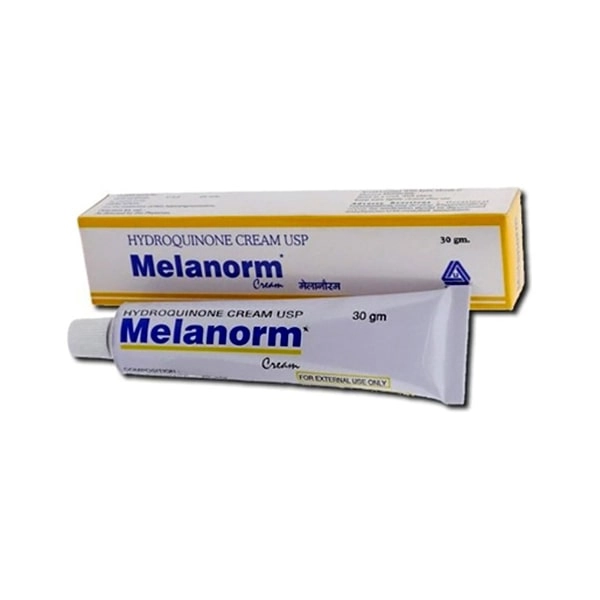
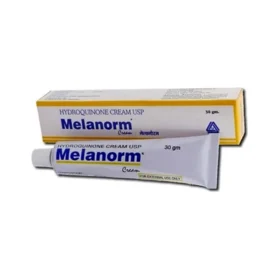
Melanorm Cream


✅ Verlicht huidpigmentatie
✅ Vermindert de melanineproductie
✅ Maakt de huidtint gelijkmatig
✅ Behandelt hyperpigmentatiestoornissen
✅ Veilig voor dagelijks gebruik
✓ Medisch beoordeeld door Morgan Ellis — Apotheekonderzoeker · 8 jaar ervaring · Laatst beoordeeld: mei 2026
💡 Snel antwoord — Wat is Melanorm Cream?
Melanorm Cream bevat hydrochinon 2% — een plaatselijk depigmenterend middel voor melasma, post-inflammatoire hyperpigmentatie (PIH) en ongelijkmatige gezichtspigmentatie. Breng 's nachts een dun laagje aan op alleen het gepigmenteerde gebied. Dagelijkse SPF 50+ breedspectrum is verplicht tijdens de behandeling. Standaard Kligman-cyclus: 4–6 maanden gebruik, gevolgd door een onderhoudsfase zonder steroïden (azelaïnezuur, niacinamide, kojiczuur) om ochronose te voorkomen. Lagere sterkte van 2% — geschikt voor cyclisch gebruik zonder steroïdecomponent.
📦 Elke bestelling is gedekt door onze Reshipment Assurance-beleid — als uw pakket niet binnen 20 werkdagen arriveert, sturen wij het opnieuw.
Waarom bestellen bij MedsBase
Onze generieke medicijnen zijn afkomstig van WHO-GMP gecertificeerde fabrikanten en worden wereldwijd verzonden in discrete, eenvoudige verpakkingen — geen medicijnnaam op de buitenkant van het pakket. Betalingen met kaart worden verwerkt via een gereguleerde processor (betalingsoverzichten vermelden een gereguleerde kaartbetalingprocessor — nooit “MedsBase” of een medicijnnaam). Crypto en SEPA bankoverschrijvingen worden ook geaccepteerd. Elke bestelling wordt ondersteund door ons Reshipment Assurance Policy.
Waarom bestellen bij MedsBase
Het kiezen van Melanorm Cream van MedsBase:
- WHO-GMP gecertificeerde fabrikant — afkomstig uit een gereguleerde faciliteit, complete verpakking met batchnummer en vervaldatum.
- Discrete verpakking — gewone envelop, geen medicatienaam aan de buitenkant.
- Wereldwijde verzending met Reshipment Assurance — als uw pakket niet binnen 20 werkdagen arriveert, sturen wij het kosteloos opnieuw (onder voorbehoud van beleidstermen).
- Loyaliteitspunten — 1 punt per $1 uitgegeven (peptiden uitgesloten); 100 punten = $5 korting.
Wat Melanorm Cream is en hoe het werkt
Melanorm Cream is een plaatselijke depigmenterende crème die bevat hydroquinon 2%. Hydrochinon is een tyrosinase-remmer — het blokkeert het enzym dat tyrosine omzet in melanine, wat bestaande pigmenten lichter maakt en de vorming van nieuw pigment vermindert. Met een sterkte van 2% is hydrochinon-monotherapie geschikt voor gevoelige huid, onderhoudsgebruik of wanneer de steroïdecomponent van een triple cream niet geschikt is. Fabrikant: Yash Pharma (WHO-GMP gecertificeerd).
Indicaties
- Melasma — symmetrische bruine gezichtspigmentatie, vaak hormoongerelateerd.
- Post-inflammatoire hyperpigmentatie — donkere vlekken na acne, eczeem, brandwonden of trauma.
- Zonne-lentigines — door de zon veroorzaakte ouderdomsvlekken op het gezicht, handen en borst.
- Sproeten en epheliden — gericht gebruik; effecten gedeeltelijk omkeerbaar bij blootstelling aan zonlicht.
Hoe aan te brengen (Kligman-cycli)
| Fase | Schema |
|---|---|
| Start | Breng 's nachts een kleine hoeveelheid aan alleen op het gepigmenteerde gebied. Begin om de andere nacht gedurende 1–2 weken als irritatie een zorg is. |
| Actieve fase | Eenmaal per nacht gedurende 4–6 maanden. Maandelijks evalueren; stop als er na 8 weken geen verbetering is. |
| Zonbescherming | Elke ochtend SPF 50+ breedspectrum verplicht. UV-blootstelling maakt 4–6 maanden werk in dagen ongedaan. |
| Cyclus stoppen | Na 4–6 maanden overschakelen op onderhoud: SPF + een niet-hydrochinon middel (azelaïnezuur 15–20%, kojiczuur, niacinamide, tranexaminezuur). |
| Herstarten cycli | Alleen hervatten als pigment terugkeert en alleen na een pauze van 2–3 maanden om ochronose te voorkomen. |
⚠️ Ochronose & langdurig gebruik — Continu gebruik van hydrochinon langer dan 6 maanden — vooral zonder afwisseling — kan exogene ochronose veroorzaken, een paradoxale blauwzwarte verkleuring die grotendeels onomkeerbaar is. De 4–6-maanden-aan / pauze-regel bestaat om deze reden. Niet gebruiken tijdens zwangerschap of borstvoeding, of op beschadigde huid.
Bijwerkingen
- Vaak voorkomend: Milde branderigheid, prikken, droogheid, schilfering, tijdelijke roodheid gedurende de eerste 2–3 weken. Verdwijnt meestal als de huid gewend raakt.
- Minder vaak: Contactdermatitis door hydrochinon, fotosensitiviteit, periorale dermatitis bij aanbrengen nabij de mond.
- Zeldzaam maar ernstig: exogene ochronose bij langdurig gebruik, halo-depigmentatie van de omliggende huid bij te brede toepassing.
Geneesmiddelinteracties
Gelijktijdig gebruik van sterke plaatselijke middelen (benzoylperoxide, alfahydroxyzuren, glycolzuurpeelings, microdermabrasie) op hetzelfde gebied vermijden zonder een interval van 24 uur. Producten die resorcinol, peroxide of salicylaten bevatten vermijden om verkleuring en extra irritatie te voorkomen.
Contra-indicaties
- Zwangerschap en borstvoeding (tretinoïne in combinatiepreparaten is teratogeen; hydrochinon heeft beperkte veiligheidsgegevens tijdens zwangerschap).
- Kinderen onder de 12 jaar.
- Bekende overgevoeligheid voor hydrochinon, retinoïden of steroïden.
- Actief eczeem, ernstige zonnebrand of open wondjes op de aanbrengplek.
- Vitiligo — depigmenterende middelen op onregelmatige pigmentverlies kunnen het contrast verergeren.
Opslag
Bewaren beneden 25 °C, uit direct licht. Hydrochinon oxideert en wordt bruin bij langdurige blootstelling aan lucht — wegwerpen als het duidelijk donkerder wordt of scherp ruikt. Sluit de tube na elk gebruik goed af.
Veelgestelde vragen
Hoe snel zie ik resultaat van Melanorm Crème?
Subtiele verlichting begint na 4–6 weken; volledig effect op melasma duurt typisch 3–6 maanden. Als er na 8 weken geen verandering is, moet de diagnose of oorzaak worden heroverwogen (zon, hormonen, post-inflammatoir).
Waarom is hydrochinon in veel landen beperkt?
De Amerikaanse FDA heeft OTC-hydrochinon in september 2020 van de markt gehaald na evaluatie van casusrapporten over ochronose en ongecontroleerd cosmetisch gebruik. Europa (EU), Japan en het grootste deel van Azië hebben vergelijkbare restricties. Het product blijft wereldwijd beschikbaar voor medisch gebruik onder specialistisch toezicht.
Kan ik Melanorm Cream op mijn hele gezicht gebruiken?
Nee — breng het alleen aan op gepigmenteerde plekken, niet op het hele gezicht. Gebruik op het hele gezicht kan leiden tot halo-depigmentatie van normaal gepigmenteerde huid en verhoogt het risico op ochronose.
Wat betekent “Kligman-cycli”?
Een protocol van 4–6 maanden gebruik van de triple cream, gevolgd door 2–3 maanden onderhoudsbehandeling zonder hydrochinon (azelaïnezuur, niacinamide, kojiczuur) voordat eventueel hervatting plaatsvindt. Dit patroon vermindert het risico op ochronose terwijl de pigmentatie onder controle blijft.
Kan ik Melanorm Cream gebruiken tijdens de zwangerschap?
Nee. Er zijn beperkte veiligheidsgegevens over hydrochinon tijdens de zwangerschap. Stel de behandeling uit tot na de zwangerschap en borstvoeding.
Waarom is zonnebrandcrème verplicht?
UV-blootstelling is de belangrijkste oorzaak van melaninesynthese en de belangrijkste oorzaak van het terugkeren van melasma. Zonder dagelijkse SPF 50+ breedspectrum zal hydrochinonbehandeling falen. Breng elke 2 uur opnieuw aan tijdens blootstelling aan de zon.
Kan ik Melanorm Cream combineren met chemische peelings?
Alleen onder dermatologisch toezicht. Peelings kunnen het effect van hydrochinon versterken, maar ook irritatie, hyperpigmentatie na de peeling en het risico op ochronose verhogen. Stop 7 dagen voor en na een peeling met hydrochinon.
Wat is ochronose en hoe herken ik het?
Exogene ochronose is een paradoxale blauwzwarte verkleuring van de behandelde huid door langdurig gebruik van hydrochinon. Het ontwikkelt zich geleidelijk en is grotendeels onomkeerbaar. Als uw behandelde plekken donkerder worden of een leigrijze tint krijgen na 4+ maanden, stop dan onmiddellijk met hydrochinon en raadpleeg een dermatoloog.
Wat zijn alternatieven voor hydrochinon?
Voor onderhoud of voor patiënten die hydrochinon niet verdragen: azelaïnezuur 15–20%, kojiczuur 1–4%, tranexaminezuur (oraal of lokaal), niacinamide 4–10%, cysteamine 5% en arbutine. Geen van deze is zo snel als hydrochinon, maar ze hebben allemaal een betere langetermijnveiligheid.
Hoe verschilt Melanorm Cream van andere hydrochinoncrèmes?
Het is monotherapie met hydrochinon 2% — langzamer dan triple-combinaties maar zachter en geschikt voor cyclisch gebruik, gevoelige huid of onderhoud.
Andere Schoonheids- & Huidverzorgingsmedicijnen
- Melalite Forte Crème — hydroquinon 4% voor melasma
- Retino-A Crème — tretinoïne voor acne en veroudering
- Melacare Crème — Kligman triple voor melasma
- Permite Crème — permethrin 5% voor schurft
- Tenovate Crème — clobetasol 0,05% voor ernstige ontstekingen
Medisch disclaimer. Deze inhoud is voor algemene informatie over het product en is geen medisch advies of een vervanging voor advies van een gekwalificeerde zorgprofessional. Gebruik elke actuele of orale medicatie alleen onder passend medisch toezicht; misbruik kan ernstige schade veroorzaken.
Meer opties in Beauty & Huidverzorging
Gerangschikt op recente bestelvolumes van MedsBase — wat andere klanten in deze categorie kiezen.


| Sterkte | 2%/0.01% |
|---|---|
| Hoeveelheid | 1 Tube/s, 3 Tube/s, 6 Tube/s |
| Farmaceutische vorm | Crème(s) |
| Fabrikant | Ajanta Pharma |
| Behandeling | Hyperpigmentatie, Melasma |
| Generiek merk | Deca Peptide |
 Melanorm Cream
Vragen & antwoorden
Melanorm Cream
Gerelateerde producten




Beoordelingen
Er zijn nog geen beoordelingen