







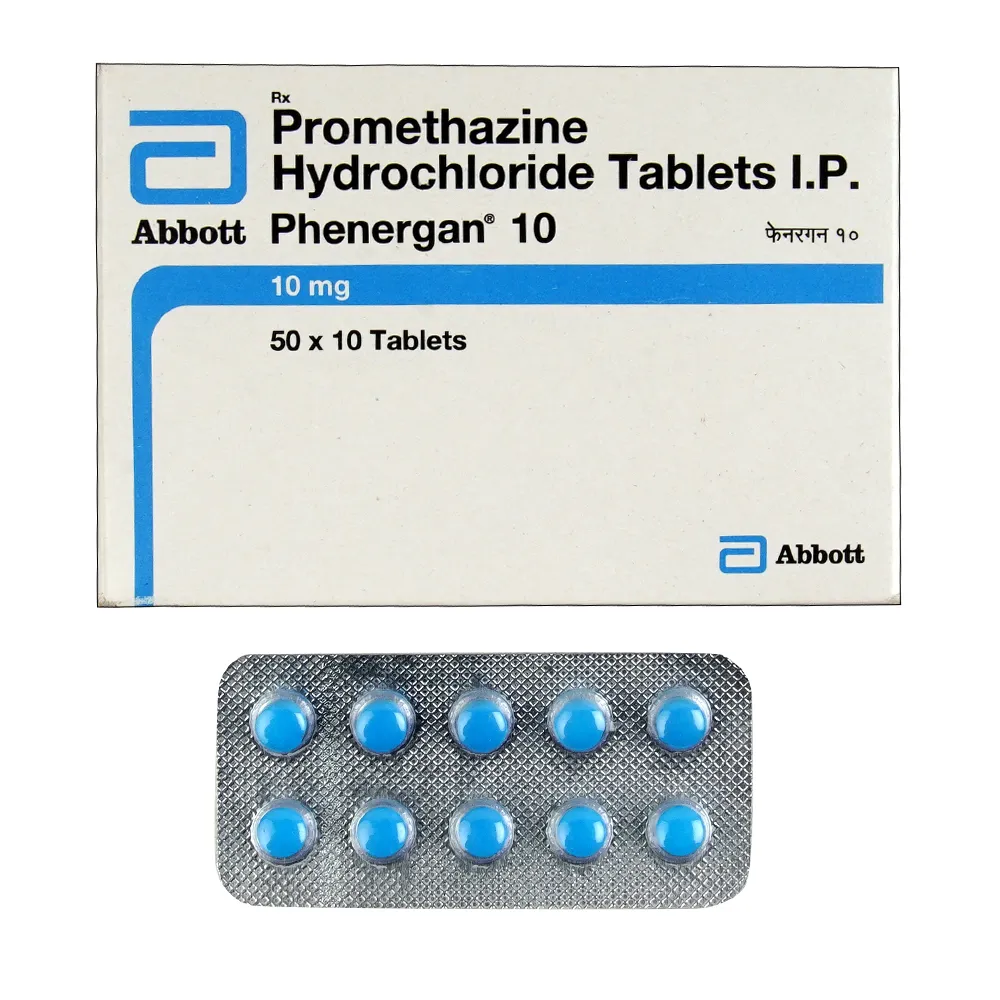
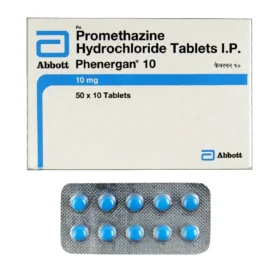
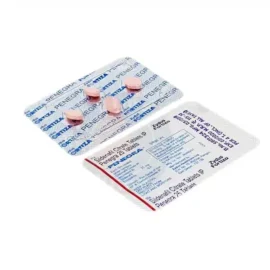
Phenergan
✅ Verlichting van misselijkheid
✅ Voorkomen van braken
✅ Verlichting van allergiesymptomen
✅ Behandeling van reisziekte
✅ Opwekking van sedatie
Phenergan bevat Promethazine.
✓ Medisch beoordeeld door Morgan Ellis — Apotheekonderzoeker · 8 jaar ervaring · Laatst beoordeeld: mei 2026
Snelle antwoord
Phenergan is een merk van promethazine 10 mg — een eerstegeneratie H1-antihistaminicum met sterke anticholinerge, anti-emetische en sederende werking. Neem één tablet 30–60 minuten voor reizen tegen reisziekte, of 10–20 mg elke 4–6 uur bij misselijkheid/allergische symptomen (gebruikelijk maximum 100 mg/dag bij volwassenen). De 10 mg tablet is de mildere, fijner doseerbare optie vergeleken met de 25 mg Avimax tablet.
Waarom bestellen bij MedsBase
📦 Elke bestelling is gedekt door onze Reshipment Assurance-beleid — als uw pakket niet binnen 20 werkdagen arriveert, sturen wij het opnieuw.
Waarom bestellen bij MedsBase
Phenergan is afkomstig van WHO-GMP gecertificeerde fabrikanten, discreet verpakt en wereldwijd verzonden. Elke bestelling wordt gedekt door onze Reshipment Assurance-beleid en ondersteund door meer dan 1.400 klantbeoordelingen.
Hoe Phenergan werkt
Promethazine combineert vier werkingsmechanismen in één molecuul: H1-antihistaminicumblokkade vermindert allergische symptomen; centrale anticholinerge werking onderdrukt de vestibulaire kernen die reisziekte veroorzaken; D2-dopamineantagonisme in de chemoreceptor trigger zone zorgt voor een direct anti-emetisch effect; en bezetting van H1/M1 in het CZS veroorzaakt dosisafhankelijke sedatie. Het begin van de werking is ongeveer 20 minuten na een orale dosis, piekeffect na 1–2 uur, en de werkingsduur is 4–6 uur (sedatie kan bij ouderen langer aanhouden).
Indicaties en dosering
| Indicatie | Volwassen dosering (10 mg tabletten) | Opmerkingen |
|---|---|---|
| Reisziekte — preventie | 20 mg (2 tabletten) 30–60 minuten voor reizen; herhaal 10–20 mg elke 6–8 uur indien nodig | Neem voorafgaand aan reizen — zodra misselijkheid is begonnen, is orale absorptie verminderd |
| Misselijkheid / braken | 10–20 mg elke 4–6 uur naar behoefte | Maximum 100 mg/dag; onderliggende oorzaak beoordelen |
| Allergische rhinitis / urticaria | 10–20 mg tot drie keer per dag | Vaak een enkele dosis van 20 mg 's avonds |
| Kortdurende sedatie | 20–50 mg voor het slapengaan | Niet voor langdurige slapeloosheid — tolerantie en anticholinergische belasting nemen toe |
| Kinderen van 5–10 jaar | 10–20 mg 's nachts voor allergie / reisziekte | Advies van een specialist voor jongere kinderen |
Belangrijk — kinderen onder de 2 jaar
Promethazine is gecontra-indiceerd bij kinderen jonger dan 2 jaar. Er zijn gevallen van fatale ademhalingsdepressie gemeld. Gebruik met voorzichtigheid bij kinderen van 2–6 jaar en alleen in de laagst effectieve dosis.
Bijwerkingen
Vaak (dosisgerelateerd): slaperigheid, droge mond, wazig zien, moeite met plassen, milde obstipatie, duizeligheid bij opstaan.
Minder vaak: fotosensitiviteit, paradoxale opwinding bij kinderen, tinnitus, milde tachycardie.
Ernstig — zoek direct medische hulp: respiratoire depressie (vooral bij jonge kinderen of in combinatie met opioïden/benzodiazepinen), neuroleptisch maligne syndroom (rigiditeit + koorts + veranderd bewustzijn), acute dystonische reactie (oculogyrische crisis, nekkramp — IV procyclidine werkt tegengesteld), ernstige orthostatische hypotensie, toevallen bij hoge doseringen.
Contra-indicaties en waarschuwingen
- Kinderen jonger dan 2 jaar (absoluut)
- Nauwe-hoekglaucoom
- Ernstige benigne prostaathyperplasie of symptomatische urineretentie
- Ernstige luchtwegaandoening — vooral wanneer sedatie de ventilatie kan verslechteren
- Gelijktijdig gebruik van MAO-remmers
- Oudere volwassenen (Beers Criteria voorzichtigheid — anticholinergische belasting, valrisico, delirium)
- Autorijden of machines bedienen — sterke sedatie houdt 6–12 uur aan
Geneesmiddelinteracties
| Interagerend geneesmiddel | Effect | Actie |
|---|---|---|
| Opioïden, benzodiazepinen, barbituraten, alcohol | Additieve CNS + respiratoire depressie | Vermijd combinatie of verlaag beide doseringen |
| Andere anticholinergica (TCA's, FGA-antipsychotica, antiparkinsonmiddelen) | Additieve droge mond, retentie, verwardheid | Vermijd stapeling; verlaag dosis bij ouderen |
| MAO-remmers | Langdurig anticholinergisch + sedatief effect | Vermijd; 14 dagen wash-out aan beide zijden |
| Adrenaline (voor hypotensie) | Omkeerbaar vasopressoreffect via alfa-blokkade | Gebruik noradrenaline / fenylefrine in plaats daarvan |
| Levodopa | D2-antagonisme vermindert antiparkinson-effectiviteit | Vermijd bij de ziekte van Parkinson — gebruik ondansetron / domperidon |
| QT-verlengende geneesmiddelen (azithromycine, kinine, amiodaron) | Additief QT-signaal bij hoge doseringen | Voorzichtigheid; vermijd bij hogere promethazinedoseringen |
Zwangerschap, borstvoeding en opslag
Promethazine heeft een lange praktijkervaring met gebruik tijdens zwangerschap (NVP en ernstige misselijkheid) — historisch gezien geclassificeerd als laag risico, maar zoals bij elk medicijn wordt de laagst effectieve dosis voor de kortste kuur aanbevolen en moet een clinicus de beslissing nemen. Kleine hoeveelheden komen in de moedermelk terecht en kunnen de baby sederen; incidenteel kortdurend gebruik is over het algemeen acceptabel, regelmatig gebruik minder. Bewaren onder 30 °C, beschermd tegen licht.
Veelgestelde vragen
Hoe lang voor vertrek moet ik Phenergan innemen?
Neem 20 mg (twee tabletten van 10 mg) ongeveer 30–60 minuten voor vertrek. Zodra reisziekte is begonnen, vermindert maagstilstand de orale opname — het is beter om na 6–8 uur een tweede dosis in te nemen dan te verdubbelen als de symptomen al ernstig zijn.
Phenergan 10 mg vs Avimax 25 mg — welke moet ik kiezen?
Beide zijn promethazine, alleen met verschillende sterktes. De 10 mg tablet (Phenergan) is de betere keuze voor avondelijke allergiebehandeling, milde reisziekte, dosering voor kinderen (ouder dan 2 jaar), en situaties waar fijnere titratie of minder sedatie nodig is. De 25 mg tablet is geschikt voor korte reizen waar je niet hoeft te rijden op de bestemming, postoperatieve misselijkheid, en volwassen doseringen waar 10 mg onvoldoende was.Avimax) is geschikt voor korte reizen waarbij u niet hoeft te rijden op de bestemming, postoperatieve misselijkheid, en doseringen voor volwassenen waarbij 10 mg onvoldoende is geweest.
Mag ik autorijden na het innemen van Phenergan?
Nee. Zelfs bij 10 mg veroorzaakt promethazine aanzienlijke slaperigheid en beïnvloedt het de reactietijd gedurende ten minste 6-12 uur. Combineer dit met alcohol of enig ander sederend geneesmiddel en de beperking is veel erger. Plan rond de dosering.
Het is gecontra-indiceerd onder de 2 jaar vanwege fatale ademhalingsdepressie in casusrapporten. Gebruik voorzichtig tussen 2 en 6 jaar en alleen in de laagst effectieve dosis. Kinderen ouder dan 5 krijgen vaak 10–20 mg voor reisziekte of allergische urticaria.
Het is gecontra-indiceerd onder de leeftijd van 2 jaar vanwege fatale respiratoire depressie in casusrapporten. Gebruik voorzichtig tussen 2 en 6 jaar en alleen in de laagst effectieve dosering. Kinderen boven de 5 jaar krijgen doorgaans 10–20 mg voor reisziekte of allergische urticaria.
Phenergan versus cetirizine of loratadine — wat is het verschil?
Cetirizine en loratadine zijn tweede-generatie antihistaminica die ontworpen zijn om de hersenen te vermijden — ze verlichten allergieën zonder veel sedatie, maar ze hebben geen anti-emetisch of vestibulair effect. Promethazine is een eerste-generatie medicijn dat vrijelijk de hersenen binnendringt — het sedateert, onderdrukt reisziekte en stopt braken. Kies het tweede-generatie medicijn voor gewone allergieën en Phenergan wanneer de sedatie of anti-emetische werking gewenst is.
Kan ik Phenergan innemen samen met mijn slaaptablet of angstremmer?
Phenergan versterkt aanzienlijk de onderdrukking van de ademhaling en het bewustzijn veroorzaakt door zolpidem, benzodiazepinen, opioïden, gabapentine of alcohol. De combinatie is niet veilig bij standaarddoseringen. Overleg met de voorschrijvend arts voordat u het combineert.
Helpt Phenergan tegen duizeligheid?
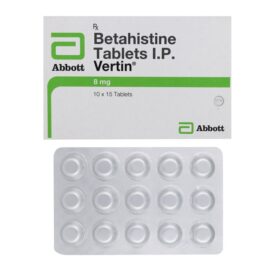
Het heeft enig effect bij acute perifere duizeligheid vanwege de anticholinerge vestibulaire onderdrukking. Voor de ziekte van Ménière of recidiverende perifere duizeligheid is betahistine (Vertin, Betavert, Betavert Tab) een geschikter middel. Promethazine is alleen voor kortdurend gebruik — langdurig gebruik vertraagt de vestibulaire compensatie van de hersenen.
Kan ik Phenergan innemen met voedsel of alcohol?
Voedsel is prima en kan maagklachten verminderen. Alcohol niet — het versterkt de sedatie aanzienlijk, verlaagt de bloeddruk verder en belemmert het denkvermogen veel meer dan elk middel afzonderlijk.
Is Phenergan veilig tijdens de zwangerschap?
Het wordt al tientallen jaren gebruikt bij ernstige misselijkheid en braken tijdens de zwangerschap en wordt over het algemeen als laagrisico beschouwd, maar geen anti-emeticum mag zonder medisch advies worden ingenomen tijdens de zwangerschap. Eerstekeus bij zwangerschapsmisselijkheid is Doxinate (doxylamine + B6).
Waarom geeft Phenergan een droge mond?
De anticholinerge werking van promethazine vermindert speeksel, tranen en luchtwegsecretie. Handig bij misselijkheid maar onaangenaam voor de mond. Drink water, kauw suikervrije kauwgom en vermijd combinatie met andere anticholinerge middelen (TCA's, oxybutynine, hyoscinepleisters).
Hoe bewaar ik Phenergan?
Onder 30 °C in de originele verpakking, beschermd tegen licht en vocht. Buiten bereik van kinderen houden — zelfs een kleine overdosis bij een jong kind kan ernstige ademhalingsdepressie veroorzaken.
Reizigers die merken dat de 10 mg sterkte van Phenergan (promethazine) bij lange vluchten of busreizen misselijkheid achterlaat, stappen meestal over op de hogere dosering. Avimax (promethazine 25 mg), neem 30 tot 60 minuten voor vertrek voor een sterker antihistaminicum anti-emetisch effect met dubbele tabletpotentie.
Andere behandelingen voor reisziekte
- Avimax (Promethazine 25 mg) —zelfde molecuul, hogere sterkte
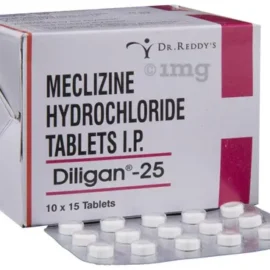
- Diligan (Meclizine 25 mg) — minder sederend antihistaminicum
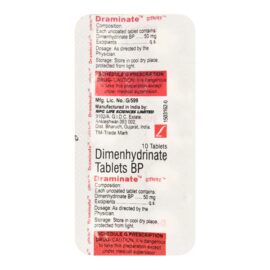
- Draminate (Dimenhydrinate 50 mg) — originele Dramamine-equivalent
- Vertin (Betahistine 8 mg) — voor vestibulaire vertigo/Menière
- Betavert Tab (Betahistine 24 mg) — volledige dosis Menière
Medische Disclaimer
Deze pagina is voor educatieve doeleinden en vervangt geen persoonlijk medisch advies. Ernstige duizeligheid met gehoorverlies, neurologisch tekort of wisselend bewustzijn is geen reisziekte — zoek dezelfde dag medische hulp. Antihistaminica en anticholinergica werken gevaarlijk samen met alcohol en CNS-depressiva. Overleg altijd met een arts bij nieuwe medicatie, vooral tijdens zwangerschap, borstvoeding of bij gebruik van andere medicijnen.
Meer opties in reisziektetabletten
Gerangschikt op recente bestelvolumes van MedsBase — wat andere klanten in deze categorie kiezen.
| Sterkte | 10 mg |
|---|---|
| Hoeveelheid | 30 Tabletten, 60 Tabletten, 90 Tabletten, 180 Tabletten |
 Phenergan
Vragen & antwoorden
Phenergan
Gerelateerde producten



Beoordelingen
Er zijn nog geen beoordelingen