









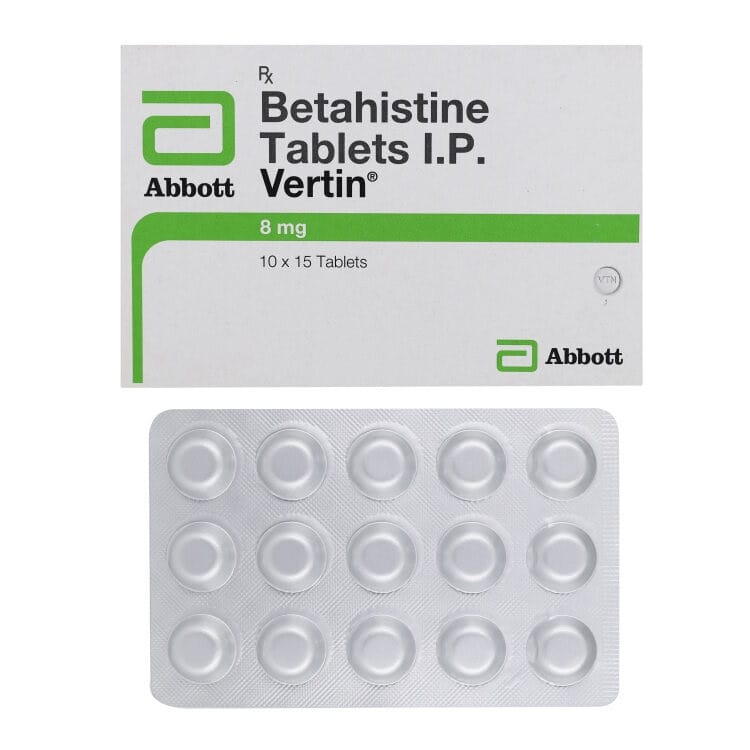
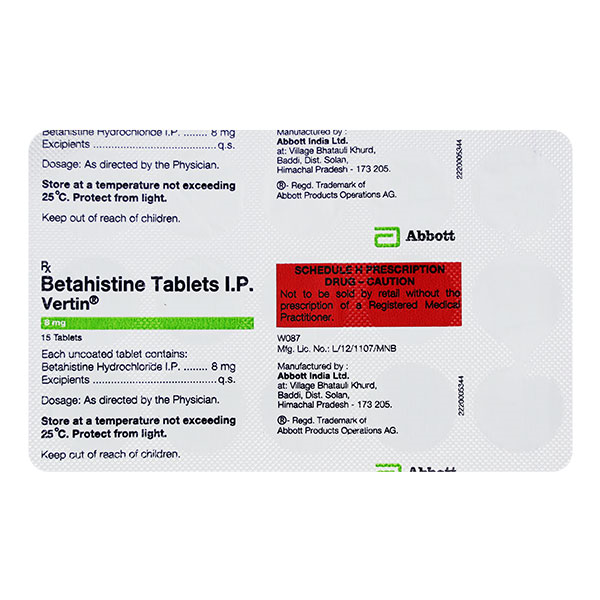
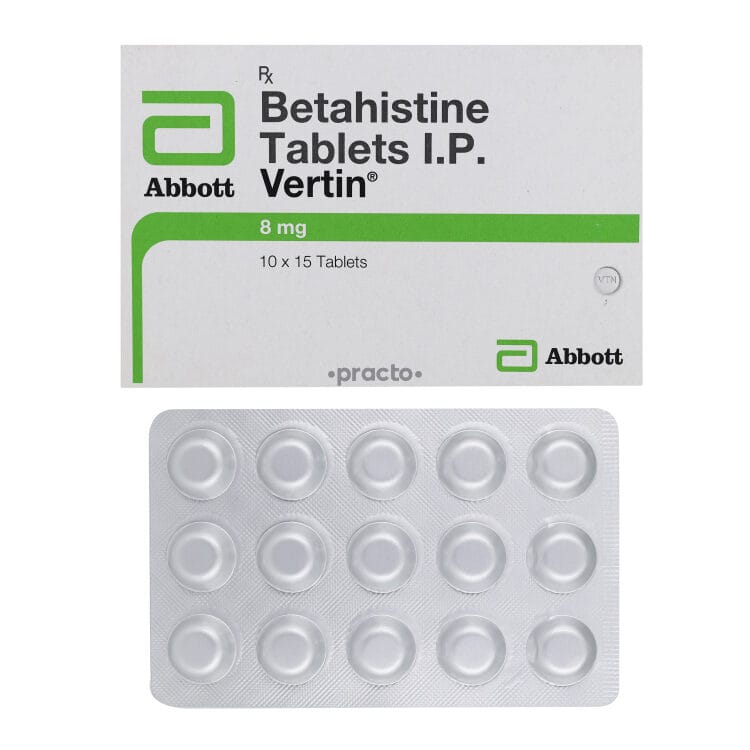
Vertin


✅ Vermindert duizeligheidsklachten
✅ Verbetert het evenwicht
✅ Minimaliseert misselijkheid
✅ Verlicht duizeligheid
✅ Verbeterde functie van het binnenoor
Vertin bevat Betahistine.
✓ Medisch beoordeeld door Morgan Ellis — Apotheekonderzoeker · 8 jaar ervaring · Laatst beoordeeld: mei 2026
⚡ Kort antwoord — Wat is Vertin?
Vertin is een betahistine dihydrochloride 8 mg tablet gebruikt voor de behandeling van perifere vertigo, tinnitus en gehoorverlies geassocieerd met de ziekte van Ménière. Het is een histamine-analoog dat de microcirculatie in het binnenoor verbetert. De gebruikelijke dosering is 8–16 mg driemaal daags bij de maaltijd. Niet voornamelijk voor reisziekte of algemene duizeligheid — daarop werken cinnarizine, prochlorperazine of dimenhydrinaat beter.
Waarom bestellen bij MedsBase
📦 Elke bestelling is gedekt door onze Reshipment Assurance-beleid — als uw pakket niet binnen 20 werkdagen arriveert, sturen wij het opnieuw.
Vertin is Abbott’s betahistine dihydrochloride 8 mg tablet, specifiek gebruikt voor perifere vestibulaire vertigo en de klassieke triade van Ziekte van Ménière: episodische duizeligheid, perceptief gehoorverlies en tinnitus. Betahistine is een zwak histamine-analoog dat sinds de jaren 60 klinisch wordt gebruikt en wereldwijd het meest voorgeschreven specifieke middel blijft voor de ziekte van Ménière.
Vertin verschilt van de medicijnen die worden gebruikt voor reisziekte (cinnarizine, dimenhydrinaat, meclizine) of van anti-emetica die worden gebruikt bij acute duizeligheidsaanvallen (prochlorperazine, promethazine). Het begrijpen van het verschil is belangrijk omdat het verkeerde medicijn voor het verkeerde type duizeligheid weinig effect heeft.
Wat is Vertin?
Vertin is een vasoactief histamine-analoog met zwakke H₁-agonistische en matige H₃-antagonistische effecten. Het wordt voornamelijk gebruikt bij aandoeningen waarbij microcirculatie in het binnenoor en endolymfatische druk verantwoordelijk worden geacht voor de symptomen.
Vertin is geïndiceerd voor:
- Ziekte van Ménière — de klassieke indicatie; vermindert de frequentie en ernst van duizeligheidsaanvallen, kan tinnitus en gehoorfluctuaties licht verbeteren
- Perifere vestibulaire vertigo — terugkerende episodes van draaiduizeligheid toegeschreven aan het binnenoor of de vestibulaire zenuw
- Vestibulaire neuritis (herstelfase) — als onderdeel van een revalidatiestrategie
- BPPV (benigne paroxismale positionele vertigo) — alleen als aanvulling; canalith-repositioneringsmanoeuvres (Epley) blijven eerste keus
Vertin is niet wordt typisch gebruikt voor reisziekte, lichtheid in het hoofd, aspecifieke duizeligheid of centrale (hersen-gerelateerde) vertigo.
Hoe Werkt Vertin?
De exacte werking van betahistine in het binnenoor is nog onderwerp van discussie, maar verschillende effecten zijn beschreven:
- Vasodilatatie van de microcirculatie in de stria vascularis in het binnenoor, waar het vermoedelijk de endolymfatische druk verlaagt bij de ziekte van Ménière
- H₃-receptorantagonisme in de vestibulaire kernen, wat de histamineomzet verhoogt en mogelijk bijdraagt aan vestibulaire compensatie
- Zwak H₁-agonisme op postsynaptische plaatsen
- Verbetering van de symmetrie van de vestibulaire zenuwoutput tijdens herstel van unilateraal vestibulair letsel
Het begin van klinisch voordeel is geleidelijk — de meeste patiënten hebben enkele weken aan continue behandeling voordat een afname van de frequentie van vertigo-episodes wordt ervaren.
Dosering en Toediening van Vertin
| Scenario | Dosering | Opmerkingen |
|---|---|---|
| Ziekte van Ménière (standaard) | 8–16 mg driemaal daags | Streef naar 24–48 mg totaal per dag; doseer op als er een gedeeltelijke respons is |
| Initiële dosering | 8 mg driemaal daags | Verhoog na 2–4 weken indien nodig |
| Hoge-dosisregime | 16 mg driemaal daags (48 mg/dag) | Ondersteund door de BEMED-studie en Europese richtlijnen |
| Onderhoudsdosis | 8 mg driemaal daags zodra controle is bereikt | Gedurende maanden voortzetten; afbouwen onder medische begeleiding |
| Ouderen | Standaarddosering | Geen routinematige verlaging |
| Zwangerschap | Vermijden tenzij essentieel | Beperkte gegevens |
| Maximale dagelijkse dosis | 48 mg | Verdeeld in drie doses |
Hoe Vertin op de juiste manier in te nemen
- Slik de tablet in zijn geheel door met water, bij voorkeur met of na een maaltijd om maagklachten te verminderen
- Verdeel de doses gelijkmatig over de dag (ochtend, middag, avond)
- Wacht minimaal 4–6 weken op een adequate dosis voordat de effectiviteit wordt beoordeeld
- Houd u aan zoutbeperking, voldoende hydratatie en matiging van cafeïne/alcohol — leefstijlmaatregelen bij Ménière versterken het medicijneffect
- Stop niet abrupt als u het maandenlang heeft gebruikt — een geleidelijke afbouw wordt meestal voorgeschreven
- Houd de frequentie van aanvallen bij in een dagboek — de belangrijkste maatstaf voor respons is het aantal draaiduizeligheidsaanvallen per maand
Bijwerkingen van Vertin
| Ernst | Bijwerking |
|---|---|
| Vaak voorkomend | Milde misselijkheid, dyspepsie, hoofdpijn |
| Minder vaak | Huiduitslag, jeuk, netelroos, opvliegers |
| Zeldzaam | Bronchospasme bij astmapatiënten, angio-oedeem, ernstige overgevoeligheid |
Zoek medische hulp bij ademhalingsmoeilijkheden, uitgebreide huiduitslag of gezichtszwelling.
Waarschuwingen en voorzorgsmaatregelen
- Feochromocytoom. Gecontra-indiceerd — histamine-analogen kunnen een catecholaminestoot veroorzaken
- Bronchiaal astma. Voorzichtig gebruiken — let op bronchospasme, vooral bij ernstige ziekte
- Maagzweer. Betahistine kan maagirritatie verergeren — innemen met voedsel en voorzichtig gebruiken
- Zwangerschap en borstvoeding. Beperkte humane gegevens — vermijd tenzij duidelijk nodig
- Alcohol. Kan evenwichts-/coördinatieklachten verergeren — strikt beperken tijdens actieve draaiduizeligheid
- BPPV. Vertin behandelt BPPV niet mechanisch — de Epley- of Semont-canalithrepositiemanoeuvre is definitief; vertin is hoogstens aanvullend
Contra-indicaties — Wie Vertin NIET moet gebruiken
- Feochromocytoom
- Bekende overgevoeligheid voor betahistine of een hulpstof
- Kinderen (beperkte veiligheidsgegevens)
- Ernstige actieve maagzweeraandoening
Geneesmiddelinteracties
| Geneesmiddel / Klasse | Interactie |
|---|---|
| H₁-antihistaminica (cetirizine, loratadine, diphenhydramine) | Werken het effect van betahistine tegen — vermijd routineus gelijktijdig gebruik |
| MAO-remmers (phenelzine, tranylcypromine, moclobemide) | Kunnen de afbraak van betahistine remmen — verhoogde spiegels; vermijd of monitor |
| β₂-agonisten (salbutamol) | Geen klinisch relevante interactie |
| Diuretica | Worden vaak samen voorgeschreven bij de behandeling van de ziekte van Ménière (meestal thiazide) — geen nadelige interactie |
| Alcohol | Kan vestibulaire symptomen verergeren — beperken |
Bewaaradvies
- Bewaren bij een temperatuur onder 25 °C op een droge plaats, uit direct zonlicht
- Bewaren in de originele blisterverpakking
- Buiten bereik van kinderen houden
- Niet gebruiken na de vervaldatum
Gerelateerde alternatieven op MedsBase
- Betavert — alternatief merk betahistine
- Stemetil — prochlorperazine, voor acute draaiduizeligheidssymptomen en misselijkheid
- Bekijk alle reisziekte- en bewegingsziektetabletten →
Veelgestelde vragen
Waar wordt Vertin voor gebruikt?
Vertin (betahistine) wordt voornamelijk gebruikt voor Ziekte van Ménière en andere vormen van perifere vestibulaire vertigo. Het vermindert de frequentie en ernst van duizeligheidsaanvallen en kan de begeleidende tinnitus en gehoorfluctuatiesymptomen enigszins verbeteren.
Hoe snel werkt Vertin?
Het effect bouwt geleidelijk op — geef 4–6 weken op een adequate dosis voordat het effect beoordeeld wordt. Betahistine vermindert de frequentie van toekomstige duizeligheidsaanvallen; het stopt niet acuut een aanval die al bezig is.
Kan ik Vertin gebruiken voor reisziekte?
Nee — betahistine is niet effectief voor reisziekte. Gebruik hiervoor cinnarizine, dimenhydrinaat, meclizine of een scopolaminepleister.
Kan ik Vertin gebruiken voor BPPV?
BPPV (benigne paroxismale positionele vertigo) reageert het beste op canalith-repositioneringsmanoeuvres zoals de Epley- of Semont-manoeuvre — deze verplaatsen de binnenoor-kristallen die BPPV veroorzaken fysiek. Medicatie is slechts ondersteunend.
Helpt Vertin tegen tinnitus?
Bij patiënten met de ziekte van Ménière verbetert tinnitus vaak samen met de beheersing van duizeligheid. Voor geïsoleerde tinnitus zonder duizeligheid is het bewijs van voordeel zwakker en worden andere benaderingen (geluidsmaskering, tinnitus retraining therapie, cognitieve gedragstherapie) geprefereerd.
Hoe lang moet ik Vertin gebruiken?
De ziekte van Ménière is een chronische aandoening; patiënten gebruiken Vertin vaak voor maanden tot jaren afhankelijk van de frequentie van episodes. Uw arts zal pogingen tot afbouwen begeleiden als u langere perioden zonder aanvallen heeft.
Mag ik Vertin gebruiken tijdens de zwangerschap?
Beperkte menselijke gegevens — meestal vermeden tenzij duidelijk nodig. Overleg met uw arts.
Wat moet ik doen tijdens een acute aanval van duizeligheid?
Vertin is een preventief medicijn; het stopt geen acute aanval. Tijdens een aanval, ga zitten of liggen in een stille, donkere kamer, vermijd plotselinge hoofdbewegingen, en bij ernstige symptomen kan een anti-emeticum zoals prochlorperazine (Stemetil) of ondansetron kortdurend worden gebruikt.
Veroorzaakt Vertin slaperigheid?
Minder dan antihistaminica zoals cinnarizine — betahistine is niet uitgesproken sederend, maar sommige gebruikers ervaren toch aanvankelijk milde slaperigheid of hoofdpijn.
Welke leefstijlmaatregelen helpen bij de ziekte van Ménière?
Zoutarm dieet (<2 g natrium/dag), regelmatige hydratatie, beperking van cafeïne en alcohol, vermijden van MSG, stressmanagement en vestibulaire revalidatieoefeningen. Deze maatregelen versterken het voordeel van Vertin en bij sommige patiënten controleren ze de symptomen zonder extra medicatie.
Vertin (betahistine) behandelt duizeligheid van vestibulaire oorsprong en de ziekte van Ménière via histaminemodulatie in plaats van antagonisme, dus voor het situationele reisziekte-uiteinde van het spectrum — auto, zee, bus, vliegtuig — is het juiste hulpmiddel de H1-antagonist Avimax (promethazine 25 mg) 30 tot 60 minuten voor de reis ingenomen.
Andere behandelingen voor duizeligheid en reisziekte
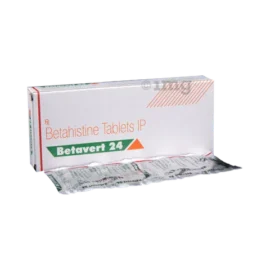
- Betavert (betahistine 8 / 16 mg, Sun Pharma)
- Betavert Tab (betahistine 24 mg)
- Diligan (meclizine 25 mg) — tegen reisziekte en acute duizeligheid eerste 48–72 uur
- Stemetil (prochlorperazine 5 mg) — acute duizeligheid / misselijkheid noodbehandeling
- Avomine (promethazine 25 mg) — sederend antihistaminicum tegen reisziekte
Meer opties in behandeling van duizeligheid & reisziekte
Gerangschikt op recente bestelvolumes van MedsBase — wat andere klanten in deze categorie kiezen.

| Sterkte | 8 mg |
|---|---|
| Hoeveelheid | 30 Tabletten, 60 Tabletten, 90 Tabletten, 180 Tabletten |
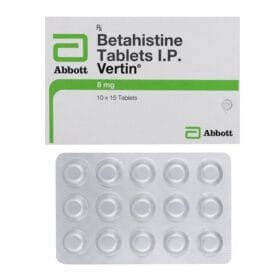 Vertin
Vragen & antwoorden
Vertin
Gerelateerde producten










Beoordelingen
Er zijn nog geen beoordelingen