







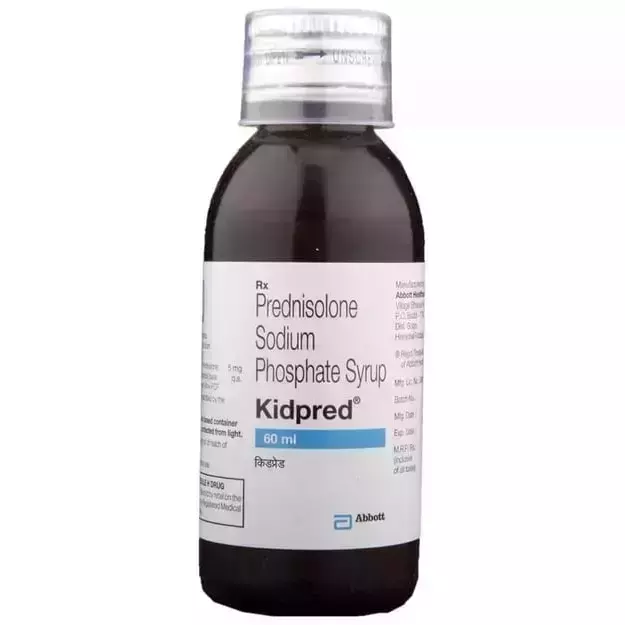
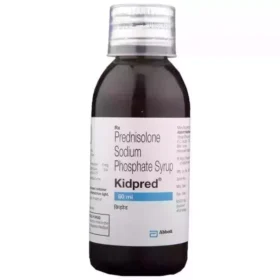
Kidpred-siroop
✅ Vermindering van ontsteking
✅ Verlichting van allergiesymptomen
✅ Behandeling van astma
✅ Behandeling van auto-immuunziekten
✅ Onderdrukking van het immuunsysteem
Kidpred Syrup bevat Prednisolone.
✓ Medisch beoordeeld door Morgan Ellis — Apotheekonderzoeker · 8 jaar ervaring · Laatst beoordeeld: mei 2026
⚡ Snel antwoord — Wat is Kidpred Syrup?
Kidpred-siroop is een orale siroop van Cipla die bevat prednisolone — een synthetisch glucocorticoid met sterke ontstekingsremmende en immunosuppressieve werking. Verkrijgbaar in een 60 mL flesje kinderdosering prednisolon orale siroop; de vloeibare formulering maakt gewichtsgebonden dosering eenvoudig bij kinderen die nog te jong zijn om tabletten betrouwbaar door te slikken. Gebruikt voor korte kuren bij acute astma-aanval (1–2 mg/kg/dag gedurende 3–5 dagen), kroep (1 mg/kg enkele orale dosis, vaak gecombineerd met vernevelde epinefrine), ernstige allergische reacties en angio-oedeem, eczeemopstoten, en langere kuren bij nefrotisch syndroom (60 mg/m²/dag tijdens inductie, daarna afbouwen om de dag) en andere auto-immuunziekten bij kinderen. Standaard pediatrische dosis: 1–2 mg/kg/dag in 1–2 verdeelde doses, met een maximum van typische volwassen equivalenten. Weeg het kind altijd voor elke kuur; doses moeten worden berekend op basis van het huidige gewicht. Korte kuren (< 5–7 dagen) hebben geen afbouw nodig; langere kuren vereisen een gecontroleerde afbouw om een bijniercrisis te voorkomen. Herhaalde of langdurige kuren kunnen de lineaire groei remmen — hoogte- en gewichtsmonitoring bij elk voorschrijversoverleg.
📦 Elke bestelling is gedekt door onze Reshipment Assurance-beleid — als uw pakket niet binnen 20 werkdagen arriveert, sturen wij het opnieuw.
Waarom bestellen bij MedsBase
Onze generieke medicijnen zijn afkomstig van WHO-GMP gecertificeerde fabrikanten en worden wereldwijd verzonden in discrete, eenvoudige verpakkingen — geen medicijnnaam op de buitenkant van het pakket. Betalingen met kaart worden verwerkt via een gereguleerde processor (betalingsoverzichten vermelden een gereguleerde kaartbetalingprocessor — nooit “MedsBase” of een medicijnnaam). Crypto en SEPA bankoverschrijvingen worden ook geaccepteerd. Elke bestelling wordt ondersteund door ons Reshipment Assurance Policy.
Wat is Kidpred Syrup?
Kidpred Syrup is een orale siroop geproduceerd door Cipla die bevat prednisolone, een synthetisch glucocorticoid met gemiddelde sterkte. De vloeibare formulering is de standaard pediatrische presentatie: het maakt precieze milligramdosering mogelijk voor kleine kinderen en baby's, en is veel gemakkelijker toe te dienen dan verpulverde tabletten aan baby's en peuters.
Kidpred Syrup is Cipla's standaard pediatrische prednisolon orale vloeistof — ontworpen voor kinderen die nog te jong zijn om tabletten betrouwbaar door te slikken en waarbij exacte gewichtsgebonden dosering belangrijk is. Wordt geleverd in een flesje van 60 mL met een meetinstrument voor nauwkeurige dosering. Controleer altijd de per mL sterkte die op het etiket van het flesje staat vermeld voordat u meet (Indiase pediatrische prednisolon siropen zijn meestal 5 mg/5 mL of 15 mg/5 mL; hetzelfde doseervolume geeft een 3× verschillend medicijndosis tussen deze twee concentraties). Prednisolon heeft sterke ontstekingsremmende en immunosuppressieve effecten in bijna elk weefsel. In de pediatrische praktijk wordt het meestal gebruikt voor korte kuren bij acute astma en kroep, eenmalige behandeling van kroep, langere kuren bij nefrotisch syndroom, en geselecteerde auto-immuun- en allergische aandoeningen.
Hoe Werkt Kidpred Syrup?
Prednisolon dringt cellen binnen, bindt aan de intracellulaire glucocorticoidreceptor, en het receptor-medicijncomplex verplaatst zich naar de kern waar het de transcriptie van honderden ontstekingsgerelateerde genen verandert. Het resultaat is een brede onderdrukking van pro-inflammatoire cytokinen (IL-1, IL-6, TNF-α), remming van fosfolipase A&sub2; via lipocortine (wat de productie van prostaglandinen en leukotriënen stopt), verminderde capillaire permeabiliteit, en onderdrukte lymfocyt- en eosinofielfunctie.
Plasma halfwaardetijd: 2–3 uur; biologische (ontstekingsremmende) halfwaardetijd: 12–36 uur. Eenmaal daags doseren in de ochtend geeft effectieve dagelijkse ontstekingsremmende dekking voor de meeste pediatrische indicaties, terwijl HPA-as suppressie wordt geminimaliseerd in vergelijking met gesplitste of avonddosering.
Begin van klinisch effect bij acute pediatrische ontstekingsaandoeningen: merkbare verbetering bij kroep of astma binnen 2–4 uur na de eerste dosis; piek ontstekingsremmend effect na 4–8 uur. Het effect houdt 24–36 uur aan na dosering.
Toepassingen en Indicaties
Kidpred Syrup wordt gebruikt bij een breed scala aan pediatrische ontstekings- en auto-immuunaandoeningen:
- Acute astma-exacerbatie — korte kuur van 3–5 dagen, geen afbouw nodig. Meest voorkomende gebruik in de Indiase pediatrische praktijk.
- Kroep (laryngotracheobronchitis) — eenmalige orale dosis van 1 mg/kg bij presentatie, vaak gecombineerd met vernevelde epinefrine. Vermindert ziekenhuisopname en respiratoire verslechtering.
- Ernstige allergische reacties, netelroos, angio-oedeem — korte kuur van 3–5 dagen met 1–2 mg/kg/dag.
- Ernstige opflakkering van atopische dermatitis (eczeem) — korte kuur; eerst plaatselijke middelen.
- Nefrotisch syndroom (meestal minimale veranderingenziekte bij kinderen) — standaard inductie is 60 mg/m²/dag gedurende 4–6 weken, daarna om de dag 40 mg/m² gedurende 4–6 weken, waarbij recidieven worden behandeld volgens vergelijkbare protocollen.
- Opvlamming van juveniele idiopathische artritis — overbruggingstherapie tijdens start van DMARD.
- Opvlamming van inflammatoire darmziekte — korte kuren voor matig-ernstige opvlamming van de ziekte van Crohn of colitis ulcerosa.
- Idiopathische trombocytopenische purpura (ITP), auto-immuun hemolytische anemie
- Acute ziekte van Kawasaki (aanvulling op IVIG in sommige protocollen)
- Ernstige virale piepende ademhaling bij jonge kinderen — geselecteerde gevallen; bewijs minder robuust dan voor echt astma.
- Acuut ruggenmergletsel, ernstig hoofdletsel, ernstige sepsis — indicaties voor gespecialiseerde intensive care.
Kidpred Siroop is niet geschikt voor: eenvoudige virale bovenste luchtweginfectie, niet-gediagnosticeerde piepende ademhaling bij zuigelingen < 12 maanden (hoog risico op virale bronchiolitis waarbij steroïden niet helpen of schadelijk zijn), of routinematig eczeembeheer (eerst plaatselijke steroïden).
Kidpred Siroop Dosering en Hoe aan een Kind te Geven
Pediatrische dosering is gewicht-afhankelijk; weeg het kind altijd voor elke kuur en herweeg bij kuren langer dan 1 maand. De sterkte van prednisolon in siroop varieert per fabrikant (meestal 5 mg/5 mL of 15 mg/5 mL) — controleer altijd de sterkte per mL op het flesetiket voordat u de dosis afmeet.
Standaard pediatrische doseringen per indicatie
| Indicatie | Dosering | Duur |
|---|---|---|
| Acute astma-exacerbatie | 1–2 mg/kg/dag (max 40–60 mg/dag) eenmaal daags 's ochtends | 3–5 dagen, niet afbouwen |
| Kroep | 1–2 mg/kg als eenmalige orale dosis (max 60 mg) | Eenmalige dosis; herhaal 1–2 keer bij ernstige gevallen |
| Ernstige allergische reactie / angio-oedeem | 1–2 mg/kg/dag eenmaal daags | 3–5 dagen |
| Ernstige eczeemopflakkering | 0,5–1 mg/kg/dag | 5–7 dagen; daarna onderhoud met topicale steroïden |
| Inductie van nefrotisch syndroom | 60 mg/m²/dag (max 60–80 mg/dag) | 4–6 weken, daarna afbouwen om de dag gedurende 4–6 weken |
| Overbrugging bij JIA-opflakkering | 0,5–1 mg/kg/dag | Totdat DMARD effect heeft; meestal 2–6 weken en daarna afbouwen |
| ITP/AIHA | 2–4 mg/kg/dag | Totdat er respons is, daarna wekenlang afbouwen |
Hoe Kidpred-siroop correct te meten en toe te dienen
- Weeg eerst het kind. Bereken de dosis altijd op basis van het actuele gewicht, niet uit het hoofd van eerdere kuren. Kinderen groeien.
- Controleer de sterkte op het etiket van het flesje. Als 15 mg/5 mL, dan is 5 mL = 15 mg; als 5 mg/5 mL, dan is 5 mL = 5 mg. Hetzelfde doseervolume geeft een 3× verschil in medicijndosering tussen deze twee producten.
- Gebruik de meegeleverde gekalibreerde orale spuit of maatbeker, geen huishoudelijke theelepel. Huishoudelijke theelepels variëren van 2,5 tot 7,5 mL; het gebruik ervan introduceert een 3-voudige doseringsfout.
- Geef de dosis 's ochtends (tussen wakker worden en ontbijt). Ochtenddosering bootst het natuurlijke cortisolritme na en minimaliseert HPA-onderdrukking en slapeloosheid.
- Geef met voedsel — vermindert maagirritatie en de vaak onaangename smaak. Meng indien nodig met een kleine hoeveelheid vruchtensap (appel, mango) of een lepel yoghurt; meng het niet in de volledige fles meld, omdat het kind deze mogelijk niet opdrinkt.
- Als het kind binnen 30 minuten na de dosis braakt, herhaal dan de volledige dosis. Als het braken na 30 minuten maar binnen 2 uur plaatsvindt, herhaal dan de halve dosis. Als het na 2 uur is, herhaal dan niet.
- Sla nooit een dosis over tijdens een acute kuur. Als een dosis wordt gemist, geef deze dan zo snel mogelijk als het wordt herinnerd en ga daarna terug naar het normale schema. Neem geen dubbele dosis.
- Stop nooit plotseling na een kuur langer dan 5–7 dagen. Afbouwen is nodig om een bijniercrisis te voorkomen. Volg het afbouwschema van de voorschrijver precies op.
- Houd lengte en gewicht bij bij elk bezoek aan de kinderarts tijdens langdurige kuren — groeiremming is de belangrijkste zorg specifiek voor kinderen.
- Vertel elke zorgverlener — schoolverpleegkundige, tandarts, SEH-arts — dat het kind Kidpred Syrup gebruikt.
Stoppen met Kidpred Syrup — Waarom afbouwen belangrijk is bij kinderen
Kinderen die langdurige steroïdenkuur ondergaan, lopen hetzelfde risico op HPA-as suppressie als volwassenen, en abrupt stoppen kan een bijniercrisis veroorzaken. Het risico is het hoogst na lange kuren (meer dan 2–3 weken bij > 1 mg/kg/dag) maar kan ook optreden na kortere kuren bij hoge dosering.
- Kuren korter dan 5–7 dagen bij 1–2 mg/kg/dag — kunnen meestal zonder afbouw worden gestopt.
- Kuren van 1–3 weken bij 1–2 mg/kg/dag — verminder met 0,25–0,5 mg/kg elke 3–5 dagen tot stoppen, of volg het specifieke plan van de voorschrijver.
- Kuren langer dan 3 weken bij 1–2 mg/kg/dag, of elk nefrotisch syndroom-regime — specialistisch begeleid afbouwen, vaak over weken tot maanden, soms via om-de-dag dosering.
- Ziekte-extra dosering — een kind dat langdurig steroïden gebruikt (inclusief de eerste weken na het stoppen van een lange kuur) heeft extra steroïden nodig tijdens koorts, braken, ernstige ziekte of operatie, net als volwassenen. Bespreek duidelijke regels voor ziekte-extra dosering met de voorschrijver.
- Ontwenningsverschijnselen — als het kind lusteloos wordt, weinig eetlust heeft, gewrichtspijn heeft of zich over het algemeen niet lekker voelt tijdens het afbouwen, ga dan een stap terug en bouw langzamer af.
Bijwerkingen van Kidpred-siroop bij kinderen
Bijwerkingen van prednisolon bij kinderen komen grotendeels overeen met die bij volwassenen, maar met specifieke zorgen over groei en gedrag bij kinderen.
Kortdurend (dagen tot weken), vaak voorkomend:
- Toegenomen eetlust, gewichtstoename
- Veranderingen in stemming en gedrag — prikkelbaarheid, agitatie, hyperactiviteit, af en toe kortdurende psychose bij hoge doseringen (vaak “steroïdenwoede” genoemd door ouders)
- Slapeloosheid, levendige dromen
- Maagzuur, dyspepsie
- Acne-opflakkeringen bij oudere kinderen en adolescenten
- Verhoogde bloedsuikerspiegel (alleen relevant bij bestaande of nieuw ontdekte diabetes)
Middellang (weken tot maanden):
- Cushingoïde uiterlijk — rond gezicht, gewichtstoename rond het middel, bisonnek
- Dunner wordende huid, gemakkelijk blauwe plekken, striae
- Verhoogde vatbaarheid voor bacteriële, virale en schimmelinfecties
- Cataract (vooral bij langdurig dagelijks gebruik)
- Verhoogde intraoculaire druk
Langdurig (maanden tot jaren):
- Onderdrukking van de lineaire groei — de meest specifieke zorg bij kinderen. Cumulatief effect; gedeeltelijk herstelbaar na het stoppen van de steroïden bij jongere kinderen, minder bij oudere kinderen in de puberteit.
- Osteoporose en fractuurrisico
- Aanhoudende diabetes
- HPA-as suppressie
- Ernstige immunosuppressie met opportunistische infecties (ernstige varicella, mazelen, Pneumocystis, TB-reactivering)
Zeldzaam maar ernstig — zoek dringend pediatrische beoordeling:
- Ernstige varicella bij een niet-immune kind op steroïden — kan fataal zijn; vereist IV aciclovir en specialistische behandeling. De varicella-status voorafgaand aan de behandeling moet worden bevestigd vóór een langdurige kuur.
- Ernstige psychiatrische reactie, hallucinatie, ernstige agitatie
- Ernstige infectie, vooral bacteriële longontsteking, septische artritis, meningitis met verborgen symptomen
- Bijniercrisis tijdens/na het afbouwen
- Plotselinge veranderingen in het gezichtsvermogen
- Ernstige buikpijn (mogelijke GI-ulceratie)
Waarschuwingen en voorzorgsmaatregelen
- Actieve of onbehandelde infectie — steroïden maskeren tekenen van infectie en verergeren de uitkomsten. Vooral relevant bij kinderen met mogelijke bacteriële meningitis (waar dexamethason vóór antibiotica wordt gegeven voor specifieke indicaties) of septische artritis.
- Varicella-status — bevestig immuniteit tegen waterpokken (voorgeschiedenis van infectie of vaccinatie) vóór een langdurige kuur. Ernstige varicella bij een niet-immune kind op steroïden is een medisch noodgeval.
- Recent live vaccine exposure — stel hoge doses uit indien mogelijk. Levende vaccins (MMR, varicella, BCG, orale polio in sommige landen, gele koorts) zijn gecontra-indiceerd bij ≥ 2 mg/kg/dag gedurende meer dan 14 dagen, en gedurende 3 maanden na het stoppen.
- Diabetes — bij kinderen met diabetes type 1 is een aanzienlijke insuline-optitratie nodig tijdens steroïdenkuren.
- Tuberculosis exposure — in TB-endemische regio's, waaronder India, screen op latente TB voor elke langdurige kuur.
- Gedrags- en psychiatrische voorgeschiedenis — waarschuw ouders over gedragsverandering. De meeste symptomen verdwijnen aan het einde van de kuur.
- Premature zuigelingen en pasgeborenen — steroïdengebruik wordt in verband gebracht met neurodevelopmentele zorgen; alleen onder toezicht van een neonatologiespecialist.
- Long-term courses — groeimonitoring bij elk bezoek, overweeg een DEXA-scan voor elke kuur langer dan 6 maanden met een significante dosis.
- Levende vaccins — geplande en reisvaccinaties moeten indien mogelijk worden gegeven vóór een langdurige kuur.
Contraindications — Children Who Should NOT Receive Kidpred Syrup
- Bekende overgevoeligheid voor prednisolon of een hulpstof in de siroop (inclusief het alcohol- of conserveermiddelgehalte van sommige formuleringen — controleer het etiket)
- Systemische schimmelinfectie (tenzij behandeld met antischimmeltherapie)
- Ongedekte actieve infectie zonder passende antimicrobiële behandeling
- Recent levend vaccin bij immunosuppressieve doseringen
- Cerebrale malaria (corticosteroïden verslechteren de uitkomst)
- Acute virale bronchiolitis bij zuigelingen jonger dan 12 maanden — steroïden zijn niet effectief en kunnen schadelijk zijn.
Geneesmiddelinteracties
| Combineren met | Effect | Wat te doen |
|---|---|---|
| NSAID's (ibuprofen, diclofenac) | Grote risico op GI-ulceratie als bijwerking bij kinderen, net als bij volwassenen | Vermijd combinatie indien mogelijk; schrijf een PPI voor kinderen voor bij langdurig NSAID + steroïdengebruik. |
| Diabetesmedicatie | Steroïden verhogen de bloedglucose | Aanzienlijke insuline-optitratie tijdens de behandeling bij type 1-diabetes. |
| Sterke CYP3A4-remmers (clarithromycine, ketoconazol, ritonavir) | Verhoog prednisolonniveaus | Let op versterkte Cushingoïde effecten; overweeg een lagere dosis. |
| Sterke CYP3A4-induceerders (rifampicine, fenytoïne, carbamazepine) | Lagere prednisolonniveaus | Mogelijk is een hogere steroïdendosis nodig bij kinderen die deze medicijnen langdurig gebruiken. |
| Levende vaccins | Risico op verspreide vaccinstam-infectie bij immuungecompromitteerde kinderen | Gecontra-indiceerd bij ≥ 2 mg/kg/dag gedurende > 14 dagen, en gedurende 3 maanden daarna. |
| Beta-2-agonisten (salbutamol, levosalbutamol, terbutaline) | Additieve hypokaliëmie — relevant bij ernstige astma-exacerbaties die hoge doses vernevelde beta-agonist + IV/orale steroïden vereisen | Controleer kalium bij ernstige acute astma; suppleer indien nodig. |
| Andere immunosuppressiva (methotrexaat, ciclosporine, biologicals) | Additief infectierisico | Combinaties komen vaak voor bij juveniele artritis of nefrotisch syndroom — specialistische begeleiding. |
Bewaaradvies
- Bewaren bij kamertemperatuur, onder 25°C, beschermd tegen licht. Sommige formuleringen moeten mogelijk na opening gekoeld worden — controleer het flesetiket.
- Houd de fles goed gesloten wanneer deze niet in gebruik is.
- Gebruik binnen de aangegeven gebruiksperiode na opening (meestal 4–6 weken; controleer het etiket).
- Gebruik niet als de siroop van kleur is veranderd, troebel is geworden of vreemd ruikt.
- Buiten bereik van kinderen houden — de zoete smaak van kindersiroop maakt een accidentele overdosis door nieuwsgierige broertjes of zusjes een reëel risico.
- Niet gebruiken na de vervaldatum op de fles.
- Breng ongebruikte siroop terug naar een apotheek voor vernietiging — giet het niet door de gootsteen.
Gerelateerde alternatieven op MedsBase
Andere medicijnen die worden gebruikt bij ontstekingsremmende en auto-immuunzorg, naast dit product:
- Barinat (baricitinib 2 / 4 mg) — JAK1/2-remmer voor RA
- Tofe (tofacitinib 5 mg) — JAK1/3-remmer voor RA, UC, PsA
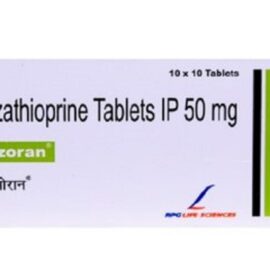
- Azoran (azathioprine 50 mg) — klassieke immunosuppressieve DMARD
- Lefuheal (leflunomide) — orale DMARD voor reumatoïde artritis
- Conimune ME (cyclosporine) - calcineurineremmer
- Wysolone (prednisolon 5 / 10 / 20 mg) — oraal corticosteroïd
- Medrol (methylprednisolon 4 / 8 / 16 mg) — oraal corticosteroïd
- Predniheal (prednisolon) — oraal corticosteroïd
- Hisone (hydrocortison) — fysiologisch vervangend steroïd
- Budez CR (budesonide) — darmgericht corticosteroïd voor de ziekte van Crohn
- Kenacort (triamcinolon) — systemisch corticosteroïd
Ontdek het volledige Ontstekingsremmende & Auto-immuunzorg category.
Veelgestelde vragen
Hoe meet ik Kidpred Siroop nauwkeurig af?
Gebruik de bijgeleverde gekalibreerde orale spuit of maatbeker, NIET een huishoudelijke theelepel. Huishoudelijke theelepels variëren van 2,5 tot 7,5 ml, wat betekent dat het gebruik ervan een 3-voudige doseringsfout introduceert. Als het bijgeleverde maatgereedschap kwijt is, vraag dan bij de apotheek om een vervangende orale spuit of koop er apart een. Lees altijd de sterkte per ml op het flesetiket en bereken het dosisvolume voordat u afmeet.
Zal Kidpred Siroop de groei van mijn kind remmen?
Een korte kuur van 3–5 dagen voor astma of kroep heeft geen waarneembaar effect op de langetermijngroei. Herhaalde korte kuren (bijvoorbeeld meerdere astmakuren per jaar) veroorzaken een kleine, meestal omkeerbare vermindering van de groeisnelheid. Langdurige dagelijkse kuren (maanden of jaren, bijvoorbeeld voor nefrotisch syndroom of ernstige juveniele artritis) veroorzaken cumulatieve groeiremming die gedeeltelijk herstelbaar kan zijn na stoppen bij jongere kinderen, minder naarmate het kind de puberteit nadert. Kinderartsen monitoren lengte, gewicht en groeisnelheid bij elk bezoek tijdens langdurige kuren, en zullen waar mogelijk overschakelen op om de dag doseren of steroïdenbesparende middelen om de impact te minimaliseren.
Mijn kind wordt erg hyperactief en prikkelbaar van Kidpred Syrup — is dit normaal?
Ja, dit is een van de meest voorkomende klachten van ouders. Gedragsverandering — prikkelbaarheid, agitatie, hyperactiviteit, slaapstoornissen, soms lijkt het alsof het een ander kind is — komt veel voor bij steroïdenkuren bij kinderen. Dit verdwijnt meestal binnen een paar dagen na het afronden van de kuur. Maatregelen: dosering alleen in de ochtend, een consistent slaapritueel, minder schermtijd, meer tijd buiten. Ernstige gedragsverandering (hallucinaties, duidelijke psychose, gevaarlijke agressie) komt niet vaak voor, maar vereist evaluatie door de voorschrijver en mogelijk dosisvermindering of vroegtijdige stopzetting.
Mijn kind heeft de dosis uitgebraakt — moet ik het opnieuw geven?
Als het braken binnen 30 minuten na de dosis plaatsvindt, geef dan de volledige dosis opnieuw. Als het braken tussen 30 minuten en 2 uur plaatsvindt, geef dan de halve dosis opnieuw. Als het braken na 2 uur plaatsvindt, is de dosis opgenomen — herhaal niet. Als het kind herhaaldelijk braakt en de orale steroïden niet binnen kan houden, neem dan contact op met de voorschrijver — mogelijk wordt overgeschakeld op IV/IM toediening in het ziekenhuis, vooral als de onderliggende aandoening (acute astma, ernstige allergische reactie, opflakkering van nefrotisch syndroom) voortdurende steroïdenbehandeling vereist.
Kan mijn kind naar school met Kidpred Syrup?
Ja, in de meeste gevallen. Informeer de schoolverpleegkundige en de leerkracht dat het kind een steroïdenkuur volgt. Twee specifieke zorgen: (1) ernstige blootstelling aan varicella — als er een geval van waterpokken in de klas is en uw kind niet immuun is (geen voorgeschiedenis van waterpokken of vaccinatie), waarschuw dan onmiddellijk de voorschrijver voor mogelijke varicella zoster immunoglobuline (VZIG); (2) ernstige blootstelling aan mazelen — hetzelfde principe. Vermijd waar mogelijk contact met zieken; anders is normale schoolgang prima.
Kan mijn kind routinevaccinaties krijgen met Kidpred Syrup?
Geïnactiveerde vaccins — griep (injectie, niet nasaal), pneumokokken, COVID-19, hepatitis A/B, HPV, meningokokken — zijn veilig en aanbevolen bij elke steroïdendosis. Levende vaccins — BMR, varicella, BCG, orale polio (waar gebruikt), gele koorts, levende nasale griep, levende Zostavax — zijn gecontra-indiceerd bij ≥ 2 mg/kg/dag prednisolon voor meer dan 14 dagen, en gedurende 3 maanden na stopzetting. Plan waar mogelijk alle levende vaccinaties vóór het starten van een langdurige kuur.
Waarom de dosis 's ochtends geven?
Het eigen cortisol van het lichaam piekt tussen 6 en 9 uur 's ochtends. Ochtenddosering van prednisolon bootst dit natuurlijke patroon na, onderdrukt de HPA-as minder dan avonddosering en vermindert slapeloosheid. Bij zeer langdurig gebruik bij kinderen (bijv. onderhoud bij nefrotisch syndroom) wordt soms voorkeur gegeven aan om de dag ochtenddosering om enige HPA-herstel op rustdagen mogelijk te maken terwijl de ziektecontrole behouden blijft.
Mijn kind gebruikt al een paar weken Kidpred Syrup en heeft nu koorts — wat moet ik doen?
Informeer de voorschrijvend arts dezelfde dag. Een kind dat langdurig steroïden gebruikt, heeft een verminderd vermogen om koorts en een immuunreactie op te bouwen, dus elke koorts kan wijzen op een mogelijke ernstige infectie. Veelvoorkomende zaken om te overwegen: longontsteking, urineweginfectie, huidinfectie, atypische longontsteking, blootstelling aan waterpokken als het kind niet immuun is. Het kind heeft mogelijk ook een TIJDELIJKE VERHOGING van de steroïdendosis nodig (ziektedagregeling) in plaats van een verlaging — vraag de voorschrijvend arts bij aanvang van een kuur langer dan 2–3 weken om duidelijke richtlijnen voor ziektedagen.
Wanneer kan ik stoppen met Kidpred Syrup?
Voor korte kuren (3–7 dagen voor astma, kroep, allergie), stop aan het einde van de geplande kuur — geen afbouw nodig. Voor kuren langer dan 5–7 dagen, volg het afbouwschema van de voorschrijvend arts. Stop nooit plotseling met een lange kuur. Als u vergeten bent te vragen over afbouwen en het flesje bijna leeg is, neem dan contact op met de voorschrijvend arts voor een afbouwplan in plaats van abrupt te stoppen. Afbouwen is uw vangnet tegen een bijniercrisis.
Waarom bestellen bij MedsBase
Kidpred Syrup wordt geleverd door een WHO-GMP gecertificeerde fabrikant met volledige COA-documentatie. Wij verzenden wereldwijd in eenvoudige, discrete verpakkingen en elke bestelling wordt gedekt door onze Reshipment Assurance-beleid. Uw betalingsbeschrijving bij betaling per kaart toont de gereguleerde betalingsverwerker (een gereguleerde kaartbetalingverwerker), nooit “MedsBase” of een medicijnnaam.
Andere ontstekingsremmende en auto-immuun medicijnen
Als Kidpred Syrup niet geschikt is voor uw situatie, zijn de volgende opties beschikbaar in deze categorie:
- Wysolone (Prednisolon 5/10/20 mg, Wyeth) — volwassen tablet-equivalent
- Predniheal (Prednisolon 5/10/20/40 mg, Healing Pharma) — volledig sterktebereik
- Medrol (Methylprednisolon 4/8/16 mg, Pfizer) — alternatief oraal steroïd
- Kenacort (Triamcinolon 4 mg, Abbott) — gefluorideerd, geen vochtretentie
- Betnesol Tab (Betamethason 0,5 mg) — langwerkend steroïd
Meer opties in ontstekingsremmende en auto-immuunzorg
Gerangschikt op recente bestelvolumes van MedsBase — wat andere klanten in deze categorie kiezen.


| Sterkte | 60 mg |
|---|---|
| Hoeveelheid | 1 Fles/s, 2 Flessen/s, 3 Flessen/s, 6 Flessen/s |
 Kidpred-siroop
Vragen & antwoorden
Kidpred-siroop
Gerelateerde producten

Beoordelingen
Er zijn nog geen beoordelingen