







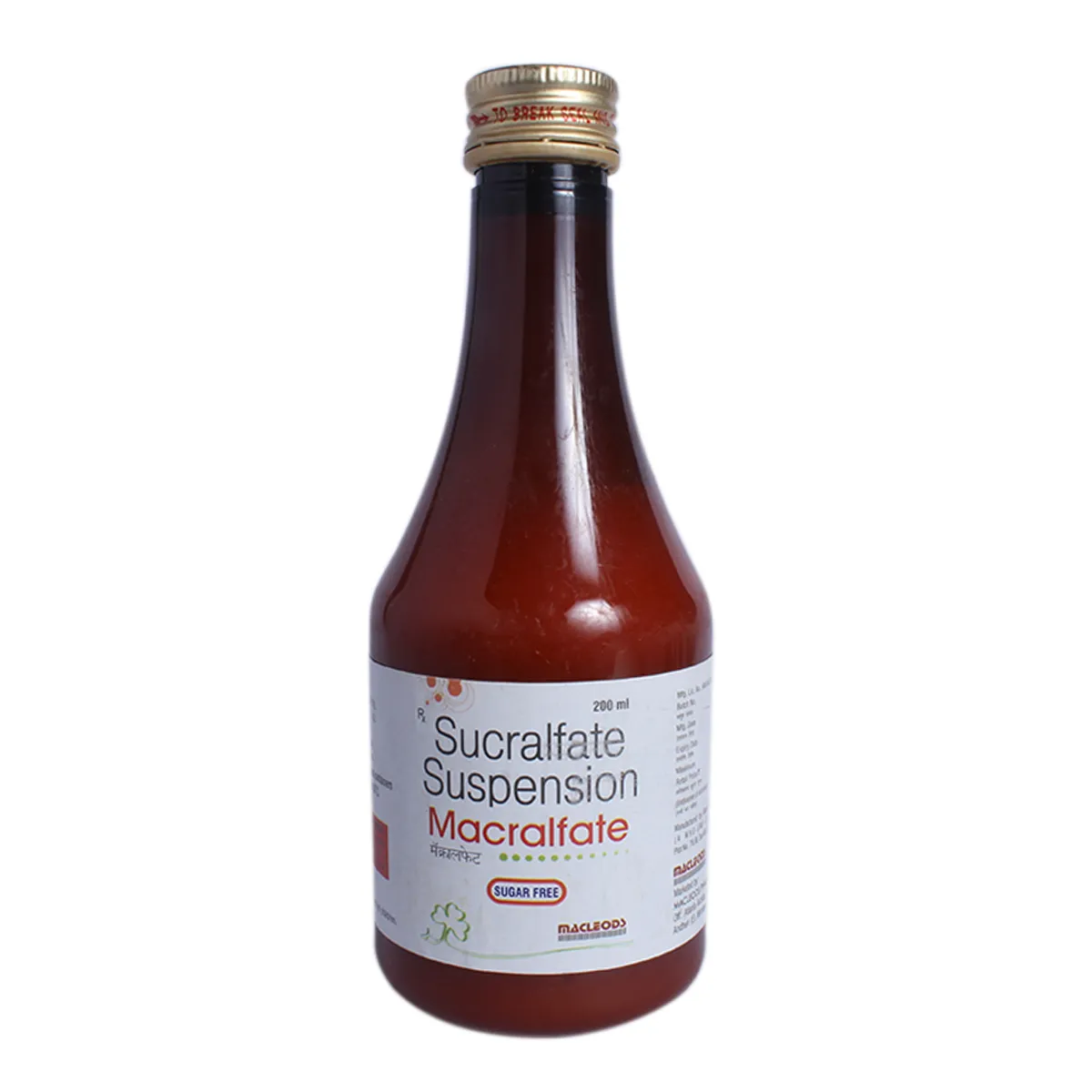
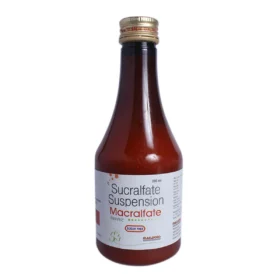
Macralfaat Suspensie
✅ Verlicht maagklachten
✅ Bevordert genezing van zweren
✅ Vormt een beschermende barrière
✅ Vermindert zuurschade
✅ Verzacht geïrriteerde maag
Macralfate Suspension bevat Sucralfate.
✓ Medisch beoordeeld door Morgan Ellis — Apotheekonderzoeker · 8 jaar ervaring · Laatst beoordeeld: mei 2026
⚡ Snel antwoord — Wat is Macralfate Suspension?
Macralfaat Suspensie bevat sucralfate 1 g per 10 mL in een flesje van 200 mL, van een WHO-GMP gecertificeerde fabrikant. Sucralfate is een mucosa-beschermer, geen zuurremmend medicijn — het is een aluminium-sucrose-octasulfaatcomplex dat polymeriseert tot een viskeuze, hechtende pasta in de zure omgeving van de maag en selectief bindt aan het oppervlak van zweren en erosies, waardoor het een fysieke beschermende barrière vormt voor 6–8 uur. Standaard dosering voor volwassenen: 10 mL (1 g) vier keer per dag op een lege maag — één uur voor de maaltijd en voor het slapengaan — gedurende 4–8 weken. Geschikt voor genezing van maagzweren, galrefluxgastritis, NSAID-ulcusprofylaxe, stralingsgeïnduceerde oesofagitis en chemotherapie-gerelateerde orale mucositis (off-label). Belangrijke timingregel: sucralfate bindt veel andere medicijnen en vermindert hun opname — houd sucralfate minstens 2 uur gescheiden van alle andere orale medicijnen. Vermijd bij dialysepatiënten (aluminiumophoping).
📦 Elke bestelling is gedekt door onze Reshipment Assurance-beleid — als uw pakket niet binnen 20 werkdagen arriveert, sturen wij het opnieuw.
Waarom bestellen bij MedsBase
Onze generieke medicijnen zijn afkomstig van WHO-GMP gecertificeerde fabrikanten en worden wereldwijd verzonden in discrete, eenvoudige verpakkingen — geen medicijnnaam op de buitenkant van het pakket. Betalingen met kaart worden verwerkt via een gereguleerde processor (betalingsoverzichten vermelden een gereguleerde kaartbetalingprocessor — nooit “MedsBase” of een medicijnnaam). Crypto en SEPA bankoverschrijvingen worden ook geaccepteerd. Elke bestelling wordt ondersteund door ons Reshipment Assurance Policy.
Wat Macralfate is
Macralfate Suspension is een orale suspensie van sucralfate — het basische aluminiumzout van sucrose octasulfaat. Elke 10 mL bevat 1 g sucralfate; de fles van 200 mL biedt daarom 20 doses. Sucralfate is een ongebruikelijk geneesmiddel omdat het niet wordt opgenomen in enige klinisch relevante hoeveelheid — het werkt volledig lokaal in het darmlumen.
Hoe Macralfate werkt (werkingsmechanisme)
In de zure omgeving van de maag (pH < 4) ondergaat sucralfate protonering en polymerisatie tot een viskeuze, kleverige, negatief geladen pasta. Zweren en erosies laten positief geladen eiwitten (vooral albumine en fibrinogeen) op hun oppervlak bloot, waaraan het negatief geladen sucralfate polymeer selectief bindt. Het resultaat is een fysieke, hechtende beschermende laag over het zweeroppervlak die 6–8 uur aanhoudt en bestand is tegen erosie door zuur, pepsine en galzouten. Sucralfate stimuleert ook lokale prostaglandine- en bicarbonaatafscheiding aan het mucosale oppervlak, verhoogt de binding van epidermale-groeifactor en vermindert de pepsineactiviteit. Het vermindert niet de maagzuursecretie — als u ook zuurremming nodig heeft (de meeste patiënten met een maagzweer hebben dit), wordt een PPI of H2 antagonist toegevoegd.
Omdat sucralfate een zure omgeving nodig heeft om te polymeriseren, neem het niet samen in met een PPI of H2 antagonist — scheid de twee door minstens 30–60 minuten (eerst sucralfate, dan het zuurremmende middel na de maaltijd werkt goed).
Indicaties — Wat Macralfate behandelt
1. Maagzweer — maag- en duodenumzweer
Sucralfate geneest duodenumzweren in 4 weken en maagzweren in 8 weken bij een dosering van 1 g vier keer per dag. De genezingspercentages zijn vergelijkbaar met H2 -antagonisten; PPI's zijn effectiever en werken sneller, maar sucralfate is nuttig waar PPI gecontra-indiceerd is of waar de patiënt de voorkeur geeft aan een niet-systemische optie.
2. Galreflux gastritis
Waar maagzuur niet het probleem is (post-gastrectomie, post-cholecystectomie galreflux), bieden PPI's weinig voordeel. De mechanische mucosale coating van sucralfate helpt in deze situatie en is een van de weinige zuurgerelateerde therapieën met een gedefinieerde niche hier.
3. NSAID-geassocieerde gastritis en ulceraprofylaxe
Voor patiënten met een lager risico onder chronische NSAID-therapie kan sucralfate gastritis en ulceraontwikkeling verminderen. PPI's zijn effectiever en zijn eerste keuze bij patiënten met een hoger risico.
4. Radiatie-oesofagitis en proctitis
Sucralfate suspensie vermindert pijn en versnelt genezing bij stralingsgeïnduceerde oesofagitis (hoofd-halskankerbehandeling) en stralingsproctitis (bekkenbestraling). De suspensie kan worden ingeslikt als een oesofaguscoating, of worden gebruikt als retentie-enema voor proctitis.
5. Door chemotherapie geïnduceerde orale mucositis (off-label)
Sucralfaatsuspensie gebruikt als mondspoeling om te gorgelen en uit te spugen, of te gorgelen en door te slikken, vermindert pijn en de ernst van zweren tijdens mucositis door chemotherapie. Het bewijs is beperkt maar ondersteunend.
6. Stressulcusprofylaxe (geselecteerde ICU-populaties)
Sommige ICU-praktijken zijn teruggeschakeld naar sucralfaat of H2 2-antagonisten voor stressulcusprofylaxe bij geselecteerde geventileerde patiënten, omdat PPI's ventilator-geassocieerde pneumonie en C. difficile percentages verhogen. Specialistische intensive-care beslissing.
7. Refractaire GERD — aanvulling op PPI
Bij refractaire reflux ondanks geoptimaliseerde PPI-therapie kan het toevoegen van sucralfaatsuspensie symptoomverlichting geven door fysiek de geërodeerde distale slokdarm te bedekken. Neem direct voor het slapengaan in als een beschermende dosis.
Dosering
| Indicatie | Dosering | Duur |
|---|---|---|
| Genezing van maagzweren | 10 mL (1 g) vier keer per dag op een lege maag | 4–8 weken |
| Onderhoud bij maagzweren | 10 mL tweemaal daags op een lege maag | zo nodig |
| NSAID-profylaxe | 10 mL tweemaal daags | duur van NSAID-therapie |
| Radiatie-oesofagitis | 10 mL vier keer per dag, langzaam doorslikken | duur van bestraling + 2 weken |
| Bestralingsproctitis | 10 mL retentie-enema BD | onder begeleiding van een specialist |
| Orale mucositis (off-label) | 10 mL spoelen-en-uitspugen vier keer per dag | 2–4 weken |
Innemen op een lege maag — één uur voor de maaltijd en voor het slapengaan, vier keer per dag. Het medicijn heeft een zure omgeving nodig om te polymeriseren; voedsel en maagzuurremmers verminderen beide de effectiviteit. Schud de fles goed voor elke dosis.
CRITICAL: Medicijntimingregel
Bijwerkingen
Sucralfaat wordt bijzonder goed verdragen omdat het niet wordt opgenomen.
Vaak (1–5%):
- Obstipatie (de meest voorkomende bijwerking; komt voor bij ~2% van de gebruikers)
- Droge mond
- Lichte misselijkheid
- Metaalachtige smaak
Zeldzaam maar belangrijk:
- Aluminiumtoxiciteit bij dialysepatiënten en ernstige chronische nierziekte — sucralfaat is een aluminiumzout; ondanks minimale absorptie kan ophoping bij chronische nierziekte encefalopathie, osteomalacie en microcytaire anemie veroorzaken. Vermijd bij dialyse.
- Hypofosfatemie (zeldzaam, bij langdurig gebruik)
- Bezoarvorming in de maag (zeer zeldzaam; gemeld bij ICU-patiënten met enterale voeding)
- Overgevoeligheidsuitslag
Geneesmiddelinteracties buiten de timingregel
Sucralfaat heeft geen enzym-gemedieerde geneesmiddelinteracties. Alle klinisch relevante interacties zijn absorptiegerelateerd en worden opgelost door doses met 2 uur te scheiden. De volledige lijst van geneesmiddelen waarvan de absorptie door sucralfaat wordt beïnvloed, is te lang om op te sommen — de veilige regel is: neem alle andere orale medicijnen minstens 2 uur gescheiden van sucralfaat in.
Contra-indicaties en voorzorgsmaatregelen
- Bekende overgevoeligheid voor sucralfaat
- Ernstige chronische nierziekte (vooral dialyse) — ophoping van aluminium
- Darmobstructie of ernstige obstipatie
- Te vroeg geboren baby's en zeer jonge kinderen — risico op bezoar
Zwangerschap, Borstvoeding en Kinderen
Zwangerschap: Sucralfaat is een van de veiligere opties bij zuurgerelateerde klachten tijdens de zwangerschap omdat het niet wordt opgenomen. Geschikt voor zwangerschapsreflux die niet reageert op leefstijlmaatregelen en antacida.
Borstvoeding: Compatibel — wordt niet opgenomen.
Kinderen: Gebruikt bij pediatrische maagzweren en mucositis door bestraling/chemotherapie. Dosering op basis van gewicht 40–80 mg/kg/dag in 4 verdeelde doses (max 1 g/dosis). Vermijd bij te vroeg geboren baby's en pasgeborenen.
Opslag
Bewaren bij 15–30 °C in de originele verpakking. Niet invriezen. Goed schudden voor elke dosis — de suspensie zet neer. Weggooien 30 dagen na eerste opening als er geen datum op het etiket staat aangegeven, of eerder als de suspensie van uiterlijk verandert.
Veelgestelde vragen
Verlaagt Macralfaat maagzuur?
Nee. Sucralfaat heeft geen invloed op de zuurproductie. Het werkt door fysiek zweren en erosies te bedekken, waardoor ze beschermd worden terwijl ze genezen. Als u ook zuurremming nodig heeft (de meeste maagzweerpatiënten hebben dit), wordt een PPI of H2 antagonist toegevoegd — sucralfaat vult deze aan in plaats van ze te vervangen.
Waarom moet ik het op een lege maag innemen?
Sucralfaat heeft een zure omgeving (pH < 4) nodig om te polymeriseren tot zijn beschermende gelvorm. Voedsel in de maag buffert zuur en vermindert de effectiviteit van sucralfaat. Antacida, PPI's en H2 antagonisten verhogen ook de pH en verminderen de effectiviteit van sucralfaat als ze tegelijkertijd worden ingenomen — neem ze met een tussenpoos van minimaal 30–60 minuten.
Hoe snel werkt het?
Sucralfaat geeft een verzachtend lokaal effect bijna direct bij contact, maar genezing van zweren duurt de gebruikelijke 4 weken (duodenum) tot 8 weken (maag). Het is geen snelwerkend symptoommedicijn zoals een antacidum.
Kan ik het samen met mijn levothyroxine innemen?
Niet tegelijkertijd — sucralfaat vermindert de opname van levothyroxine aanzienlijk. Neem levothyroxine zoals gewoonlijk 's ochtends eerst op de nuchtere maag, en neem sucralfaat minstens 2 uur later (bijvoorbeeld voor de lunch). Als uw doseringsschema de 2-uurs interval niet toelaat, controleer dan na 6–8 weken het TSH opnieuw en pas zo nodig de levothyroxinedosis aan.
Is Macralfate veilig tijdens de zwangerschap?
Ja — een van de voorkeursopties voor zuurgerelateerde klachten tijdens de zwangerschap omdat het niet wordt opgenomen. Sucralfaat wordt aanbevolen na antacida en leefstijlmaatregelen en vóór PPI's bij zwangerschapsreflux.
Waarom is het niet veilig voor dialysepatiënten?
Sucralfaat is een aluminiumzout. Hoewel de hoeveelheid die wordt opgenomen minimaal is, scheiden gezonde nieren het zonder problemen uit. Dialysepatiënten kunnen aluminium niet verwijderen en kunnen het na verloop van tijd ophopen, wat kan leiden tot aluminiumgerelateerde encefalopathie, osteomalacie en microcytaire anemie. Vermijd sucralfaat bij dialyse; gebruik in plaats daarvan H2 antagonisten of PPI's.
Kan ik het combineren met een PPI?
Ja — dit is een erkende strategie bij refractaire maagzweren, ernstige oesofagitis en galreflux-gastritis. Neem het sucralfaat één uur voor de maaltijd en de PPI 30–60 minuten voor dezelfde maaltijd — de PPI zorgt voor basale zuurremming terwijl het sucralfaat een fysieke mucosale beschermlaag biedt.
Veroorzaakt Macralfate verstopping?
Ja — de meest voorkomende bijwerking, bij ongeveer 2% van de gebruikers. Producten die aluminium bevatten, hebben de neiging verstopping te veroorzaken. Verhoog de waterinname, voedingsvezels en lichaamsbeweging. Als de verstopping hinderlijk is, overleg dan met uw voorschrijver of sucralfaat kan worden gepauzeerd of vervangen door een alternatief.
Wordt het opgenomen in de bloedbaan?
Minder dan 5% wordt opgenomen onder normale darmomstandigheden, en het grootste deel daarvan is het aluminiumgedeelte dat vervolgens via de nieren wordt uitgescheiden. Het intacte sucralfaatpolymer is in wezen beperkt tot het darmlumen en bereikt de systemische circulatie niet in klinisch relevante hoeveelheden.
Kan het worden gebruikt voor mondzweren?
Ja, off-label — de suspensie die in de mond wordt gespoeld als een spoel-en-spuug (of spoel-en-slik) geeft symptomatische verlichting en versnelt de genezing bij mucositis door chemotherapie/bestraling en bij ernstige afteuze stomatitis. Beperk dit tot 4 keer per dag gedurende 2–4 weken.
Gerelateerde alternatieven
Andere producten in Algemene gezondheid die klanten ook bekijken:
Meer opties in de behandeling van maagzuurreflux
Gerangschikt op recente bestelvolumes van MedsBase — wat andere klanten in deze categorie kiezen.

| Sterkte | 200 ml |
|---|---|
| Hoeveelheid | 1 Fles/s, 2 Flessen/s, 3 Flessen/s, 6 Flessen/s |
 Macralfaat Suspensie
Vragen & antwoorden
Macralfaat Suspensie
Gerelateerde producten


Beoordelingen
Er zijn nog geen beoordelingen