







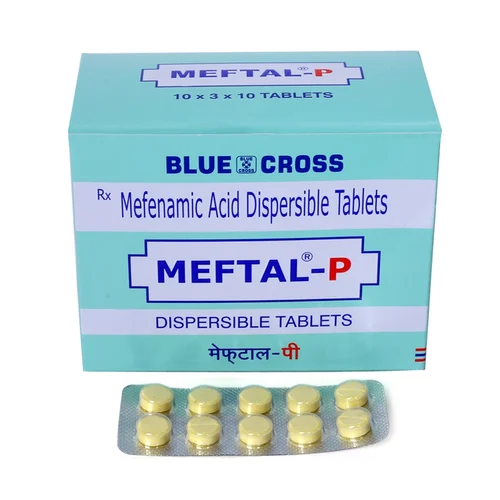
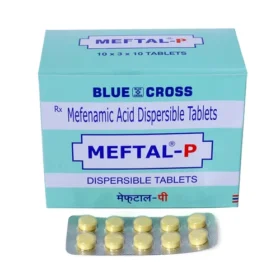
Meftal-P
✅ Verlicht menstruatiepijn
✅ Verlaagt koorts snel
✅ Verlicht hoofdpijnklachten
✅ Vermindert spierkrampen
✅ Behandelt tandpijn
Meftal-P bevat Mefenamic Acid.
✓ Medisch beoordeeld door Morgan Ellis — Apotheekonderzoeker · 8 jaar ervaring · Laatst beoordeeld: mei 2026
⚡ Kort antwoord — Wat is Meftal-P?
Meftal-P is een mefenamic acid 100 mg tablet — de pediatrische of lage doseringssterkte van dit NSAID uit de fenamaatklasse. Het wordt gebruikt voor koorts, milde tot matige pijn en menstruatiepijn. Bij kinderen is de dosering gewichtgebaseerd (~6,5 mg/kg driemaal daags); volwassenen nemen meestal 2 tot 3 tabletten (200–300 mg) driemaal daags. Neem in met voedsel. Mefenaminezuur heeft een bijzonder sterke onderzoeksbasis voor primaire dysmenorroe (menstruatiepijn), waar het tot de meest effectieve NSAID's behoort.
📦 Elke bestelling is gedekt door onze Reshipment Assurance-beleid — als uw pakket niet binnen 20 werkdagen arriveert, sturen wij het opnieuw.
Waarom bestellen bij MedsBase
Onze generieke medicijnen zijn afkomstig van WHO-GMP gecertificeerde fabrikanten en worden wereldwijd verzonden in discrete, eenvoudige verpakkingen — geen medicijnnaam op de buitenkant van het pakket. Betalingen met kaart worden verwerkt via een gereguleerde processor (betalingsoverzichten vermelden een gereguleerde kaartbetalingprocessor — nooit “MedsBase” of een medicijnnaam). Crypto en SEPA bankoverschrijvingen worden ook geaccepteerd. Elke bestelling wordt ondersteund door ons Reshipment Assurance Policy.
Meftal-P 100 mg is een tablet van mefenamic acid, een niet-selectief NSAID uit de fenamaatchemische klasse. De 100 mg sterkte is de pediatrische doseringstablet in veel markten; het wordt ook gebruikt in meervoudige tabletten doseringen bij volwassenen wanneer een lage startdosis of fijne titratie de voorkeur heeft. De hoogsterkte vorm voor volwassenen is de 250 mg en 500 mg Meftal tablet.
Mefenaminezuur is opmerkelijk vanwege zijn sterke effect op primaire dysmenorroe (menstruatiepijn). Het pijnmechanisme van dysmenorroe wordt aangedreven door de productie van prostaglandinen in de baarmoeder, en mefenaminezuur blokkeert zowel de prostaglandinesynthese (COX-remming) als de werking van prostaglandinen op de receptor — een dubbel werkingsmechanisme dat het een licht voordeel geeft ten opzichte van ibuprofen in sommige directe vergelijkende onderzoeken bij dysmenorroe.
Waar wordt Meftal-P voor gebruikt?
- Koorts bij kinderen (gebruik bij kinderen, dosering op basis van gewicht)
- Milde tot matige pijn bij kinderen en volwassenen — hoofdpijn, tandpijn, spier- en gewrichtspijn, pijn na vaccinatie
- Primaire dysmenorroe — menstruatiekrampen (volwassenen; gebruik de 500 mg tablet bij hogere doseringen)
- Menorragie — hevig menstrueel bloedverlies, om zowel het bloedverlies als de pijn te verminderen
- Posttraumatische pijn in zachte weefsels bij oudere kinderen
- Juveniele idiopathische artritis — specialistische begeleiding
Dosering Meftal-P
- Kinderen ≥ 6 maanden tot 14 jaar: ongeveer 6,5 mg/kg per dosis, drie keer per dag, na het eten. Voor een kind van 15 kg is dat één tablet van 100 mg drie keer per dag. Maximale behandelduur: 7 dagen.
- Adolescenten en volwassenen: 200–300 mg (2–3 tabletten) driemaal daags na de maaltijd, maximaal 7 dagen voor acute indicaties. Voor dysmenorroe wordt meestal de hogere sterkte van 250 of 500 mg Meftal-tablet voorkeur gegeven.
- Ouderen: laagste effectieve dosis; mefenaminezuur heeft meer kans op maag-darm- en nierbijwerkingen bij oudere patiënten.
Neem altijd in met voedsel of melk. Slik heel door met water. Meftal-P tabletten zijn klein genoeg om indien nodig te kunnen worden gehalveerd voor gewichtsgebonden dosering bij kinderen. Voor zeer jonge kinderen is de pediatrische suspensie vaak handiger.
Hoe Werkt Mefenaminezuur?
Mefenaminezuur is een niet-selectieve cyclo-oxygenaseremmer (blokkeert zowel COX-1 als COX-2), die de prostaglandinesynthese vermindert op plaatsen van ontsteking, letsel en in de baarmoeder. In tegenstelling tot andere NSAID's heeft mefenaminezuur ook een direct antagonistische werking op prostaglandinereceptoren — wat bijdraagt aan de specifieke effectiviteit bij menstruatiepijn en baarmoeder-gerelateerde pijn.
GI-veiligheid. Meftal-P (of het NSAID-bestanddeel) brengt een reëel risico op gastritis, maagzweer en bovenste maag-darmbloedingen met zich mee. Het risico is het hoogst bij patiënten ouder dan 65 jaar, bij mensen met een voorgeschiedenis van maagzweren en bij iedereen die ook lage doses aspirine, corticosteroïden, SSRI's of antistollingsmiddelen gebruikt. Neem in met voedsel, in de laagste effectieve dosis voor de kortst mogelijke tijd, en overleg met uw arts over het toevoegen van een protonpompremmer (omeprazol, pantoprazol) voor behandelingen langer dan 2–4 weken.
Wie Moet Geen Meftal-P Gebruiken?
- Bekende overgevoeligheid voor mefenaminezuur of enige NSAID
- Actieve maagzweer of voorgeschiedenis van maag-darmbloedingen
- Ontstekingsopvlamming van de darmen (mefenaminezuur wordt specifiek geassocieerd met diarree en colitis-opvlammingen)
- Ernstig hartfalen, vastgestelde ischemische hartziekte
- Ernstige lever- of nierfunctiestoornis
- Derde trimester van de zwangerschap
- Astma, urticaria of angio-oedeem veroorzaakt door aspirine of NSAID's
Bijwerkingen
- Vaak voorkomend: diarree (vooral kenmerkend voor mefenaminezuur — meer dan andere NSAID's), dyspepsie, misselijkheid, buikpijn, hoofdpijn, duizeligheid, huiduitslag
- Minder vaak voorkomend: maagzweer, GI-bloeding, verhoogde leverenzymen, verminderde nierfunctie, verhoogde bloeddruk
- Zeldzaam maar ernstig: ernstige colitis, hemolytische anemie, acuut nierletsel, Stevens-Johnson-syndroom, toevallen (vooral bij overdosering)
Stop mefenaminezuur onmiddellijk als aanhoudende of bloederige diarree optreedt — dit is een bekende bijwerking die niet altijd verdwijnt door de behandeling voort te zetten.
Bestellen & Levering
MedsBase biedt wereldwijde verzending bij elke bestelling. Bestellingen worden verzonden in discrete verpakkingen en arriveren in verpakkingen van de fabrikant. Als uw gewenste verpakkingsmaat niet op voorraad is, neem dan contact op met de klantenservice voor een verwachte leverdatum.
Medisch disclaimer. De informatie op deze pagina is alleen bedoeld voor algemene educatie. Het is geen vervanging voor advies van uw eigen arts of apotheker. Overleg met een gekwalificeerde zorgverlener voordat u een therapie start, stopt of wijzigt, vooral als u een voorgeschiedenis heeft van maagzweer, hartaandoeningen, nieraandoeningen, astma, leveraandoeningen of als u zwanger bent.
Veelgestelde vragen
Waar wordt Meftal-P voor gebruikt?
Meftal-P (mefenaminezuur 100 mg) wordt gebruikt voor koorts, milde tot matige pijn en menstruatiepijn. Bij kinderen is het een op gewicht gebaseerd koorts- en pijnmedicijn; bij volwassenen wordt het gebruikt in doses van 2–3 tabletten of, vaker, wordt de hogere sterkte Meftal 250/500 mg gebruikt.
Is Meftal-P alleen voor kinderen?
Nee — de 100 mg sterkte is gelabeld voor kinderen, maar wordt ook gebruikt bij volwassenen wanneer een nauwkeurige dosering of lage dosis de voorkeur heeft. Voor volwassen dysmenorroe en pijn is de 250 of 500 mg Meftal-tablet meestal praktischer.
Hoe verschilt mefenaminezuur van ibuprofen?
Beide zijn niet-selectieve NSAID's. Mefenaminezuur heeft een licht voordeel bij dysmenorroe omdat het ook prostaglandinereceptoren direct blokkeert. Het veroorzaakt vaker diarree als bijwerking en wordt meestal voor kortere periodes gebruikt dan ibuprofen.
Hoe geef ik Meftal-P aan een kind?
De dosis is ongeveer 6,5 mg per kg lichaamsgewicht, 3 keer per dag, na de maaltijd, voor maximaal 7 dagen. Een kind van 15 kg krijgt ongeveer één 100 mg tablet drie keer per dag. Controleer altijd bij een kinderarts en gebruik een weegschaal — schat het gewicht niet.
Kan ik Meftal-P op een lege maag geven?
Nee — geef het altijd na voedsel of melk. Mefenaminezuur op een lege maag veroorzaakt vaak direct indigestie.
Waarom veroorzaakt Meftal-P bij sommige mensen diarree?
Mefenaminezuur heeft een specifiek, relatief vaak voorkomend verband met diarree dat niet in dezelfde mate geldt voor andere NSAID's. Het mechanisme is niet volledig begrepen, maar hangt waarschijnlijk samen met effecten op darmprostaglandinen. Aanhoudende of bloederige diarree is een reden om te stoppen.
Hoe lang mag ik Meftal-P gebruiken?
Korte kuren (tot 7 dagen) voor acute pijn of koorts. Voor dysmenorroe meestal 2–3 dagen per menstruatiecyclus.
Is Meftal-P veilig tijdens de zwangerschap?
Vermijd na 20 weken; gecontra-indiceerd in het derde trimester. Gebruik in de vroege zwangerschap alleen op medisch advies; paracetamol is eerste keus.
Kan mijn kind paracetamol en Meftal-P samen gebruiken?
Ja. Ze werken via verschillende mechanismen en kunnen worden afgewisseld of gecombineerd in correct afgewogen pediatrische doseringen. Dit is gangbare praktijk bij aanhoudende hoge koorts bij kinderen onder pediatrisch toezicht.
Kunnen volwassenen Meftal-P gebruiken voor menstruatiekrampen?
Ja, hoewel de Meftal-tablet van 250 of 500 mg meestal handiger is voor volwassen dosering. Bij 100 mg is een typische startdosis voor volwassenen 2 tabletten (200 mg) drie keer daags gedurende de eerste 2–3 dagen van een cyclus.
Wat als een kind moet overgeven na Meftal-P?
Als het braken binnen 30 minuten na inname optreedt, herhaal de dosis eenmaal. Als het braken later dan 30 minuten optreedt, herhaal niet — de meeste opname heeft dan al plaatsgevonden. Bij aanhoudend braken, neem contact op met uw kinderarts.
Gerelateerde alternatieven
Andere producten in Chronische aandoeningen die klanten ook bekijken:
- Voveran Emulgel
- Baclof Vloeistof (Baclofen Oraale Oplossing 5 mg/5 ml) — Verlichting van spasticiteit
- Valance
- Glynase Xl
- Loratin
Meer opties in pijnstillende medicatie
Gerangschikt op recente bestelvolumes van MedsBase — wat andere klanten in deze categorie kiezen.
| Sterkte | 100 mg |
|---|---|
| Hoeveelheid | 30 Tabletten, 60 Tabletten, 90 Tabletten, 180 Tabletten |
 Meftal-P
Vragen & antwoorden
Meftal-P
Gerelateerde producten


Beoordelingen
Er zijn nog geen beoordelingen