









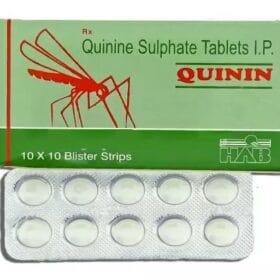
Quinin 300

✅ Verlichting van malaria-symptomen
✅ Koortsverlagend
✅ Uitroeiing van parasieten
✅ Verbeterd herstel
✅ Voorkoming van terugval
Quinin bevat Quinine Sulphate.
✓ Medisch beoordeeld door Morgan Ellis — Apotheekonderzoeker · 8 jaar ervaring · Laatst beoordeeld: mei 2026
Snelle antwoord
Quinin 300 bevat kininesulfaat 300 mg (East African Pharmaceuticals (of generiek 300 mg)). Het is een tweedelijns orale behandeling voor chloroquine-resistente ongecompliceerde P. falciparum malaria — historisch gecombineerd met doxycycline, tetracycline of clindamycine om de behandeling te verkorten en recidief te verminderen. Moderne WHO-richtlijnen geven de voorkeur aan artemisinine combinatietherapie (ACT) waar beschikbaar; kinine blijft in gebruik waar ACT's niet beschikbaar zijn, gecontra-indiceerd zijn of hebben gefaald. Standaard behandelingsdosis: 650 mg elke 8 uur gedurende 3–7 dagen met doxycycline 100 mg tweemaal daags gedurende 7 dagen. Bijwerkingencluster (“cinchonisme” — tinnitus, hoofdpijn, misselijkheid, duizeligheid, wazig zien) komt vaak voor en is dosisbeperkend. NIET voor rusteloze benen krampen (FDA black-box waarschuwing sinds 2010 voor dat off-label gebruik). Gebruik NIET zonder medisch toezicht.
🛡️ Elke bestelling wordt gedekt door onze Reshipment Assurance-beleid — als uw pakket niet binnen 20 werkdagen arriveert, sturen wij een gratis vervanging via EMS of ITPS koerier.
Waarom bestellen bij MedsBase
Quinin 300 is afkomstig van een WHO-GMP gecertificeerde fabrikant en wordt wereldwijd verzonden in discrete verpakking. Elke bestelling wordt ondersteund door onze Reshipment Assurance-beleid en ondersteund door onze 1.400+ klantbeoordelingen. Wereldwijde verzending zonder receptpapieren.
Over Quinin 300
Quinin 300 is een 300 mg kininesulfaat tablet vervaardigd door East African Pharmaceuticals (of generiek 300 mg) onder WHO-GMP gecertificeerde omstandigheden. Kinine is het oorspronkelijke antimalariamiddel — geëxtraheerd uit de bast van de Zuid-Amerikaanse kinaboom door Jezuïetenmissionarissen in de 17e eeuw, geïsoleerd in pure vorm door Pelletier en Caventou in 1820, en de standaard malariabehandeling voor de volgende 100 jaar vóór chloroquine. Het staat nog steeds op de WHO Essential Medicines lijst voor tweedelijns P. falciparum behandeling en als IV-therapie voor ernstige malaria waar IV artesunaat niet beschikbaar is.
Hoe kinine werkt
Kinine is een kinakalkaloïde dat interfereert met de haem-detoxicatie van parasieten in de voedselvacuole — hetzelfde mechanisme als chloroquine en mefloquine. Het is actief tegen bloedstadia van P. falciparum (inclusief de meeste chloroquine-resistente stammen), P. vivax, P. ovale en P. malariae. Het ruimt GEEN slapende hypnozoïeten op — primaquine is nodig voor een radicale genezing van vivax/ovale.
Kinine heeft een korte halfwaardetijd (~11 uur) — driemaal daagse dosering is nodig tijdens behandelingskuren. Het heeft een smal therapeutisch venster: effectiviteit is dosisgerelateerd, maar dat geldt ook voor toxiciteit (cinchonisme, hypoglykemie, QT-verlenging, zeldzame cardiotoxiciteit).
Indicaties en dosering
| Indicatie | Dosering | Opmerkingen |
|---|---|---|
| Ongecompliceerde chloroquine-resistente P. falciparum malaria, volwassenen | 650 mg oraal elke 8 uur gedurende 3 dagen (Afrika) of 7 dagen (Zuidoost-Azië) | Combineer met doxycycline 100 mg BID gedurende 7 dagen, of clindamycine 20 mg/kg/dag tijdens zwangerschap. |
| Ernstige malaria, intraveneus in het ziekenhuis (waar intraveneus artesunaat niet beschikbaar is) | 20 mg/kg laaddosis over 4 uur → 10 mg/kg elke 8 uur intraveneus | Hartmonitoring + glucosemonitoring verplicht. Schakel over op orale 650 mg elke 8 uur zodra verdragen. |
| Babesiosis (B. microti / B. divergens) — tweedelijns | 650 mg elke 6–8 uur met clindamycine of atovaquon-azitromycine | Gespecialiseerde context voor door teken overgedragen ziekten. |
| Kinderen met ongecompliceerde P. falciparum (≥ 6 kg) | 8,3 mg/kg elke 8 uur gedurende 3–7 dagen | In combinatie met gewicht-geschikte doxycycline (≥ 8 jaar) of clindamycine (elke leeftijd). |
Bijwerkingen
- Vaak voorkomend (cinchonisme, ≥ 30%): tinnitus, hoofdpijn, misselijkheid, duizeligheid, wazig zien, mild hoogfrequent gehoorverlies — meestal reversibel na staken.
- Maag-darm: buikpijn, braken, diarree.
- Cardiovasculair: QTc-verlenging, hypotensie (vooral bij snelle IV bolus — quinine nooit IV pushen), hartkloppingen.
- Endocrien: hypoglykemie (kan ernstig zijn, vooral tijdens zwangerschap of bij IV-gebruik).
- Hematologisch: trombocytopenie, hemolytische anemie (bij G6PD-deficiënte patiënten), hemolytisch-uremisch syndroom (zeldzaam maar ernstig — kan fataal zijn).
- Overgevoeligheid: huiduitslag, netelroos, angio-oedeem, anafylaxie, geneesmiddelgeïnduceerde lupus.
- Neurologisch: zelden epileptische aanvallen, optische neuritis, plotseling gehoorverlies.
Geneesmiddelinteracties
| Interactie | Effect | Beheer |
|---|---|---|
| Mefloquine / chloroquine / hydroxychloroquine | Additieve cardiotoxiciteit + verlaagde aanvalsdrempel | Vermijd combinatie — gebruik één antimalariamiddel. |
| Halofantrine | Ernstige additieve QTc-verlenging | Absolute contra-indicatie. |
| Digoxine | Kinine verhoogt digoxineniveau 2–3 keer | Halveer digoxinedosis; monitor digoxineniveau nauwlettend. |
| Warfarine | Kinine versterkt antistollingseffect | Verhoog de frequentie van INR-monitoring. |
| QT-verlengende geneesmiddelen (azithromycine, ondansetron, fluoroquinolonen, antipsychotica, methadon) | Additieve QTc-verlenging | Vermijd combinatie, vooral bij patiënten met elektrolytstoornissen. |
| Sterke CYP3A4-remmers (ketoconazol, ritonavir, clarithromycine) | Verhoogd kininegehalte → cinchonisme / cardiotoxiciteit | Dosisverlaging; vermijd combinatie waar mogelijk. |
| Sterke CYP3A4-induceerders (rifampicine, fenytoïne, carbamazepine, Sint-Janskruid) | Lager kininegehalte → behandelingsfalen | Vermijd combinatie; kies een alternatief antimalariamiddel. |
| Insuline / sulfonylureumderivaten | Additieve hypoglykemie | Controleer de bloedglucose nauwkeurig. |
Contra-indicaties en waarschuwingen
- Absoluut: overgevoeligheid voor kinine, quinidine of verwante cinchona-alkaloïden; bestaande optische neuritis; tinnitus; G6PD-deficiëntie (hemolyse); myasthenia gravis (verergert neuromusculaire blokkade); ernstige geleidingsstoornis (hooggradig AV-blok, ernstige bradycardie, verlengd QTc); gelijktijdig gebruik van halofantrine; trombocytopenische purpura geassocieerd met eerdere kininegebruik.
- Sterke waarschuwing: nier- of leverfunctiestoornissen, atriumfibrilleren met geleidingsdefecten, patiënten gevoelig voor hypoglykemie (diabetici behandeld met insuline / sulfonylureumderivaten, ernstige malaria), zwangerschap (risico op hypoglykemie).
- Zwangerschap: compatibel (met clindamycinepartner). Het risico op hypoglykemie wordt versterkt — nauwlettende glucosemonitoring is vereist.
- Borstvoeding: compatibel — kleine hoeveelheden in moedermelk zijn onvoldoende voor profylaxe of schade bij de zuigeling.
Opslag
Bewaren onder 25 °C op een droge plaats, in de originele verpakking. Buiten bereik van kinderen houden.
Veelgestelde vragen
Is Quinine 300 eerste keus voor malaria?
Nee. Moderne WHO-richtlijnen bevelen artemisinine-combinatietherapie aan (artemether-lumefantrine, dihydroartemisinine-piperaquine, artesunaat-amodiaquine) als eerste keus voor ongecompliceerde P. falciparum-malaria. Kinine is een tweedelijnsoptie wanneer ACT's niet beschikbaar zijn, gecontra-indiceerd zijn of hebben gefaald.
Waarom quinine combineren met doxycycline of clindamycine?
Quinine alleen heeft een langzame parasietverwijderingssnelheid en aanzienlijke recidieven (terugval door achtergebleven parasieten) wanneer het als monotherapie wordt gebruikt bij moderne resistente stammen. Het toevoegen van een partnerdrug (doxycycline, tetracycline of clindamycine tijdens zwangerschap) verkort de effectieve behandelingsduur, vermindert recidieven en verbetert de resultaten.
Wat is cinchonisme en is het gevaarlijk?
Cinchonisme is het cluster van tinnitus, hoofdpijn, misselijkheid, duizeligheid en mild hoogfrequent gehoorverlies dat wordt gezien bij therapeutische doses quinine. Het is oncomfortabel maar meestal omkeerbaar na stoppen. Ernstig cinchonisme (doofheid, vertigo, ernstige misselijkheid, mentale verandering) vereist dosisherziening of overschakeling op een ander antimalariamiddel.
Kan Quinin 300 worden gebruikt tijdens zwangerschap?
Ja — quinine gecombineerd met clindamycine (niet doxycycline, wat gecontra-indiceerd is tijdens zwangerschap) is een erkende optie voor de behandeling van P. falciparum tijdens zwangerschap, vooral in het eerste trimester waar ACT-veiligheidsgegevens beperkt zijn. Het risico op hypoglykemie is verhoogd — nauwlettende glucosemonitoring is vereist.
Kan ik Quinin 300 gebruiken voor nachtelijke beenkrampen?
Nee. De FDA heeft in 2010 een black-box waarschuwing uitgegeven tegen het gebruik van quinine voor nachtelijke beenkrampen of rustelozebenensyndroom — fatale aritmieën, ernstige trombocytopenie en hemolytisch-uremisch syndroom zijn gemeld. Het risico-batenverhouding is onaanvaardbaar voor niet-malaria gebruik.
Is quinine gerelateerd aan quinidine?
Ja — het zijn stereo-isomeren (spiegelbeeldmoleculen) van elkaar, beide geëxtraheerd uit kinabast. Quinidine heeft een krachtiger klasse-Ia antiaritmisch effect en wordt niet langer gebruikt als antimalariamiddel. Quinine behoudt enig antiaritmisch effect — wat de QT-verlenging en cardiale signalen verklaart.
Wat moet ik doen als ik tinnitus of gehoorverlies krijg?
Milde tinnitus komt vaak voor en duidt op therapeutische plasmaspiegels — ga door met de voorgeschreven dosis. Ernstige tinnitus, vertigo of gehoorverlies → zoek medische beoordeling. Plotseling ernstig gehoorverlies kan permanent zijn; wacht niet af.
Waarom is glucosemonitoring nodig?
Quinine stimuleert de insulineafgifte door pancreatische bètacellen. Ernstige hypoglykemie is het gevaarlijkst tijdens zwangerschap, bij IV-gebruik en bij patiënten met sepsis of ernstige malaria. Plotselinge verwardheid, zweten, tachycardie of coma bij een patiënt die quinine gebruikt → controleer onmiddellijk de glucose en geef IV dextrose indien laag.
Kan ik alcohol drinken tijdens het gebruik van Quinin 300?
Vermijd alcohol tijdens de behandeling — het versterkt de CNS-effecten (duizeligheid, hoofdpijn) en belast de lever extra. Hervat na voltooiing van de behandeling.
Hoe zit het met kinine in tonicwater?
Tonicwater bevat een minimale hoeveelheid kinine (FDA-limiet ~ 83 mg/L) — ver onder therapeutische doseringen. Een portie van 250 mL bevat ~ 20 mg kinine, vergeleken met 650 mg per dosis bij malaria-behandeling. Tonicwater heeft geen klinisch significant antimalariaal of schadelijk effect.
Wat als ik een dosis vergeet?
Neem de vergeten dosis zo snel mogelijk in. Neem geen dubbele dosis. De halfwaardetijd van 11 uur betekent dat een vergeten 8-uurlijkse dosis een meetbaar effect heeft op de plasmaspiegel — strikte timing om de 8 uur is belangrijk tijdens de actieve behandeling.
Andere Malaria-tabletten
- Cendox 100 mg — Doxycycline — standaard combinatiemiddel bij kinine voor chloroquine-resistente P. falciparum
- Mefque 250 mg — Mefloquine — wekelijkse profylaxe-optie voor resistente gebieden
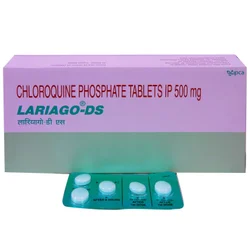
- Lariago 250 mg — Chloroquine — alleen voor chloroquine-gevoelige gebieden
- Primaquine 15 mg — Radicale behandeling voor vivax/ovale terugkerende malaria — G6PD-test vereist
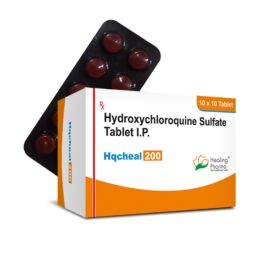
- HCQS 200/400 mg — Hydroxychloroquine — antimalariamiddel + indicaties voor auto-immuunziekten
Meer opties in Malaria Tabletten
Gerangschikt op recente bestelvolumes van MedsBase — wat andere klanten in deze categorie kiezen.


| Sterkte | 300 mg |
|---|---|
| Hoeveelheid | 30 Tabletten, 60 Tabletten, 90 Tabletten, 180 Tabletten |
 Quinin 300
Vragen & antwoorden
Quinin 300
Gerelateerde producten






Beoordelingen
Er zijn nog geen beoordelingen