







Reactin
✅ Pijnverlichting
✅ Ontstekingsremmende eigenschappen
✅ Vermindert zwelling
✅ Verlicht gewrichtsongemak
✅ Beheert symptomen van artritis
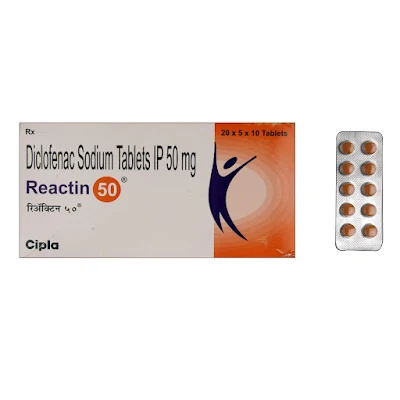
Reactin bevat Diclofenac.
✓ Medisch beoordeeld door Morgan Ellis — Apotheekonderzoeker · 8 jaar ervaring · Laatst beoordeeld: mei 2026
⚡ Kort antwoord — Wat is Reactin?
Reactin is een diclofenac 50 mg tablet (directe afgifte), een krachtig niet-selectief NSAID dat veel wordt gebruikt voor acute en chronische pijn en ontstekingen. De gebruikelijke dosering voor volwassenen is 50 mg driemaal daags bij de maaltijd (maximaal 150 mg/dag). Reactin is geïndiceerd voor artrose, reumatoïde artritis, ankyloserende spondylitis, acute jicht, musculoskeletale letsels, postoperatieve pijn, dysmenorroe en nier-/galkoliek. Diclofenac heeft een hoger cardiovasculair risico dan ibuprofen — gebruik de laagst effectieve dosis voor de kortst mogelijke duur.
📦 Elke bestelling is gedekt door onze Reshipment Assurance-beleid — als uw pakket niet binnen 20 werkdagen arriveert, sturen wij het opnieuw.
Waarom bestellen bij MedsBase
Onze generieke medicijnen zijn afkomstig van WHO-GMP gecertificeerde fabrikanten en worden wereldwijd verzonden in discrete, eenvoudige verpakkingen — geen medicijnnaam op de buitenkant van het pakket. Betalingen met kaart worden verwerkt via een gereguleerde processor (betalingsoverzichten vermelden een gereguleerde kaartbetalingprocessor — nooit “MedsBase” of een medicijnnaam). Crypto en SEPA bankoverschrijvingen worden ook geaccepteerd. Elke bestelling wordt ondersteund door ons Reshipment Assurance Policy.
Reactin 50 mg is een tablet voor directe afgifte van diclofenac, een van de krachtigste orale NSAID's in klinisch gebruik wereldwijd. Diclofenac staat op de WHO-lijst van essentiële geneesmiddelen en is het werkpaard onder de NSAID's voor een sterk ontstekingsremmend effect — ongeveer tweemaal zo krachtig per milligram als ibuprofen.
De 50 mg tablet is de standaard dosis voor directe afgifte bij volwassenen voor acute pijn en chronische inflammatoire artritis. Voor eenvoudigere tweemaal daagse dosering en gelijkmatigere plasmaspiegels wordt de verlengde afgifte 100 mg vorm (Reactin SR) vaak verkozen bij langdurige therapie.
Waar wordt Reactin voor gebruikt?
- Artrose en reumatoïde artritis
- Ankyloserende spondylitis
- Acute jicht — korte kuur met hoge dosis
- Postoperatieve pijn — tandheelkundig, orthopedisch, gynaecologisch
- Acuut musculoskeletaal letsel — verstuikingen, verrekkingen, weke delen letsel
- Primaire dysmenorroe (menstruatiepijn)
- Nier- en galkoliek — sterke verlichting van viscerale pijn
- Acute migraine (soms)
- Lage rugpijn (korte kuur)
Hoe Werkt Diclofenac?
Diclofenac is een niet-selectieve NSAID. Het blokkeert de cyclooxygenase (COX-1 en COX-2) enzymen die arachidonzuur omzetten in prostaglandinen — de moleculen die pijn, zwelling en koorts veroorzaken op plaatsen van weefselschade. Minder prostaglandine betekent minder pijn en ontsteking. Omdat COX-1-afgeleide prostaglandinen ook het maagslijmvlies beschermen en de nierdoorbloeding reguleren, is hetzelfde mechanisme dat NSAID's hun voordeel geeft ook verantwoordelijk voor hun belangrijkste bijwerkingen.
Reactin Dosering
- Volwassenen: 50 mg twee of drie keer per dag bij de maaltijd
- Maximum: 150 mg/dag (drie tabletten)
- Acute jicht: 50 mg drie keer per dag gedurende 2–3 dagen, afbouwen naarmate de ontsteking afneemt
- Ouderen: laagste effectieve dosis, zorgvuldige monitoring van bloeddruk, nierfunctie en GI-tolerantie
- Nierfunctiestoornis: vermijden bij CrCl < 30 mL/min
- Leverfunctiestoornis: vermijden bij ernstige beperking
Inslikken met water, tijdens of na de maaltijd. Houd minimaal 6 uur tussen de doses. Bent u een dosis vergeten? Neem deze alsnog in, tenzij de volgende dosis binnen 2 uur gepland staat — sla dan over. Nooit een dubbele dosis nemen.
GI-veiligheid. Elke orale NSAID — inclusief Reactin — brengt een reëel risico op gastritis, maagzweren en bovenste GI-bloedingen met zich mee. Het risico is het hoogst bij patiënten ouder dan 65 jaar, bij mensen met een voorgeschiedenis van maagzweren en bij iedereen die ook lage doses aspirine, corticosteroïden, SSRI's of antistollingsmiddelen gebruikt. Neem Reactin met voedsel, bij de laagst effectieve dosis voor de kortst mogelijke tijd, en overleg met uw arts over een protonpompremmer (omeprazol, pantoprazol) voor behandelingen langer dan 2–4 weken.
Wie mag Reactin niet gebruiken?
- Bekende overgevoeligheid voor diclofenac of enige NSAID
- Actieve of terugkerende maagzweer of gastro-intestinale bloeding
- Astma, urticaria of angio-oedeem veroorzaakt door aspirine of NSAID's
- Ernstig hartfalen (NYHA IV), vastgestelde ischemische hartziekte, perifeer arterieel vaatlijden of cerebrovasculaire aandoening (gebruik een alternatieve NSAID)
- Recent CABG-operatie
- Ernstige leverfunctiestoornis
- Ernstige nierinsufficiëntie (CrCl < 30 ml/min)
- Derde trimester van de zwangerschap
Cardiovasculaire en renale veiligheid
Alle niet-aspirine NSAID's brengen een zekere toename van het risico op hartaanval, beroerte en hartfalen met zich mee — met name diclofenac en COX-2-selectieve middelen. Ze kunnen ook de bloeddruk verhogen en de nierfunctie verminderen, vooral bij oudere patiënten en bij iedereen die een NSAID combineert met een ACE-remmer/ARB plus een diureticum. Gebruik de laagst effectieve dosis voor de kortst mogelijke duur en bespreek een langdurige behandeling met uw arts als u cardiovasculaire of nierrisicofactoren heeft.
Bijwerkingen
- Vaak voorkomend: dyspepsie, maagzuur, misselijkheid, buikpijn, diarree of obstipatie, hoofdpijn, duizeligheid, huiduitslag, milde enkelzwelling
- Minder vaak voorkomend: maagzweer, GI-bloeding, hypertensie, verhoogde leverenzymen, tinnitus, verminderde nierfunctie
- Zeldzaam: ernstige hepatotoxiciteit, Stevens-Johnson-syndroom, aseptische meningitis, anafylaxie, verergering van hartfalen
Reactin vs Reactin SR vs Voveran SR
Alle drie de producten bevatten diclofenac. Ze verschillen in dosering en afgifte:
- Reactin 50 mg IR — standaard acute en kortdurende dosering; drie keer per dag ingenomen
- Reactin SR 100 mg — gereguleerde afgifte; een of twee keer per dag; geschikt voor chronische ontstekingsaandoeningen
- Voveran SR 75 mg — gereguleerde afgifte in lagere sterkte; meestal twee keer per dag
Bestellen & Levering
MedsBase biedt wereldwijde verzending bij elke bestelling. Bestellingen worden verzonden in discrete verpakkingen en arriveren in verpakkingen van de fabrikant. Als uw gewenste verpakkingsmaat niet op voorraad is, neem dan contact op met de klantenservice voor een verwachte leverdatum.
Medisch disclaimer. De informatie op deze pagina is alleen bedoeld voor algemene educatie. Het is geen vervanging voor advies van uw eigen arts of apotheker. Overleg met een gekwalificeerde zorgverlener voordat u een therapie start, stopt of wijzigt, vooral als u een voorgeschiedenis heeft van maagzweer, hartaandoeningen, nieraandoeningen, astma, leveraandoeningen of als u zwanger bent.
Veelgestelde vragen
Waar wordt Reactin 50 mg voor gebruikt?
Reactin (diclofenac 50 mg) wordt gebruikt voor acute en chronische pijn en ontsteking — artrose, reumatoïde artritis, ankyloserende spondylitis, acute jicht, postoperatieve pijn, musculoskeletaal letsel, nierkoliek en dysmenorroe.
Hoe lang duurt het voordat Reactin werkt?
Pijnverlichting begint meestal binnen 30–60 minuten na een orale dosis; piekeffect na 1–2 uur. Het ontstekingsremmende effect bij artritis bouwt op over 1–2 weken van regelmatige inname.
Moet ik Reactin met voedsel innemen?
Ja — altijd. Innemen met of direct na voedsel. Dit vermindert maagirritatie en maag-darmbijwerkingen.
Hoe verschilt Reactin van Reactin SR?
Hetzelfde molecuul (diclofenac). Reactin is 50 mg direct-afgevend, 2–3 keer per dag te doseren. Reactin SR is 100 mg vertraagd-afgevend, een of twee keer per dag te doseren. Reactin heeft de voorkeur voor korte acute behandelingen; Reactin SR is beter voor aanhoudende inflammatoire artritis.
Is Reactin veiliger dan ibuprofen?
Per milligram is diclofenac krachtiger dan ibuprofen maar brengt het een hoger cardiovasculair risico met zich mee. Voor incidenteel kortdurend gebruik zijn beide acceptabel. Voor langer gebruik en bij patiënten met hart- en vaatziekten heeft lage dosis ibuprofen of naproxen over het algemeen de voorkeur.
Kan ik Reactin met paracetamol innemen?
Ja. Paracetamol werkt via een ander mechanisme en wordt routinematig gecombineerd met diclofenac voor sterkere pijnverlichting.
Kan ik alcohol drinken tijdens het gebruik van Reactin?
Af en toe een glaasje wordt meestal verdragen. Regelmatig of veel alcohol drinken verhoogt het risico op maag-darmbloedingen aanzienlijk — vermijd dit tijdens de behandeling.
Is Reactin veilig tijdens de zwangerschap?
Vermijd gebruik na 20 weken zwangerschap; absoluut gecontra-indiceerd in het derde trimester (risico op voortijdige sluiting van de ductus arteriosus). Gebruik in de vroege zwangerschap alleen op advies van een specialist.
Kan ik Reactin langdurig gebruiken?
Voor chronische inflammatoire artritis kan het langer worden gebruikt in de laagst effectieve dosis, bij voorkeur met een protonpompremmer en regelmatige controle van bloeddruk, nierfunctie en leverenzymen. Voor acute musculoskeletale pijn beperk de kuur tot 5–10 dagen.
Kan ik Reactin gebruiken met bloeddruk- of hartfalenmedicatie?
Wees voorzichtig. Diclofenac kan de werking van ACE-remmers, ARB’s en diuretica verminderen en hartfalen verergeren. Korte kuren zijn meestal beheersbaar; langdurig gebruik vereist een risico-batenafweging met uw arts.
Wat als ik een dosis Reactin mis?
Neem het in zodra u eraan denkt, tenzij uw volgende dosis binnen 2 uur gepland staat. Neem nooit een dubbele dosis.
Gerelateerde alternatieven
Andere producten in Chronische aandoeningen die klanten ook bekijken:
Meer opties in pijnstillende medicatie
Gerangschikt op recente bestelvolumes van MedsBase — wat andere klanten in deze categorie kiezen.
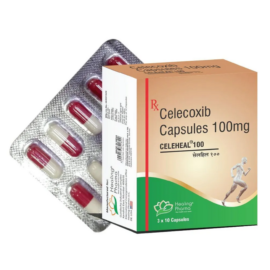
| Sterkte | 50 mg |
|---|---|
| Hoeveelheid | 30 Tabletten, 60 Tabletten, 90 Tabletten, 180 Tabletten |
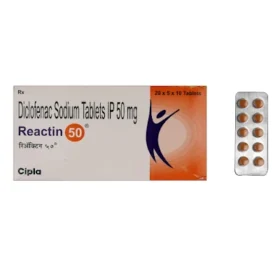 Reactin
Vragen & antwoorden
Reactin
Gerelateerde producten

Beoordelingen
Er zijn nog geen beoordelingen