







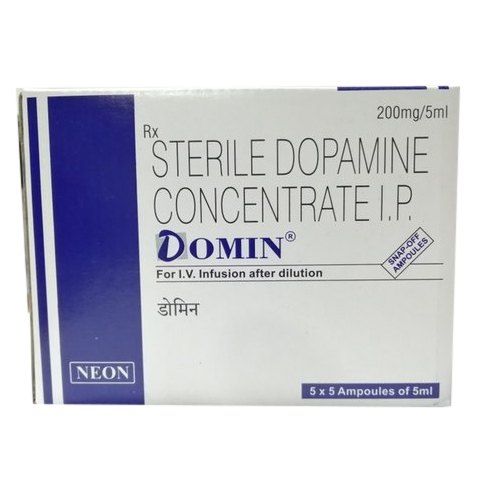
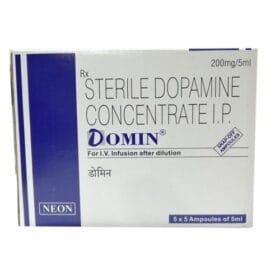
Domin Injection
✅ Verbeterde bloedcirculatie
✅ Verbeterde nierfunctie
✅ Behandelt shock
✅ Behandelt lage bloeddruk
✅ Reguleert hartslag
Domin Injection bevat Dopamine.
✓ Medisch beoordeeld door Morgan Ellis — Apotheekonderzoeker · 8 jaar ervaring · Laatst beoordeeld: mei 2026
⚡ Snel antwoord — Wat is Domin Injectie?
Domin Injection is een steriel concentraat van dopaminehydrochloride 40 mg/ml (5 ml ampul = 200 mg) gebruikt voor intraveneuze infusie in kritieke zorgsituaties. Het is een vasopressor en positief inotroop middel aangewezen voor de kortdurende hemodynamische ondersteuning bij shock (septische, cardiogene, hypovolemische na volumevervanging), acuut hartfalen met hypotensie, en symptomatische bradycardie. Het moet worden verdund en toegediend via continue intraveneuze infusie met bewaking van hart en bloeddruk, bij voorkeur via een centrale veneuze lijn. Dit is een medicijn voor ziekenhuisgebruik — het is niet geschikt voor zelfadministratie of poliklinisch gebruik.
📦 Elke bestelling is gedekt door onze Reshipment Assurance-beleid — als uw pakket niet binnen 20 werkdagen arriveert, sturen wij het opnieuw.
Waarom bestellen bij MedsBase
Onze generieke medicijnen zijn afkomstig van WHO-GMP gecertificeerde fabrikanten en worden wereldwijd verzonden in discrete, eenvoudige verpakkingen — geen medicijnnaam op de buitenkant van het pakket. Betalingen met kaart worden verwerkt via een gereguleerde processor (betalingsoverzichten vermelden een gereguleerde kaartbetalingprocessor — nooit “MedsBase” of een medicijnnaam). Crypto en SEPA bankoverschrijvingen worden ook geaccepteerd. Elke bestelling wordt ondersteund door ons Reshipment Assurance Policy.
Domin Injection 40 mg/mL (5 mL ampul) is een steriele geconcentreerde oplossing van dopaminehydrochloride. Elke 5 mL ampul bevat 200 mg dopamine en is bedoeld voor verdunning en continue intraveneuze infusie in ziekenhuisomgevingen. Dopamine staat op de WHO-lijst van essentiële geneesmiddelen.
Dopamine is een endogeen catecholamine — de directe metabolische precursor van noradrenaline en ook een neurotransmitter. Wanneer het in farmacologische doses via IV-infusie wordt toegediend, is het een dosisafhankelijke vasopressor en cardiaal stimulerend middel, met effecten die veranderen met de infusiesnelheid:
- Lage dosis (1–5 mcg/kg/min — “nierdosis”): dopaminereceptoren; traditioneel gedacht om de renale perfusie te verhogen, hoewel modern bewijs routinematig gebruik van “nierdosis” bij oligurie niet ondersteunt
- Matige dosis (5–10 mcg/kg/min): bèta-1-adrenerge effecten — verhoogde cardiale contractiliteit, slagvolume en hartminuutvolume
- Hoge dosis (> 10 mcg/kg/min): alfa-1-adrenerge effecten — perifere vasoconstrictie en toename van de systemische vaatweerstand
Alleen voor ziekenhuisgebruik. Domin Injection is een kritieke zorgmedicatie. Het moet worden toegediend door een gekwalificeerde clinicus in een ziekenhuis, intensive care-afdeling of spoedeisende hulp met continue hartmonitoring en voorbereide noodapparatuur. Het is niet niet geschikt voor zelftoediening, poliklinisch gebruik of thuisgebruik onder welke omstandigheid dan ook.
Waar wordt Domin Injection voor gebruikt?
- Septische shock — wanneer vloeistofresuscitatie alleen niet voldoende is om de bloeddruk te herstellen (noradrenaline is eerste keus in de meeste moderne richtlijnen, maar dopamine blijft een erkend alternatief)
- Cardiogene shock — met name wanneer de hartfrequentie laag is en inotrope ondersteuning nodig is
- Acuut hartfalen met hypotensie — lage cardiale output met slechte weefselperfusie
- Symptomatische bradycardie — wanneer atropine en transcutane pacing niet beschikbaar zijn of onvoldoende werken
- Lage cardiale output na hartchirurgie
- Distributieve shock na initiële vochtresuscitatie
- Ernstige anafylaxie met refractaire hypotensie (als tweedelijnsbehandeling na adrenaline en vochttoediening)
Moderne sepsisrichtlijnen (Surviving Sepsis 2021) vermelden noradrenaline als eerstelijns vasopressor, met dopamine gereserveerd als alternatief voor geselecteerde patiënten (bijv. patiënten met bradycardie en geen risico op aritmieën). Het gebruik van dopamine voor renale bescherming (“renale dosis dopamine”) wordt niet ondersteund door huidig bewijs en wordt niet meer aanbevolen als routinebehandeling.
Hoe Werkt Dopamine?
Dopamine werkt op drie belangrijkereceptorsystemen in een dosisafhankelijk patroon:
- Dopaminereceptoren (D1, D2): renale, mesenteriale en coronair vasodilatatie bij lage doseringen
- Beta-1-adrenerge receptoren: myocardcontractiliteit en hartfrequentie bij middelmatige doseringen; verhoogt het hartminuutvolume
- Alpha-1-adrenerge receptoren: perifere arteriële vasoconstrictie bij hoge doseringen; verhoogt de gemiddelde arteriële druk
In de praktijk krijgen de meeste patiënten dopamine in het middelmatige tot hoge doseringsbereik (5–20 mcg/kg/min), waar beta- en alpha-effecten overlappen. Pure “renale doseringen” worden niet langer aanbevolen voor nierbescherming.
Domin-injectie dosering en toediening
- Verdunning: één ampul van 200 mg in 250 mL 0,9% natriumchloride of 5% dextrose geeft een concentratie van 800 mcg/mL. Hogere concentraties (1.600 mcg/mL) worden gebruikt wanneer vochtrestrictie nodig is.
- Toedieningsweg: alleen continue IV-infusie. Centrale veneuze toegang wordt sterk aanbevolen — perifere extravasatie kan weefselnecrose en digitale ischemie veroorzaken.
- Startdosering: 2–5 mcg/kg/min; titreer omhoog in stappen van 2–5 mcg/kg/min elke 10–30 minuten op basis van bloeddruk, hartfrequentie, urineproductie en tekenen van weefselperfusie.
- Gebruikelijk effectief bereik: 5–20 mcg/kg/min; doseringen boven 20 mcg/kg/min bieden zelden extra voordeel en zijn geassocieerd met tachyarrithmieën en verslechterde uitkomsten.
- Monitoring: continue ECG, invasieve arteriële bloeddruk, centrale veneuze druk of equivalent, urineproductie, serumlactaat en klinische tekenen van perfusie.
- Afleren: geleidelijk afbouwen (verlaag de dosering met 25–50% elke 10–30 minuten op basis van de hemodynamische respons). Plotseling stoppen kan hypotensie veroorzaken.
Extravasatie is een spoedgeval. Als dopamine uit de infusieplaats lekt naar het omliggende weefsel, veroorzaakt dit ernstige lokale vasoconstrictie en kan dit leiden tot huidnecrose. Stop de infusie onmiddellijk, verwijder de canule niet voorafgaand aan specialistisch advies en infiltreer het gebied zo snel mogelijk met fentolamine (5–10 mg verdund in 10–15 mL normale zoutoplossing).
Wie mag Domin-injectie niet ontvangen?
- Bekende overgevoeligheid voor dopamine
- Feochromocytoom — ongecontroleerde alfastimulatie veroorzaakt hypertensieve crisis
- Niet-gecorrigeerde tachyaritmieën — dopamine is pro-aritmisch
- Ventriculaire fibrillatie
- Ongecorrigeerde hypovolemie — volumereanimatie moet voorop staan; het gebruik van een vasopressor op een lege tank is schadelijk
- Gebruik met extreme voorzichtigheid bij: recent myocardinfarct, ischemische hartziekte, perifeer vaatlijden, ziekte van Buerger
- Gelijktijdig MAO-remmergebruik — versterkt het pressoreffect aanzienlijk (verlaag de dosis dopamine tot een tiende)
- Gelijktijdig fenytoïne — kan hypotensie en bradycardie veroorzaken
Bijwerkingen
- Vaak voorkomend: tachycardie, ectopische slagen, hypertensie bij hoge doses, misselijkheid en braken
- Vaak bij hoge doses: ventriculaire en supraventriculaire aritmieën, angina pectoris, hypertensie
- Lokaal: infuusplaatspijn, flebitis, weefselnecrose bij extravasatie
- Overig: perifere vasoconstrictie met koude extremiteiten en digitale ischemie, verergering van myocardischemie, onderdrukking van schildklierstimulerend hormoon, immunosuppressief effect (relevant op IC)
Geneesmiddelinteracties
- MAO-remmers: extreme voorzichtigheid — gebruik een tiende van de gebruikelijke startdosis
- Fenytoïne: kan ernstige hypotensie en bradycardie veroorzaken
- Andere vasopressoren (noradrenaline, adrenaline, vasopressine): additieve cardiale en vasculaire effecten; vaak gecombineerd op de IC
- Bètablokkers: kan de inotrope respons verminderen
- Alfablokkers: vermindert de pressorrespons
- Tricyclische antidepressiva, cocaïne, ergotalkaloïden: versterkt het pressoreffect
- Inhalatie-anesthetica (halothaan, cyclopropaan): kan het myocard gevoeliger maken voor door dopamine geïnduceerde aritmieën
Bestellen & Levering
MedsBase biedt wereldwijde verzending voor elke bestelling. Bestellingen worden verzonden in discrete verpakkingen en arriveren in verpakkingen van de fabrikant. Als uw voorkeurssterkte of verpakkingsgrootte niet op voorraad is, neem dan contact op met de klantenservice voor een leverdatum.
Medisch disclaimer. De informatie op deze pagina is alleen bedoeld voor algemene educatie. Het is geen vervanging voor advies van uw eigen arts of apotheker. Overleg met een gekwalificeerde zorgprofessional voordat u een therapie start, stopt of wijzigt.
Veelgestelde vragen
Waar wordt Domin Injectie voor gebruikt?
Domin Injectie (dopamine HCl 40 mg/mL) wordt gebruikt in kritieke zorgsituaties voor hemodynamische ondersteuning bij shock (septische, cardiogene, distributieve), acuut hartfalen met hypotensie en symptomatische bradycardie. Het is een ziekenhuismedicijn dat via continue IV-infusie wordt toegediend met hartmonitoring.
Is Domin Injectie een bloeddrukmedicijn?
Het verhoogt de bloeddruk, dus in letterlijke zin ja - maar het wordt alleen gebruikt in noodsituaties en op intensive care-afdelingen voor patiënten die in shock zijn of gevaarlijk lage bloeddruk hebben. Het is geen medicijn voor chronische hoge bloeddruk (hypertensie); in die context zou het de verkeerde klasse zijn en potentieel gevaarlijk.
Kan Domin Injection thuis worden toegediend?
Nee. Dopamine is een kritieke zorgmedicijn dat continue intraveneuze infusie, bewaking van hart- en arteriële druk en directe toegang tot noodapparatuur vereist. Het wordt toegediend in ziekenhuizen, IC's en spoedeisende hulpafdelingen door gekwalificeerde clinici — niet thuis, niet in poliklinische settings, niet door een patiënt.
Waarom wordt dopamine toegediend via continue infusie in plaats van een enkele injectie?
Dopamine heeft een halfwaardetijd van slechts 2 minuten in de circulatie. Een enkele bolus zou een effect hebben dat hooguit een minuut of twee aanhoudt. Om een stabiele hemodynamische ondersteuning te behouden, moet het via continue infusie worden toegediend met een gecontroleerde snelheid, afgestemd op de bloeddruk en klinische respons van minuut tot minuut.
Is dopamine hetzelfde als noradrenaline?
Beide zijn vasopressoren die worden gebruikt bij shock, maar ze verschillen. Dopamine heeft dopaminerge, bèta- en alfa-effecten afhankelijk van de dosis. Noradrenaline is vrijwel puur een alfa-adrenerge vasopressor met enig bèta-1 effect. Moderne sepsisrichtlijnen (Surviving Sepsis 2021) bevelen noradrenaline aan als eerstelijnsbehandeling; dopamine is een alternatief voor geselecteerde patiënten, met name die met bradycardie.
Beschermt dopamine de nieren?
Niet betrouwbaar. “Renale dosis dopamine” (1–3 mcg/kg/min) werd historisch gebruikt voor nierbescherming of om oligurie te behandelen. Gerandomiseerde trials en meta-analyses hebben geen klinisch betekenisvol voordeel aangetoond voor de nierfunctie of mortaliteit, en huidige richtlijnen raden routinematig gebruik voor deze indicatie af.
Wat is extravasatie en waarom is het een noodgeval?
Extravasatie is wanneer de IV-vloeistof in het omliggende weefsel lekt in plaats van in de ader. Bij dopamine kan de intense lokale vasoconstrictie weefselnecrose, huidafbraak en (in ernstige gevallen) digitale ischemie veroorzaken. Als het optreedt, moet de infusie onmiddellijk worden gestopt en moet phentolamine (een alfa-blokker) zo snel mogelijk in het getroffen gebied worden geïnjecteerd.
Kan dopamine hartritmestoornissen veroorzaken?
Ja — vooral bij hogere doseringen (> 10 mcg/kg/min). Tachycardie, ectopische slagen, atriumfibrilleren en ventriculaire tachycardie kunnen allemaal optreden. Continue hartmonitoring tijdens dopaminebehandeling is standaard.
Hoe wordt de dosis berekend?
Dopamine wordt gedoseerd in microgram per kilogram lichaamsgewicht per minuut (mcg/kg/min). De startdosering is typisch 2–5 mcg/kg/min, opgetitreerd op basis van bloeddruk en perfusie. Het voorschrijvend team berekent de infusiepompsnelheid op basis van het gewicht van de patiënt en de ampulconcentratie.
Kan Domin Injection intramusculair worden toegediend?
Nee — dopamine is alleen bedoeld voor continue intraveneuze infusie. Het kan niet intramusculair of subcutaan worden toegediend.
Wordt Domin Injection gebruikt bij kinderen?
Ja, op gewichtsgebaseerde doseringen. Pediatrische dopamine wordt gebruikt op neonatale en pediatrische intensive care-afdelingen voor shock en lage cardiale output, onder specialistisch toezicht.
Gerelateerde alternatieven
Andere producten in Chronische aandoeningen die klanten ook bekijken:
- Budecort Inhaler
- Neurobion Forte RF-injectie (Methylcobalamine + B6 + B3) — Zenuwherstel
- Pirox Gel
- Xepar
- Topicon
Meer opties in Hart & Bloeddruk
Gerangschikt op recente bestelvolumes van MedsBase — wat andere klanten in deze categorie kiezen.
| Sterkte | 40 mg/ml (5ml) |
|---|---|
| Hoeveelheid | 5 Ampul(len), 10 Ampul(len), 15 Ampul(len), 30 Ampul(len), 60 Ampul(len) |
 Domin Injection
Vragen & antwoorden
Domin Injection
Gerelateerde producten




Beoordelingen
Er zijn nog geen beoordelingen