







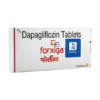
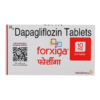
Forxiga (Dapagliflozin)
✅ Reguleert Bloedsuiker
✅ Vermindert hartfalen
✅ Aids Gewichtsverlies
✅ Verbeterd Niergezondheid
✅ Verlaagt Bloeddruk
Forxiga bevat Dapagliflozin
✓ Medisch beoordeeld door Morgan Ellis — Apotheekonderzoeker · 8 jaar ervaring · Laatst beoordeeld: mei 2026
⚡ Kort antwoord — Wat is Forxiga?
Forxiga is een merk van dapagliflozin (5 mg of 10 mg), een SGLT-2-remmer (“gliflozin”) gebruikt voor diabetes type 2, hartfalen en chronische nierziekte (CKD). Het werkt door de heropname van glucose in de nieren te blokkeren, waardoor 70–90 g glucose per dag via de urine wordt uitgescheiden. Dit verlaagt de bloedglucose onafhankelijk van insuline, resulteert in 2–3 kg gewichtsverlies, een daling van de bloeddruk met 3–5 mmHg en — uniek onder antidiabetica — vermindert het ziekenhuisopnames voor hartfalen en vertraagt het de progressie van CKD bij patiënten met of zonder diabetes. HbA1c-reductie: 0,5–0,8 procentpunten. Dosering: 10 mg eenmaal daags 's ochtends, met of zonder voedsel. Een sterkte van 5 mg is beschikbaar voor sommige patiënten. Voor indicaties van hartfalen of CKD: 10 mg/dag. als monotherapie. Belangrijkste risico's: genitale schimmel (vaak voorkomend, mild), urineweginfectie, zeldzame diabetische ketoacidose (soms met bijna-normale glucose — “euglycemische DKA”) en volumetekort. Vermijd bij type 1 diabetes. als monotherapie. Belangrijkste risico's: genitale schimmelinfectie (vaak voorkomend, mild), urineweginfectie, zelden diabetische ketoacidose (soms met bijna-normale glucose - “euglycemische DKA”) en volumetekort. Niet gebruiken bij diabetes type 1.
📦 Elke bestelling is gedekt door onze Reshipment Assurance-beleid — als uw pakket niet binnen 20 werkdagen arriveert, sturen wij het opnieuw.
Waarom bestellen bij MedsBase
Onze generieke medicijnen zijn afkomstig van WHO-GMP gecertificeerde fabrikanten en worden wereldwijd verzonden in discrete, eenvoudige verpakkingen — geen medicijnnaam op de buitenkant van het pakket. Betalingen met kaart worden verwerkt via een gereguleerde processor (betalingsoverzichten vermelden een gereguleerde kaartbetalingprocessor — nooit “MedsBase” of een medicijnnaam). Crypto en SEPA bankoverschrijvingen worden ook geaccepteerd. Elke bestelling wordt ondersteund door ons Reshipment Assurance Policy.
Wat Is Forxiga?
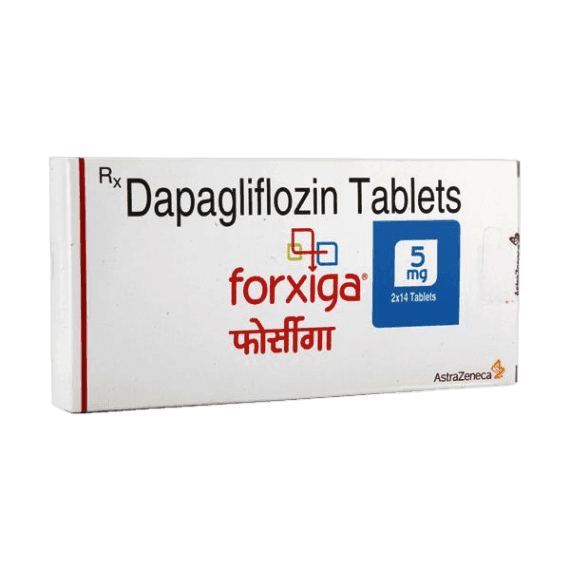
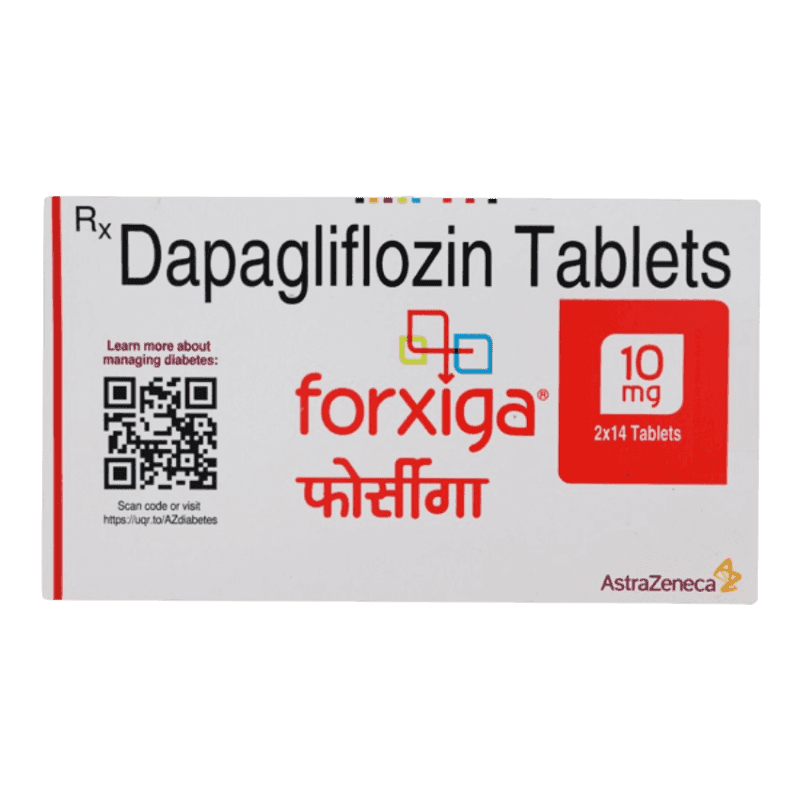
Forxiga is een orale SGLT-2 (natrium-glucose co-transporter-2) remmer die dapagliflozin (5 mg of 10 mg) bevat, geproduceerd door AstraZeneca. Beschikbaar in verpakkingen van 28, 56 of 84 tabletten. Het is goedgekeurd voor:
- Diabetes type 2 — voor glykemische controle, meestal als toevoeging aan metformin of als tweedelijnsbehandeling
- Chronische nierziekte — om progressie te vertragen, met of zonder diabetes
- Chronische nierziekte — om de progressie te vertragen, met of zonder diabetes
dapagliflozin werd voor het eerst goedgekeurd in 2012 (origineel merk: Forxiga in de EU / Farxiga in de VS, AstraZeneca). Het is een van de klinisch belangrijkste klassen van antidiabetica in het afgelopen decennium, omdat hetzelfde medicijn drie van de meest voorkomende langetermijncomplicaties van diabetes gelijktijdig behandelt.
Hoe Werkt Forxiga?
Gezonde nieren filteren 180 g glucose per dag via de glomeruli en absorberen bijna alles weer terug in de bloedbaan via de SGLT-2-transporter in de proximale tubulus. Bij diabetes wordt deze heropname juist opgereguleerd — het lichaam houdt meer glucose vast precies wanneer het wat zou moeten loslaten.
dapagliflozin blokkeert selectief SGLT-2, waardoor 70–90 g glucose per dag via de urine wordt uitgescheiden. Dit:
- Verlaagt de bloedglucose met ongeveer 30–50 mg/dL — onafhankelijk van insuline
- Vermindert het gewicht met 2–3 kg — glucoseverlies via urine komt overeen met ~280–320 kcal/dag
- Verlaagt de systolische bloeddruk met 3–5 mmHg — deels door osmotische diurese, deels via andere pathways
- Vermindert de intraglomerulaire druk — vertraagt de progressie van CKD
- Verbeterd de cardiale energiemetabolisme — draagt bij aan de voordelen bij hartfalen
Cardiovasculaire, hartfalen en niergerelateerde voordelen
dapagliflozin heeft een ongewoon sterk uitkomstentrial-dataset:
- DECLARE-TIMI 58 (2019) — verminderde het samengestelde eindpunt van cardiovasculaire sterfte of ziekenhuisopname voor hartfalen; MACE was niet-inferieur.
- DAPA-HF (2019) — 26% reductie in verslechtering van hartfalen of cardiovasculaire sterfte bij HFrEF-patiënten, ongeacht diabetesstatus. DELIVER (2022) heeft het voordeel uitgebreid naar HFpEF.
- DAPA-CKD (2020) — 39% reductie in progressie van CKD, vroegtijdig gestopt vanwege effectiviteit. Voordeel bij CKD met of zonder diabetes type 2.
Deze onderzoeken hebben de praktijk veranderd: SGLT-2 remmers worden nu aanbevolen voor elke patiënt met diabetes type 2 die cardiovasculaire aandoeningen, hartfalen of CKD heeft — ongeacht de HbA1c.
Dosering en toediening
Standaard dosering: 10 mg eenmaal daags 's ochtends, met of zonder voedsel. Een sterkte van 5 mg is beschikbaar voor sommige patiënten. Voor hartfalen of CKD indicaties: 10 mg/dag.
- Eenmaal daagse dosering; het tijdstip kan worden vastgelegd in een routine.
- Niet nodig om met voedsel in te nemen (tenzij anders vermeld voor canagliflozin).
- Dosis vergeten — neem het alsnog in als het binnen 12 uur wordt herinnerd; anders overslaan.
- Forxiga/dapagliflozin: initiatie toegestaan vanaf een eGFR van 25 mL/min/1.73 m² voor hartfalen/CKD indicaties; doorgaan tot dialyse. Voor glykemische controle bij diabetes neemt de effectiviteit af onder een eGFR van 45.
- Niet starten tijdens acute ziekte met uitdroging (risico op AKI en euglycemische DKA).
- Ziektedagregels: onderbreek de SGLT-2-remmer tijdens elke acute ziekte met braken, diarree of verminderde orale inname. Herstart bij normaal eten.
Bijwerkingen
Vaak voorkomend:
- Genitale schimmelinfecties (spruw) — tot 10% van de gebruikers, vooral vrouwen. Eenvoudig te behandelen met antischimmelmiddelen.
- Urineweginfecties — licht verhoogd risico; meestal eenvoudige blaasontsteking.
- Toegenomen urinelozing (polyurie), milde uitdroging, duizeligheid bij opstaan (orthostatische hypotensie) — vooral in de eerste 2 weken.
- Bescheiden stijging van LDL-cholesterol (meestal < 0,2 mmol/L).
Zeldzaam maar belangrijk:
- Diabetische ketoacidose (DKA) — zeldzaam (< 0,1% per jaar) maar kan optreden bij bijna normale bloedglucose (“euglycemische DKA”). Risicofactoren: verminderde koolhydraatinname, acute ziekte, operatie, insulinedosering verminderen. Symptomen: misselijkheid, braken, buikpijn, diepe ademhaling. Stop het medicijn en zoek direct medische hulp.
- Volume-depletie — hoger risico bij oudere volwassenen, mensen die plaspillen gebruiken of een lage bloeddruk hebben.
- Acuut nierletsel — meestal pre-renaal bij uitdroging; omkeerbaar wanneer het medicijn wordt gestopt.
- Fournier-gangreen — extreem zeldzame necrotiserende perineale infectie; medisch noodgeval.
- Geen amputatiesignaal.
Geneesmiddelinteracties
- Plasmiddelen (vooral lis- en thiazidediuretica) — additioneel volumeverlies; overweeg de dosis te verlagen bij start.
- Insuline en sulfonylureumderivaten — additionele glucoseverlaging; die doses moeten mogelijk worden verlaagd om hypoglykemie te voorkomen.
- Lithium — verhoogd urineverlies kan lithiumspiegels verhogen.
- Rifampicine — verlaagt de SGLT-2-remmerniveaus; een hogere dosis kan nodig zijn.
- Antihypertensiva — bloeddrukverlagend effect; let op duizeligheid.
Wie mag Forxiga niet gebruiken?
- Diabetes mellitus type 1 (tenzij off-label en onder specialistisch toezicht)
- Diabetische ketoacidose — huidig of recente voorgeschiedenis
- Ernstige nierfunctiestoornis onder de startgrens
- Terminale nierinsufficiëntie bij dialyse (stop bij empagliflozin zodra dialyse begint; dapagliflozin kan volgens sommige protocollen worden voortgezet)
- Ernstige vochttekort of hypotensie
- Zwangerschap en borstvoeding — beperkte gegevens; vermijden
- Bekende overgevoeligheid voor SGLT-2-remmers
- Canagliflozin: eerdere amputatie van onderste ledematen of actieve voetzweer (relatief)
Opslag
Bewaar Forxiga onder 30°C op een droge plaats, in de originele blister. Buiten bereik van kinderen houden.
Veelgestelde vragen
Is Forxiga hetzelfde als dapagliflozin?
Ja — Forxiga bevat dapagliflozin als werkzaam bestanddeel. Bio-equivalentie is vereist door regelgevende instanties, dus het klinische effect is hetzelfde bij dezelfde dosering.
Is dapagliflozin hetzelfde als Jardiance?
Nee — het zijn twee verschillende SGLT-2-remmers met vergelijkbare klasse-effecten. Dapagliflozin (Forxiga) heeft DAPA-HF en DAPA-CKD onderzoeksgegevens; empagliflozin (Jardiance) heeft EMPA-REG, EMPEROR en EMPA-KIDNEY. Beide zijn goedgekeurd voor diabetes type 2, hartfalen (inclusief HFpEF) en chronische nierziekte. Voor de meeste patiënten komt de keuze neer op beschikbaarheid, kosten en voorkeur van de voorschrijver.
Zal Forxiga me helpen afvallen?
Ja, bescheiden — typisch 2–3 kg gewichtsverlies over 6–12 maanden. Het gewichtsverlies komt doordat je nieren 70–90 g glucose (~280–320 kcal) per dag via de urine uitscheiden. Het is reëel maar beperkt — verwacht niet de dramatische effecten zoals gezien bij GLP-1-receptoragonisten zoals semaglutide (Ozempic, Wegovy) of tirzepatide (Mounjaro).
Zal Forxiga mijn bloeddruk verlagen?
Ja — verwacht ongeveer een systolische daling van 3–5 mmHg. Als u al bloeddrukmedicatie gebruikt en bijna op streefwaarde zit, kan een dosisverlaging nodig zijn wanneer u Forxiga start om duizeligheid te voorkomen.
Kan Forxiga spruw of urineweginfecties veroorzaken?
Ja — genitale schimmel is de meest voorkomende bijwerking (tot 10% van de gebruikers, vooral vrouwen). Het is meestal mild en gemakkelijk te behandelen met lokale of orale antischimmelmiddelen. Urineweginfecties komen iets vaker voor maar zijn meestal eenvoudig. Goede hygiëne helpt; de meeste patiënten hoeven het medicijn niet te stoppen.
Kan ik Forxiga gebruiken als mijn nieren niet optimaal functioneren?
Ja — en in feite beschermen SGLT-2-remmers beschermen de nieren bij CKD. Startcut-offs verschillen per molecuul (zie de sectie over renale dosering), maar eenmaal gestart worden ze meestal voortgezet tot aan dialyse omdat het nierbeschermende effect aanhoudt, zelfs wanneer het glucoseverlagende effect is afgenomen.
Wat moet ik doen op ziektedagen of voor een operatie?
Stop tijdelijk met Forxiga tijdens acute ziekte met uitdroging, braken of verminderde vochtinname, en tijdens grote operaties of vasten. Dit verkleint het risico op euglykemische DKA en acuut nierfalen. Hervat de inname zodra u weer normaal eet en drinkt.
Waar kan ik Forxiga online kopen?
U kunt Forxiga (5 mg of 10 mg) bestellen bij MedsBase in verpakkingen van 28, 56 of 84 tabletten. Wij verzenden wereldwijd, met discrete verpakking en gegarandeerd echte WHO-GMP gecertificeerde fabrikantvoorraad.
Gerelateerde diabetesmedicatie
- Jardiance — Empagliflozin 25 mg (Boehringer)
- Forxiga — Dapagliflozin 5/10 mg (AstraZeneca)
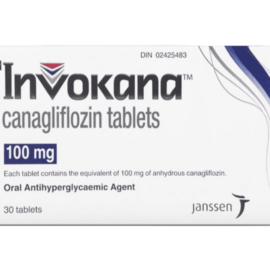
- Invokana — Canagliflozin 100 mg (Janssen)
- Glyxambi — Empagliflozin + Linagliptin combinatie
- Januvia — Sitagliptin (DPP-4 alternatief)
- Glycomet SR — Metformine met vertraagde afgifte
- Bekijk alle diabetesmedicatie
Gerelateerde alternatieven
Andere producten in Chronische aandoeningen die klanten ook bekijken:
Meer opties in Diabetes
Gerangschikt op recente bestelvolumes van MedsBase — wat andere klanten in deze categorie kiezen.

| Sterkte | 5 mg, 10 mg |
|---|---|
| Hoeveelheid | 14 Tablet/s, 28 Tablet/s, 56 Tablet/s, 84 Tablet/s |
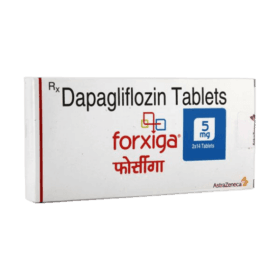 Forxiga (Dapagliflozin)
Vragen & antwoorden
Forxiga (Dapagliflozin)
Gerelateerde producten


Beoordelingen
Er zijn nog geen beoordelingen