








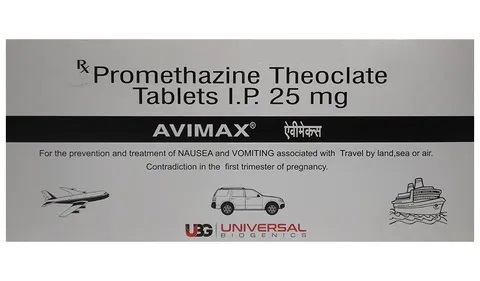
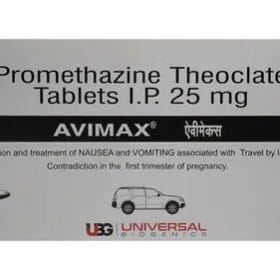
Avimax
✅ Verlichting van misselijkheid
✅ Voorkomen van braken
✅ Behandeling van reisziekte
✅ Verlichting van allergiesymptomen
✅ Opwekking van sedatie
Avimax bevat Promethazine.
✓ Medisch beoordeeld door Morgan Ellis — Apotheekonderzoeker · 8 jaar ervaring · Laatst beoordeeld: mei 2026
Snelle antwoord
Avimax is een merk van promethazine 25 mg — een eerste generatie H1-antihistaminicum met een sterke sederende, anticholinerge en anti-emetische werking. Neem één tablet 30–60 minuten voor reizen tegen reisziekte, of 12,5–25 mg elke 4–6 uur bij misselijkheid of postoperatief gebruik. Dit is de sterkere variant van Phenergan 10 mg — kies Avimax 25 mg wanneer de lagere dosering onvoldoende is en u daarna niet hoeft te rijden.
Waarom bestellen bij MedsBase
📦 Elke bestelling is gedekt door onze Reshipment Assurance-beleid — als uw pakket niet binnen 20 werkdagen arriveert, sturen wij het opnieuw.
Waarom bestellen bij MedsBase
Avimax wordt ingekocht bij WHO-GMP gecertificeerde fabrikanten, discreet verpakt en wereldwijd verzonden. Elke bestelling wordt gedekt door onze Reshipment Assurance-beleid en ondersteund door meer dan 1.400 klantbeoordelingen.
Avimax is een antihistaminicum onder specialistisch toezicht dat bevat Promethazine, een eerstegeneratie antihistaminicum uit de fenothiazineklasse. Al decennia lang gebruikt in de klinische praktijk, Avimax tablet biedt betrouwbare verlichting bij allergische aandoeningen, misselijkheid, braken en reisziekte. Het heeft ook bekende sederende eigenschappen die het nuttig maken als pre-operatief of post-operatief hulpmiddel.
Wanneer u Avimax online koopt bij MedsBase, ontvangt u originele, farmaceutisch kwalitatieve Promethazine tabletten verzonden vanuit gelicentieerde faciliteiten met discrete verpakking en wereldwijde levering.
Hoe Avimax Werkt
Avimax promethazine oefent zijn therapeutische effecten uit via meerdere farmacologische mechanismen, wat het een van de meest veelzijdige eerstegeneratie antihistaminica maakt die beschikbaar zijn.
- H1-receptorantagonisme — Promethazine blokkeert competitief histamine op H1-receptoren in het lichaam. Deze werking vermindert allergische symptomen zoals niezen, jeuk, loopneus en tranende ogen door te voorkomen dat histamine de ontstekingscascade activeert.
- Antimuscarinische (anticholinerge) werking — Avimax blokkeert muscarine acetylcholine receptoren, wat bijdraagt aan het uitdrogende effect op secreties en een sleutelrol speelt in zijn anti-misselijkheid en anti-reisziekte eigenschappen.
- Dopamine-antagonisme — Door het blokkeren van dopamine D2-receptoren in de chemoreceptor trigger zone biedt Promethazine krachtige anti-emetische effecten, wat helpt bij het beheersen van misselijkheid en braken door verschillende oorzaken.
- Sedatieve werking — Promethazine passeert gemakkelijk de bloed-hersenbarrière en onderdrukt de activiteit van het centrale zenuwstelsel, wat leidt tot dosisafhankelijke sedatie die klinisch nuttig is in pre- en postoperatieve situaties.
Na orale toediening wordt Avimax goed opgenomen uit het maag-darmkanaal. De effecten beginnen meestal binnen 20 minuten en duren 4 tot 6 uur, hoewel sedatieve effecten langer kunnen aanhouden. Het geneesmiddel wordt uitgebreid gemetaboliseerd in de lever en voornamelijk uitgescheiden via de urine.
Avimax Gebruiken en Indicaties
Avimax tablet is geïndiceerd voor een breed scala aan aandoeningen vanwege zijn multimodale werkingsmechanisme.
Allergische aandoeningen
Avimax is effectief voor de symptomatische verlichting van allergische rhinitis (hooikoorts), urticaria (netelroos), allergische conjunctivitis en andere allergische reacties. Het vermindert niezen, jeuk, neusverstopping en huiduitslag veroorzaakt door histaminevrijstelling.
Misselijkheid en braken
Avimax voor misselijkheid is een van de meest voorkomende toepassingen. De combinatie van H1-blokkade, anticholinerge effecten en dopamine-antagonisme maakt het zeer effectief tegen misselijkheid en braken door verschillende oorzaken, waaronder postoperatieve misselijkheid en braken (PONV), medicatie-geïnduceerde misselijkheid en maag-darmziekten.
Reisziekte
Promethazine is een goed ingeburgerde keuze voor het voorkomen en behandelen van reisziekte. Wanneer het 30 tot 60 minuten voor de reis wordt ingenomen, kan Avimax de duizeligheid, misselijkheid en braken die gepaard gaan met reizen per auto, boot of vliegtuig aanzienlijk verminderen of voorkomen.
Sedatie
Vanwege zijn uitgesproken CNS-onderdrukkende eigenschappen wordt Avimax gebruikt als sedativum voor en na operatieve ingrepen, tijdens de bevalling en om slaap te bevorderen in kortdurende situaties waar sedatie medisch gepast is.
Avimax Dosering Gids
De aanbevolen Avimax dosering varieert afhankelijk van de aandoening die wordt behandeld. De volgende tabel geeft een overzicht van standaard doseringsrichtlijnen voor volwassenen.
| Aandoening | Dosering | Frequentie / Opmerkingen |
|---|---|---|
| Allergische aandoeningen | 25 mg | Eenmaal voor het slapengaan, of 12,5 mg voor de maaltijd en voor het slapengaan |
| Misselijkheid en braken | 25 mg aanvangsdosis | Vervolgens 12,5–25 mg elke 4–6 uur indien nodig |
| Reisziekte | 25 mg | 30–60 minuten voor reizen; kan na 8–12 uur worden herhaald |
| Pre-operatieve sedatie | 25–50 mg | Avond voor de operatie en/of voor de ingreep |
| Sedatie ('s nachts) | 25–50 mg | Voor het slapengaan zoals voorgeschreven door de arts |
Pediatrische dosering (kinderen ouder dan 2 jaar): 0,5 mg per pond lichaamsgewicht, aangepast aan de specifieke indicatie. De dosis mag niet meer dan 25 mg bedragen voor een enkele toediening, tenzij voorgeschreven door een arts. Gebruik altijd de laagst effectieve dosis voor de kortst mogelijke duur.
Toedieningstips: Avimax-tabletten moeten met een vol glas water worden ingenomen. Het innemen van het medicijn met voedsel kan maagklachten verminderen. Voor reisziektepreventie is het essentieel om de dosis 30 tot 60 minuten voor vertrek in te nemen voor optimale effectiviteit.
Voordelen van Avimax
- Multifunctionele verlichting — één medicijn voor allergieën, misselijkheid, reisziekte en de behoefte aan sedatie
- Snel werkend — effecten beginnen ongeveer 20 minuten na orale toediening
- Bewezen effectiviteit — Promethazine wordt al meer dan zes decennia veilig gebruikt in de klinische praktijk
- Krachtig anti-emeticum — effectief tegen misselijkheid en braken via meerdere receptorwegen
- Effectieve preventie van reisziekte — een van de meest betrouwbare medicijnen tegen reisgerelateerde misselijkheid en duizeligheid
- Nuttige sederende eigenschappen — biedt kalmerende effecten die nuttig zijn in perioperatieve en acute klinische situaties
- Betaalbaar en toegankelijk — een kosteneffectief alternatief voor nieuwere, merkgebonden antihistaminica en anti-emetica
Bijwerkingen van Avimax
Zoals alle medicijnen kan Avimax bijwerkingen veroorzaken. De meeste zijn mild en dosisgerelateerd, en verdwijnen naarmate het lichaam aan de behandeling went.
Veelvoorkomende bijwerkingen:
- Slaperigheid en sedatie (de meest voorkomende bijwerking)
- Droge mond, neus of keel
- Duizeligheid of licht gevoel in het hoofd
- Wazig zien
- Obstipatie
- Urineretentie
Minder vaak voorkomende bijwerkingen:
- Verwardheid of desoriëntatie, vooral bij oudere patiënten
- Fotosensitiviteit (verhoogde gevoeligheid voor zonlicht)
- Tinnitus (oorsuizen)
- Misselijkheid of braken (paradoxaal)
Ernstige bijwerkingen (zoek direct medische hulp):
- Respiratoire depressie — vooral gevaarlijk bij kinderen; kan fataal zijn
- Neuroleptisch maligne syndroom (NMS) — een zeldzame maar levensbedreigende reactie gekenmerkt door hoge koorts, spierstijfheid, veranderd bewustzijn en autonome instabiliteit
- Ernstige dystone reacties — onvrijwillige spiercontracties die het gezicht, de nek of de rug aantasten
- Aanzienlijke daling van de bloeddruk — vooral bij het opstaan vanuit een zittende houding
- Toevallen — met name bij hoge doseringen of bij gevoelige personen
Belangrijke waarschuwingen
Geboxte waarschuwing — Kinderen onder 2 jaar: Avimax (Promethazine) is gecontra-indiceerd bij kinderen jonger dan 2 jaar. Er zijn fatale gevallen van respiratoire depressie gemeld in deze leeftijdsgroep. Promethazine moet met uiterste voorzichtigheid worden gebruikt bij kinderen van 2 jaar en ouder, en de laagst effectieve dosis moet altijd worden gebruikt. Vermijd gelijktijdig gebruik met andere ademhalingsremmers bij pediatrische patiënten.
Verminderde alertheid
- — Rijd niet, bedien geen zware machines of verricht geen activiteiten die mentale alertheid vereisen totdat u weet hoe Avimax u beïnvloedt. — Do not drive, operate heavy machinery, or perform activities requiring mental alertness until you know how Avimax affects you.
- Alcohol — Vermijd alcohol tijdens het gebruik van Avimax, omdat dit de CNS-depressie en sedatie versterkt.
- Oudere patiënten — Verhoogd risico op verwardheid, sedatie, valpartijen en anticholinerge bijwerkingen. Gebruik de laagst effectieve dosis.
- Zwangerschap — Gebruik alleen wanneer duidelijk nodig en de voordelen opwegen tegen de risico's. Overleg met uw zorgverlener.
- Leverfunctiestoornis — Promethazine wordt uitgebreid gemetaboliseerd door de lever; dosisaanpassing kan nodig zijn bij patiënten met leveraandoeningen.
Geneesmiddelinteracties
Avimax kan interacteren met verschillende medicijnklassen. Informeer uw zorgverlener over alle medicijnen, supplementen en kruidenproducten die u gebruikt voordat u begint Avimax promethazine.
- CNS-depressiva — Opioïden, benzodiazepines, barbituraten, slaapmiddelen en andere sederende medicijnen kunnen de sedatie en respiratoire depressie aanzienlijk verhogen in combinatie met Avimax.
- MAO-remmers — Kan de anticholinerge en sederende effecten van Promethazine verlengen en versterken. Gelijktijdig gebruik moet worden vermeden of nauwlettend worden gecontroleerd.
- Anticholinergica — Andere medicijnen met anticholinerge eigenschappen (tricyclische antidepressiva, bepaalde antipsychotica, antiparkinsonmiddelen) kunnen het risico op bijwerkingen zoals urineretentie, obstipatie, droge mond en verwardheid verhogen.
- Epinefrine — Promethazine kan het vasopressoreffect van epinefrine omkeren. Gebruik geen epinefrine om hypotensie veroorzaakt door Promethazine te behandelen; gebruik in plaats daarvan norepinefrine of fenylefrine.
- Levodopa — Promethazine kan de effectiviteit van levodopa verminderen vanwege zijn dopamine-blokkerende werking.
Veelgestelde vragen (FAQ)
Waar wordt Avimax tablet voor gebruikt?
Avimax tablet wordt gebruikt voor de behandeling van allergische aandoeningen zoals hooikoorts en netelroos, om misselijkheid en braken te voorkomen en te behandelen (inclusief postoperatieve misselijkheid), om reisziekte te voorkomen en als kortdurend kalmeringsmiddel. Het werkzame bestanddeel, Promethazine, werkt via meerdere mechanismen die het effectief maken voor al deze indicaties.
Hoe snel werkt Avimax?
Wanneer het oraal wordt ingenomen, begint Avimax meestal te werken binnen 20 minuten. Het volledige anti-emetische en antihistaminische effect wordt meestal binnen 30 tot 60 minuten gevoeld. Voor het voorkomen van reisziekte moet de tablet minstens 30 minuten voor aanvang van de reis worden ingenomen om voldoende absorptie mogelijk te maken.
Kan Avimax worden gebruikt voor slaap?
Promethazine wordt soms voorgeschreven of kortdurend gebruikt vanwege zijn sederende effecten om de slaap te bevorderen. Het wordt echter niet aanbevolen als een langdurig slaapmiddel. Er kan tolerantie voor het sederende effect ontstaan, en er zijn veiliger alternatieven die specifiek zijn ontworpen voor chronische slapeloosheid. Volg altijd het advies van uw arts op met betrekking tot het gebruik van Avimax voor sedatie.
Is Avimax veilig voor kinderen?
Avimax is strikt gecontra-indiceerd bij kinderen onder de 2 jaar vanwege het risico op fatale respiratoire depressie. Bij kinderen van 2 jaar en ouder kan het met voorzichtigheid worden gebruikt in de laagst effectieve dosering onder medisch toezicht. Ouders en verzorgers moeten alert zijn op tekenen van overmatige sedatie of ademhalingsmoeilijkheden.
Mag ik autorijden na het innemen van Avimax?
Nee. Avimax veroorzaakt bij de meeste mensen aanzienlijke slaperigheid. U mag niet autorijden, machines bedienen of activiteiten uitvoeren die volledige mentale alertheid vereisen totdat u weet hoe het medicijn op u inwerkt. De sederende effecten kunnen enkele uren na inname aanhouden. Het combineren van Avimax met alcohol of andere sederende middelen vermindert uw vermogen om veilig te functioneren verder.
Wat is het verschil tussen Avimax en nieuwere antihistaminica?
Avimax bevat Promethazine, een eerste-generatie antihistaminicum dat de bloed-hersenbarrière passeert en sedatie veroorzaakt. Nieuwere (tweede-generatie) antihistaminica zoals cetirizine en loratadine zijn ontworpen om voornamelijk buiten het centrale zenuwstelsel te werken, waardoor ze aanzienlijk minder slaperigheid veroorzaken. Avimax biedt echter anti-emetische en sederende voordelen die nieuwere antihistaminica niet bieden, waardoor het de voorkeurskeuze is wanneer deze effecten gewenst zijn.
Disclaimer
Deze productinformatie is uitsluitend bedoeld voor educatieve en informatieve doeleinden en vormt geen medisch advies. Avimax (Promethazine) is een medicijn dat onder specialistisch toezicht moet worden gebruikt en alleen onder begeleiding van een gekwalificeerde zorgverlener mag worden ingenomen. Raadpleeg altijd uw arts of apotheker voordat u een medicijn start, stopt of wijzigt. De hier gepresenteerde informatie is niet bedoeld als vervanging voor professioneel medisch advies, diagnose of behandeling. Individuele reacties op medicatie kunnen variëren. MedsBase aanvaardt geen aansprakelijkheid voor het gebruik of misbruik van enig product dat op deze pagina wordt beschreven.
Veelgestelde vragen
Andere behandelingen voor reisziekte
- Phenergan (Promethazine 10 mg) —zelfde molecuul, lagere sterkte
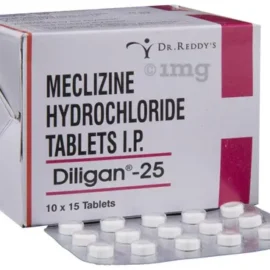
- Diligan (Meclizine 25 mg) — minder sederend antihistaminicum
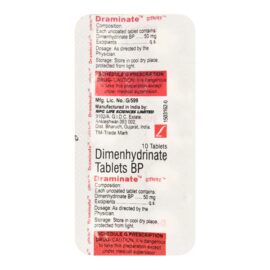
- Draminate (Dimenhydrinate 50 mg) — originele Dramamine-equivalent
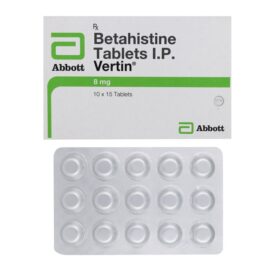
- Vertin (Betahistine 8 mg) — voor vestibulaire vertigo/Menière
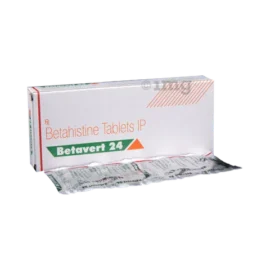
- Betavert Tab (Betahistine 24 mg) — volledige dosis Menière
Meer opties in reisziektetabletten
Gerangschikt op recente bestelvolumes van MedsBase — wat andere klanten in deze categorie kiezen.
| Sterkte | 25 mg |
|---|---|
| Hoeveelheid | 30 Tabletten, 60 Tabletten, 90 Tabletten, 180 Tabletten |
 Avimax
Vragen & antwoorden
Avimax
Gerelateerde producten




Beoordelingen
Er zijn nog geen beoordelingen