








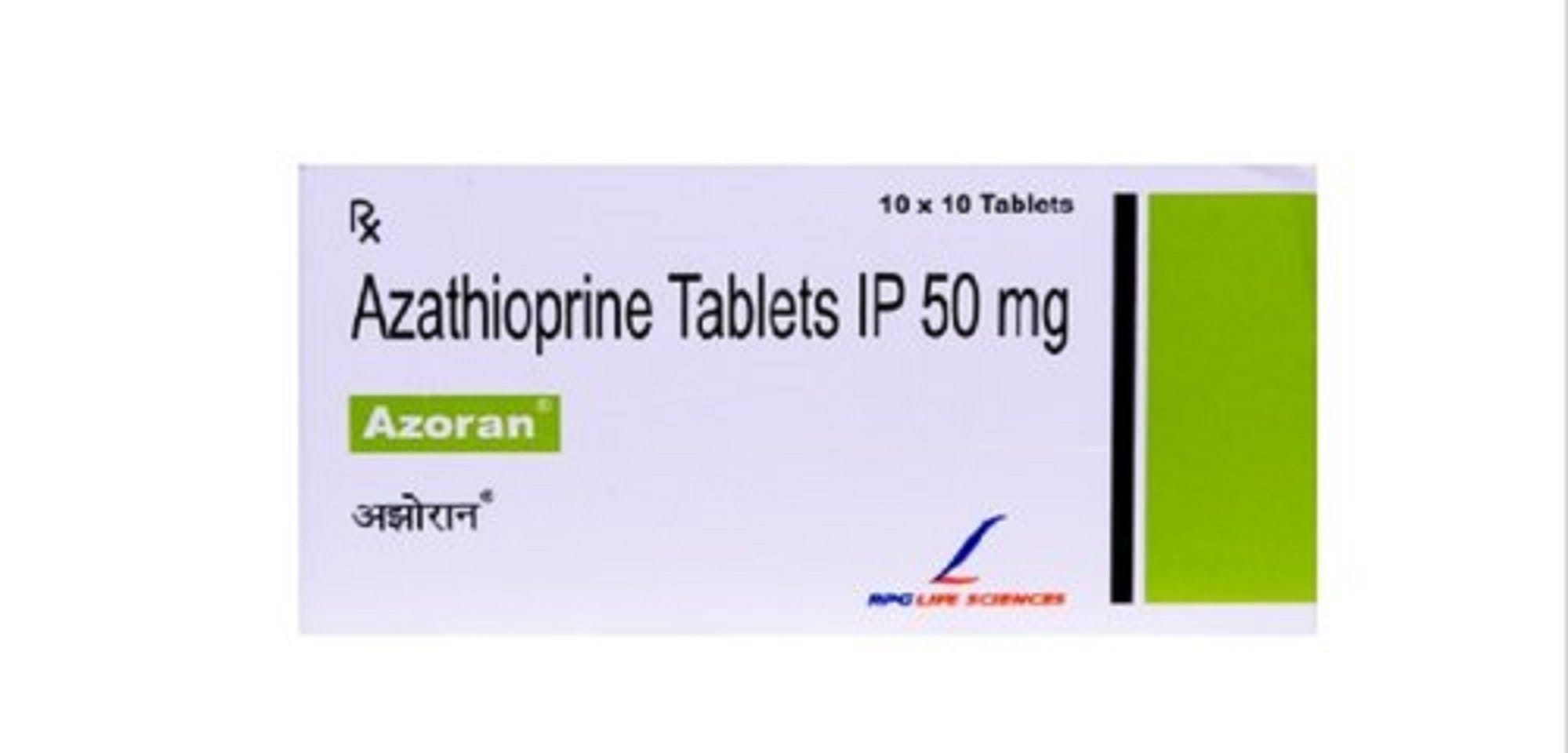
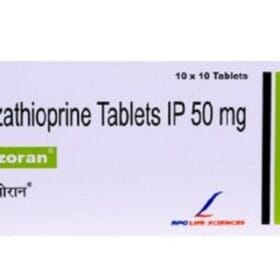
Azoran
✅ Immuunsysteemmodulatie
✅ Vermindert ontsteking
✅ Voorkomt orgaanafstoting
✅ Behandelt auto-immuunziekten
✅ Langetermijnbeheer
Azoran bevat Azathioprine.
✓ Medisch beoordeeld door Morgan Ellis — Apotheekonderzoeker · 8 jaar ervaring · Laatst beoordeeld: mei 2026
⚡ Snel antwoord — Wat is Azoran?
Azoran is een orale tablet van RPG Life Sciences met azathioprine 50 mg — een klassieke purine-antagonist immunosuppressivum gemetaboliseerd in vivo tot 6-mercaptopurine. Gebruikt om orgaanafstoting te voorkomen en om een breed scala aan auto-immuun- en ontstekingsaandoeningen te beheersen (reumatoïde artritis, lupus, inflammatoire darmziekten, auto-immuunhepatitis, myasthenia gravis, vasculitis, pemphigus). Standaard dosering voor volwassenen: 1–3 mg/kg eenmaal daags, langzaam opgehoogd. TPMT (en bij voorkeur NUDT15) genotypering of enzymactiviteitstesten is verplicht voor de eerste dosis — patiënten met lage of afwezige TPMT-activiteit ontwikkelen catastrofale, levensbedreigende myelosuppressie bij standaarddoseringen. Het begin is traag — 8–16 weken voor een steroïd-besparend effect. Langetermijnrisico's omvatten infectie, beenmergsuppressie, hepatotoxiciteit en een licht verhoogd risico op lymfoom en niet-melanoom huidkanker.
📦 Elke bestelling is gedekt door onze Reshipment Assurance-beleid — als uw pakket niet binnen 20 werkdagen arriveert, sturen wij het opnieuw.
Waarom bestellen bij MedsBase
Onze generieke medicijnen zijn afkomstig van WHO-GMP gecertificeerde fabrikanten en worden wereldwijd verzonden in discrete, eenvoudige verpakkingen — geen medicijnnaam op de buitenkant van het pakket. Betalingen met kaart worden verwerkt via een gereguleerde processor (betalingsoverzichten vermelden een gereguleerde kaartbetalingprocessor — nooit “MedsBase” of een medicijnnaam). Crypto en SEPA bankoverschrijvingen worden ook geaccepteerd. Elke bestelling wordt ondersteund door ons Reshipment Assurance Policy.
Wat Is Azoran?
Azoran is een orale tablet vervaardigd door RPG Life Sciences die azathioprine 50 mg. bevat. Azathioprine is een pro-drug — na absorptie wordt het (niet-enzymatisch en door glutathione-S-transferase) omgezet in 6-mercaptopurine (6-MP), dat verder wordt gemetaboliseerd tot actieve thioguanine-nucleotiden die in DNA worden ingebouwd en de purinesynthese in snel delende cellen, met name lymfocyten, blokkeren.
Azoran is RPG Life Sciences’ merknaam voor generiek azathioprine — een van de oudste immunosuppressiva die nog routinematig in de kliniek worden gebruikt en het klassieke steroidbesparende middel bij IBD, SLE, auto-immuunhepatitis, myasthenia gravis en onderhoudstherapie na orgaantransplantaties. Azathioprine wordt sinds de jaren 1960 klinisch gebruikt en blijft een van de hoekstenen van steroidbesparende immunosuppressiva — voor onderhoud na orgaantransplantaties en een breed scala aan auto-immuunziekten. De belangrijkste rollen zijn ofwel als primair immunosuppressivum (bij milde tot matige ziekte) of als steroidbesparend middel (toegevoegd aan corticosteroidtherapie om een steroidafbouw mogelijk te maken terwijl de ziekte onder controle blijft).
Hoe Werkt Azoran?
Azathioprine werkt op DNA-niveau in delende immuuncellen:
- Pro-drug omzetting — azathioprine wordt binnen enkele uren na inname omgezet in 6-MP.
- Drievoudige metabolisme van 6-MP:
- HGPRT pathway → 6-thioguanine nucleotiden (6-TGN), het belangrijkste actieve metaboliet. 6-TGN wordt opgenomen in DNA en verstoort de purinesynthese in lymfocyten.
- TPMT pathway → 6-methyl-mercaptopurine, grotendeels inactief. Patiënten met lage TPMT-activiteit leiden meer 6-MP naar het actieve 6-TGN pathway — wat bij normale doseringen tot ernstige myelosuppressie leidt.
- Xanthine oxidase pathway → inactief thiourinezuur. Dit is het pathway dat wordt geblokkeerd door allopurinol — wat verklaart waarom allopurinol + standaarddosis azathioprine een potentieel dodelijke combinatie is.
- Lymfocyt-selectief — T- en B-cellen zijn bijzonder gevoelig omdat ze afhankelijk zijn van de de novo purinesyntheseweg in plaats van salvage.
Begin van klinisch effect: 8–16 weken voor de meeste auto-immuunziekten. Azathioprine is geen snelwerkend medicijn — corticosteroïden zijn meestal nodig gedurende de eerste 2–3 maanden totdat azathioprine het overneemt.
Toepassingen en Indicaties
- Orgaantransplantatie — onderhoudsimmunosuppressie bij nier-, lever- en harttransplantaties (minder vaak gebruikt tegenwoordig — mycophenolaat heeft het grotendeels vervangen in moderne protocollen)
- Inflammatoire darmziekten — steroïdsparende onderhoudsbehandeling bij de ziekte van Crohn en colitis ulcerosa
- Reumatoïde artritis — voor patiënten die methotrexaat of biologicals niet verdragen
- Systemische lupus erythematosus (SLE) — inclusief onderhoud na inductie van lupus nefritis
- Auto-immuunhepatitis — standaard onderhoud in combinatie met (of ter vervanging van) lage doses prednisolon
- Myasthenia gravis — steroïdsparende langdurige therapie
- ANCA-geassocieerde vasculitis — remissiebehandeling na inductie
- Pemphigus vulgaris en bulleus pemfigoïd — steroïdsparend bij chronische ziekte
- Atopisch eczeem — ernstige refractaire gevallen
- Multiple sclerose (relapsing-remitting) — incidenteel gebruik wanneer ziekte-modificerende therapieën niet beschikbaar zijn
Azoran is niet voor: ongediagnosticeerde gewrichtspijn, eerstelijnsbehandeling van de meeste auto-immuunziekten wanneer sneller werkende of effectievere alternatieven beschikbaar zijn, of bij patiënten bij wie geen TPMT-test en basisbloedonderzoek zijn uitgevoerd.
Voordat u met Azoran begint — Verplichte screening
Azathioprine is een van de weinige veelgebruikte medicijnen waarbij farmacogenetisch testen voor de eerste dosis standaardzorg is. Het overslaan hiervan kan leiden tot fatale beenmerguitval.
- TPMT-genotype of enzymactiviteitstest — identificeert de ~1 op 300 patiënten van Europese afkomst met afwezige TPMT-activiteit (homozygoot variant) en de ~10% met verminderde activiteit (heterozygoot). Afwezige TPMT-activiteit betekent dat de standaarddosis binnen enkele weken tot catastrofale myelosuppressie zal leiden.
- NUDT15-genotype (indien beschikbaar) — vooral belangrijk bij patiënten van Aziatische, Hispanische en Afrikaanse afkomst, waarbij NUDT15-varianten een vergelijkbaar risico op myelosuppressie veroorzaken, onafhankelijk van de TPMT-status.
- Volledig bloedbeeld — basislijn; start niet als ANC < 1,5 of bloedplaatjes < 100.
- Leverfunctietesten — basislijn ALT, AST, ALP, bilirubine. Stel uit bij significante afwijkingen.
- Nierfunctie — azathioprine wordt gedeeltelijk via inactieve metabolieten in de urine uitgescheiden; dosisaanpassing kan nodig zijn bij ernstig nierfalen.
- Hepatitis B / C en HIV-screening — voorkomt reactivatie van chronische virale hepatitis en identificeert co-infecties die gespecialiseerde zorg vereisen.
- Latente TB-screening — QuantiFERON of TST; behandel latente TB voordat langdurige immunosuppressie wordt gestart.
- Varicella-zoster-status — seronegatieve patiënten moeten het varicellavaccin (levend) ontvangen VOORDAT azathioprine wordt gestart — levende vaccins zijn gecontra-indiceerd zodra de behandeling is begonnen.
- Zwangerschapstest bij vrouwen in de vruchtbare leeftijd; bespreking van anticonceptie is nodig.
- Vaccinatiebeoordeling — update geïnactiveerde vaccins (griep, pneumokokken, COVID-19, Shingrix, HPV). Levende vaccins gecontra-indiceerd tijdens behandeling.
Azoran Dosering en hoe in te nemen
Azoran is verkrijgbaar in 50 mg. Dosering is gebaseerd op gewicht en wordt zorgvuldig getitreerd.
- Standaard bereik voor volwassenen: 1–3 mg/kg lichaamsgewicht eenmaal daags.
- Begin laag: meestal 50 mg eenmaal daags gedurende 1–2 weken, met bloedbeeldcontrole in week 1 en week 2; verhoog daarna naar de streefdosis als bloedwaarden stabiel zijn.
- Onderhoud bij auto-immuunziekten: 1–2,5 mg/kg/dag typisch.
- Onderhoud na transplantatie: 1–3 mg/kg/dag afhankelijk van het regime.
- TPMT heterozygoot of intermediaire activiteit: verlaag startdosis tot 50% (0,5–1,5 mg/kg/dag).
- TPMT homozygoot deficiënt, of NUDT15 deficiënt: azathioprine is gecontra-indiceerd (of gebruik < 10% van de standaarddosis onder specialistisch toezicht met intensieve monitoring).
- Nierfunctiestoornis: verlaag de dosis bij ernstige beperking; vermijd bij ESRD zonder specialistische begeleiding.
- Met voedsel: inneem met of na voedsel om misselijkheid te verminderen.
Hoe Azoran op de juiste manier in te nemen
- Begin nooit zonder TPMT-test (en NUDT15 waar beschikbaar). Dit is de belangrijkste veiligheidsmaatregel.
- Slik de tabletten heel in met water, tijdens of na de maaltijd. Vermijd het pletten of kauwen van de tabletten — azathioprine is een cytotoxisch geneesmiddel en stof kan schadelijk zijn voor verzorgers. Was uw handen na het hanteren.
- Eénmaal daags op een consistent tijdstip — meestal bij de avondmaaltijd om eventuele misselijkheid overdag te verminderen.
- CBC en LFT's na 1, 2, 4, 8, 12 weken, daarna elke 3 maanden voor onbepaalde tijd. Een daling van WBC onder 3,0 of neutrofielen onder 1,5 vereist specialistische beoordeling en meestal dosisvermindering of onderbreking.
- Sla de controlebloedonderzoeken niet over — vertraagd optredende myelosuppressie kan maanden of jaren na aanvang van de behandeling optreden, vooral bij nieuwe co-medicatie (allopurinol is de klassieke trigger).
- Dagelijks breedspectrum SPF 50 zonnebrandcrème. Azathioprine verhoogt het risico op niet-melanoom huidkanker aanzienlijk — jaarlijkse dermatologische controle voor patiënten met een lichte huid of iedereen die langdurig wordt behandeld.
- Meld direct elke keelpijn, onverklaarde koorts, blauwe plekken, bloedingen, mondzweren of ernstige vermoeidheid — dit kan het eerste teken zijn van beenmergsuppressie.
- Informeer elke voorschrijver dat u azathioprine gebruikt — vooral vóór het starten van een nieuw medicijn dat begint met “allopurinol” of een urinezuurverlagende therapie.
- Vermijd levende vaccins tijdens de behandeling en gedurende ten minste 3 maanden na het stoppen.
- Plan een zwangerschap vooraf met de voorschrijver — azathioprine wordt over het algemeen als compatibel met zwangerschap beschouwd voor maternale indicaties (in tegenstelling tot mycophenolaat), maar de beslissing is individueel.
Bijwerkingen van Azoran
Vaak voorkomend (eerste 4–8 weken):
- Misselijkheid, braken, buikpijn (meestal verdwijnend; ergst in de eerste maand)
- Diarree
- Vermoeidheid
- Hoofdpijn
- Milde haarverdunning
- Licht verhoogde leverenzymen (ALT, AST)
Minder vaak maar belangrijk:
- Myelosuppressie — leukopenie, neutropenie, trombocytopenie, anemie. Meestal dosisafhankelijk en omkeerbaar.
- Overgevoeligheidsreactie — koorts, huiduitslag, gewrichtspijn, soms hypotensie, typisch in de eerste 4 weken. Verdwijnt bij stoppen en keert meestal terug bij herstarten.
- Hepatotoxiciteit — milde ALT-stijging komt vaak voor; cholestatische hepatitis en veno-occlusieve ziekte zijn zeldzaam maar ernstig.
- Pancreatitis — idiosynchratisch, komt vaker voor bij IBD-patiënten. Stop permanent als het optreedt.
- Mondzweren
- Verhoogd risico op infecties — bacterieel, viraal (vooral herpes zoster), schimmel, parasitair
Zeldzaam maar ernstig — zoek dringend medisch advies:
- Ernstige levensbedreigende myelosuppressie — TPMT-deficiënte patiënten, gelijktijdig gebruik van allopurinol, of hoge dosis blootstelling. Plotselinge keelpijn, koorts, blauwe plekken, bloedingen of ernstige vermoeidheid is het waarschuwingssignaal.
- Lymfoom — post-transplantaire lymfoproliferatieve ziekte (PTLD); hepatosplenisch T-cellymfoom (zeldzaam maar vaak fataal; hoger risico bij jonge mannen met IBD die een combinatie van azathioprine + TNF-remmer gebruiken)
- Niet-melanoom huidkanker — aanzienlijk verhoogd bij langdurig gebruik, vooral bij patiënten met een lichte huid en cumulatieve blootstelling aan de zon
- Progressieve multifocale leuko-encefalopathie (PML) — zeldzaam maar gemeld, meestal bij zwaar geïmmunosupprimeerde patiënten
- Reactivatie van hepatitis B of gordelroos, gedissemineerde herpes, opportunistische infectie
Waarschuwingen en voorzorgsmaatregelen
- Actieve ernstige infectie — niet starten; onderbreken tijdens koortsende ziekte.
- Voorgeschiedenis van of actieve maligniteit (anders dan behandelde niet-melanoom huidkanker) — relatieve contra-indicatie; specialistische beslissing.
- Jonge mannen met IBD — specifiek (zeldzaam) risico op hepatosplenisch T-cellymfoom, vooral wanneer azathioprine wordt gecombineerd met een TNF-remmer. Bespreek alternatieven voor monotherapie.
- Chronische hepatitis B of C — risico op virale reactivering; behandel met antivirale therapie (entecavir of tenofovir voor HBV) waar nodig.
- Latente TB — behandel voordat langdurige immunosuppressie wordt gestart.
- Zwangerschap — azathioprine wordt over het algemeen als compatibel beschouwd met zwangerschap voor maternale auto-immuunziekten (in tegenstelling tot mycophenolaat, wat absoluut gecontra-indiceerd is). Continuering tijdens de zwangerschap moet een gedeelde beslissing zijn met specialistische input; onbehandelde actieve auto-immuunziekte vormt vaak een hoger risico voor de foetus dan het medicijn. Vaders die azathioprine gebruiken tijdens de conceptie: geen sterk bewijs van teratogeniciteit.
- Borstvoeding — kleine hoeveelheden metabolieten komen in de moedermelk terecht, maar klinisch gebruik suggereert een laag risico voor de baby; over het algemeen als acceptabel beschouwd met monitoring van de baby.
- Kinderen — gebruikt bij pediatrische IBD, transplantatie en auto-immuunhepatitis. Dezelfde farmacogenetische testen zijn vereist.
- Levende vaccins zijn gecontra-indiceerd tijdens de behandeling. Geïnactiveerde vaccins zijn veilig. Plan Shingrix en reisvaccins voordat u begint.
- Blootstelling aan de zon — dagelijks breedspectrum SPF 50; jaarlijkse dermatologische controle voor patiënten met een lichte huid en diegenen die langdurig worden behandeld.
- Omgaan door zwangere of zogende verzorgers — azathioprine is geclassificeerd als een cytotoxisch geneesmiddel. Draag handschoenen bij het verstrekken van gebroken of fijngemaakte tabletten; was uw handen na het hanteren.
Contra-indicaties — Wie mag Azoran NIET gebruiken
- Bekende overgevoeligheid voor azathioprine, 6-mercaptopurine of enig tablet-hulpstof
- Volledig TPMT- of NUDT15-deficiëntie (homozygote variant) — gebruik een andere medicatieklasse
- Ernstige actieve infectie (bacterieel, viraal, fungale, mycobacterieel)
- Actieve onbehandelde hepatitis B of C zonder antivirale dekking
- Ernstige leverziekte (gedecompenseerde cirrose)
- Eerdere azathioprine-geïnduceerde pancreatitis (absolute contra-indicatie voor hergebruik)
- Ernstige baseline myelosuppressie (ANC < 1.0, trombocyten < 75, Hb < 8 g/dL)
- Zwangerschapsplanning waarbij mycophenolaat of methotrexaat niet als alternatieven zijn overwogen (specialistisch oordeel)
Geneesmiddelinteracties
| Combineren met | Effect | Wat te doen |
|---|---|---|
| Allopurinol, febuxostat (urinezuurverlagend) | Levensbedreigende myelosuppressie — xanthine-oxidase wordt geblokkeerd, 6-MP hoopt op in de actieve cytotoxische route. Sterfgevallen gemeld. | Verminder azathioprine tot 25–33% van de standaarddosis EN controleer wekelijks CBC gedurende 4 weken. Alternatief: schakel over op een niet-XO middel (lesinurad, uricosurica). |
| Aminosalicylaten (mesalazine, sulfasalazine, olsalazine) | TPMT remmen — matig extra risico op myelosuppressie | Veelvoorkomende combinatie bij IBD. Controleer CBC vaker. |
| Warfarine | Azathioprine kan het effect van warfarine verminderen (mechanisme onduidelijk) | Controleer INR nauwlettend bij starten of stoppen van azathioprine. |
| ACE-remmers, ARB's | Additief risico op anemie | Controleer Hb. |
| Co-trimoxazol (trimethoprim-sulfamethoxazol) | Additieve myelosuppressie | Wordt vaak gebruikt voor Pneumocystis-profylaxe bij zwaar geïmmunosupprimeerde patiënten — controleer CBC. |
| Ribavirine (behandeling van hepatitis C) | Ernstige myelosuppressie via remming van inosine monofosfaat dehydrogenase | Vermijd combinatie. Voltooi de HCV-behandeling voordat u zo mogelijk azathioprine start. |
| TNF-remmers (infliximab, adalimumab, certolizumab) | Standaardcombinatie bij IBD; licht verhoogd risico op lymfoom, vooral bij jonge mannen (hepatosplenaal T-cellymfoom) | Weeg het voordeel (IBD-controle) af tegen het zeldzame lymfoomrisico. Overweeg monotherapie zodra de situatie stabiel is. |
| Levende vaccins (BMR, waterpokken, gele koorts, BCG, Zostavax, levende neusgriep) | Risico op gedissemineerde vaccinstam-infectie | Gecontra-indiceerd tijdens de behandeling en gedurende 3 maanden na het stoppen. |
| Corticosteroïden | Additieve immunosuppressie (beoogde combinatie) | Standaard - azathioprine wordt vaak gebruikt als een steroïdsparend middel. |
| Andere immunosuppressiva (MMF, ciclosporine, tacrolimus, JAK-remmers, biologica) | Additief risico op infecties en maligniteiten | Alleen in zorgvuldig gecontroleerde transplantatie- of specialistische contexten. |
Bewaaradvies
- Bewaren bij kamertemperatuur, onder 25°C, in de originele blisterverpakking, beschermd tegen licht en vocht.
- Buiten bereik van kinderen houden - azathioprine is cytotoxisch en gevaarlijk als het wordt ingeslikt door een kind of huisdier.
- Niet gebruiken na de vervaldatum op de verpakking.
- Breng ongebruikte tabletten terug naar een apotheek als cytotoxisch afval - gooi ze niet bij het huisvuil of spoel ze niet door.
- Was uw handen na het aanraken. Verzorgers moeten handschoenen gebruiken bij het hanteren van gebroken tabletten, vooral als ze zwanger zijn of borstvoeding geven.
Gerelateerde alternatieven op MedsBase
Andere medicijnen die worden gebruikt bij ontstekingsremmende en auto-immuunzorg, naast dit product:
- Barinat (baricitinib 2 / 4 mg) — JAK1/2-remmer voor RA
- Tofe (tofacitinib 5 mg) — JAK1/3-remmer voor RA, UC, PsA
- Lefuheal (leflunomide) — orale DMARD voor reumatoïde artritis
- Conimune ME (cyclosporine) - calcineurineremmer
- Wysolone (prednisolon 5 / 10 / 20 mg) — oraal corticosteroïd
- Medrol (methylprednisolon 4 / 8 / 16 mg) — oraal corticosteroïd
- Predniheal (prednisolon) — oraal corticosteroïd
- Hisone (hydrocortison) — fysiologisch vervangend steroïd
- Budez CR (budesonide) — darmgericht corticosteroïd voor de ziekte van Crohn
- Kenacort (triamcinolon) — systemisch corticosteroïd
Ontdek het volledige Ontstekingsremmende & Auto-immuunzorg category.
Veelgestelde vragen
Waarom heb ik TPMT-testen nodig voordat ik met Azoran begin?
Thiopurine methyltransferase (TPMT) is het enzym dat de actieve metaboliet van azathioprine ontgift. Ongeveer 1 op de 300 mensen van Europese afkomst heeft GEEN functionele TPMT (homozygote deficiëntie), en ongeveer 10% heeft verminderde activiteit (heterozygoot). Bij de standaarddosering zal een patiënt met TPMT-deficiëntie binnen enkele weken catastrofale, levensbedreigende beenmergsuppressie ontwikkelen. TPMT-testen - ofwel genotypering of enzymactiviteitsbepaling - identificeert deze patiënten voordat ze de eerste tablet innemen. NUDT15-testen is bovendien belangrijk voor patiënten van Aziatische, Hispanische en Afrikaanse afkomst, die een ander hoogrisicovariant hebben.
Wanneer begint Azoran te werken?
Azathioprine werkt langzaam. Het klinische effect doet er 8–16 weken dagen over om merkbaar te worden. Tijdens deze inductieperiode blijft u meestal corticosteroïden of een ander snelwerkend medicijn gebruiken voor ziektecontrole. Verwacht niet dat u zich in de eerste 4 weken anders voelt - en stop niet met azathioprine omdat het “niet lijkt te werken” in de eerste maand.
Waarom is allopurinol zo gevaarlijk in combinatie met Azoran?
Allopurinol blokkeert xanthine-oxidase, een van de drie enzymen die 6-MP (de actieve vorm van azathioprine) metaboliseren. Met geblokkeerd xanthine-oxidase wordt meer 6-MP omgeleid naar de actieve cytotoxische route - de niveaus stijgen scherp en ernstige beenmergfalen kan binnen enkele weken volgen. Als u azathioprine gebruikt en uratenverlagende therapie nodig heeft, kunt u (a) de azathioprinedosis verlagen tot 25-33% van de normale dosis EN wekelijks CBC monitoren, (b) overschakelen naar een niet-XO uratenverlagend medicijn (lesinurad, probenecid), of (c) tijdelijk stoppen met azathioprine. Dit is de gevaarlijkste geneesmiddelinteractie bij azathioprine.
Welke bloedtesten heb ik nodig bij gebruik van Azoran?
Volledig bloedbeeld en leverfunctietesten in week 1, 2, 4, 8, 12, en vervolgens elke 3 maanden onbepaald. Vaker (wekelijks gedurende 4 weken) bij het starten van een nieuw medicijn, vooral allopurinol of co-trimoxazol. Elke daling van WBC onder 3,0 × 10&sup9;/L of ANC onder 1,5, of elke stijging van ALT boven 3× de bovengrens van normaal, vereist beoordeling door de voorschrijver en meestal dosisvermindering of onderbreking.
Kan ik zwanger worden tijdens het gebruik van Azoran?
Azathioprine wordt over het algemeen als compatibel beschouwd met zwangerschap voor maternale auto-immuunziekten — het medicijn passeert de foetus, maar de lever van de vroege foetus mist de enzymen om het te activeren tot 6-TGN, waardoor blootstelling van de foetus aan de actieve vorm beperkt is. Dit is zeer verschillend van mycophenolaat, dat sterk teratogeen is en absoluut gecontra-indiceerd is tijdens zwangerschap. Veel reumatologen, IBD-specialisten en transplantatieartsen zetten azathioprine voort tijdens de zwangerschap omdat de risico's van ongecontroleerde maternale ziekte zwaarder wegen dan het medicijnrisico. Bespreek dit met uw specialist minstens 3 maanden voor een geplande conceptie. Effectieve anticonceptie is niet verplicht, maar gedeelde besluitvorming wel.
Waarom ben ik vatbaarder voor infecties en huidkanker bij gebruik van Azoran?
Azathioprine onderdrukt over het algemeen lymfocyten, waardoor uw vermogen om te reageren op bacteriële, virale en schimmelinfecties verminderd is — met name herpes zoster-reactivering. Het belemmert ook specifiek DNA-herstel in door UV beschadigde huidcellen, wat het risico op plaveiselcel- en basaalcelcarcinoom aanzienlijk verhoogt (meestal na 5+ jaar behandeling). Dagelijkse SPF 50 zonbescherming, zonbeschermende kleding, het vermijden van zonnebanken en een jaarlijks dermatologisch onderzoek verminderen dit risico aanzienlijk.
Wat moet ik doen als ik een ernstige keelpijn of koorts krijg bij gebruik van Azoran?
Stop direct met Azoran en laat direct een volledig bloedbeeld maken. Onverklaarde koorts, ernstige keelpijn, mondzweren, ongebruikelijke blauwe plekken, bloedend tandvlees of extreme vermoeidheid zijn waarschuwingssignalen van beenmergonderdrukking of ernstige infectie. Elk van deze symptomen bij een patiënt die azathioprine gebruikt, wordt als een noodgeval behandeld totdat een normaal CBC dit uitsluit. Start azathioprine alleen weer op na overleg met de voorschrijver.
Kan ik levende vaccins krijgen tijdens gebruik van Azoran?
Nee. Levende vaccins — MMR, varicella, gele koorts, BCG, levend Zostavax-gordelroosvaccin, levend nasaal griepvaccin — zijn gecontra-indiceerd tijdens azathioprinebehandeling en gedurende 3 maanden na stopzetting. Plan al deze vaccinaties voor aanvang van de behandeling. Geïnactiveerde vaccins zijn prima en aanbevolen: jaarlijkse griepprik, pneumokokken, COVID-19, recombinant Shingrix, HPV. Het recombinant Shingrix-vaccin (niet het oudere levende Zostavax) is het juiste gordelroosvaccin bij immunosuppressiva.
Hoelang blijf ik Azoran gebruiken?
Voor de meeste auto-immuun- en ontstekingsaandoeningen is azathioprine een langdurige onderhoudsbehandeling — vaak 2–10 jaar, soms onbepaald, afhankelijk van ziektecontrole en alternatieve opties. Voor transplantatie-indicaties is het levenslang. Uw specialist zal periodiek beoordelen of voortzetting nog nodig is. Stop nooit abrupt met azathioprine zonder overleg met een specialist — ziekte-opflakkeringen komen vaak voor en kunnen ernstig zijn.
Waarom bestellen bij MedsBase
Azoran wordt geleverd door een WHO-GMP gecertificeerde fabrikant met volledige COA-documentatie. Wij verzenden wereldwijd in eenvoudige, discrete verpakkingen en elke bestelling wordt gedekt door onze Reshipment Assurance-beleid. Uw betalingsbeschrijving bij betaling per kaart toont de gereguleerde betalingsverwerker (een gereguleerde kaartbetalingverwerker), nooit “MedsBase” of een medicijnnaam.
Andere ontstekingsremmende en auto-immuun medicijnen
Als Azoran niet geschikt is voor uw situatie, zijn de volgende opties beschikbaar in deze categorie:
- Lefuheal (Leflunomide 10/20 mg) — pyrimidinesynthese-remmer
- Conimune ME (Cyclosporine 25/50/100 mg) — calcineurineremmer
- Barinat (Baricitinib 2/4 mg) — selectieve JAK1/JAK2-remmer
- Tofe (Tofacitinib 5 mg) — pan-JAK-remmer
- Wysolone (Prednisolone 5/10/20 mg) — overbruggend corticosteroïd
Meer opties in ontstekingsremmende en auto-immuunzorg
Gerangschikt op recente bestelvolumes van MedsBase — wat andere klanten in deze categorie kiezen.


| Sterkte | 50 mg |
|---|---|
| Hoeveelheid | 30 Tabletten, 60 Tabletten, 90 Tabletten, 180 Tabletten |
 Azoran
Vragen & antwoorden
Azoran
Gerelateerde producten



Beoordelingen
Er zijn nog geen beoordelingen