







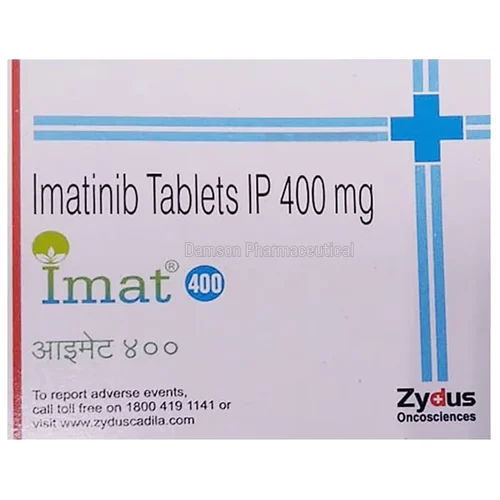
Imat
✅ Behandelt leukemie
✅ Beheerst Gastro-intestinale Stromale Tumoren
✅ Beheerst chronische myeloïde leukemie
✅ Vertraagt tumorgroei
✅ Verbetert de algehele overleving
Imat bevat Imatinib.
✓ Medisch beoordeeld door Morgan Ellis — Apotheekonderzoeker · 8 jaar ervaring · Laatst beoordeeld: mei 2026
⚡ Snelle vraag — Wat is Imat?
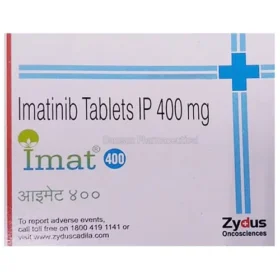
Imat is een orale tablet van Natco Pharma met imatinib mesylaat op 400 mg — het origineel BCR-ABL tyrosinekinaseremmer en het medicijn dat chronische myeloïde leukemie (CML) veranderde van een dodelijke ziekte in een chronische aandoening. Standaardindicaties: CML in chronische fase (400 mg/dag), CML in versnelde/blastfase (600–800 mg/dag), Philadelphia-chromosoom-positieve ALL, gastro-intestinaal stromaal tumor (GIST), en verschillende andere zeldzame KIT/PDGFRA-gedreven kankers. Innemen met voedsel en een groot glas water om maag-darmklachten te verminderen. Verplichte monitoring: volledig bloedbeeld + leverfunctietesten elke 2 weken gedurende de eerste 2–3 maanden, daarna maandelijks; cytogenetische + moleculaire respons (BCR-ABL-transcript) elke 3 maanden bij CML.
📦 Elke bestelling is gedekt door onze Reshipment Assurance-beleid — als uw pakket niet binnen 20 werkdagen arriveert, sturen wij het opnieuw.
Wat Is Imat?
Imat is een orale tablet van Natco Pharma met imatinib mesylaat 400 mg. Imatinib was het eerste selectieve BCR-ABL tyrosinekinaseremmer middel dat werd goedgekeurd (Novartis, merknaam Gleevec/Glivec, 2001) en dat een revolutie teweegbracht in de behandeling van chronische myeloïde leukemie (CML) — het veranderde een voorheen dodelijke ziekte in een chronische aandoening met een bijna normale levensverwachting bij behandeling. Het blokkeert ook de verwante KIT- en PDGFRA-receptorkinases, waardoor het werkzaam is bij gastro-intestinale stromale tumoren (GIST) en verschillende andere zeldzame kankersoorten.
Hoe Werkt Imat?
Het Philadelphiachromosoom (een t(9;22)-translocatie) creëert de constitutief actieve BCR-ABL-fusiekinase die chronische myeloïde leukemie veroorzaakt. Imatinib bindt aan de ATP-bindingsplaats van BCR-ABL en vergrendelt het in een inactieve conformatie, waardoor de proliferatieve signalering stopt. Dezelfde verbinding remt ook de verwante KIT-receptor (overactief bij GIST en mestcelziekte) en PDGFRA-receptor (overactief bij sommige sarcomen).
Toepassingen en Indicaties
- Chronische fase Philadelphia-chromosoom-positieve CML (eerste lijn; 400 mg/dag)
- Versnelde fase of blastencrisis CML (600–800 mg/dag, vaak als brug naar allogene transplantatie)
- Philadelphia-chromosoom-positieve acute lymfatische leukemie (ALL), in combinatie met chemotherapie
- Niet-resectabel, recidiverend of gemetastaseerd gastro-intestinaal stromaal tumoren (GIST)
- Adjuvante therapie na GIST-resectie (3 jaar, KIT-positieve ziekte)
- Hypereosinofiel syndroom met FIP1L1-PDGFRA fusie
- Dermatofibrosarcoma protuberans (PDGFRB-gestuurd)
- Agressieve systemische mastocytose (KIT D816V negatief)
Imat Dosering en Hoe In Te Nemen
Standaard dosering per indicatie:
- Chronische fase CML: 400 mg/dag (1 × 400 mg tablet)
- Versnelde/blast fase CML, Ph+ ALL: 600–800 mg/dag (in 1–2 verdeelde doses)
- GIST: 400 mg/dag; verhogen tot 800 mg/dag bij progressie
- Innemen met voedsel en een groot glas water — minimaliseert misselijkheid en slokdarmirritatie.
- Elke dag op hetzelfde tijdstip.
- In zijn geheel doorslikken. Tabletten kunnen worden opgelost in water of appelsap (geen grapefruitsap) als slikken moeilijk is.
- Verplichte monitoring: Volledig bloedbeeld + leverfunctietesten elke 2 weken gedurende de eerste 2–3 maanden, daarna maandelijks. BCR-ABL transcriptniveau (PCR) elke 3 maanden bij CML — belangrijkste maat voor behandelingsrespons. Jaarlijks ECG / echo voor hartfunctie.
- Beenmerg + cytogenetische respons: baseline en na 3, 6, 12 maanden bij CML — bepaalt behandelingssucces of noodzaak voor overstap naar tweedelijns TKI (dasatinib, nilotinib, bosutinib, ponatinib).
- Stop niet zonder instructie van de oncoloog — behandelingvrije remissie is alleen mogelijk na een aanhoudende diepe moleculaire respons (MR4 of beter) gedurende minimaal 2 jaar, onder specialistische begeleiding.
Bijwerkingen van Imat
Vaak voorkomend (vaak mild, verdwijnen vanzelf): misselijkheid, diarree, vochtretentie (periorbitaal oedeem, perifeer oedeem), spierkrampen, huiduitslag, vermoeidheid, gewichtstoename.
Belangrijk — verplichte monitoring:
- Myelosuppressie — neutropenie, trombocytopenie, anemie (zeer vaak voorkomend); dosisverlaging of onderbreking bij ernstige gevallen
- Hepatotoxiciteit — leverfunctiestoornissen komen vaak voor; ernstige hepatitis kan optreden
- Hartfunctiestoornissen — congestief hartfalen (zeldzaam maar gedocumenteerd)
- Hypothyreoïdie bij patiënten na thyreoïdectomie die levothyroxine gebruiken
- Hypofosfatemie, hypocalciëmie
- Nierfunctiestoornis
Zeldzaam maar ernstig: Syndroom van Stevens-Johnson / TEN, leverfalen, ernstige vochtretentie, GI-bloeding, tumorlysesyndroom (hoge tumorlast), hersenoedeem bij patiënten met hersentastasen.
Waarschuwingen en voorzorgsmaatregelen
- Zwangerschap: teratogeen in dierstudies; casusrapporten van menselijke misvormingen. Sterke anticonceptie tijdens de behandeling en gedurende 14 dagen na de laatste dosis. Overleg met oncoloog bij zwangerschapswens.
- Borstvoeding: vermijden — imatinib wordt uitgescheiden in moedermelk.
- Voorgeschiedenis van hartfunctiestoornissen: baseline + voortdurende echo / BNP-monitoring.
- Leveraandoening: voorzichtige dosering; monitor LFTs aanvankelijk wekelijks.
- Hypothyreoïdie op levothyroxine: imatinib verhoogt de klaring van levothyroxine; controleer TSH en verhoog de dosis levothyroxine indien nodig.
- Chirurgie: verhoogd risico op bloedingen door verminderde wondgenezing; stop imatinib peri-operatief onder specialistische begeleiding.
Geneesmiddelinteracties
| Combineren met | Effect | Wat te doen |
|---|---|---|
| Sterke CYP3A4-remmers (ketoconazol, ritonavir, clarithromycine) | Verhoog imatinibspiegels — toxiciteit | Verminder de dosis imatinib met ~50% indien onvermijdelijk. |
| Sterke CYP3A4-induceerders (rifampicine, fenytoïne, carbamazepine, Sint-Janskruid) | Lagere imatinibspiegels — behandelingsfalen | Vermijden. Indien onvermijdelijk, verhoog de dosis met 50% onder specialistische begeleiding. |
| Warfarine | Verhoogd bloedingrisico (CYP2C9-remming + plaatjeseffecten) | Overstappen op LMWH of DOAC; controleer INR aanvankelijk wekelijks. |
| Levothyroxine | Imatinib verhoogt de klaring van levothyroxine — TSH stijgt | Controleer TSH; verhoog levothyroxinedosis indien nodig. |
| Paracetamol (hoge dosis, regelmatig) | Opstapeling van hepatotoxiciteit | Beperk tot incidenteel gebruik. |
| Grapefruitsap | Verhoogt imatinibspiegels | Vermijd grapefruit en grapefruitsap. |
Opslag
- Bewaren bij kamertemperatuur, 15–30°C, in originele blister.
- Buiten bereik van kinderen, vrouwen in de vruchtbare leeftijd en huisdieren houden.
Gerelateerde alternatieven op MedsBase
Andere oncologische medicijnen die naast dit product wordt aangeboden:
Bekijk alle anti-kankermedicijnen →
Veelgestelde vragen
Hoe effectief is Imat voor chronische myeloïde leukemie?
Imatinib is een van de meest succesvolle doelgerichte kankertherapieën ooit ontwikkeld. De totale overleving na 10 jaar bij chronische fase CML met imatinib is ongeveer 85%, vergeleken met een mediane overleving van 4–6 jaar vóór TKI-therapie. Ongeveer 90% van de patiënten bereikt binnen 12–18 maanden een volledige cytogenetische respons. Een aanzienlijke minderheid (~50% met een aanhoudende diepe moleculaire respons) kan uiteindelijk onder specialistische begeleiding proberen te stoppen met de behandeling.
Waarom moet ik Imat met voedsel innemen?
Twee redenen: (1) voedsel vermindert significant misselijkheid en het risico op slokdarmirritatie; (2) imatinib wordt goed opgenomen, maar consistente inname met voedsel vermindert de variabiliteit van dag tot dag. Neem in met de grootste maaltijd van de dag en een vol glas water. Vermijd inname op een lege maag of met grapefruitsap (wat de spiegels en toxiciteitsrisico verhoogt).
Welke bloedtesten heb ik nodig?
Verplicht: Volledig bloedbeeld en leverfunctietesten elke 2 weken gedurende de eerste 2–3 maanden, daarna maandelijks. BCR-ABL transcriptniveau met PCR elke 3 maanden bij CML — dit is de belangrijkste maatstaf voor behandelingsrespons en bepaalt of imatinib wordt voortgezet of wordt overgeschakeld op een tweede generatie TKI (dasatinib, nilotinib). Een jaarlijkse hartbeoordeling (ECG, echo of BNP) is redelijk bij patiënten met cardiale risicofactoren.
Kan ik kinderen krijgen terwijl ik Imat gebruik?
Imatinib is teratogeen in dierstudies en er bestaan casusrapporten van menselijke misvormingen. Sterke anticonceptie is verplicht tijdens de behandeling en gedurende ten minste 14 dagen na de laatste dosis, zowel bij mannelijke als vrouwelijke patiënten. Bespreek gezinsplanning met de oncoloog voordat u begint — in sommige gevallen kan een geplande behandelingsvrije remissiepoging een mogelijkheid bieden voor conceptie.
Wat is “behandelingsvrije remissie” bij CML?
Ongeveer 50% van de CML-patiënten die een aanhoudende diepe moleculaire respons (MR4 of beter) gedurende ten minste 2–3 jaar bereiken kunnen proberen om imatinib te stoppen onder nauwlettend toezicht. Ongeveer de helft van degenen die stoppen, behoudt remissie zonder behandeling voor onbepaalde tijd. De andere helft recidiveert moleculair en start opnieuw met imatinib (wat meestal remissie opnieuw induceert). Dit is een specialistische beslissing — stop nooit eenzijdig met imatinib.
Imat versus nieuwere TKI's (dasatinib, nilotinib, bosutinib)?
Imatinib is eerstelijns voor de meeste nieuw gediagnosticeerde chronische fase CML — lange veiligheidsrecord, lagere kosten, gevestigde gegevens over behandelingsvrije remissie. Dasatinib en nilotinib zijn tweede generatie TKI's met snellere en diepere moleculaire responsen; voorkeursbehandeling eerstelijns bij hoger risico ziekte of jongere patiënten die behandelingsvrije remissie prioriteren. Bosutinib, ponatinib zijn gereserveerd voor resistentie of intolerantie. De keuze is zeer individueel — specialistische hematologische beslissing.
Zal Imat werken voor mijn GIST-tumor?
Voor GIST hangt de respons op imatinib af van de onderliggende KIT- of PDGFRA-mutatie. KIT exon 11-mutaties hebben een responspercentage van ~85% bij 400 mg/dag. KIT exon 9-mutaties hebben 800 mg/dag nodig. KIT/PDGFRA wild-type GIST en PDGFRA D842V-mutatie reageren slecht — alternatieve TKIs (avapritinib voor D842V) zijn nodig. Mutatietesten zijn verplicht voordat imatinib voor GIST wordt gestart.
Waarom houd ik vocht vast bij gebruik van Imat?
Vochtretentie — periorbitale wallen, enkelzwelling, gewichtstoename — is een van de meest kenmerkende bijwerkingen van imatinib, die tot 60% van de patiënten treft. Het mechanisme omvat PDGFR-remming en milde renale natriumretentie. Beheer met een zoutarm dieet en zo nodig een bescheiden diureticum. Ernstige vochtretentie (longoedeem, pleura-effusie) vereist dosisvermindering of onderbreking.
Mag ik alcohol drinken terwijl ik Imat gebruik?
Beperk alcohol — zowel alcohol als imatinib worden door de lever verwerkt, en de combinatie verhoogt het risico op hepatotoxiciteit. Af en toe kleine hoeveelheden zijn meestal verdraagbaar; dagelijks of overmatig drinken moet worden vermeden. Informeer uw oncoloog als uw leverfunctietesten stijgen.
Waarom bestellen bij MedsBase
Elke batch wordt ingekocht bij een WHO-GMP gecertificeerde fabrikant. Bestellingen worden verzonden in eenvoudige, ongemarkeerde verpakkingen door onze logistieke partners en vallen onder onze Reshipment Assurance-beleid: als een pakket niet binnen 20 werkdagen arriveert, sturen wij kosteloos een nieuwe zending, zonder vragen te stellen.
Gerelateerde Antikankermedicijnen
Andere oncologische medicijnen die naast dit product wordt aangeboden:
- Imatib (imatinib 100/400 mg)
- Veenat (imatinib 100/400 mg)
- Votrient (pazopanib 200/400 mg)
- Hydrosar (hydroxyurea 500 mg)
- Riborea (ribociclib 200 mg)
Meer opties in antikankermedicatie
Gerangschikt op recente bestelvolumes van MedsBase — wat andere klanten in deze categorie kiezen.

| Sterkte | 400 mg |
|---|---|
| Hoeveelheid | 30 Tabletten, 60 Tabletten, 90 Tabletten, 180 Tabletten |
 Imat
Imat
Vragen & antwoorden
Imat
Gerelateerde producten



Beoordelingen
Er zijn nog geen beoordelingen