








Xyzal
✅ Verlicht allergieklachten
✅ Vermindert jeuk
✅ Beheerst niezen
✅ Vermindert een loopneus
✅ Bevat Levocetirizine
Xyzal bevat Levocetirizine.
✓ Medisch beoordeeld door Morgan Ellis — Apotheekonderzoeker · 8 jaar ervaring · Laatst beoordeeld: mei 2026
⚡ Snel antwoord — Wat is Xyzal?
Xyzal is een merk van levocetirizine (5 mg), een tweede generatie, niet-sederend oraal antihistaminicum gebruikt voor hooikoorts (allergische rhinitis), chronische idiopathische urticaria (netelroos), jeukende huid en allergische conjunctivitis. Het blokkeert histamine H1-receptoren in de perifere weefsels die allergiesymptomen veroorzaken — niezen, loopneus, jeukende ogen, netelroos — zonder significant de bloed-hersenbarrière te passeren, waardoor de meeste mensen er niet slaperig van worden. Werking: binnen 30–60 minuten; duur: 24 uur. Eenmaal daags doseren. Pure actieve (R)-enantiomeer van cetirizine — je krijgt dezelfde receptorbinding bij de helft van de dosis met ongeveer de helft van de slaperigheid. Avonddosering is standaard. Veilig voor langdurig dagelijks gebruik (maanden tot jaren) bij de meeste volwassenen. Veelvoorkomende bijwerkingen: milde hoofdpijn, droge mond, vermoeidheid. Vermijd bij bekende overgevoeligheid; dosering aanpassen bij significante nierfunctiestoornis.
📦 Elke bestelling is gedekt door onze Reshipment Assurance-beleid — als uw pakket niet binnen 20 werkdagen arriveert, sturen wij het opnieuw.
Waarom bestellen bij MedsBase
Onze generieke medicijnen zijn afkomstig van WHO-GMP gecertificeerde fabrikanten en worden wereldwijd verzonden in discrete, eenvoudige verpakkingen — geen medicijnnaam op de buitenkant van het pakket. Betalingen met kaart worden verwerkt via een gereguleerde processor (betalingsoverzichten vermelden een gereguleerde kaartbetalingprocessor — nooit “MedsBase” of een medicijnnaam). Crypto en SEPA bankoverschrijvingen worden ook geaccepteerd. Elke bestelling wordt ondersteund door ons Reshipment Assurance Policy.
Wat is Xyzal?
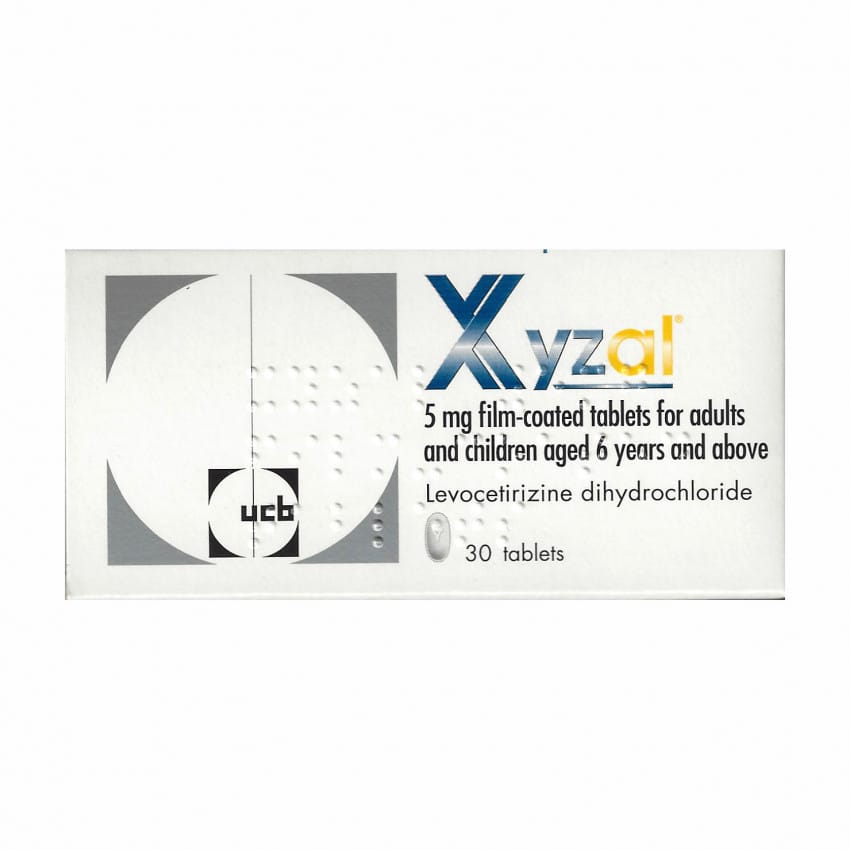
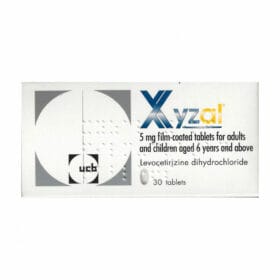
Xyzal is een oraal antihistaminicum dat levocetirizine (5 mg) bevat, verkrijgbaar als tabletten. Geproduceerd door UCB Pharma, in verpakkingen van 30, 60, 90 of 180 tabletten. Origineel merk: Xyzal (UCB, 2001 EU / 2007 VS).
levocetirizine behoort tot de tweede generatie (niet-sederende) H1-antihistamineklasse — ontwikkeld om het allergieblokkerende effect van oudere medicijnen zoals difenhydramine of feniramine te behouden, terwijl de sedatie, droge mond en cognitieve bepermingen veroorzaakt door hun doordringing in de hersenen worden verwijderd. Middelen van de tweede generatie zijn de eerstelijns orale antihistaminica voor allergische rhinitis en chronische urticaria volgens elke belangrijke allergierichtlijn (ARIA, EAACI, AAAAI).
Waar wordt Xyzal voor gebruikt?
- Seizoensgebonden allergische rhinitis (hooikoorts) — niezen, loopneus, jeukende neus, jeukende/waterige ogen veroorzaakt door pollen (boom, gras, onkruid)
- Perennial allergische rhinitis — het hele jaar door symptomen van huisstofmijt, huidschilfers van dieren, schimmel
- Chronische idiopathische urticaria (netelroos) — terugkerende jeukende bulten die langer dan 6 weken aanhouden
- Allergische conjunctivitis — jeukende, waterige, rode ogen door allergenen
- Milde allergische huidreacties — pruritus (jeuk), reacties op insectenbeten, milde contacturticaria
Het is niet een behandeling voor anafylaxie (gebruik adrenaline/epinefrine-auto-injector), astma (gebruik geïnhaleerd corticosteroïd + bronchodilatator) of allergische voedselreacties die verder gaan dan milde huidverschijnselen.
Hoe werkt Xyzal?
Wanneer u wordt blootgesteld aan een allergeen (pollen, stof, huidschilfers van dieren), geven mestcellen en basofielen in de huid en slijmvliezen histamine. histamine vrij. Histamine bindt aan H1-receptoren en veroorzaakt de klassieke allergiecascade: vasodilatatie, vasculaire lekkage, jeuk, niezen, verhoogde slijmsecretie en gladde spiercontractie.
levocetirizine is een selectieve inverse agonist van H1-receptoren. Het stabiliseert de receptor in zijn inactieve toestand, waardoor de signalering zelfs bij basale histamineniveaus wordt verminderd. Belangrijke kenmerken van de tweede generatie:
- Perifere H1-selectiviteit — sterke binding in neus, huid, bindvlies; minimale binding in de hersenen
- Slechte bloed-hersenbarrièrepenetratie — dus weinig tot geen sedatie
- Minimale anticholinerge activiteit — in tegenstelling tot 1e generatie middelen, geen droge mond, urineretentie of constipatie bij therapeutische doseringen
- Geen tachyfylaxie — het effect vermindert niet na wekenlang dagelijks gebruik (een veelvoorkomende misvatting)
Dosering en toediening
Standaard dosering: 5 mg eenmaal daags in de avond. Kinderen 6–11: 2,5 mg eenmaal daags. Dosis of frequentie verminderen bij nierfunctiestoornissen.
- Begin van werking: 30–60 minuten.
- Piek effect: 0,8–1 uur.
- Werkingduur: 24 uur — daarom is eenmaal daags doseren voldoende voor de meeste patiënten.
- Dosis vergeten? Neem het in zodra u eraan denkt, tenzij uw volgende dosis binnen een paar uur gepland staat; verdubbel de dosis niet.
- Seizoensgebruik. Start 1–2 weken voor uw gebruikelijke pollenseizoen voor het beste effect; gebruik het dagelijks door het seizoen heen.
- Chronische urticaria. Richtlijnen staan toe dosering verhogen tot 2–4× standaard dosis als de symptomen niet onder controle zijn — uitgevoerd onder medisch toezicht.
Bijwerkingen
Minder sederend dan zijn ouderstof cetirizine bij equivalente klinische werkzaamheid — slaperigheidspercentages in onderzoeken zijn ongeveer de helft van die van cetirizine 10 mg.
Vaak (< 5% in de meeste onderzoeken):
- Lichte hoofdpijn
- Droge mond
- Vermoeidheid
- Misselijkheid of buikklachten
Minder vaak voorkomend:
- Duizeligheid, slaapstoornissen
- QT-interval effecten bij supratherapeutische doseringen (uiterst zeldzaam bij standaarddoseringen; historisch relevanter voor de teruggetrokken middelen terfenadine en astemizol, niet voor huidige tweede-generatie antihistaminica)
- Overgevoeligheidsreacties, huiduitslag
- Voorbijgaande transaminasestijging
Geneesmiddelinteracties
- Alcohol en CNS-depressiva — additief sederend effect (minimaal voor niet-sederende middelen; vermijd hoge-dosiscombinaties).
- Ketoconazol, erytromycine, claritromycine, ritonavir — kan plasmaspiegels van loratadine/desloratadine/ebastine licht verhogen via CYP3A4-remming. Klinisch effect meestal gering.
- Vruchtensap (grapefruit, sinaasappel, appel) — vermindert de opname van fexofenadine aanzienlijk (~30–40%). Innemen met water.
- Antacida met aluminium/magnesium — verminderen de opname van fexofenadine; neem met 2 uur ertussen.
- Pimozide, QT-verlengende middelen — voorzichtigheid geboden; vermijd hoge-dosiscombinaties.
Gebruik tijdens zwangerschap en bij kinderen
Zwangerschap: Beperkte zwangerschapsspecifieke gegevens, maar als het actieve enantiomeer van cetirizine wordt het over het algemeen als compatibel beschouwd; cetirizine of loratadine hebben meestal de voorkeur als eerste keuze waar mogelijk.
Borstvoeding: Tweede-generatie antihistaminica komen in kleine hoeveelheden in de moedermelk terecht en worden als compatibel met borstvoeding beschouwd. Loratadine en cetirizine hebben de meeste gegevens.
Kinderen: Goedgekeurd vanaf 6 maanden (siroop) in de meeste markten; 5 mg tablet vanaf 6 jaar.
Wie mag Xyzal niet gebruiken?
- Bekende overgevoeligheid voor levocetirizine of andere antihistaminica in dezelfde klasse
- Ernstig nierfalen zonder doseringsaanpassing
- Terminaal nierfalen bij hemodialyse (dosering volgens nefrologische richtlijnen)
- Ernstig leverfalen — doseringsvermindering aanbevolen voor sommige moleculen
- Kinderen onder de leeftijdsgrens voor de formulering
- Zwangerschap/borstvoeding — alleen gebruiken op medisch advies; loratadine en cetirizine hebben de voorkeur waar mogelijk
Opslag
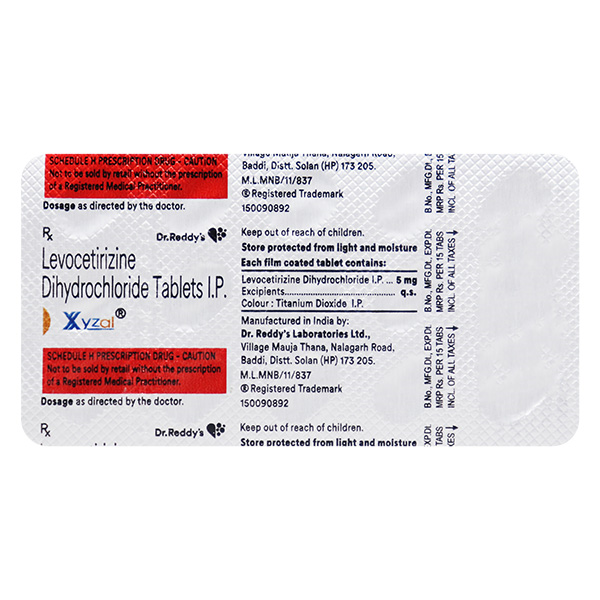
Bewaar Xyzal onder 25°C op een droge plaats, in de originele blister. Buiten bereik van kinderen houden.
Veelgestelde vragen
Is Xyzal hetzelfde als levocetirizine?
Ja — Xyzal bevat de werkzame stof levocetirizine. Bio-equivalentie met het originele merk (Xyzal (UCB, 2001 EU / 2007 VS)) is vereist door regelgevende instanties, dus het klinische effect is hetzelfde bij dezelfde dosering.
Wat is het verschil tussen Xyzal (levocetirizine) en Zyrtec (cetirizine)?
Cetirizine is een racemisch mengsel van twee enantiomeren; alleen het (R)-enantiomeer bindt aan de H1-receptor. Levocetirizine is dat actieve enantiomeer in gezuiverde vorm. Het klinische effect is zeer vergelijkbaar, maar 5 mg levocetirizine veroorzaakt minder slaperigheid dan 10 mg cetirizine. Beide werken; levocetirizine is iets 'schoner'.
Maakt Xyzal me slaperig?
Minder sederend dan zijn ouderstof cetirizine bij equivalente klinische werkzaamheid — de percentages slaperigheid in onderzoeken zijn ongeveer de helft van die bij cetirizine 10 mg. Als u zich wel slaperig voelt, neem uw dosis dan 's avonds in, of schakel over op fexofenadine (het minst sederende antihistaminicum van de tweede generatie).
Is het veilig om Xyzal dagelijks maanden- of jarenlang te gebruiken?
Ja — langdurig dagelijks gebruik van 2e-generatie antihistaminica is goed onderzocht en veilig voor de meeste volwassenen. Er is geen tachyfylaxie (het effect vermindert niet), geen cumulatieve orgaantoxiciteit en geen onttrekkingssyndroom. Patiënten met chronische urticaria nemen vaak jarenlang dagelijks een antihistaminicum.
Kan ik Xyzal met andere allergiemedicijnen innemen?
Ja, in de meeste gevallen. Het combineren van een oraal antihistaminicum met een intranasale corticosteroid (bijv. mometason, fluticason) is de standaardcombinatie voor matige hooikoorts. Oogdruppels (olopatadine, ketotifen) kunnen worden toegevoegd voor oogsymptomen. Vermijd het combineren van twee orale antihistaminica tegelijkertijd zonder medisch advies.
Hoe snel werkt Xyzal?
Het effect begint meestal na 30–60 minuten, met een piekwerking na 0,8–1 uur. Voor seizoensgebonden hooikoorts geeft starten 1–2 weken voor het gebruikelijke triggerseizoen de beste controle.
Wat gebeurt er als ik meer dan de aanbevolen dosis neem?
Een eenmalige overdosis van 2e-generatie antihistaminica veroorzaakt zelden ernstige schade bij enkele malen de standaarddosis, maar kan slaperigheid, tachycardie en (zelden) QT-verlenging veroorzaken. Zoek medisch advies als meer dan 5× de standaarddosis is ingenomen, vooral bij kinderen.
Waar kan ik Xyzal online kopen?
U kunt Xyzal (5 mg) bestellen bij MedsBase in verpakkingen van 30, 60, 90 of 180 tabletten. Wij verzenden wereldwijd met discrete verpakking en voorraad van een gecertificeerde WHO-GMP fabrikant.
Gerelateerde allergiemedicijnen
- Allegra — Fexofenadine (minst sedatieve antihistamine)
- Xyzal — Levocetirizine (actieve enantiomeer van cetirizine)
- Okacet — Cetirizine (generieke Zyrtec)
- Lorfast Meltab — Loratadine oraal oplosbaar
- Dazit — Desloratadine
- Meta Spray — Mometasone intranasale corticosteroid
- Arzep — Azelastine + Fluticasone neusspray
- Bekijk alle hooikoorts- en allergiemedicijnen
Gerelateerde alternatieven
Andere producten in Chronische aandoeningen die klanten ook bekijken:
Meer opties in behandeling van hooikoorts/allergieën
Gerangschikt op recente bestelvolumes van MedsBase — wat andere klanten in deze categorie kiezen.


| Sterkte | 5 mg |
|---|---|
| Hoeveelheid | 30 Tabletten, 60 Tabletten, 90 Tabletten, 180 Tabletten |
 Xyzal
Xyzal
Vragen & antwoorden
Xyzal
Gerelateerde producten





Beoordelingen
Er zijn nog geen beoordelingen