







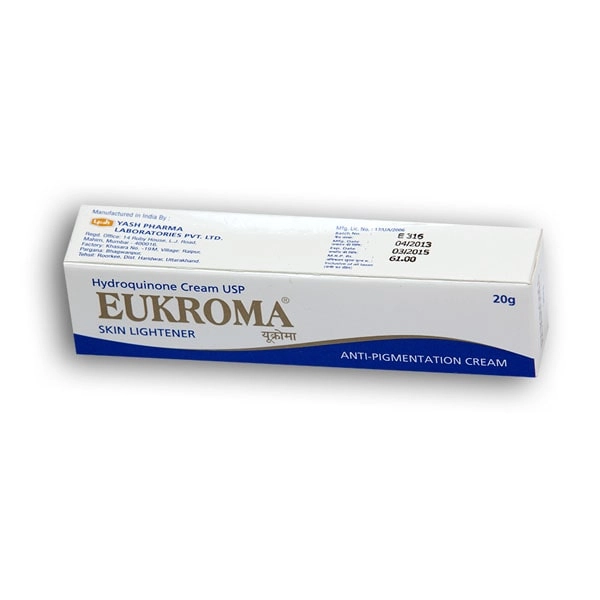
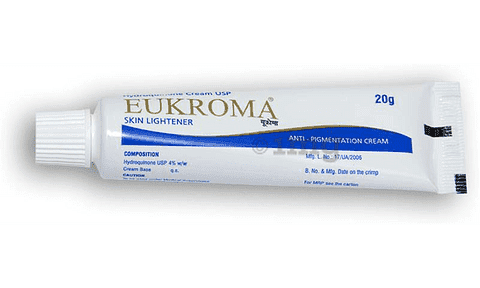
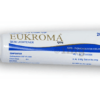
Eukroma Crème

✅ Verlicht de huidskleur
✅ Vermindert pigmentatie
✅ Behandelt huidaandoeningen
✅ Bevordert een egale teint
✅ Verbetering van de huidgezondheid
✓ Medisch beoordeeld door Morgan Ellis — Apotheekonderzoeker · 8 jaar ervaring · Laatst beoordeeld: mei 2026
⚡ Snelle Antwoord — Wat is Eukroma Cream?
Eukroma Crème is een topische depigmenterende crème van Yash Pharma met hydroquinone 4%. Gebruikt voor melasma, post-inflammatoire hyperpigmentatie (PIH) na acne, en zonnelentigines. Breng een dun laagje aan op donkere vlekken een of twee keer per nacht, met een strikt maximaal 4–6 maanden kuur voor een verplichte pauze om exogene ochronose te voorkomen. Dagelijks breedspectrum SPF 50+ in de ochtend is verplicht — UV-blootstelling maakt het effect van hydrochinon binnen enkele dagen teniet. Niet gebruiken tijdens zwangerschap of borstvoeding. De Amerikaanse FDA heeft hydroquinon in 2020 beperkt tot specialistisch toezicht.
📦 Elke bestelling is gedekt door onze Reshipment Assurance-beleid — als uw pakket niet binnen 20 werkdagen arriveert, sturen wij het opnieuw.
Waarom bestellen bij MedsBase
Onze generieke medicijnen zijn afkomstig van WHO-GMP gecertificeerde fabrikanten en worden wereldwijd verzonden in discrete, eenvoudige verpakkingen — geen medicijnnaam op de buitenkant van het pakket. Betalingen met kaart worden verwerkt via een gereguleerde processor (betalingsoverzichten vermelden een gereguleerde kaartbetalingprocessor — nooit “MedsBase” of een medicijnnaam). Crypto en SEPA bankoverschrijvingen worden ook geaccepteerd. Elke bestelling wordt ondersteund door ons Reshipment Assurance Policy.
Wat Is Eukroma Cream?
Eukroma Cream is een depigmenterende crème voor uitwendig gebruik van Yash Pharma die hydroquinone 4%. Hydroquinon is op dit moment het meest effectieve depigmenterende middel voor uitwendig gebruik — de gouden standaard voor melasma en post-inflammatoire hyperpigmentatie. Eukroma Cream is een enkelvoudige hydroquinonformulering, anders dan de meervoudige Kligman-triple combinaties (die tretinoïne en een plaatselijk corticosteroïd toevoegen voor een sterkere maar meer tijdsgebonden behandeling).
Enkelvoudige hydroquinon is milder dan triple-combinatiecrèmes en kan iets langer worden gebruikt (meestal 4–6 maanden continu, daarna een pauze), maar het is nog steeds niet voor onbepaalde tijd cosmetische huidverlichting — dat is de populatie met risico op exogene ochronose (een paradoxale permanente verdonkering). Bij cyclisch gebruik en met strikte SPF-bescherming is Eukroma Cream veilig en effectief.
Hoe Werkt Eukroma Cream?
Hydrochinone remt het enzym tyrosinase in melanocyten, waardoor de melaninesynthese wordt geblokkeerd bij de beperkende stap (omzetting van tyrosine in dihydroxyphenylalanine, DOPA). Twee praktische effecten:
- Verminderde productie van nieuw melanine — bestaande donkere vlekken worden niet donkerder, en na verloop van weken verlicht het oppervlakkige pigment doordat melanine-bevattende keratinocyten afsterven en worden afgestoten.
- Selectieve cytotoxiciteit voor melanocyten bij hogere concentraties — vermindert de algehele melanocytenactiviteit in het behandelde gebied.
Zichtbare verlichting na 4–8 weken; maximaal effect na 3–4 maanden. Het effect is volledig UV-afhankelijk — zonder strikt gebruik van breedspectrum zonnebrandcrème keert het effect van hydrochinone binnen dagen terug bij onbeschermde blootstelling aan de zon.
Toepassingen en Indicaties
- Melasma (chloasma) — symmetrische bruine vlekken op wangen, voorhoofd, bovenlip, vaak hormonaal gestuurd
- Post-inflammatoire hyperpigmentatie (PIH) na acne, eczeem of brandwonden, vooral bij Fitzpatrick huidtypen III–VI
- Zonne-lentigines (zonnevlekken, ouderdomsvlekken) op het gezicht en de rug van de handen
- Sproeten (epheliden) — minder effectief; UV-gedreven en hebben de neiging terug te komen
- Onderhoud na een Kligman-triple cyclus — milder dan de triple combo voor continu gebruik
Eukroma Cream is niet voor: diepe dermale pigmentmelasma (vereist laser of chemische peeling), fotodermatitis, beschadigde of eczeemhuid, of dagelijkse langdurige cosmetische huidverlichting (dit is de populatie met risico op ochronose).
Eukroma Cream Dosering en Toepassing
Eukroma Cream is verkrijgbaar in tubes van 20 g met 4% hydroquinon.
Hoe Eukroma Cream Correct Aan te Brengen
- Was voorzichtig met een milde niet-schuimende reiniger, dep daarna droog. Wacht 20–30 minuten tot de huid volledig droog is.
- Eerst een pleistertest uitvoeren — breng een kleine hoeveelheid aan op de binnenkant van de onderarm gedurende 24 uur voor gebruik op het gezicht. Hydrochinon veroorzaakt contactdermatitis bij 3–5% van de gebruikers.
- Breng een dun laagje alleen aan op de donkere vlekken — niet op het hele gezicht. Vermijd de omliggende gezonde huid.
- Vermijd ogen, mondhoeken, neusgaten, lippen, slijmvliezen, oogleden en de hals.
- Een of twee keer per nacht — begin met een keer per nacht, verhoog naar twee keer (ochtend + avond) alleen als het wordt verdragen en onder SPF.
- Maximale continue kuur: 4–6 maanden. Neem daarna een pauze van 2–3 maanden voordat u een nieuwe kuur start. Overschrijd niet meer dan 8 maanden totaal hydrochinongebruik in een periode van 12 maanden.
- Dagelijks breedspectrum SPF 50+ in de ochtend is verplicht — niet alleen tijdens de behandeling maar ook onbepaald daarna, omdat UV pigment reactiveert. Breng elke 2–3 uur opnieuw aan buiten. Gebruik een hoed met brede rand. Vermijd zonnebanken volledig.
- Stop onmiddellijk als u blauwzwarte of leigrijze verkleuring van de behandelde gebieden opmerkt, aanhoudende prikkeling of terugkerende donkere verkleuring.
Bijwerkingen van Eukroma Cream
Vaak voorkomend (mild, verdwijnt binnen 2–3 weken):
- Milde droogheid, schilfering op de behandelde plek
- Prikkelend of branderig gevoel bij aanbrengen (ergste week 1–2)
- Milde roodheid
- Verhoogde gevoeligheid voor zon
Minder vaak:
- Allergische contactdermatitis (3–5%)
- Halo-effect — lichter worden van de gezonde huid rond de donkere vlek (verminder door alleen op de vlek zelf aan te brengen, niet op de omliggende rand)
- Tijdelijke terugkeer van hyperpigmentatie bij abrupt stoppen
Zeldzaam maar stop en laat een dermatologisch onderzoek uitvoeren:
- Exogene ochronose — blauwzwarte of leigrijze paradoxale hyperpigmentatie; ontwikkelt zich bij continu gebruik langer dan 6 maanden, vooral bij hogere concentraties en op Fitzpatrick V–VI huid. Kan permanent zijn.
- Ernstige contactdermatitis of eczeemreactie
Waarschuwingen en voorzorgsmaatregelen
- Zwangerschap en borstvoeding: gecontra-indiceerd. Hydrochinon is FDA Zwangerschapscategorie C met tot 35% systemische absorptie gedocumenteerd bij gezichtstoepassing. Gebruik azelaïnezuur (Zwangerschapscategorie B) in plaats daarvan voor melasma.
- Blootstelling aan zon: dagelijks breedspectrum SPF 50+ is verplicht. Zonder dit keert het depigmenterende effect binnen enkele dagen terug en verhoogt u het risico op ochronose.
- Cyclusprotocol: gebruik nooit continu langer dan 6 maanden. Neem een pauze van 2–3 maanden tussen de behandelingen. Overschrijd niet meer dan 8 maanden hydrochinongebruik in een periode van 12 maanden.
- FDA-maatregel 2020: de FDA heeft in september 2020 alle vrij verkrijgbare hydrochinonproducten van de Amerikaanse markt gehaald. Hydrochinon is nu beperkt tot specialistisch toezicht in de VS, EU, Japan en het grootste deel van Azië.
- Niet aanbrengen op beschadigde huid, actief eczeem, ernstige zonnebrand of open wonden.
- Voer vooraf een plakproef uit bij gezichtsgebruik — breng aan op de binnenkant van de onderarm gedurende 24 uur.
- Harsen, epileren met draad, laserontharing, dermabrasie, microneedling, chemische peelings: Stop met Eukroma Cream 7–10 dagen voor een van deze procedures.
- Kinderen onder 12 jaar: niet voor gebruik bij kinderen.
Contra-indicaties — Wie mag Eukroma Cream NIET gebruiken
- Bekende overgevoeligheid voor hydrochinon of een bestanddeel van de formulering
- Zwangerschap, zwangerschapswens of borstvoeding
- Actief eczeem, ernstige rosacea, beschadigde huid, huilend dermatitis of open wonden op het te behandelen gebied
- Bestaande exogene ochronose (blauwzwarte hydrochinon-geïnduceerde pigmentatie
- Kinderen onder de 12
- Patiënten die niet bereid zijn zich te houden aan dagelijks SPF 50+ en het cyclusprotocol
Interacties tussen medicijnen en huidverzorging
| Combineren met | Effect | Wat te doen |
|---|---|---|
| Topische retinoïden (tretinoïne, adapaleen, tazaroteen) | Synergistisch — retinoïde verhoogt de penetratie van hydrochinon en versnelt pigmentomzetting | Eukroma Cream 's nachts op donkere vlekken; retinoïde 's nachts op het hele gezicht (niet tegelijkertijd — afwisselen of laagjes aanbrengen met 30 minuten wachttijd). |
| Vitamine C 10–15% (L-ascorbinezuur) | Compatibel — complementaire tyrosinaseremming + UV-antioxidant | Vitamine C 's ochtends onder SPF; Eukroma Cream 's nachts. |
| Niacinamide 5% | Compatibel — vermindert melanosoomoverdracht; ondersteunt de barrièrefunctie | Uitstekend begeleidend product, dag of nacht. |
| Azelaïnezuur 15–20% | Compatibel — complementaire werkingsmechanismen | Azelaïnezuur 's ochtends, Eukroma Cream 's nachts op de vlekken. |
| Hoge concentratie AHA/BHA leave-on serums | Opgestapelde irritatie, verhoogd risico op ochronose | Beperken tijdens actieve hydroquinonekuur. |
| Resorcinol, fenolhoudende producten | Verhoogd risico op ochronose | Vermijd combinatie. |
| Dagelijks breedspectrum SPF 50+ | Verplicht begeleidend product | Aanbrengen elke ochtend. Buiten elke 2–3 uur opnieuw aanbrengen. |
| Waterstofperoxide, benzoylperoxide (op hetzelfde gebied) | Versnelt de oxidatie van hydrochinon — vermindert de effectiviteit en kan de huid tijdelijk verkleuren | Breng BPO 's ochtends aan, Eukroma Cream 's nachts — nooit gelijktijdig. |
Bewaaradvies
- Bewaren bij kamertemperatuur, 15–25°C. Houd goed gesloten en uit direct zonlicht.
- Hydrochinon oxideert (wordt bruin of grijs) bij blootstelling aan lucht en licht, waardoor het zijn werking verliest. Als de crème verkleurd is, gooi deze dan weg.
- Gooi weg 6 maanden na eerste opening, zelfs als het product nog goed lijkt.
- Buiten bereik van kinderen houden.
Gerelateerde alternatieven op MedsBase
Andere depigmenterende en acne-producten verkrijgbaar op MedsBase:
- Melrio Cream (hydrochinon + tretinoïne + fluocinolon)
- Melacare Forte Cream (hydrochinon + tretinoïne + mometason)
- Kojiglo Forte Cream (hydrochinon + tretinoïne + mometason)
- Epilite Liquid (hydrochinon 2%)
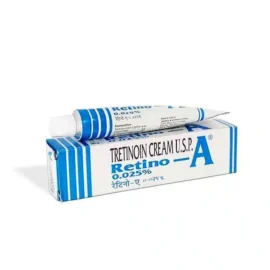
- Retino-A Crème (tretinoïne 0,025% / 0,05%)
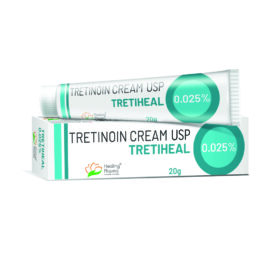
- Tretiheal Crème (tretinoïne 0,025% / 0,05% / 0,1%)
- Isotroin (orale isotretinoïne 5 / 10 / 20 / 30 mg)
Handige lectuur: Tretinoïne crème versus gel · Tretinoïne versus retinol · Alles wat je wilt weten over acne.
Veelgestelde vragen
Wanneer zie ik resultaten van Eukroma Cream?
Zichtbare verlichting na 4–8 weken; maximaal effect na 3–4 maanden. Onderhoud tijdens de pauzeperiode gebeurt met azelaïnezuur 15–20%, vitamine C, niacinamide en strikt SPF 50+. Zonder dagelijkse SPF verdwijnen de resultaten binnen enkele dagen — dit is de belangrijkste factor.
Waarom werd hydrochinone door de FDA beperkt?
De FDA heeft hydrochinone zonder recept in september 2020 van de Amerikaanse markt gehaald september 2020 naar aanleiding van geaccumuleerde casusrapporten van exogene ochronose (een paradoxale permanente verkleuring door langdurig dagelijks gebruik). Hydrochinon is nog steeds toegestaan in concentraties tot 4% onder voorschriftbegeleiding — het veiligheidsmechanisme is de medische begeleiding van cyclisch gebruik, niet het verwijderen van het middel.
Is hydrochinon veilig? Ik heb gehoord dat het kanker veroorzaakt.
Het IARC heeft hydrochinon geclassificeerd als Groep 3 (niet classificeerbaar wat betreft carcinogeniciteit bij mensen) — wat betekent dat de rattengegevens niet overdraagbaar zijn naar topische blootstelling bij mensen. Decennia van dermatologisch gebruik in 2–4% concentratie cyclisch hebben geen verhoogd kankerrisico bij mensen aangetoond. Het echte veiligheidsprobleem is ochronose (een pigmentatie bijwerking), niet kanker, en het is te voorkomen door het cyclische protocol en dagelijks SPF 50+ te volgen.
Kan ik Eukroma Cream gebruiken tijdens zwangerschap of borstvoeding?
Nee. Hydrochinon is FDA Zwangerschapscategorie C met tot 35% systemische absorptie bij gezichtstoepassing. Voor zwangerschapsgerelateerde melasma, schakel over naar azelaïnezuur 15–20% (Zwangerschapscategorie B) en strikt dagelijks SPF 50+.
Wat is exogene ochronose en hoe kan ik het voorkomen?
Exogene ochronose is een blauw-zwarte of leigrijze paradoxale pigmentatie door continu gebruik van hydrochinon langer dan 6 maanden, komt vaker voor bij concentraties >4% en op huidtype Fitzpatrick V–VI. Het kan permanent. Preventie: houd u aan een maximale continue kuur van 4–6 maanden, neem een pauze van 2–3 maanden tussen de kuren, breng het nooit aan op een groter gebied dan nodig en stop onmiddellijk als behandelde plekken donkerder worden in plaats van lichter.
Waarom heb ik dagelijks SPF 50+ nodig?
UV-blootstelling activeert melanocyten en draait alle behaalde resultaten terug. Zonder dagelijkse breedspectrum SPF 50+ (mineraal of hybride heeft de voorkeur voor melasma), zullen zelfs kleine hoeveelheden incidenteel zonlicht (rijden, buiten lopen) wekenlang gebruik van de crème binnen enkele dagen tenietdoen. SPF is belangrijker dan de crème zelf voor langdurige controle van hyperpigmentatie.
Eukroma Cream versus de Kligman triple (hydrochinon + tretinoïne + steroïde)?
Enkelvoudig hydrochinon zoals Eukroma Cream is milder dan de triple-combinatiecrèmes (Melrio, Melacare, Kojiglo) en kan voor iets langere kuren worden gebruikt. De triple-combinaties zijn sneller en krachtiger maar brengen de risico's van steroïde-atrofie en rebound-dermatitis met zich mee vanwege de corticosteroïde-component, daarom zijn ze beperkt tot kuren van slechts 8 weken. Veel dermatologen schrijven de triple-combinatie voor voor een agressieve kuur van 8 weken, gevolgd door onderhoud met enkelvoudig hydrochinon gedurende 4–6 maanden — om het beste van beide regimes te krijgen.
Wat is het “halo-effect” en hoe voorkom ik het?
Het halo-effect is het lichter worden van de gezonde huid rond het behandelde donkere plekje, wat een zichtbare ring van lichtere huid veroorzaakt. Voorkom dit door Eukroma Cream precies alleen op de donkere vlek zelf aan te brengen, eventueel met een wattenstaafje, en niet op de omringende gezonde huidrand.
Kan ik Eukroma Cream op mijn lichaam gebruiken (borst, handen, nek)?
Ja — enkelvoudige hydrochinon kan buiten het gezicht worden gebruikt voor zonnevlekken op de handruggen, “zonneketting”-pigmentatie of post-inflammatoire vlekken op lichaamsdelen. Zelfde cycliregel (maximaal 4–6 maanden), zelfde SPF 50+ vereiste voor de behandelde gebieden. De Kligman-drievoudige combinaties zijn niet afgeraden voor gebruik buiten het gezicht vanwege steroïde atrofie bij langdurig gebruik op lichaamsdelen.
Gerelateerde alternatieven
Andere producten in Algemene gezondheid die klanten ook bekijken:
Meer opties in Beauty & Huidverzorging
Gerangschikt op recente bestelvolumes van MedsBase — wat andere klanten in deze categorie kiezen.


| Sterkte | 4% |
|---|---|
| Hoeveelheid | 1 Tube/s, 3 Tube/s, 6 Tube/s |
| Farmaceutische vorm | Crème(s) |
| Fabrikant | Yash Pharma |
| Behandeling | Hyperpigmentatie, Melasma |
| Generiek merk | Hydrochinon + Kojic Acid |
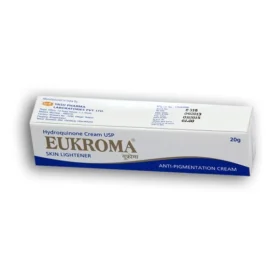 Eukroma Crème
Vragen & antwoorden
Eukroma Crème
Gerelateerde producten





Beoordelingen
Er zijn nog geen beoordelingen