








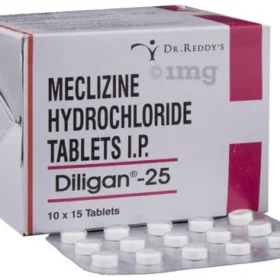
Diligan

✅ Verlicht reisziekte
✅ Verlicht symptomen van duizeligheid
✅ Vermindert misselijkheid
✅ Bestrijdt duizeligheid
✅ Behandelt braken
Diligan bevat Meclizine.
✓ Medisch beoordeeld door Morgan Ellis — Apotheekonderzoeker · 8 jaar ervaring · Laatst beoordeeld: mei 2026
⚡ Kort antwoord — Wat is Diligan?
Diligan is een meclizine 25 mg tablet van een eerste generatie H1 antihistaminicum met anticholinerge en centraal anti-emetische werking. Het wordt ingenomen 1 uur voor de reis om reisziekte te voorkomen (auto's, boten, vliegtuigen), en voor een korte kuur (≤ 72 uur) om acute perifere vertigo door labyrinthitis of vestibulaire neuritis te onderdrukken. De gebruikelijke dosis voor volwassenen is 25–50 mg één uur voor de reis, elke 24 uur herhalen indien nodig. Veroorzaakt slaperigheid — niet autorijden of machines bedrijven gedurende 8–12 uur na inname.
Waarom bestellen bij MedsBase
📦 Elke bestelling is gedekt door onze Reshipment Assurance-beleid — als uw pakket niet binnen 20 werkdagen arriveert, sturen wij het opnieuw.
Diligan is het WHO-GMP generieke equivalent van Antivert/Bonine, geleverd als 25 mg tabletten en kauwtabletten. Meclizine heeft een bewezen staat van dienst van meer dan 60 jaar voor reisziekte en is een van de weinige medicijnen met FDA Zwangerschapscategorie B-status voor misselijkheid/braken tijdens de zwangerschap wanneer andere middelen gecontra-indiceerd zijn.
Waar Diligan voor wordt gebruikt
- Preventie van reisziekte — eerstekeus voor auto-, zee- en luchtverkeer; neem 1 uur voor blootstelling
- Acute perifere vertigo — vestibulaire neuritis, labyrinthitis, eerste aanval van BPPV — alleen korte kuur (≤ 72 uur), daarna stoppen om centrale compensatie mogelijk te maken
- Acute Menière-vertigo-aanval — reddingsdosis; chronisch management gebruikt in plaats daarvan betahistine
- Postoperatieve misselijkheid — off-label aanvulling na middenooroperatie
Meclizine is niet het juiste medicijn voor chronische ziekte van Menière (gebruik Vertin of Betavert), centrale vertigo (hersenoorsprong), of algemene lichtheid in het hoofd door posturale daling of hartritmestoornissen.
Waarom bestellen bij MedsBase
Diligan wordt geleverd door een WHO-GMP-gecertificeerde fabrikant, verpakt in blisterverpakkingen en discreet wereldwijd verzonden. Elke bestelling wordt gedekt door onze Reshipment Assurance-beleid — als het niet binnen 20 werkdagen arriveert, sturen wij kosteloos een nieuwe zending. Meer dan 1.400 geverifieerde klanten — lees beoordelingen.
Hoe Diligan Werkt
Meclizine is een eerste generatie H1 antihistaminicum van de piperazineklasse dat de bloed-hersenbarrière passeert. In de centrale vestibulaire banen dempt het de activiteit van de vestibulaire kernen als reactie op abnormale sensorische input, wat de draaisensatie veroorzaakt bij reisziekte en acute perifere vertigo. De anticholinerge werking vermindert ook de autonome component (misselijkheid, zweten, bleekheid) die gepaard gaat met vestibulaire stimulatie.
Het begint te werken na 30–60 minuten, piekeffect na 1–2 uur, werkingsduur 8–12 uur. Daarom wordt de dosering één uur voor reizen ingenomen en dagelijks herhaald tijdens lange reizen.
Dosering
| Indicatie | Dosering | Opmerkingen |
|---|---|---|
| Preventie van reisziekte | 25–50 mg, 1 uur voor reizen | Herhaal elke 24 uur tijdens lange reizen; max 100 mg/dag |
| Acute perifere vertigo | 25–50 mg tweemaal daags | Maximaal 72 uur — langer gebruik vertraagt vestibulaire compensatie |
| Acute episode van Menière | 25 mg naar behoefte | Alleen toevoegen aan betahistine onderhoud tijdens een aanval |
| Kinderen < 12 jaar | Vermijden | Beperkte pediatrische gegevens; gebruik dimenhydrinaat of cinnarizine in plaats daarvan |
| Ouderen | Start met 12,5–25 mg | Hoger risico op anticholinergische belasting; vallen en verwardheid zijn reële zorgen |
| Zwangerschap | 25 mg naar behoefte | FDA Categorie B; een van de veiligere anti-emetische opties wanneer eerstelijns doxylamine + B6 faalt |
Belangrijk — Gebruik Niet Langer Dan 72 Uur voor Vertigo
Bijwerkingen
| Frequentie | Effect |
|---|---|
| Vaak (> 10%) | Slaperigheid, sedatie, droge mond |
| Vaak (1–10%) | Wazig zien, obstipatie, moeilijk plassen, vermoeidheid |
| Minder vaak | Tachycardie, hartkloppingen, rusteloosheid bij ouderen (paradoxaal), hoofdpijn |
| Zeldzaam | Acuut glaucoom met gesloten kamerhoek, urineretentie, anafylaxie |
Contra-indicaties en voorzorgsmaatregelen
- Geslotenhoekglaucoom — anticholinerg effect kan een acute aanval van gesloten kamerhoek glaucoom uitlokken
- Prostaatvergroting / urineretentie — verergert de uitstroomobstructie
- Ernstig astma / COPD — verdikt bronchiale secreties
- Kinderen onder de 12 — onvoldoende gegevens; alternatieven bestaan
- Gelijktijdige sedativa of alcohol — additionele CNS-depressie
- Zwangerschap en borstvoeding — FDA Categorie B; kleine hoeveelheden in moedermelk — voorkeur boven scopolamine indien nodig
Geneesmiddelinteracties
| Geneesmiddel / Klasse | Interactie |
|---|---|
| Alcohol, opioïden, benzodiazepinen, hypnotica | Additieve sedatie; vermijd combinatie met volledige doses tegen reisziekte |
| Andere anticholinergica (oxybutynine, scopolamine, TCA's, eerste-generatie antihistaminica) | Cumulatieve anticholinergische belasting — droge mond, obstipatie, urineretentie, verwardheid bij ouderen |
| MAO-remmers | Verleng en versterk anticholinergische effecten |
| Levodopa | Antihistaminicum kan het effect van levodopa verminderen; zelden klinisch relevant bij enkele doses |
| Cinnarizine, betahistine | Farmacologische antagonisme; combineer niet routinematig — kies één strategie |
Opslag
- Bewaren onder 25 °C op een droge plaats, uit direct zonlicht
- Bewaren in de originele blister, buiten bereik van kinderen
- Niet gebruiken na de vervaldatum
Veelgestelde vragen
Wanneer moet ik Diligan innemen voor reizen?
Een uur voor blootstelling aan beweging. De dosis van 25–50 mg bereikt een piek plasmaspiegel na 1–2 uur en werkt 8–12 uur, dus een enkele dosis dekt een volledige reisdag. Voor meerdaagse reizen, herhaal elke 24 uur.
Diligan versus Vertin — welke heb ik nodig?
Diligan (meclizine) is bedoeld voor acuut, kortdurend vestibulaire suppressie: reisziekte, de eerste 48–72 uur van een perifere vertigo-episode, of een acute aanval van Menière. Vertin / Betavert (betahistine) is bedoeld voor chronisch onderhoud van de ziekte van Menière — het verminderen van de frequentie van toekomstige aanvallen over weken tot maanden. Ze hebben tegengestelde rollen.
Kan ik Diligan gebruiken tijdens de zwangerschap?
Meclizine heeft een FDA-zwangerschapscategorie B-classificatie — een van de veiligere anti-emetica wanneer eerstelijns doxylamine + pyridoxine faalt. Overleg met uw verloskundige voor regelmatig gebruik.
Maakt Diligan slaperig?
Ja — sedatie is de meest voorkomende bijwerking, die bij meer dan 10% van de gebruikers optreedt. Rijd niet of bedien geen machines gedurende 8–12 uur na een dosis. Neem de eerste dosis thuis voor de reisdag om uw individuele reactie te leren kennen.
Hoe verschilt Diligan van Phenergan / Avomine?
Promethazine (Phenergan, Avomine) is een fenothiazine met een sterker sedatief en anti-emetisch effect — de voorkeur wanneer misselijkheid het dominante symptoom is, maar meer sederend en niet veilig bij kinderen onder de 2 jaar. Meclizine heeft een milder sedatieprofiel en een langere werkingsduur, waardoor het praktischer is voor een reisdag van een volwassene.
Kunnen kinderen Diligan gebruiken?
Meclizine wordt niet aanbevolen voor kinderen onder de 12 jaar — er zijn beperkte veiligheidsgegevens. Voor reisziekte bij kinderen worden meestal dimenhydrinaat of cinnarizine gebruikt, onder medische begeleiding.
Stopt Diligan een aanval van Ménière?
Het vermindert de duizeligheid en misselijkheid tijdens een actieve episode, maar verandert de onderliggende aandoening niet. Voor chronisch beheer van Ménière zijn betahistine (Vertin of Betavert), zoutbeperking en hydratatie de onderhoudsstrategie. Meclizine is alleen voor acute verlichting.
Is Diligan verslavend?
Nee — meclizine is geen gereguleerde stof en heeft geen potentieel voor afhankelijkheid. Het belangrijkste langetermijnrisico is de anticholinerge belasting bij oudere gebruikers (droge mond, obstipatie, cognitieve effecten).
Helpt Diligan bij BPPV?
Alleen kortdurend tijdens de ernstigste symptomen. BPPV is mechanisch — een verplaatste otolietkristal in een halfcirkelvormig kanaal — en de definitieve behandeling is een canalith-repositioneringsmanoeuvre (Epley, Semont). Meclizine maskeert symptomen; het verplaatst de kristal niet. Gebruik het de eerste 24–48 uur, laat daarna iemand de Epley-manoeuvre uitvoeren.
Kan ik alcohol drinken bij gebruik van Diligan?
Vermijd alcohol tijdens het gebruik van meclizine. Gecombineerde CNS-depressie verergert slaperigheid, evenwicht en reactietijd — een reëel val- en ongeluksrisico, vooral bij oudere volwassenen.
Hoe lang duurt het voordat Diligan begint te werken?
30–60 minuten tot waarneembaar effect; piek na 1–2 uur; werkingsduur 8–12 uur. Neem het 1 uur voor blootstelling ter preventie — het innemen nadat reisziekte is opgetreden is veel minder effectief dan preventief gebruik.
Meclizine in Diligan is een langwerkend, minder sederend alternatief voor reisziekte overdag, maar wanneer een sterkere sedatie gewenst is tijdens een nachtelijke veerboot- of busreis, biedt een enkele Avimax (promethazine 25 mg) die voorafgaand aan de reis wordt ingenomen, een krachtigere antihistaminische en anti-emetische werking met betrouwbare slaperigheid.
Andere behandelingen voor duizeligheid en reisziekte
- Vertin (betahistine 8 mg) — onderhoudstherapie bij de ziekte van Ménière
- Betavert (betahistine 8 / 16 mg) — alternatief betahistine merk
- Betavert Tab (betahistine 24 mg) — hogere sterkte, eenmaal daagse optie
- Avomine (promethazine 25 mg) — alternatief antihistaminicum tegen reisziekte
- Stemetil MD (prochlorperazine 5 mg ODT) — acute verlichting bij duizeligheid en misselijkheid
Medische Disclaimer
Deze pagina is alleen voor informatieve doeleinden en is geen vervanging voor advies van een gekwalificeerde clinicus. Plotselinge ernstige duizeligheid met neurologische symptomen (plotseling gehoorverlies, dubbelzien, onduidelijke spraak, zwakte, gevoelloosheid, ernstige hoofdpijn of onvaste gang) vereist dringende medische evaluatie — dit kan wijzen op een beroerte of centrale pathologie in plaats van een binnenoorprobleem. Bespreek nieuwe duizeligheidsymptomen altijd met een arts voordat u zelf gaat behandelen.
Meer opties in behandeling van duizeligheid & reisziekte
Gerangschikt op recente bestelvolumes van MedsBase — wat andere klanten in deze categorie kiezen.

| Sterkte | 25 mg |
|---|---|
| Hoeveelheid | 30 Tabletten, 60 Tabletten, 90 Tabletten, 180 Tabletten |
 Diligan
Vragen & antwoorden
Diligan
Gerelateerde producten












Beoordelingen
Er zijn nog geen beoordelingen