








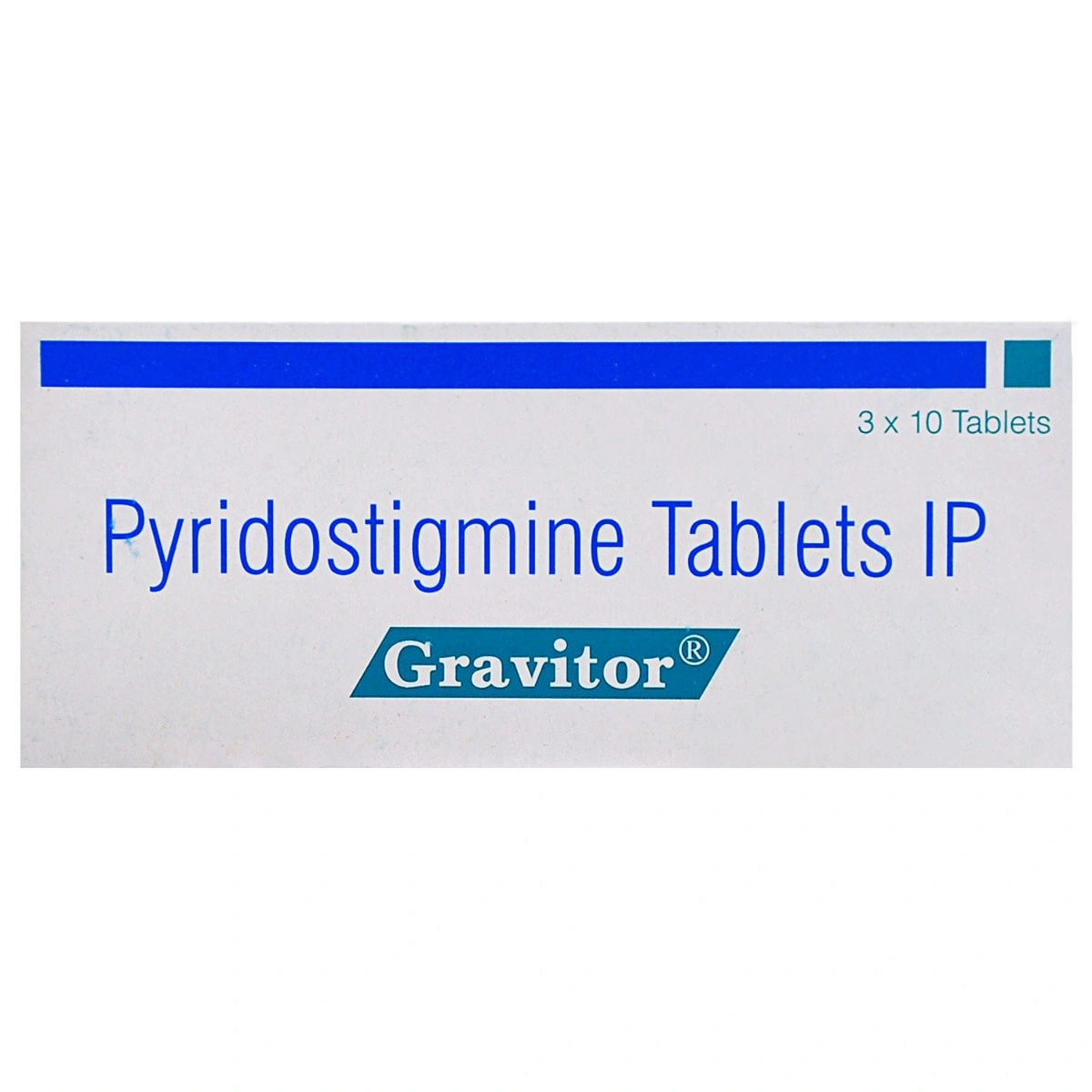
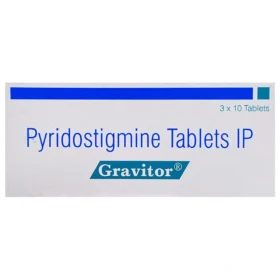
Gravitor
✅ Verbetering van spierkracht
✅ Verbeterde neuromusculaire transmissie
✅ Verlichting van symptomen van myasthenia gravis
✅ Verbeterde spiercoördinatie
✅ Verbeterde motorische functie
Gravitor bevat Pyridostigmine.
✓ Medisch beoordeeld door Morgan Ellis — Apotheekonderzoeker · 8 jaar ervaring · Laatst beoordeeld: mei 2026
⚡ Kort antwoord — Wat is Gravitor?
Gravitor is een oraal tablet met directe afgifte die pyridostigminebromide (60 mg) — een acetylcholinesteraseremmer gebruikt voor de behandeling van myasthenia gravis. Werkingsduur: 3–6 uur per dosis. Het werkt door de afbraak van acetylcholine bij de neuromusculaire junctie te blokkeren, waardoor de spierkracht wordt hersteld bij patiënten bij wie de acetylcholinereceptoren worden geblokkeerd door auto-antilichamen. Dosering voor volwassenen bij myasthenia gravis: 30–120 mg elke 4–6 uur voor de vorm met directe afgifte (typisch 60 mg drie tot vijf keer per dag); 180 mg elke 12–24 uur voor de vorm met vertraagde afgifte. Neem 30–45 minuten voor de maaltijd in als dysfagie het dominante symptoom is. Veelvoorkomende bijwerkingen: buikkrampen, diarree, misselijkheid, zweten, verhoogde speekselvloed, miosis (kleine pupillen), spiertrekkingen. Let op voor een cholinerge crisis — een overdosis kan een myasthene crisis nabootsen; de edrophonium- of ice-packtest kan onderscheid maken.
📦 Elke bestelling is gedekt door onze Reshipment Assurance-beleid — als uw pakket niet binnen 20 werkdagen arriveert, sturen wij het opnieuw.
Waarom bestellen bij MedsBase
Onze generieke medicijnen zijn afkomstig van WHO-GMP gecertificeerde fabrikanten en worden wereldwijd verzonden in discrete, eenvoudige verpakkingen — geen medicijnnaam op de buitenkant van het pakket. Betalingen met kaart worden verwerkt via een gereguleerde processor (betalingsoverzichten vermelden een gereguleerde kaartbetalingprocessor — nooit “MedsBase” of een medicijnnaam). Crypto en SEPA bankoverschrijvingen worden ook geaccepteerd. Elke bestelling wordt ondersteund door ons Reshipment Assurance Policy.
Wat is Gravitor?
Gravitor is een orale pyridostigminebromide tablet met directe afgifte verkrijgbaar in 60 mg. Pyridostigmine is een quaternaire ammonium reversible acetylcholinesteraseremmer geïntroduceerd in 1955 en sindsdien een van de hoekstenen van de behandeling van myasthenia gravis. Omdat het molecuul een permanent geladen quaternair ammonium is, passeert het niet de bloed-hersenbarrière — centrale effecten zijn minimaal in vergelijking met tertiaire-amine cholinesterase-remmers die worden gebruikt voor de ziekte van Alzheimer.
Gravitor wordt geleverd door een WHO-GMP-gecertificeerde fabrikant en is bio-equivalent aan het originele merk pyridostigmine (Mestinon®).
Hoe Werkt Gravitor?
Bij myasthenia gravis verminderen auto-antilichamen (meestal anti-acetylcholine-receptor-antilichamen, soms anti-MuSK) het aantal functionele acetylcholine-receptoren bij de neuromusculaire junctie. Het signaal van motorische zenuw naar spier wordt inefficiënt en spieren raken snel vermoeid — het kenmerkende kenmerk van de ziekte.
Pyridostigmine remt omkeerbaar acetylcholinesterase, het enzym dat acetylcholine afbreekt in de synaptische spleet. Met minder enzymactiviteit blijft acetylcholine langer aanwezig en bereikt het meer receptoren, wat een sterker signaal produceert bij de resterende functionele acetylcholine-receptoren. Het klinische resultaat is verbeterde spierkracht — met name voor ptosis, dysfagie, dysartrie en ledemaatvermoeidheid.
Pyridostigmine is symptomatisch, niet ziekte-modificerend. Het beïnvloedt niet het onderliggende auto-immuunproces. Ziekte-modificerende therapie (corticosteroïden, azathioprine, mycophenolaat, rituximab, eculizumab, efgartigimod, thymectomie) is nodig om de ziekteactiviteit onder controle te houden bij matig-ernstige gevallen.
Toepassingen en Indicaties
- Myasthenia gravis — symptomatische behandeling (de belangrijkste indicatie; goedgekeurd door de FDA)
- Opheffing van niet-depolariserende neuromusculaire blokkade na een operatie (intraveneuze vorm, alleen in het ziekenhuis)
- Postoperatieve ileus en urineretentie — oudere indicatie, voornamelijk historisch
- Off-label gebruik: orthostatische hypotensie (autonome insufficiëntie), congenitale myasthene syndromen, slow-channel syndromen, post-COVID vermoeidheid (zeer beperkt bewijs)
Pyridostigmine is niet eerste keus voor: dementie bij de ziekte van Alzheimer (gebruik donepezil, rivastigmine, galantamine), ziekte van Parkinson, of als routine cognitieve versterker.
Gravitor Dosering en Hoe In Te Nemen
Gravitor sterkte: 60 mg.
Standaard dosering voor volwassenen bij myasthenia gravis:
- Startdosis: 30–60 mg elke 4 uur, geleidelijk opgetitreerd naar de dosis die de beste symptomatische verlichting geeft zonder cholinergische bijwerkingen.
- Typisch onderhoud: 60 mg drie tot vijf keer per dag (180–300 mg/dag). Sommige patiënten hebben 30 mg nodig, anderen tot 120 mg per dosis. De maximale totale dagelijkse dosis is over het algemeen 600 mg/dag, maar doses boven 360 mg/dag voegen zelden voordeel toe en verhogen de kans op cholinergische bijwerkingen.
- Plan de doseringen rond maaltijden en activiteiten — bijvoorbeeld 30–45 minuten voor de maaltijd als dysfagie dominant is; voor activiteiten die kracht vereisen (autorijden, werk, traplopen).
- Kinderen: 1 mg/kg per dosis elke 4–6 uur; titreer onder specialistische begeleiding naar effect.
- Nierfunctiestoornis: Dosis aanpassen op basis van creatinineklaring — verlaag de dosis en frequentie bij CrCl <30 mL/min.
Hoe u Gravitor op de juiste manier inneemt
- Met of zonder voedsel — voedsel heeft geen significant effect op de opname. Sommige patiënten nemen het 30–45 minuten voor de maaltijd als slikproblemen het dominante symptoom zijn.
- Plan de doseringen rond uw dagelijkse activiteiten en maaltijden. Pyridostigmine is symptomatisch — het doel is om het maximale effect te hebben wanneer u het het meest nodig heeft. De meeste patiënten vinden een persoonlijk schema (bijv. bij het opstaan, voor de lunch, midden op de middag, voor het diner) beter dan een rigide vieruurly dosering.
- Houd uw dosis-respons bij. Houd de eerste weken een kort dagboek bij: dosis, tijd, symptoomniveau. Dit helpt uw neuroloog om het schema aan te passen.
- Let op overdosering. Cholinerge bijwerkingen (buikkrampen, diarree, zweten, speekselvloed, spiertrekkingen) en toenemende zwakte zijn waarschuwingssignalen. Toenemende zwakte bij pyridostigmine kan zowel een onvoldoende dosis (myasthenisch) als een te hoge dosis (cholinerge) betekenen — ga niet uit van 'meer is beter'.
- Informeer elke voorschrijver en tandarts. Veel medicijnen kunnen myasthenia verergeren (aminoglycosiden, fluoroquinolonen, macroliden, magnesium, bètablokkers, neuromusculaire blokkers tijdens operaties, telithromycine — FDA black-box). Vermijd telithromycine volledig.
- Houd extra doses beschikbaar tijdens reizen of ziekte. Infecties, koorts en emotionele stress kunnen de behoefte aan pyridostigmine verhogen.
- Niet abrupt stoppen. Plotseling stoppen kan een myasthene crisis veroorzaken — ernstige zwakte met ademhalingsfalen. Verminderingen moeten onder specialistisch toezicht plaatsvinden.
- Houd een noodplan paraat. Ernstige zwakte met ademhalingsmoeilijkheden, speeksel dat niet weggeslikt kan worden of onvermogen om armen op te tillen vereist spoedeisende hulp — dit kan duiden op een myasthene crisis (onderdosering of ziekte-opflakkering) of een cholinerge crisis (overdosering), wat een medisch noodgeval is.
Bijwerkingen van Gravitor
Vaak voorkomend (vaak dosisgerelateerd — cholinerge bijwerkingen):
- Buikkrampen, diarree (meest voorkomend — 30–50% bij hogere doseringen)
- Misselijkheid, braken
- Toegenomen speekselvloed, zweten
- Miosis (vernauwde pupillen), wazig zien, traanvorming
- Spiertrekkingen, fasciculaties
- Toegenomen bronchiale secretie
- Urine-aandrang, frequent urineren
Minder vaak maar belangrijk:
- Bradycardie (trage hartslag)
- Hypotensie
- Huiduitslag
- Angst, agitatie
- Cholinergisch effect op de blaas (urge)
Zeldzaam maar zoek direct medische hulp:
- Cholinergische crisis — ernstige buikkrampen, hevige diarree, speekselvloed, zweten, fasciculaties, gevolgd door toenemende zwakte met respiratoir falen. Onderscheidbaar van myasthene crisis door edrofoniumtest of ijszakrespons. Behandeling: stop pyridostigmine, IV atropine, ondersteunende zorg.
- Anafylaxie of ernstige overgevoeligheid
- Ernstige bradycardie, AV-blok
- Bronchospasme (ernstig bij astma/COPD)
- Ernstige hypotensie
Waarschuwingen en voorzorgsmaatregelen — KRITISCH
- Cholinergische crisis versus myasthene crisis — beide presenteren zich met toenemende zwakte en respiratoir falen. Beide kunnen fataal zijn zonder behandeling. Ga er nooit vanuit dat verhoging van pyridostigmine verslechterende zwakte oplost; raadpleeg eerst uw neuroloog.
- Astma, COPD, bronchiëctasieën — pyridostigmine verhoogt bronchiale secretie en kan bronchospasme uitlokken. Gebruik met voorzichtigheid; houd een rescue-inhalator beschikbaar.
- Bradycardie, AV-blok, recent myocardinfarct — pyridostigmine kan de hartslag verlagen en AV-geleiding verslechteren. Voorzichtigheid; cardiologisch advies.
- Mechanische darm- of urinewegobstructie — absoluut gecontra-indiceerd.
- Geneesmiddelen die myasthenia gravis verergeren — vele. Opmerkelijke voorbeelden: aminoglycosiden (gentamicine, neomycine, amikacine), fluoroquinolonen, macroliden, telithromycine (FDA black-box, niet gebruiken bij MG), magnesium, bètablokkers (met name propranolol), penicillamine, lithium, neuromusculaire blokkers tijdens operaties. Vertel elke voorschrijver, tandarts en chirurg dat u MG heeft.
- Nierfunctiestoornis — pyridostigmine wordt via de nieren uitgescheiden; dosering aanpassen op basis van de creatinineklaring.
- Zwangerschap — pyridostigmine wordt over het algemeen beschouwd als de veiligste behandeling voor myasthenia gravis tijdens de zwangerschap; specialistisch toezicht is essentieel.
- Operatie — informeer uw anesthesist over Gravitor en uw myasthenia gravis. Veel anesthetica en neuromusculaire blokkers gedragen zich anders bij MG.
- Rijden — over het algemeen veilig, maar wazig zien en miosis kunnen het rijden bij weinig licht beïnvloeden.
Contra-indicaties — Wie moet Gravitor NIET gebruiken
- Bekende overgevoeligheid voor pyridostigmine, neostigmine, edrofonium of een hulpstof in de tablet
- Mechanische darm- of urinewegobstructie
- Acute peritonitis
- Ernstige bradycardie, volledig hartblok, recent myocardinfarct zonder specialistisch advies
- Ernstig astma of actieve bronchospasmen (relatief)
Geneesmiddelinteracties
| Combineren met | Effect | Wat te doen |
|---|---|---|
| Aminoglycosiden (gentamicine, neomycine, amikacine) | Verslechteren de neuromusculaire overdracht — kunnen een myasthenische crisis veroorzaken | Vermijd waar mogelijk. Indien noodzakelijk, nauwlettend monitoren; ademhalingsondersteuning gereed houden. |
| Fluoroquinolonen (ciprofloxacine, levofloxacine, moxifloxacine) | Kunnen MG verergeren; FDA-waarschuwing | Alleen gebruiken als er geen alternatief is; nauwlettend observeren. |
| Telithromycin | Black-box waarschuwing — ernstige MG-verergeringen | Volledig vermijden bij MG. |
| Macroliden (azithromycin, erythromycin, clarithromycin) | Kan MG verergeren | Voorzichtig gebruiken; observeren. |
| Magnesium (IV, oraal hoge dosis) | Verergert neuromusculaire transmissie | Vermijd waar mogelijk magnesiumhoudende maagzuurremmers en laxeermiddelen. IV magnesium is gecontra-indiceerd. |
| Bètablokkers (met name propranolol) | Kan MG verergeren | Gebruik indien nodig cardio-selectieve bètablokkers; observeer. |
| Atropine, glycopyrrolaat | Antagoniseer pyridostigmine | Wordt bewust gebruikt bij een cholinerge crisis; vermijd anders. |
| Neuromusculaire blokkers (succinylcholine, rocuronium, vecuronium) | Onvoorspelbare reactie bij MG | De anesthesist moet op de hoogte zijn van MG vóór de operatie. |
| Penicillamine, interferon-alfa, statines (zeldzaam), checkpointremmers | Kan MG veroorzaken of verergeren | Specialistische begeleiding. |
Bewaaradvies
- Bewaren bij kamertemperatuur, 15–30°C. Bescherm tegen vocht — pyridostigmine is hygroscopisch.
- Bewaar de tabletten in de originele blisterverpakking of fles tot gebruik; sluit de dop goed.
- Bewaar niet in de badkamer.
- Buiten bereik van kinderen houden — een overdosis pyridostigmine veroorzaakt ernstige cholinerge toxiciteit.
- Gebruik niet na de vervaldatum.
- Breng ongebruikte tabletten terug naar een apotheek voor juiste verwijdering.
Gerelateerde alternatieven op MedsBase
Andere medicijnen op voorraad voor gerelateerde aandoeningen:
- Bekijk alle neurologische & epilepsiemedicijnen
- Bekijk anti-migrainemiddelen
- Bekijk medicijnen voor geestelijke gezondheid & psychiatrie
Veelgestelde vragen
Hoe snel werkt Gravitor?
Het effect begint 30–60 minuten na inname; piekeffect na 1–2 uur. Duur is 3–6 uur per dosis voor de directwerkende vorm. Patiënten plannen de doseringen meestal rond de belangrijkste activiteiten — voor de maaltijd als dysfagie het dominante symptoom is, bij het opstaan als ochtendzwakte het probleem is, voor werk of autorijden voor uithoudingsvermogen. Het optimale schema is patiëntspecifiek en wordt in de eerste weken afgestemd onder begeleiding van uw neuroloog.
Hoe kan ik het verschil zien tussen meer Gravitor nodig hebben en te veel nemen?
De twee lijken op elkaar — dat is het lastigste aspect van MG-beheer. Beide veroorzaken toenemende zwakte. Cholinerg overschot (te veel pyridostigmine) gaat gepaard met buikkrampen, hevige diarree, zweten, speekselvloed, miosis (kleine pupillen) en zichtbare spiertrekkingen (fasciculaties). Myasthene verergering (onvoldoende medicatie of ziekte-opflakkering) gaat niet gepaard met deze cholinerge kenmerken. Bij twijfel, neem contact op met uw neuroloog of zoek spoedeisende hulp — neem niet zomaar meer pyridostigmine. De edrofoniumtest of ijspakkingtest kan in de spoedeisende hulp onderscheid maken.
Geneest Gravitor mijn myasthenia gravis?
Nee — pyridostigmine is symptomatisch, niet ziekte-modificerend. Het verbetert de sterkte van het signaal van zenuw naar spier maar heeft geen invloed op het onderliggende auto-immuunproces. Ziekte-modificerende behandeling bij matig-ernstige MG omvat corticosteroïden, azathioprine, mycofenolaat, rituximab, eculizumab, efgartigimod en thymectomie. De meeste patiënten met matig-ernstige MG hebben uiteindelijk zowel pyridostigmine voor symptoomcontrole als een ziekte-modificerend middel nodig.
Waarom verergeren antibiotica zoals ciprofloxacine mijn MG?
Verschillende medicatieklassen verstoren de neuromusculaire overdracht: aminoglycosiden, fluoroquinolonen, macroliden, telithromycine, bètablokkers, magnesium, neuromusculaire blokkers. Ze verminderen de acetylcholine-afgifte aan het zenuwuiteinde of blokkeren postsynaptische acetylcholinereceptoren. Bij een patiënt met MG kan deze duw de balans van gecompenseerd naar crisis doen omslaan. Telithromycine is gecontra-indiceerd (FDA black-box). Vertel elke voorschrijver, tandarts en chirurg dat u MG heeft voordat u een nieuw recept krijgt.
Waarom moet mijn dosering gedurende de dag worden aangepast?
Myasthenia-symptomen fluctueren met activiteit, vermoeidheid, tijdstip van de dag, maaltijden en infecties. Een vaste, regelmatige dosering is zelden optimaal. De meeste patiënten stellen de timing af — bijvoorbeeld een extra dosis 30–45 minuten voor de lunch als kauwen u vermoeit, voor het sporten of voor het autorijden. Uw neuroloog helpt u om een persoonlijk schema op te stellen op basis van uw eigen doseringsresponsdagboek in de eerste weken.
Mag ik alcohol drinken bij gebruik van Gravitor?
Licht, incidenteel alcoholgebruik wordt meestal verdragen maar niet aangemoedigd — alcohol verergert onafhankelijk vermoeidheid en spierkracht bij MG. Zwaar drinken en binge-drinken moeten worden vermeden. Alcohol kan u ook uitdrogen en de bijwerkingen van pyridostigmine (krampen, diarree) onaangenamer maken.
Is Gravitor veilig tijdens de zwangerschap?
Pyridostigmine wordt over het algemeen beschouwd als de veiligste MG-behandeling tijdens de zwangerschap en wordt al decennia gebruikt bij zwangere MG-patiënten. Specialistische begeleiding is essentieel omdat MG tijdens de zwangerschap of postpartum kan opvlammen, en de dosering mogelijk moet worden aangepast. Magnesiumsulfaat (gebruikt bij pre-eclampsie) is gecontra-indiceerd bij MG — informeer uw verloskundige.
Wat moet ik doen als ik ziek ben of koorts heb?
Infecties, koorts en emotionele stress verhogen de behoefte aan pyridostigmine en kan een myasthene exacerbatie veroorzaken. Zoek dezelfde dag medisch advies bij elke koortsende ziekte, vooral als de ademhaling of het slikken wordt aangetast. Vermijd de antibiotica die MG verergeren (aminoglycosiden, fluoroquinolonen, macroliden, telithromycine); ampicilline, ceftriaxone en doxycycline zijn meestal veiligere alternatieven.
Het bewijs is zeer beperkt.
Sommige clinici hebben pyridostigmine off-label gebruikt voor de autonome dysfunctiecomponent van post-COVID-syndroom, met ondersteuning uit casusreeksen maar geen grote RCT. De dosering en bijwerkingenrisico's zijn vergelijkbaar met het gebruik bij myasthenia. Dit is geen primaire indicatie en moet alleen worden overwogen na specialistische evaluatie. Sommige clinici hebben pyridostigmine off-label gebruikt voor de autonome dysfunctiecomponent van post-COVID-syndroom, met ondersteuning uit casusreeksen maar geen grote RCT. De dosering en risico's op bijwerkingen zijn vergelijkbaar met het gebruik bij myasthenia. Dit is geen primaire indicatie en zou alleen na specialistische evaluatie overwogen moeten worden.
Hoe stop ik met Gravitor als ik het niet meer nodig heb?
Waar wordt Gravitor geproduceerd?. Pyridostigmine is symptomatisch, dus het verlagen van de dosis brengt de onderliggende ziekte weer aan het licht — als de ziekteactiviteit goed onder controle is (bijvoorbeeld door immunosuppressie of thymectomie), kan de dosis vaak over weken tot maanden worden verlaagd. Plotseling stoppen bij actieve ziekte kan een myasthene crisis met respiratoir falen veroorzaken.
Waar wordt Gravitor geproduceerd?
Gravitor-tabletten WHO-GMP gecertificeerde fabrikant en is bio-equivalent aan het originele pyridostigminebromide (Mestinon®). Batchanalysercertificaten zijn op aanvraag beschikbaar.
Gerelateerde alternatieven
Andere producten in Chronische aandoeningen die klanten ook bekijken:
Meer opties in neurologische aandoeningen en epilepsie
Gerangschikt op recente bestelvolumes van MedsBase — wat andere klanten in deze categorie kiezen.


| Sterkte | 60 mg |
|---|---|
| Hoeveelheid | 10 tabletten, 30 tabletten, 60 tabletten, 90 tabletten, 180 tabletten |
 Gravitor
Vragen & antwoorden
Gravitor
Gerelateerde producten














Beoordelingen
Er zijn nog geen beoordelingen