







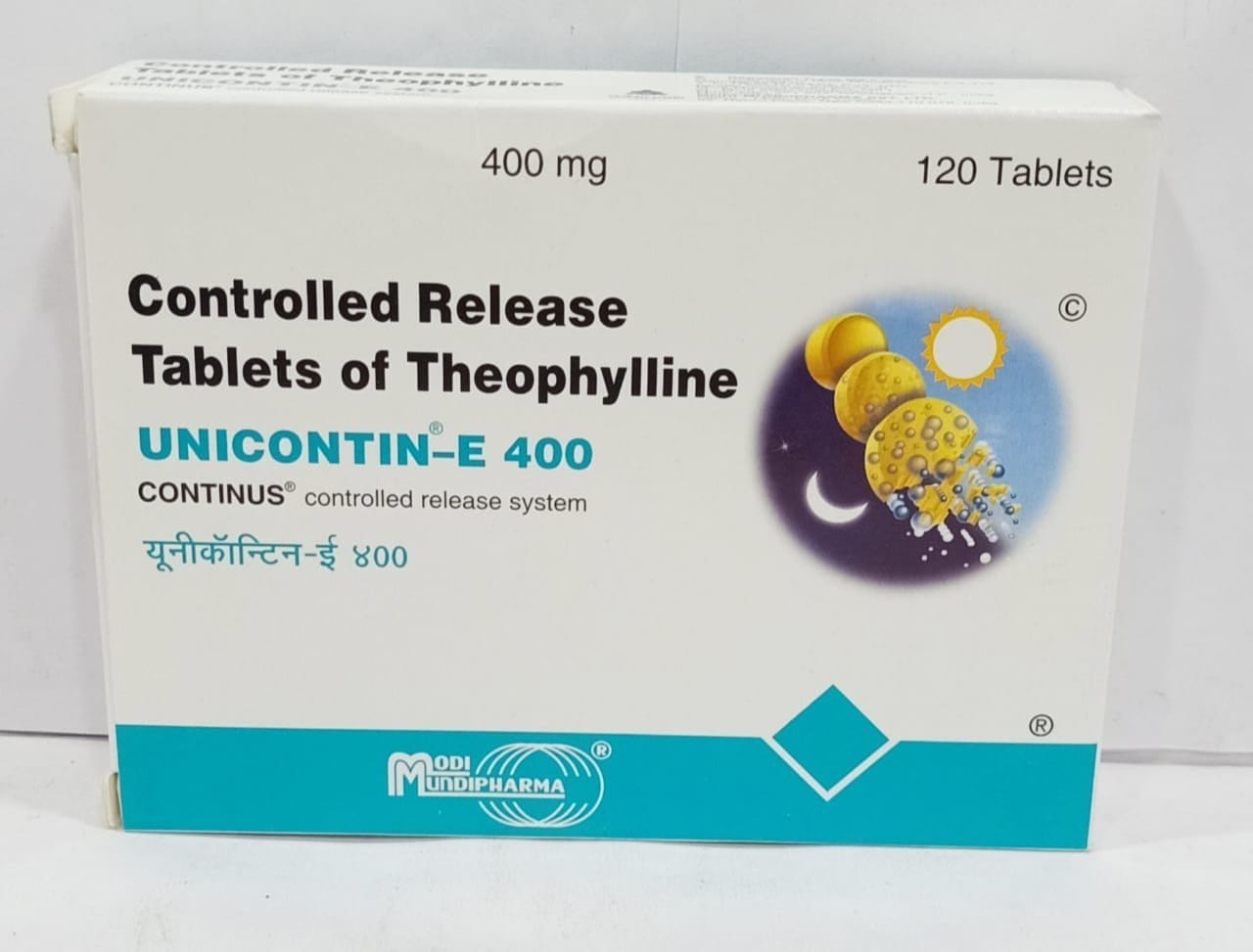
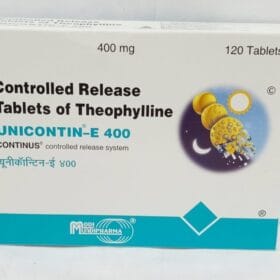
Unicontin-E
✅ Verlicht bronchospasme
✅ Verbeterde longfunctie
✅ Vermindert kortademigheid
✅ Verbeterde luchtwegdoorstroming
✅ Beheerst astmasymptomen
Unicontin-E bevat Theofylline.
✓ Medisch beoordeeld door Morgan Ellis — Apotheekonderzoeker · 8 jaar ervaring · Laatst beoordeeld: mei 2026
⚡ Kort antwoord — Wat is Unicontin-E?
Unicontin-E bevat theofylline, een methylxanthine bronchodilatator met ontstekingsremmende effecten, gebruikt als aanvullende therapie bij chronische astma en COPD. Theofylline werkt op meerdere doelen — fosfodiësteraseremming (verhoging van cAMP), adenosine-receptorantagonisme en HDAC2-activering (ontstekingsremmend). Het heeft een smal therapeutisch venster (streefserum 10–20 mg/L; toxiciteit bij 20+) en vele geneesmiddelinteracties, wat zorgvuldige dosering en (bij sommige patiënten) bloedspiegelmonitoring vereist. Elke tablet met gereguleerde afgifte bevat 400 mg, geproduceerd door Modi-Mundipharma in WHO-GMP gecertificeerde faciliteiten.
📦 Elke bestelling is gedekt door onze Reshipment Assurance-beleid — als uw pakket niet binnen 20 werkdagen arriveert, sturen wij het opnieuw.
Waarom bestellen bij MedsBase
Onze generieke medicijnen zijn afkomstig van WHO-GMP gecertificeerde fabrikanten en worden wereldwijd verzonden in discrete, eenvoudige verpakkingen — geen medicijnnaam op de buitenkant van het pakket. Betalingen met kaart worden verwerkt via een gereguleerde processor (betalingsoverzichten vermelden een gereguleerde kaartbetalingprocessor — nooit “MedsBase” of een medicijnnaam). Crypto en SEPA bankoverschrijvingen worden ook geaccepteerd. Elke bestelling wordt ondersteund door ons Reshipment Assurance Policy.
Wat Is Unicontin-E?
Unicontin-E is een oraal methylxanthine-bronchodilatator. Methylxanthines zijn afgeleid van natuurlijke alkaloïden (theofylline is de dimethylxanthine die in thee voorkomt). Hun gebruik is sinds de jaren 90 afgenomen omdat geïnhaleerde β2-agonisten en corticosteroïden de eerste keus werden — maar ze behouden een rol als derdelijns add-on-therapie bij moeilijk behandelbaar astma en COPD.
Hoe Werkt Unicontin-E?
- Fosfodiësteraseremming (PDE3, PDE4) — verhoogt cyclisch AMP in gladde spieren van de luchtwegen en ontstekingscellen; netto resultaat is bronchodilatatie en verminderde afgifte van mediatoren.
- Adenosine receptor antagonisme — blokkeert adenosine-gemedieerde bronchoconstrictie en afgifte van mediatoren uit mestcellen.
- HDAC2-activering (theofylline bij lage serumspiegels van 5–10 mg/L) — herstelt de gevoeligheid voor corticosteroïden bij COPD en ernstig astma waar steroïdresistentie deels wordt veroorzaakt door verminderde HDAC2.
- Diafragma contractiliteit — methylxanthines verminderen diafragmavermoeidheid, nuttig bij COPD met ernstige luchtwegbeperking.
Toepassingen en Indicaties
- Ernstig chronisch astma — aanvulling op hoge dosis ICS-LABA waar extra bronchodilatatie nodig is
- COPD-onderhoud — aanvulling op LAMA-LABA of triple therapie
- Nachtelijk astma — gereguleerde afgifteformulering zorgt voor bronchodilatatie gedurende de nacht
- Apneu van prematuriteit (theofylline) — gebruik bij neonaten
- Cor pulmonale en pulmonale hypertensie — aanvullend
Dosering Unicontin-E
| Patiënt | Dosering | Frequentie |
|---|---|---|
| Volwassenen — initieel | 200 mg | Tweemaal daags; titreren tot serumspiegel 10–20 mg/L |
| Volwassenen — onderhoud | 400 mg | Tweemaal daags (of 600 mg eenmaal daags ER) |
| Ouderen/hartfalen/leverziekte | Halveer de dosis | Controleer het serumgehalte |
Bijwerkingen van Unicontin-E
- Misselijkheid, braken, dyspepsie
- Hoofdpijn
- Tremor
- Slaapstoornissen, rusteloosheid
- Tachycardie, hartkloppingen
- Milde hypokaliëmie bij hoge doseringen
Giftige niveaus (>20 mg/L) — spoed:
- Ernstige misselijkheid, aanhoudend braken
- Hartritmestoornissen (atriumfibrilleren, supraventriculaire tachycardie)
- Toevallen (vaak zonder waarschuwing)
- Hypotensie, hyperglykemie, hypokaliëmie, hypercalciëmie
Waarschuwingen en voorzorgsmaatregelen
- Smalle therapeutische breedte. Streefserum 10–20 mg/L. Controleer bloedspiegel 5 dagen na start, na doseringswijziging, bij nieuw interactief medicijn, bij stoppen met roken en tijdens ziekte/koorts (klaring daalt).
- Veel geneesmiddelinteracties — zie interactietabel. Vooral gemetaboliseerd door CYP1A2; veel remmers en inductoren beïnvloeden de spiegels aanzienlijk.
- Roken induceert CYP1A2 en verlaagt theofyllinespiegels met ~50% — hertitratie nodig bij stoppen met roken.
- Hartziekte: voorzichtig gebruiken bij ritmestoornissen, hartfalen, ernstige hypertensie.
- Hyperthyreoïdie: verhoogde klaring plus versterkte adrenerge effecten.
- Zwangerschap en borstvoeding: meestal vermeden; alleen gebruiken als het voordeel duidelijk is.
- Leveraandoening: dosis verlagen — methylxanthines worden hepatisch gemetaboliseerd.
Contra-indicaties
- Overgevoeligheid voor theofylline of andere xanthines (cafeïne, theobromine)
- Actieve maagzweer
- Ongecontroleerde tachyaritmieën
- Ernstig hartfalen (NYHA IV)
Geneesmiddelinteracties
| Interagerend geneesmiddel | Effect | Wat te doen |
|---|---|---|
| Ciprofloxacin, erytromycine, claritromycine, fluvoxamine | Remmen CYP1A2 → verhoogde theofyllinespiegels → toxiciteit (misselijkheid, aritmie, aanvallen) | Vermijd of verlaag theofyllinedosis met 50%; controleer serumspiegels |
| Cimetidine, allopurinol | Verhoogde theofyllinespiegels | Verlaag dosis; monitor spiegels |
| Fenytoïne, carbamazepine, rifampicine | Induceert CYP — lagere spiegels | Hogere dosis kan nodig zijn |
| Roken | Induceert CYP1A2 — lagere spiegels | Dosis opnieuw titreren bij stoppen met roken |
| β-agonisten, diuretica | Additieve hypokaliëmie | Controleer het kaliumgehalte |
Opslag
- Bewaren beneden 25°C op een koele, droge plaats uit direct zonlicht.
- Bewaar in de originele verpakking tot gebruik ter bescherming tegen vocht en licht.
- Niet gebruiken na de vervaldatum die op de strip staat vermeld.
- Buiten bereik van kinderen houden.
Gerelateerde alternatieven op MedsBase
- Asthalin Inhaler — salbutamol verlichter
- Budecort Inhaler — budesonide ICS-preventer
- Foracort Inhaler — budesonide + formoterol ICS-LABA
- Tiova Inhaler — tiotropium LAMA voor COPD
- Montair — montelukast LTRA-tablet
Veelgestelde vragen
Wordt theofylline nog gebruikt in modern astmamanagement?
Ja, maar als derdelijns toevoeging. Geïnhaleerde β2-agonisten, ICS, ICS-LABA, LTRA en LAMA zijn eerstelijns; theofylline wordt toegevoegd bij refractaire ziekte, vooral nachtelijk astma. De smalle therapeutische index en vele geneesmiddelinteracties beperken het gebruik.
Hoe wordt de dosis bepaald?
Aangepast aan het serumtheofyllinegehalte van 10–20 mg/L. Controleer 5 dagen na start, na dosiswijziging, bij nieuw interactiegeneesmiddel, bij stoppen met roken en tijdens ziekte/koorts.
Waarom zoveel interacties?
Theofylline wordt gemetaboliseerd door CYP1A2 — veel geneesmiddelen verhogen de niveaus (ciprofloxacine, erytromycine, fluvoxamine, cimetidine) of verlagen de niveaus (rifampicine, fenytoïne, roken).
Hoe lang werkt Unicontin-E?
De gereguleerde afgiftetablet biedt 12 uur dekking. Tweemaal daagse dosering handhaaft stabiele serumspiegels.
Wat zijn de toxische symptomen?
Ernstige misselijkheid, aanhoudend braken, tachycardie, hartkloppingen, tremor, hyperactiviteit, aanvallen (vaak zonder waarschuwing), aritmieën, hypotensie. Toxiciteit boven 20 mg/L is een noodgeval — stop de dosis, controleer het niveau, ondersteunende zorg.
Kan ik het met cafeïne innemen?
Cafeïne en theofylline zijn beide methylxanthines met overlappende effecten. Zware cafeïne kan tremor, tachycardie en slapeloosheid versterken. Verminder cafeïne als er symptomen zijn.
Waarom beïnvloedt roken de dosis?
Roken induceert CYP1A2 (het enzym dat theofylline metaboliseert). Rokers hebben hogere doses nodig; bij stoppen stijgen de niveaus — hertitratie is nodig.
Is Unicontin-E veilig tijdens zwangerschap?
Over het algemeen wordt het vermeden tenzij het voordeel duidelijk is. Geïnhaleerde therapie heeft de voorkeur.
Kan ik Unicontin-E tabletten fijnmaken of splitsen?
Nee — gecontroleerd-afgifte tabletten moeten in hun geheel worden ingeslikt. Fijnmaken vernietigt het afgiftematrix en riskeert acute toxiciteit.
Gerelateerde alternatieven
Andere producten in Chronische aandoeningen die klanten ook bekijken:
Meer opties in Astma/COPD-behandeling
Gerangschikt op recente bestelvolumes van MedsBase — wat andere klanten in deze categorie kiezen.

| Sterkte | 400 mg |
|---|---|
| Hoeveelheid | 10 tabletten, 30 tabletten, 60 tabletten, 90 tabletten, 180 tabletten |
 Unicontin-E
Vragen & antwoorden
Unicontin-E
Gerelateerde producten





Beoordelingen
Er zijn nog geen beoordelingen