







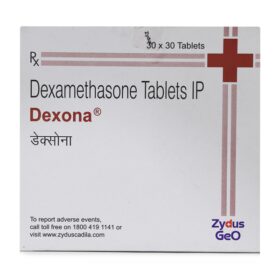
Dexona-tablet
✅ Snelle verlichting van ontstekingen
✅ Effectieve pijnbestrijding
✅ Verlicht ernstige allergieën
✅ Behandelt auto-immuunziekten
✅ Verlicht luchtwegproblemen
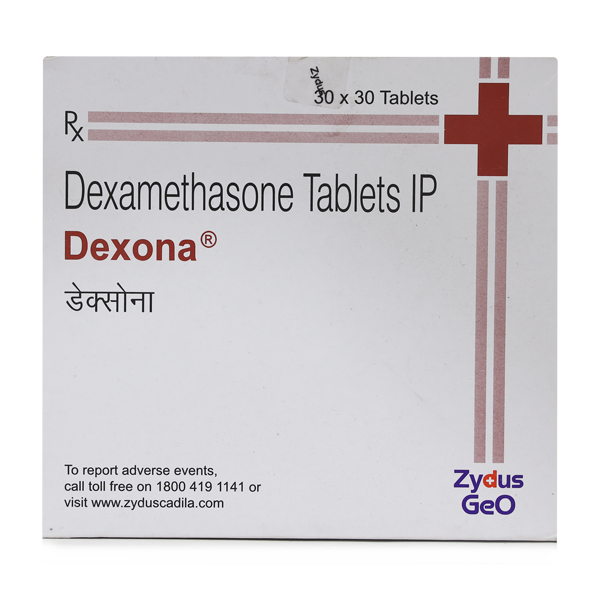
Dexona Tablet bevat Dexamethasone.
✓ Medisch beoordeeld door Morgan Ellis — Apotheekonderzoeker · 8 jaar ervaring · Laatst beoordeeld: mei 2026
⚡ Snel antwoord — Wat is Dexona Tablet?
Dexona-tablet is een dexamethason 0,5 mg orale tablet, een krachtig langwerkend synthetisch corticosteroïd dat wordt gebruikt voor een breed scala aan inflammatoire, allergische, auto-immuun- en maligne aandoeningen. Het heeft 25 tot 30 keer de ontstekingsremmende werking van hydrocortison per milligram, geen mineralocorticoïde (zoutretinerende) activiteit, en een lange biologische halfwaardetijd (36–54 uur) waardoor eenmaal daagse dosering mogelijk is. De gebruikelijke doseringen variëren van 0,75 mg tot 9 mg per dag afhankelijk van de indicatie. Altijd innemen met voedsel; stop niet abrupt na langdurige kuren.
📦 Elke bestelling is gedekt door onze Reshipment Assurance-beleid — als uw pakket niet binnen 20 werkdagen arriveert, sturen wij het opnieuw.
Waarom bestellen bij MedsBase
Onze generieke medicijnen zijn afkomstig van WHO-GMP gecertificeerde fabrikanten en worden wereldwijd verzonden in discrete, eenvoudige verpakkingen — geen medicijnnaam op de buitenkant van het pakket. Betalingen met kaart worden verwerkt via een gereguleerde processor (betalingsoverzichten vermelden een gereguleerde kaartbetalingprocessor — nooit “MedsBase” of een medicijnnaam). Crypto en SEPA bankoverschrijvingen worden ook geaccepteerd. Elke bestelling wordt ondersteund door ons Reshipment Assurance Policy.
Dexona 0,5 mg is een orale tablet die bevat dexamethasone, een synthetisch langwerkend glucocorticosteroïd. Dexamethason staat op de WHO-lijst van essentiële geneesmiddelen en is een van de meest gebruikte corticosteroïden in de klinische praktijk, met toepassingen variërend van cerebraal oedeem en anti-emetische bescherming tijdens chemotherapie tot allergische reacties, auto-immuunziekten en (opvallend sinds 2020) ernstige COVID-19.
In vergelijking met hydrocortison en prednisolon heeft dexamethason drie onderscheidende farmacologische kenmerken:
- Zeer hoge glucocorticoidpotentie — 25–30× hydrocortison
- Geen mineralocorticoïde activiteit — veroorzaakt geen vochtretentie, helpt niet bij bijniercrisis
- Lange biologische halfwaardetijd (36–54 uur) — maakt eenmaal daagse dosering mogelijk
Waar wordt Dexona Tablet voor gebruikt?
- Cerebraal oedeem van primaire of uitgezaaide hersentumoren
- Anti-emetische bescherming tijdens chemotherapie (zeer effectief, vaak gecombineerd met 5-HT3-antagonisten)
- Ernstige COVID-19 zuurstofbehoefte (RECOVERY trial 2020; 6 mg per dag gedurende maximaal 10 dagen)
- Ernstige acute allergische reacties
- Auto-immuunopflakkeringen — SLE, reumatoïde artritis, vasculitis, inflammatoire darmziekte
- Ernstig astma en ernstige COPD-exacerbaties (enkele dosis van 8–12 mg is effectief op de SEH)
- Kroep bij kinderen — een enkele orale dosis van 0,15–0,6 mg/kg
- Prenataal gebruik voor foetale longrijping (gespecialiseerd verloskundig gebruik bij risico op vroeggeboorte)
- Hematologische maligniteit — onderdeel van chemotherapieprotocollen (ALL, multipel myeloom)
- Bacteriële meningitis — aanvullend voor het verminderen van neurologische gevolgen
- Dexamethason suppressietest — diagnostisch gebruik voor het syndroom van Cushing
Hoe werkt dexamethason?
Dexamethason bindt met hoge affiniteit aan intracellulaire glucocorticoïdreceptoren. De geactiveerde receptor verplaatst naar de kern en moduleert gentranscriptie, wat brede ontstekingsremmende, immunosuppressieve en metabolische effecten veroorzaakt. Bij therapeutische doses onderdrukt dexamethason de productie van cytokinen, vermindert het de migratie van leukocyten naar weefsel, stabiliseert het de vasculaire permeabiliteit en vermindert het de ontstekingscascade.
Dexona Tablet Dosering
- Milde ontstekingsaandoeningen: 0,75–3 mg/dag (1,5–6 tabletten van 0,5 mg)
- Matige aandoeningen: 4–6 mg/dag
- Ernstige aandoeningen, cerebraal oedeem, chemotherapie anti-emeticum: 4–16 mg/dag (4 mg en 8 mg tabletten — Decmax — zijn praktischer bij deze doseringen)
- Kroep (kinderen): enkele orale dosis van 0,15 mg/kg (tot 0,6 mg/kg)
- — verbetert de verdraagzaamheid van metformine. om maagirritatie te verminderen
- Ochtenddosis (voor 9 uur 's ochtends) bootst het natuurlijke cortisolritme na en vermindert HPA-as suppressie
Potentie en equivalentie van corticosteroïden
Verschillende corticosteroïden verschillen voornamelijk in potentie, werkingsduur en mineralocorticoïde (zoutretinerende) activiteit. De onderstaande tabel geeft de klinisch bruikbare equivalentie — hiermee kunt u een dosis van één steroïd omzetten naar de equivalente dosis van een ander.
| Corticosteroïde | Glucocorticoïde potentie | Equivalente dosis | Mineralocorticoïde | Duur |
|---|---|---|---|---|
| Hydrocortison | 1 (referentie) | 20 mg | Aanzienlijk | 8–12 uur |
| Prednisolon | 4 | 5 mg | Laag | 12–36 uur |
| Methylprednisolon | 5 | 4 mg | Minimaal | 12–36 uur |
| Dexamethason | 25–30 | 0,75 mg | Geen | 36–54 uur |
| Betamethason | 25–30 | 0,75 mg | Geen | 36–54 uur |
Wie mag Dexona niet gebruiken?
- Systemische schimmelinfectie (anders dan als vervangingstherapie bij bijnierinsufficiëntie)
- Levende vaccins tijdens immunosuppressieve doses (raadpleeg een specialist voor BCG, BMR, gele koorts, varicella, orale tyfus)
- Actieve onbehandelde bacteriële infectie (start eerst met antibiotica)
- Actieve tuberculose zonder anti-TB bescherming
- Bekende overgevoeligheid voor het actieve molecuul of een hulpstof
- Voorzichtig gebruiken bij: diabetes mellitus, congestief hartfalen, hypertensie, osteoporose, maagzweer, psychiatrische aandoeningen, glaucoom, herpes simplex ophthalmicus
- Zwangerschap: alleen gebruiken als duidelijk nodig — prednisolon en hydrocortison passeren de placenta minder dan dexamethason/betamethason, die de voorkeur hebben wanneer een effect op de foetus gewenst is (bijv. longrijping)
Bijwerkingen van Corticosteroïden
Bijwerkingen van corticosteroïden zijn dosis- en duurafhankelijk. Korte kuren (< 2 weken) met matige doses worden meestal goed verdragen. Langere of hogere dosis therapie veroorzaakt het klassieke “Cushingoïde” profiel.
Kortetermijn (eerste 1–2 weken):
- Slapeloosheid, angst, euforie, prikkelbaarheid — vooral bij doses > 20 mg prednisolone-equivalent
- Toegenomen eetlust, gewichtstoename
- Verhoogde bloedglucose (vooral bij diabetes)
- Vochtretentie, milde enkelzwelling
- Maagzuur, dyspepsie
- Hypertensie — vooral bij hogere mineralocorticoïde activiteit (hydrocortison, fludrocortison)
Langetermijn (weken tot maanden):
- Osteoporose en wervelfracturen
- Spierafbraak en proximale myopathie
- Verdunning van de huid, gemakkelijk blauwe plekken, striae, vertraagde wondgenezing
- Cushingoïd uiterlijk — vollemaansgezicht, centrale obesitas, bisonnek
- Cataract, glaucoom
- Verhoogde vatbaarheid voor infecties (bacterieel, viraal, schimmel, parasitair)
- Avasculaire necrose van de femurkop
- Onderdrukking van de HPA-as — risico op bijniercrisis bij abrupt stoppen
- Psychiatrische effecten — depressie, manie, psychose
- Maagzweer, vooral in combinatie met NSAID's
Zeldzaam maar ernstig: steroïdepsychose, pancreatitis, posterieure subcapsulaire cataract, ernstige osteonecrose.
Stop nooit abrupt met corticosteroïden na een langdurige kuur. Elke kuur langer dan 2–3 weken, of elke dosering boven een fysiologische vervangingsdosis (ongeveer 7,5 mg prednisolon of 40 mg hydrocortison per dag), onderdrukt de hypothalamus-hypofyse-bijnieras. Abrupt stoppen kan een levensbedreigende bijniercrisis veroorzaken — misselijkheid, braken, lage bloeddruk, shock. Kuren langer dan 3 weken moeten geleidelijk worden afgebouwd, meestal over 1–4 weken afhankelijk van duur en dosering. Draag een steroïdenwaarschuwingskaart tijdens langdurige behandeling en informeer elke arts, tandarts of chirurg over uw steroïdengebruik.
Bestellen & Levering
MedsBase biedt wereldwijde verzending bij elke bestelling. Bestellingen worden verzonden in discrete verpakkingen en arriveren in verpakkingen van de fabrikant. Als uw gewenste verpakkingsmaat niet op voorraad is, neem dan contact op met de klantenservice voor een verwachte leverdatum.
Medisch disclaimer. De informatie op deze pagina is alleen bedoeld voor algemene educatie. Het is geen vervanging voor advies van uw eigen arts of apotheker. Overleg met een gekwalificeerde zorgprofessional voordat u een therapie start, stopt of wijzigt.
Veelgestelde vragen
Waar wordt Dexona Tablet voor gebruikt?
Dexona (dexamethason 0,5 mg) wordt gebruikt voor inflammatoire, allergische, auto-immuun en maligne aandoeningen — cerebraal oedeem, chemotherapie anti-emeticum dekking, ernstige COVID-19, ernstige allergische reacties, auto-immuun opvlammingen, kroep en specifieke hematologische maligniteiten.
Hoe verschilt dexamethason van prednisolon of hydrocortison?
Dexamethason is ~25–30 keer krachtiger dan hydrocortison per milligram, heeft geen zoutretinerende (mineralocorticoïde) werking en heeft een veel langere halfwaardetijd. Het verdient de voorkeur wanneer een krachtig ontstekingsremmend effect nodig is zonder vochtretentie (cerebraal oedeem, antenatale longrijping, chemotherapie), maar is niet de voorkeurskeuze voor bijniercrisis, waar zoutretinerende werking nodig is.
Hoe lang duurt het voordat Dexona werkt?
Orale dexamethason bereikt zijn maximale plasmaconcentratie binnen 1–2 uur. Het ontstekingsremmende effect begint binnen 1–2 uur en is maximaal binnen 6–12 uur. Vanwege de lange halfwaardetijd blijven de effecten aanhouden gedurende 36–54 uur na een enkele dosis.
Moet ik Dexona 's ochtends innemen?
Ja — neem het bij voorkeur bij het ontbijt in. Ochtenddosering bootst het natuurlijke dagelijkse cortisolritme na en veroorzaakt minder onderdrukking van de HPA-as dan avonddosering.
Kan ik abrupt stoppen met Dexona?
Korte kuren (minder dan 2 weken) kunnen meestal zonder afbouwschema worden gestopt. Langere kuren vereisen een geleidelijke afbouw om een bijniercrisis te voorkomen — raadpleeg uw arts voordat u stopt met een behandeling langer dan 3 weken.
Zorgt Dexona voor gewichtstoename?
Korte kuren veroorzaken zelden significante gewichtsveranderingen. Langdurige of hooggedoseerde therapie kan vochtretentie, verhoogde eetlust en Cushingoïde vetverdeling veroorzaken.
Is Dexona veilig tijdens de zwangerschap?
Dexamethason passeert de placenta gemakkelijker dan prednisolon of hydrocortison. Het wordt bewust gebruikt voor de bevordering van longrijping bij de foetus. Voor maternale aandoeningen wordt tijdens de zwangerschap meestal prednisolon geprefereerd, tenzij dexamethason specifiek is geïndiceerd.
Is Dexona hetzelfde als Decdan?
Beide bevatten dexamethason 0,5 mg en zijn klinisch equivalent. Decdan is een merk van Cadila/Wockhardt; Dexona is een merk van Zydus Cadila.
Is Dexona hetzelfde als Decmax?
Zelfde molecuul (dexamethason). Dexona is 0,5 mg; Decmax is 4 mg — wordt gebruikt wanneer hogere enkelvoudige doses nodig zijn.
Kan Dexona worden gebruikt bij diabetes?
Ja, maar met nauwlettende controle van de bloedglucose. Dexamethason verhoogt de bloedsuikerspiegel en diabetici kunnen tijdens de behandeling aanpassingen in hun insuline of orale hypoglykemica nodig hebben.
Kan Dexona gebruikt worden bij kinderen?
Ja — met name voor kroep en specifieke chemotherapieregimes. De dosering is op basis van gewicht en moet onder toezicht staan van een kinderarts.
Gerelateerde alternatieven
Andere producten in Chronische aandoeningen die klanten ook bekijken:
Meer opties in pijnstillende medicatie
Gerangschikt op recente bestelvolumes van MedsBase — wat andere klanten in deze categorie kiezen.
| Sterkte | 0.5 mg |
|---|---|
| Hoeveelheid | 30 Tabletten, 60 Tabletten, 90 Tabletten, 180 Tabletten |
 Dexona-tablet
Vragen & antwoorden
Dexona-tablet
Gerelateerde producten




Beoordelingen
Er zijn nog geen beoordelingen