







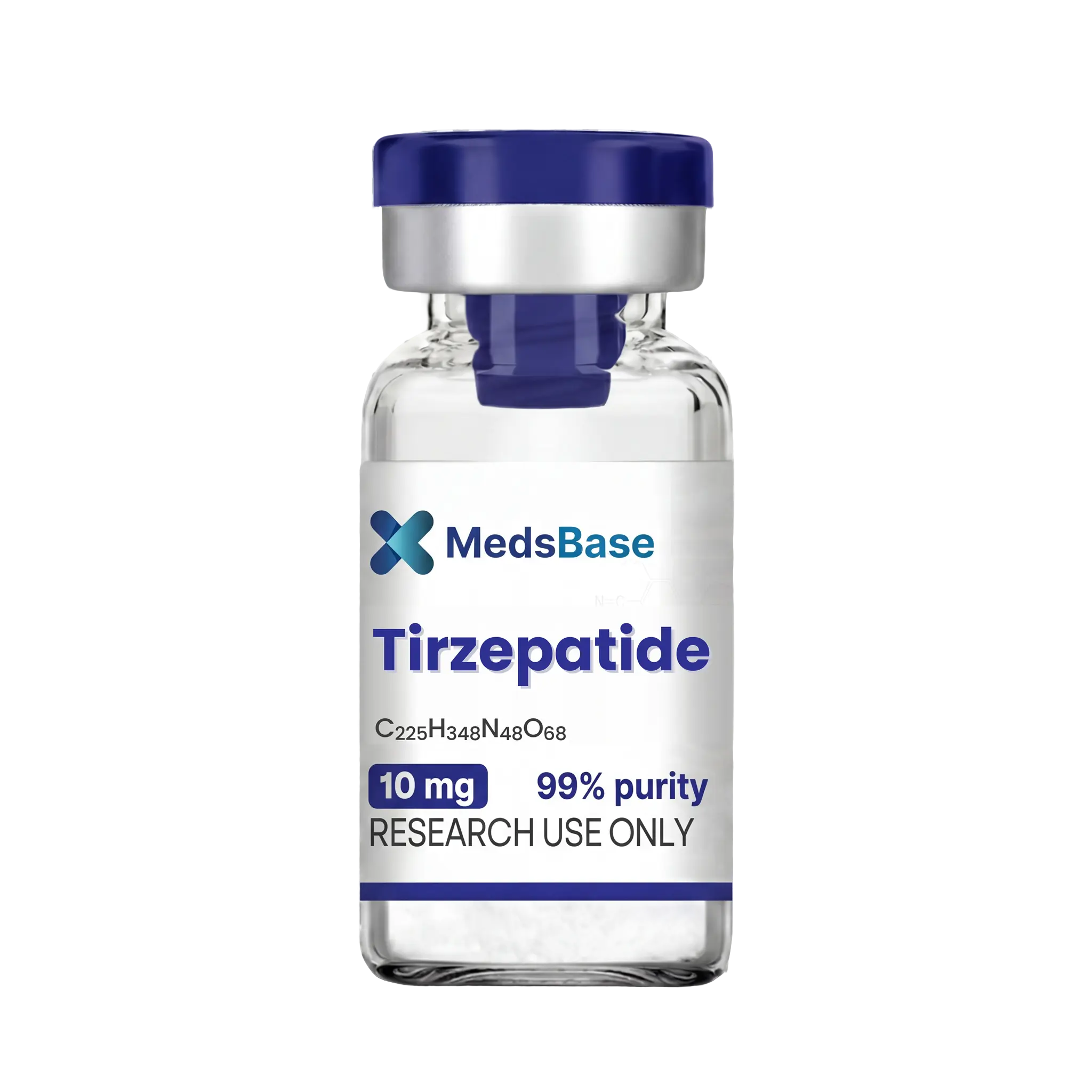
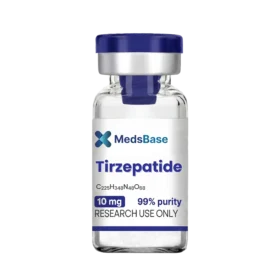
Tirzepatide
✅ Dual GLP-1 + GIP receptor co-agonist
✅ Grootste enkelvoudige peptide-effect op lichaamsgewicht
✅ Ondersteunt onderzoek naar glykemische controle
✅ Adipocyten lipolyse & energieverbruik
✅ Eenmaal per week doseringsprotocollen
Tirzepatide bevat synthetisch peptideverbinding.
✓ Medisch beoordeeld door Morgan Ellis — Apotheekonderzoeker · 8 jaar ervaring · Laatst beoordeeld: mei 2026
Snelle vraag — Wat is Tirzepatide?
Tirzepatide is een 39-aminozuur dubbel GLP-1 en GIP receptor co-agonist peptide en het actieve onderzoeksmolecuul achter Mounjaro en Zepbound. Het produceert het grootste lichaamsgewicht- en glykemische effect van elk enkel peptide in het huidige gepubliceerde onderzoek, waarbij het dubbele-receptorprofiel een aanzienlijk grotere respons oplevert dan enkele GLP-1-agonisten in head-to-head trials zoals SURPASS-2. De plasmahalfwaardetijd is ongeveer 120 uur (~5 dagen), wat een eenmaal per week dosering mogelijk maakt. Leverbaar in 5 mg tot 120 mg lyofiliseerbare flesjes uitsluitend voor laboratoriumonderzoek.
📦 Elke bestelling is gedekt door onze Reshipment Assurance-beleid — als uw pakket niet binnen 20 werkdagen arriveert, sturen wij het opnieuw.
| Specificatie | Detail |
|---|---|
| CAS-nummer | 2023788-19-2 |
| Molecuulformule | C225H348N48O68 |
| Moleculair gewicht | 4813.45 Da |
| Sequentie | Y-Aib-EGTFTSDYSI-Aib-LDKIAQKAFVQWLIAGGPSSGAPPPS (39 aa, GIP-gebaseerde backbone met Aib2, Aib13, en Lys20-C20 vetzure diacylering via γGlu-γGlu spacer) |
| Form | Lyofiliseerd poeder (wit tot off-white) |
| Zuiverheid | ≥99% (HPLC geverifieerd, COA op aanvraag) |
| Opslag | Lyofiliseerd: 2–8 °C (koelkast) voor werkvoorraad; −20 °C voor langdurige opslag van ongeopende flesjes. Gereconstitueerd: 2–8 °C, gebruik binnen ~30 dagen. Bescherm tegen licht. Vries de gereconstitueerde oplossing niet in en ontdooi deze niet. |
| Oplosbaarheid | Bacteriostatisch water (aanbevolen) of steriel water voor kortere gebruiksperioden |
| Onderzoeksgebruik | Alleen voor laboratoriumonderzoek. Niet voor humaan of veterinair diagnostisch of therapeutisch gebruik. |
Wat Is Tirzepatide?
Tirzepatide is een 39-aminozuur dual incretinereceptor co-agonist die zowel de glucagon-like peptide-1 (GLP-1) als de glucose-dependent insulinotropic polypeptide (GIP) receptoren activeert met vergelijkbare potentie. Ontwikkeld door Eli Lilly en gepubliceerd in 2018, was het de eerste dual-incretine agonist die regulatoire goedkeuring kreeg (Mounjaro voor diabetes type 2 in 2022, Zepbound voor chronisch gewichtsbeheer in 2023). Tirzepatide is gebouwd op het GIP-peptide skelet — niet het GLP-1 skelet dat door semaglutide wordt gebruikt — met twee α-aminoisoboterzuur (Aib) substituties op posities 2 en 13 die resistent zijn tegen DPP-4 splitsing en een C20 vetzure diacid gehecht aan lysine 20 via twee γ-glutaminezuur spacers. De C20 acylketen is één koolstof langer dan de C18 van semaglutide, wat zorgt voor een strakkere albuminebinding en een lichtjes ander farmacokinetisch profiel.
Tirzepatide’s goed gekarakteriseerde structuur heeft de empirische formule C225H348N48O68 met een gemiddeld molecuulgewicht van 4813.45 Da. De plasmahalfwaardetijd is ongeveer 120 uur (~5 dagen), wat een eenmaal per week subcutane dosering mogelijk maakt in gepubliceerd onderzoek. De verbinding wordt geleverd als een hoogzuiver lyofiliseerd poeder voor reconstitutie met bacteriostatisch water. Farmaceutische tirzepatide (Mounjaro, Zepbound) is door de FDA goedgekeurd voor humaan therapeutisch gebruik onder de productiecontroles van Eli Lilly; de onderzoekskwaliteit tirzepatide die hier wordt verkocht, wordt geleverd uitsluitend voor laboratoriumonderzoek en is niet door de FDA goedgekeurd voor humane of veterinaire toediening. Voor breder incretineonderzoek, zie onze Semaglutide en Retatrutide productpagina's.
Werkingsmechanisme — Dual GLP-1 / GIP Receptor Co-Agonisme
Wat tirzepatide onderscheidt van eerdere single-incretine peptiden is zijn gebalanceerde co-activatie van twee verschillende receptoren, elk met complementaire metabolische effecten zoals waargenomen in gepubliceerd onderzoek:
- GLP-1 receptor activatie — verzadiging, β-cel insulinesecretie, maaglediging — Tirzepatide bindt aan de GLP-1 receptor met een affiniteit vergelijkbaar met native GLP-1, waardoor Gαs-gekoppelde adenylaatcyclase en downstream cAMP/PKA-signalering wordt geactiveerd. Dit produceert de canonieke GLP-1 effecten: glucose-afhankelijke versterking van insulinesecretie uit pancreatische β-cellen, onderdrukking van glucagon uit α-cellen, vertraagde maaglediging en centrale eetlustremmende effecten via arcuate-nucleus POMC-neuronen. Dit aspect overlapt met het mechanisme van semaglutide.
- GIP receptor activatie — adipocyten lipolyse, energieverbruik, β-cel ondersteuning — Het GIP-component is wat tirzepatide farmacologisch onderscheidend maakt. GIP-receptoractivatie versterkt de insulinesecretie op een glucose-afhankelijke manier (aanvullend op het effect van GLP-1), maar werkt ook op adipocyten om lipolyse te bevorderen onder vastende omstandigheden terwijl het de opslag van triglyceriden ondersteunt in de gevoede toestand. Onderzoek suggereert dat GIP-receptorsignalering ook bescheiden de rustende energie-uitgave verhoogt en werkt in CNS-gebieden die verschillen van GLP-1, inclusief de dorsomediale hypothalamus. Het netto-effect is een additief lichaamsgewichtssignaal dat verder gaat dan wat GLP-1 alleen produceert.
- Receptorbalans en structurele verfijning — In radioligand-bindingsassays toont tirzepatide een hogere affiniteit voor de GIP-receptor dan voor de GLP-1-receptor — een ongebruikelijke verhouding die het onderscheidt van eerdere dual-agonistkandidaten. De asymmetrie is intentioneel: de GIP-achtergrond zorgt voor een hogere GIP-receptorpotentie terwijl de aangebrachte modificaties voldoende GLP-1-activiteit behouden. Tirzepatide wordt soms omschreven als “GIP-bevooroordeeld” in receptorfarmacologie, wat implicaties heeft voor de differentiële signalering die wordt waargenomen in onderzoeksmodellen.
De C20-vetzuurdiacyl-verankering op lysine 20 bindt reversibel aan circulerend serumalbumine, waardoor een peptide-depot wordt gevormd dat tirzepatide beschermt tegen renale klaring en zorgt voor een plasma-halfwaardetijd van ~120 uur. De dubbele Aib-substitutie (posities 2 en 13) voorkomt DPP-4-splitsing op twee verschillende plaatsen, wat redundante proteolytische bescherming biedt. Samen zetten deze structurele kenmerken wat anders een kortwerkend incretine zou zijn om in een eenmaal per week toe te dienen onderzoekspeptide.
Gepubliceerde onderzoeksapplicaties
Tirzepatide wordt gebruikt in laboratoriumonderzoekscontexten die onderzoeken:
- Glykemische controle en insulinegevoeligheid — directe vergelijking met semaglutide en andere GLP-1-monoagonisten (Frias et al., NEJM 2021 SURPASS-2); db/db, ZDF en hoogvetdieet knaagdier modellen; effecten op HbA1c-surrogaten, nuchtere glucose en hyperinsulinemisch-euglykemische clamp parameters
- Lichaamsgewicht en adipositasonderzoek — de SURMOUNT-1-studie toonde ~22% lichaamsgewichtsvermindering bij 15 mg wekelijks over 72 weken, het grootste enkelvoudige peptide-effect dat destijds in klinisch onderzoek werd gedocumenteerd; knaagdier DIO-modellen, lichaamssamenstelling (DEXA / MRI), respiratoire uitwisselingsratio
- MASLD/MASH (metabool-dysfunctie-geassocieerde leverziekte) — hepatisch triglyceridegehalte, ALT/AST, fibrose-stadiëring; SYNERGY-NASH trial dataset
- Cardiovasculair onderzoek — effecten op bloeddruk, lipidenprofielen, atheroscleroseprogressie in ApoE-/- modellen; SURPASS-CVOT cardiovasculaire uitkomsten data
- Slaapapneu-onderzoek — ernst van obstructief slaapapneu, apneu-hypopneu-index in de SURMOUNT-OSA dataset
- Nierbescherming in diabetische nefropathie-modellen — albuminurie, glomerulaire filtratiesnelheid, mesangiale expansie in streptozotocine-geïnduceerde en Akita-muis diabetische nierziekte
- Vergelijkend incretinepeptide-onderzoek — benchmark voor dual-agonist vs single-agonist vs triple-agonist vergelijkingen. Zie onze Retatrutide vs Tirzepatide gids en het Semaglutide productpagina voor vergelijkbare producten.
Voor een bredere context over waar tirzepatide past binnen het metabolische-peptidelandschap, zie Retatrutide (triple GLP-1/GIP/glucagon agonist, de volgende-generatie vergelijker) en onze Ozempic vs Mounjaro gids. Bekijk het volledige onderzoekspeptiden catalogus voor gerelateerde verbindingen.
Beschikbare sterktes en concentraties
MedsBase stocks Tirzepatide in eleven lyophilized vial strengths covering the full research dose-titration range from pilot dosing through multi-month bulk protocols. Each strength is available in 10-vial, 20-vial, or 30-vial pack formats with full reconstitution guidance:
| Vulsterkte | Typisch Onderzoeksgebruik | Verpakkingsgroottes |
|---|---|---|
| 5 mg | Proefdosering, lage titratie, korte cycli | 10, 20 of 30 vialen |
| 10 mg | Onderhoudsonderzoekssterkte, middelmatige titratie | 10, 20 of 30 vialen |
| 15 mg | Klinisch-equivalente doelsterkte (maximale goedgekeurde menselijke dosis) | 10, 20 of 30 vialen |
| 20 mg | Hoge-dosis onderzoeksarm, verkennende protocollen | 10, 20 of 30 vialen |
| 30 mg | Meerweekse protocollen vanuit een enkele vial, lager reconsitutievolume | 10, 20 of 30 vialen |
| 40 mg | Langdurig onderzoek, lagere kosten per mg | 10, 20 of 30 vialen |
| 50 mg | Meermaandelijkse protocollen, vergelijkend dosis-responsonderzoek | 10, 20 of 30 vialen |
| 60 mg | Hoge-dosis vergelijkende onderzoeksarm | 10, 20 of 30 vialen |
| 80 mg | Bulk onderzoeksvial, lage kosten per mg | 10, 20 of 30 vialen |
| 100 mg | Multi-cohort studies, multi-maand protocollen | 10, 20 of 30 vialen |
| 120 mg | Maximale bulk onderzoeksfles, laagste kosten per mg | 10, 20 of 30 vialen |
Alle elf sterktes hebben dezelfde chemische vorm (gevriesdroogd poeder, 99%+ HPLC zuiverheid). Hogere mg-flessen vereisen kleinere reconstitutievolumes per eenheidsdosis, wat nuttig is voor onderzoekers die injectievolume minimaliseren of langdurige multi-maand protocollen uitvoeren vanuit een enkele fles. Omdat de gereconstitueerde oplossing stabiel is voor ~30 dagen, hangt de optimale flesgrootte voor een bepaald protocol af van de wekelijkse dosis × weken-per-fles afweging.
Hoe het zich verhoudt — Tirzepatide vs Semaglutide vs Retatrutide
Tirzepatide bevindt zich in het centrum van het moderne incretine-agonist onderzoekslandschap, tussen de enkele-receptor Semaglutide (GLP-1 alleen) en de drievoudige-receptor Retatrutide (GLP-1 + GIP + glucagon). Elke stap op de receptorladder produceert een progressief groter lichaamsgewichtseffect in head-to-head onderzoek maar ook bredere systemische signalering.
| Criterium | Semaglutide | Tirzepatide | Retatrutide |
|---|---|---|---|
| Receptorprofiel | GLP-1 (enkelvoudig) | GLP-1 + GIP (dubbel) | GLP-1 + GIP + glucagon (drievoudig) |
| Peptide backbone | GLP-1 (31 aa) | GIP (39 aa) | GIP-achtig (39 aa) |
| Halfwaardetijd | ~165 uur (~7 dagen) | ~120 uur (~5 dagen) | ~6 dagen |
| Vetzuurverbinding | C18 diacid + AEEA-AEEA | C20 diacid + γGlu-γGlu | C20 diacid + γGlu |
| Merkreferentie | Ozempic / Wegovy / Rybelsus | Mounjaro / Zepbound | Onderzoek (LY3437943) |
| Typische wekelijkse onderzoeksdosis | 0,25–2,4 mg | 2,5–15 mg | 2–12 mg |
| Effect op lichaamsgewicht in onderzoeken | ~15% (STEP) | ~22% (SURMOUNT-1) | ~24% (Fase 2) |
| Sterkste onderzoekssignaal | Glykemische controle, cardiovasculair | Gecombineerd glykemisch + lichaamsgewicht, MASH | Grootste effect op lichaamsgewicht |
De head-to-head SURPASS-2 trial (Frias et al., NEJM 2021) toonde superieure HbA1c- en lichaamsgewichtsreductie met tirzepatide 15 mg versus semaglutide 1 mg over 40 weken — een van de grootste directe vergelijkingsdatasets in incretineonderzoek. Voor methodologische details over het dual- versus triple-agonistlandschap, lees Retatrutide versus Tirzepatide: triple versus dual agonist en Ozempic versus Mounjaro. Onderzoekers die tussen deze peptiden kiezen, wegen doorgaans receptorselectiviteit (schonere farmacologie met semaglutide), effectgrootte (groter bij tirzepatide en retatrutide) en de kwaliteit van beschikbare onderzoeksdata (uitgebreid voor semaglutide en tirzepatide, nog in ontwikkeling voor retatrutide) tegen elkaar af.
Opslag en Reconstituering
Voor reconstituering: Bewaar lyofiliseerde flesjes gekoeld bij 2–8 °C in de originele verpakking voor kortdurend gebruik. Voor ongebruikte langdurige opslag, vries in bij −20 °C. Lyofiliseerd tirzepatide is stabiel onder koeling tot 24 maanden en bij −20 °C tot 36 maanden. Vermijd vries-ontdooicycli van het lyofiliseerde poeder.
Reconstitueringsprocedure: Spuit bacteriostatisch water langs de zijkant van het peptideflesje (niet direct op de lyofiliseerde cake). Voor een flesje van 10 mg levert 2,0 ml bacteriostatisch water een werkconcentratie van 5 mg/ml op — 10 streepjes op een U-100-insulinespuit komt overeen met 500 mcg. Draai voorzichtig — schud niet — en laat 2–5 minuten staan voor volledige oplossing. Een correct gereconstitueerde oplossing moet helder en kleurloos zijn. niet Schud — en laat 2–5 minuten staan voor volledige oplossing. Een correct gereconstitueerde oplossing moet helder en kleurloos zijn.
Na reconstitutie: Bewaar gekoeld bij 2–8 °C en gebruik binnen 30 dagen voor optimale stabiliteit. Vries de gereconstitueerde oplossing niet in — vries-dooicycli tasten de peptide-integriteit aan. Gooi elke fles weg die troebelheid, neerslag of verkleuring vertoont. Omdat tirzepatide volgens onderzoeksprotocollen eenmaal per week wordt toegediend, ondersteunt een enkele gereconstitueerde fles van 10 mg doorgaans 2–4 weken dosering, afhankelijk van de doeldosis; een fles van 50 mg ondersteunt 10–20 weken bij klinisch equivalente doseringen.
Veelgestelde vragen
Waar wordt Tirzepatide voor gebruikt in onderzoek?
Tirzepatide wordt gebruikt in laboratoriumonderzoek naar glykemische controle, insulinegevoeligheid, lichaamsgewicht en adipositas, MASLD/MASH leverziekte, cardiovasculaire eindpunten, slaapapneu en diabetische nefropathie. Het is de meest uitgebreid gekarakteriseerde dubbele GLP-1/GIP-agonist en fungeert als standaard vergelijkingsarm voor nieuwere multi-agonist peptide-onderzoeken. De onderzoekskwaliteit tirzepatide die hier wordt verkocht is niet FDA-goedgekeurd voor humaan therapeutisch gebruik en wordt strikt geleverd voor laboratoriumonderzoek.
Hoe verschilt Tirzepatide van Semaglutide?
The structural difference is the receptor profile and the peptide backbone. Tirzepatide is built on the 39-amino-acid GIP backbone and co-activates both GIP and GLP-1 receptors. Semaglutide is built on the 31-amino-acid GLP-1 backbone and activates only the GLP-1 receptor. The GIP component in tirzepatide adds adipose-tissue lipolysis and modest increases in energy expenditure that GLP-1-only peptides don’t produce. In head-to-head trials (SURPASS-2), tirzepatide 15 mg produced superior HbA1c and body-weight reduction vs semaglutide 1 mg over 40 weeks.
Hoe verschilt Tirzepatide van Retatrutide?
Beide zijn gebaseerd op GIP-scaffolds, maar retatrutide voegt glucagonreceptoractiviteit toe bovenop GLP-1 en GIP — waardoor het een triple agonist wordt. De toegevoegde glucagoncomponent draagt verder bij aan energieverbruik en adipocytenlipolyse. Gepubliceerde fase 2-data van retatrutide tonen een gewichtsverlies van ~24% bij 12 mg per week, wat iets hoger is dan de 22% van tirzepatide in SURMOUNT-1. Tirzepatide heeft een uitgebreidere trialdataset; retatrutide bevindt zich nog in een laat ontwikkelingsstadium.
Wat is de gebruikelijke onderzoeksdosis van Tirzepatide?
Gepubliceerde protocollen gebruiken typisch een titratieschema dat start met 2,5 mg per week en elke 4 weken met 2,5 mg wordt verhoogd tot een onderhoudsdosis van 5–15 mg per week. Een flesje van 10 mg, gereconstitueerd met 2,0 mL bacteriostatisch water, levert een concentratie van 5 mg/mL — 10 eenheden op een U-100-spuit komt overeen met 500 mcg.
Is Tirzepatide goedgekeurd door de FDA?
Farmaceutische tirzepatide is door de FDA goedgekeurd onder de merknamen Mounjaro (type 2 diabetes, 2022) en Zepbound (chronisch gewichtsbeheer, 2023), vervaardigd volgens GMP-normen door Eli Lilly. De onderzoekskwaliteit tirzepatide die hier wordt verkocht, is een apart product dat uitsluitend bedoeld is voor laboratoriumonderzoek en is niet niet door de FDA goedgekeurd voor menselijk of veterinair gebruik. Het mag niet worden toegediend aan mensen of dieren.
Hoe moet Tirzepatide worden opgeslagen?
Gevriesdroogde flesjes: gekoeld bewaren bij 2–8 °C voor kortdurende werkvoorraad, of bij −20 °C voor langdurige opslag van ongeopende flesjes. Gereconstitueerde oplossing: gekoeld bewaren bij 2–8 °C, binnen 30 dagen gebruiken. Bevries de gereconstitueerde oplossing niet — vries-ontdooicycli degraderen het peptide. Bescherm te allen tijde tegen direct licht.
Hoe reconstitueer ik Tirzepatide?
Volg de hierboven beschreven reconstitutieprocedure. Voeg bacteriostatisch water toe langs de zijkant van het flesje (niet rechtstreeks op het gevriesdroogde poeder), draai voorzichtig en laat 2–5 minuten staan voor volledige oplossing. Schud niet het flesje niet. Een correct gereconstitueerde oplossing is helder en kleurloos. Voor een flesje van 10 mg + 2,0 mL oplosmiddel is de werkconcentratie 5 mg/mL.
Welke sterktes heeft MedsBase op voorraad?
MedsBase carries Tirzepatide in eleven lyophilized vial strengths: 5 mg, 10 mg, 15 mg, 20 mg, 30 mg, 40 mg, 50 mg, 60 mg, 80 mg, 100 mg, and 120 mg. Each strength is available in 10-vial, 20-vial, or 30-vial pack sizes. All vials are supplied at 99%+ HPLC purity with a certificate of analysis available on request.
Wat is de halfwaardetijd van Tirzepatide?
Tirzepatide heeft een plasmahalfwaardetijd van ongeveer 120 uur (~5 dagen) na subcutane toediening. Deze halfwaardetijd wordt bereikt door reversibele binding aan circulerend serumalbumine via de C20-vetdiacidether bij lysine 20, wat het peptide beschermt tegen renale klaring. Gecombineerd met de dubbele Aib-substitutie (posities 2 en 13) die DPP-4-cleavage blokkeert, resulteert dit in een wekelijkse doseringsfrequentie vergelijkbaar met de ~165 uur halfwaardetijd van semaglutide.
Waarom veroorzaakt Tirzepatide meer gewichtsverlies dan Semaglutide?
Het meest aangehaalde mechanisme is de GIP-receptorcomponent. GIP-receptoractivatie draagt extra effecten bij die GLP-1 alleen niet produceert: versterkte lipolyse van adipocyten onder vastenomstandigheden, bescheiden toename van het rustenergieverbruik en CNS-effecten in de dorsomediale hypothalamus die verschillen van de GLP-1-signalering in de nucleus arcuatus. Het gecombineerde dubbele signaal leidt tot een additionele vermindering van het lichaamsgewicht vergeleken met GLP-1 alleen in directe onderzoeksmodellen.
Veroorzaakt Tirzepatide bijwerkingen in onderzoek?
De meest consistente bevinding is gastro-intestinaal — misselijkheid, tijdelijke eetlustremming en vertraagde maaglediging zijn dosisafhankelijk en hebben de neiging af te nemen over 4–8 weken van continue dosering naarmate receptor-tachyphylaxis ontstaat. Minder vaak voorkomende bevindingen zijn effecten op de galblaasmotiliteit en (in knaagdier-modellen met schildklier-C-celgevoeligheid) C-celhyperplasie — het laatste is een soort-specifiek signaal dat in langdurige klinische follow-up niet is waargenomen bij mensen.
Kunnen Tirzepatide en Semaglutide in onderzoek worden vergeleken?
Ja — directe vergelijking is een van de meest actief bestudeerde vragen in incretine-farmacologie. De klinische SURPASS-2-studie vergeleek Tirzepatide 15 mg direct met Semaglutide 1 mg bij patiënten met diabetes type 2; preklinisch en groeiend real-world bewijs breidt de vergelijking uit naar lichaamsgewicht, MASH en cardiovasculaire eindpunten. Semaglutide blijft de standaard GLP-1-vergelijker; Tirzepatide is de standaard dubbele agonist-vergelijker.
Hoe lang duurt het voordat Tirzepatide effecten laat zien in preklinisch onderzoek?
Acute farmacodynamische effecten op glucosetolerantie en maaglediging zijn al binnen uren na de eerste dosis detecteerbaar. Effecten op lichaamsgewicht in DIO-knaagdier-modellen worden doorgaans statistisch significant na 1–2 weken van wekelijkse dosering en blijven toenemen tot 8–16 weken. Het maximale effect op lichaamssamenstelling wordt meestal waargenomen na 16–24 weken van continue dosering in onderzoeksmodellen, wat overeenkomt met het traject in humane studies.
Kan ik Tirzepatide bestellen voor internationale verzending?
Ja. MedsBase verzendt Tirzepatide wereldwijd vanuit ons toegewijde peptide-verzendnetwerk. Bestellingen met alleen peptiden komen in aanmerking voor onze zelfstandige peptide-verzendservice. Alle bestellingen worden verzonden in temperatuurgecontroleerde verpakkingen met volledige tracking en vallen onder onze Reshipment Assurance-beleid.
Andere peptiden voor metabolisch en lichaamssamenstellingsonderzoek
- Semaglutide — Enkele GLP-1-agonist (Ozempic/Wegovy/Rybelsus actief) — standaard glykemische en CV-onderzoeksvergelijker
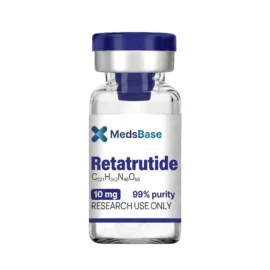
- Retatrutide — Drievoudige GLP-1/GIP/glucagon-agonist — next-generation multi-as metabolisch onderzoek
- Tesamorelin — GHRH-analoog — onderzoek naar visceraal vetweefsel
- MOTS-c — Mitochondriaal gecodeerd peptide dat beweging nabootst — AMPK en insulinegevoeligheidsonderzoek
- CJC-1295 met DAC — Langwerkend GHRH-analoog voor onderzoek naar de groeias
Verder lezen
📖 Vergelijk het landschap van langwerkende incretines
Lees onze directe vergelijkingen: Retatrutide vs Tirzepatide — triple versus dual agonist en Ozempic versus Mounjaro. Behandelt receptorfarmacologie, sequentie-engineering, halfwaardetijd, dosis-respons en de directe vergelijkingsstudiegegevens die tirzepatide onderscheiden van semaglutide (SURPASS-2) en van de triple-agonist fase 2-resultaten van retatrutide.
Meer opties in Peptiden
Gerangschikt op recente bestelvolumes van MedsBase — wat andere klanten in deze categorie kiezen.
| Sterkte | 5 mg, 10 mg, 15 mg, 20 mg, 30 mg, 40 mg, 50 mg, 60 mg, 80 mg, 100 mg, 120 mg |
|---|---|
| Hoeveelheid | 10 flacons, 20 flacons, 30 flacons |
 Tirzepatide
Vragen & antwoorden
Tirzepatide
Gerelateerde producten
Beoordelingen
Er zijn nog geen beoordelingen