







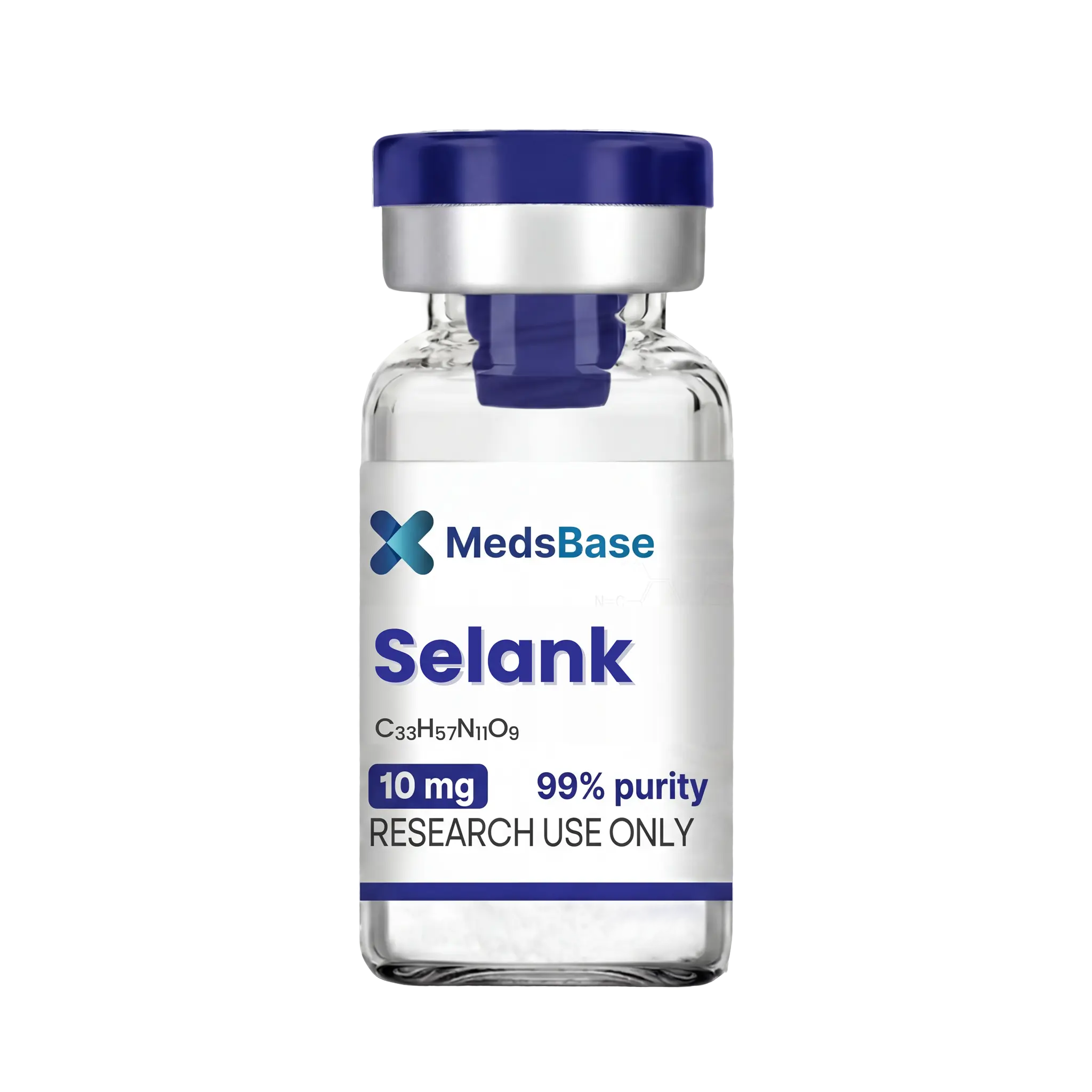
Selank
✅ Anxiolyticum zonder sedatie
✅ Multi-pathway GABA / BDNF / enkefaline modulatie
✅ Onderzoeksstof voor stressbestendigheid
✅ Intranasaal bioactief peptide
✅ Schoner afbouwschema vergeleken met benzodiazepinen
Selank bevat synthetisch peptideverbinding.
✓ Medisch beoordeeld door Morgan Ellis — Apotheekonderzoeker · 8 jaar ervaring · Laatst beoordeeld: mei 2026
Kort antwoord — Wat is Selank?
Selank is een synthetisch heptapeptide van 7 aminozuren, ontwikkeld aan de Russische Academie van Wetenschappen als een analoog van het endogene immunomodulerende peptide tuftsin. Volgens gepubliceerd onderzoek werkt het als een anxiolytisch nootropicum dat GABAerge, serotonerge en enkefalinesignalering moduleert en de BDNF-expressie verhoogt zonder de sedatie of afhankelijkheidsrisico's van benzodiazepinen. Leverbaar in 5 mg en 10 mg lyofilisaten voor uitsluitend laboratoriumonderzoek.
📦 Elke bestelling is gedekt door onze Reshipment Assurance-beleid — als uw pakket niet binnen 20 werkdagen arriveert, sturen wij het opnieuw.
| Specificatie | Detail |
|---|---|
| CAS-nummer | 129954-34-3 |
| Molecuulformule | C33H57N11O9 |
| Moleculair gewicht | 751.88 Da |
| Sequentie | Thr-Lys-Pro-Arg-Pro-Gly-Pro-NH2 (TKPRPGP-NH2, 7 aminozuren; C-terminaal geamideerd tuftsin-analoog) |
| Form | Lyofiliseerd poeder (wit tot off-white) |
| Zuiverheid | ≥99% (HPLC geverifieerd, COA op aanvraag) |
| Opslag | Lyofiliseerd: 2–8 °C (koelkast) voor werkvoorraad; −20 °C voor langdurige opslag van ongeopende flesjes. Gereconstitueerd: 2–8 °C, gebruik binnen ~30 dagen. Bescherm tegen licht. Vries de gereconstitueerde oplossing niet in en ontdooi deze niet. |
| Oplosbaarheid | Bacteriostatisch water (aanbevolen) of steriel water voor korter gebruik. Compatibel met intranasale onderzoeksformuleringen. |
| Onderzoeksgebruik | Alleen voor laboratoriumonderzoek. Niet voor humaan of veterinair diagnostisch of therapeutisch gebruik. |
Wat Is Selank?
Selank is een synthetisch heptapeptide ontwikkeld in de jaren 90 aan het Instituut voor Moleculaire Genetica van de Russische Academie van Wetenschappen, hetzelfde laboratorium dat Semax. ontwikkelde. Het is structureel een analoog van het endogene immunomodulerende tetrapeptide tuftsin (TKPR), verlengd aan de C-terminus met een Pro-Gly-Pro staart die proteolytische stabiliteit en een geamideerde C-terminus biedt. Deze staartverlenging verlengt de plasmahalfwaardetijd aanzienlijk vergeleken met natuurlijk tuftsin, dat binnen minuten wordt afgebroken, terwijl de immunomodulerende activiteit van het oorspronkelijke peptide behouden blijft.
Selanks goed gekarakteriseerde sequentie is TKPRPGP-NH2, molecuulgewicht 751,88 Da, empirische formule C33H57N11O9. Het wordt geleverd als een hoogzuiver lyofilisaat voor reconstitutie met bacteriostatisch water. In Rusland is Selank goedgekeurd als een anxiolyticum op recept onder de naam Selank (intranasale spray); buiten het post-Sovjetblok is het niet goedgekeurd door de FDA, EMA, MHRA of enige andere grote regelgevende instantie. Het onderzoeksgrade Selank dat hier wordt verkocht, is geleverd uitsluitend voor laboratoriumonderzoek en is niet goedgekeurd voor menselijke of veterinaire toediening. Voor onderzoek naar zusterpeptiden, zie onze Semax productpagina.
Werkingsmechanisme — GABAerge, serotonerge en BDNF-paden
Wat Selank onderscheidt onder anxiolytische onderzoeksstoffen is zijn multipad-neuromodulerend profiel zonder directe receptorbinding aan de GABAA benzodiazepinebindingsplaats — elk draagt bij aan het waargenomen anxiolytische en nootropische fenotype in gepubliceerd onderzoek:
- GABAerge modulatie zonder benzodiazepinebindingsplaats — Selank versterkt GABA-gemedieerde remming via allosterische effecten die verschillen van de benzodiazepine-bindingsplaats. In onderzoeksmodellen bij knaagdieren verhoogt het de drempel voor aanvallen en veroorzaakt het anxiolyse in de elevated-plus-maze en open-field tests, maar zonder de sedatie, verlies van motorische coördinatie, afhankelijkheid of rebound-angst die wordt gezien bij diazepam. Deze unieke wijze van GABA-modulatie is het meest bestudeerde aspect van Selank's farmacologie.
- Serotonerge en enkefalinergische signalering — Gepubliceerd onderzoek heeft een verhoogd serotonine-metabolisme (5-HIAA / 5-HT-ratio) gedocumenteerd in corticale en limbische regio's na toediening van Selank bij knaagdieren, samen met een upregulatie van enkefaline-genexpressie. Het gecombineerde serotonerge en enkefalinergische signaal wordt verondersteld bij te dragen aan stemmingsmodulerende en stressbestendigheidseffecten in chronische-stress onderzoeksmodellen.
- BDNF-expressie en neuroplasticiteit — Selank verhoogt de expressie van brain-derived neurotrophic factor (BDNF) in de hippocampus en prefrontale cortex volgens gepubliceerd onderzoek, een mechanisme dat steeds meer wordt erkend als centraal voor de langetermijneffecten van stemmingsmodulerende verbindingen. BDNF-upregulatie ondersteunt ook Selank's nootropische profiel — verbeterde geheugenconsolidatie en leerprestaties in knaagdier-maze-taken.
Selank is intranasaal biobeschikbaar (een van de weinige peptiden met gedocumenteerde mucosale absorptie), wat de primaire onderzoeksroute is in gepubliceerde Russische en Oost-Europese studies. De intranasale route omzeilt first-pass metabolisme en levert het peptide direct via de cribriforme plaat naar centrale compartimenten, wat CNS-effecten produceert binnen minuten na toediening. Subcutane toediening is ook gedocumenteerd in preklinisch onderzoek en produceert een vergelijkbaar farmacologisch profiel met een iets langzamere aanvang.
Gepubliceerde onderzoeksapplicaties
Selank wordt gebruikt in laboratoriumonderzoekcontexten die onderzoeken:
- Anxiolytische farmacologie — elevated-plus-maze, open-field, social-interaction tests in knaagdier-modellen van gegeneraliseerde angst; vergelijkende armen tegen benzodiazepines (diazepam) en SSRIs (Kozlovskaya et al., Eksp Klin Farmakol; Inozemtsev et al., Bull Exp Biol Med)
- Stressbestendigheid en HPA-as-onderzoek — chronische milde stress, restraint-stress en geleerde-hulpeloosheid-modellen; cortisol- en ACTH-dynamiek
- BDNF- en neuroplasticiteitsonderzoek — hippocampale en prefrontale BDNF-expressie, dendritische spine-morfologie, langetermijnpotentiëring-elektrofysiologie
- Cognitief en geheugenonderzoek — Morris water maze, novel object recognition, passive avoidance; nootropische effecten onafhankelijk van anxiolyse
- Immunomodulatie — Selank erft de immunomodulerende activiteit van tuftisine, met gedocumenteerde effecten op de cytokinebalans (TNF-α, IL-6, IFN-γ) en macrofaagfunctie in gepubliceerd onderzoek
- Vergelijkend onderzoek versus benzodiazepinen — directe vergelijking met diazepam, alprazolam en fenazepam wat betreft anxiolytische werkzaamheid, afhankelijkheidsrisico en rebound; Selanks schone ontwenningsprofiel is een van de meest aangehaalde bevindingen in de Russische literatuur
- Zuster-peptideonderzoek — benchmarking tegen Semax (een zusterheptapeptide uit hetzelfde laboratorium) voor nootropische en neuroprotectieve effecten.
Voor een bredere context over kleine-peptide neuromodulatie en nootropisch onderzoek, zie Semax als de canonieke Russisch-ontwikkelde nootropische vergelijker, Epitalon voor pineal-peptide levensduuronderzoek, en BPC-157 voor het parallelle kleine-peptide genezingsonderzoeksmiddel. Bekijk het volledige onderzoekspeptiden catalogus voor gerelateerde verbindingen.
Beschikbare sterktes en concentraties
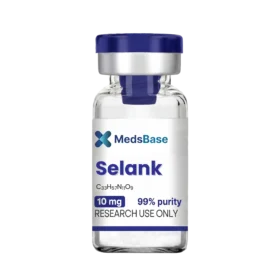
MedsBase stocks Selank in two lyophilized vial sizes calibrated to typical research protocol lengths. Each strength is available in 10-vial, 20-vial, or 30-vial pack formats with full reconstitution guidance:
| Vulsterkte | Typisch Onderzoeksgebruik | Verpakkingsgroottes |
|---|---|---|
| 5 mg | Korte onderzoeksprotocollen, pilotdosering, intranasale-voertuigformuleringsstudies | 10, 20 of 30 vialen |
| 10 mg | Standaard onderzoekssterkte, uitgebreide protocollen, laagste kosten per mg | 10, 20 of 30 vialen |
Beide sterktes hebben dezelfde chemische vorm (lyofiliseerbaar poeder, 99%+ HPLC zuiverheid). Vials met hogere mg vereisen kleinere reconsitutievolumes per eenheidsdosis, wat nuttig is wanneer onderzoekers het injectie- of intranasaaltoedieningsvolume in knaagdierprotocollen willen minimaliseren.
Hoe het zich verhoudt — Selank versus Semax
Selank en Semax zijn zusterpeptiden die ontwikkeld zijn in hetzelfde Russische laboratorium (Institute of Molecular Genetics, Russian Academy of Sciences) en vaak in onderzoek worden vergeleken omdat ze een heptapeptide-structuur, intranasale biologische beschikbaarheid en een Russische regelgevingsgeschiedenis delen, maar aanzienlijk verschillen in primaire farmacologische werking. Selank is de klassieke anxiolyticum van het duo; Semax is het klassieke nootropicum/neuroprotectivum.
| Criterium | Selank | Semax |
|---|---|---|
| Lengte | 7 aminozuren (heptapeptide) | 7 aminozuren (heptapeptide) |
| Ouderpeptide | Tuftsin (TKPR) | ACTH(4-10) fragment |
| Primair werkingsmechanisme | GABA-modulatie, BDNF, enkefaline | BDNF, melanocortine receptoren, dopamine |
| Primair onderzoekssignaal | Anxiolyticum, stressbestendigheid | Nootropicum, neuroprotectief, focus |
| Typische onderzoeksdosis (intranasaal) | 300–900 mcg/dag | 200–1.000 mcg/dag |
| Russisch klinisch gebruik | Goedgekeurd anxiolyticum (intranasaal) | Goedgekeurd nootropicum / herstel na beroerte (intranasaal) |
| Stacking in onderzoek | Vaak gecombineerd met Semax voor complementair anxiolytisch+nootroop effect | Vaak gecombineerd met Selank |
Omdat de twee peptiden werken op complementaire assen — Selank op GABA/anxiolytisch, Semax op melanocortine/dopaminergisch/nootroop — worden ze vaak samen toegediend in onderzoeksprotocollen die cognitieve prestaties onder stress onderzoeken, waarbij beide componenten (kalmte en focus) bijdragen aan het bestudeerde fenotype.
Opslag en Reconstituering
Voor reconstituering: Bewaar lyofiliseerde flesjes gekoeld bij 2–8 °C in de originele verpakking voor kortdurende werkvoorraad. Voor ongeopende langdurige opslag, vries in bij −20 °C. Lyofiliseerde Selank is stabiel onder koeling tot 24 maanden en bij −20 °C tot 36 maanden. Vermijd vries-ontdooicycli van het lyofiliseerde poeder.
Reconstitueringsprocedure: injecteer bacteriostatisch water langs de zijkant van het peptideflesje (niet rechtstreeks op het lyofilisaat). Voor een flesje van 5 mg levert 1,0 mL bacteriostatisch water een werkconcentratie van 5 mg/mL op; 0,1 mL levert een onderzoeksdosis van 500 mcg. Draai voorzichtig — doe niet Schud — en laat 2–5 minuten staan voor volledige oplossing. Een correct gereconstitueerde oplossing moet helder en kleurloos zijn. Voor intranasale-voertuig onderzoeksformuleringen kan de gereconstitueerde oplossing worden overgebracht naar een gekalibreerde neussprayfles die ~100 μL per pomp afgeeft.
Na reconstitutie: Bewaar gekoeld bij 2–8 °C en gebruik binnen 30 dagen voor optimale stabiliteit. Vries de gereconstitueerde oplossing niet in — vries-ontdooicycli tasten de peptide-integriteit aan. Gooi elk flesje weg dat troebelheid, neerslag of verkleuring vertoont.
Veelgestelde vragen
Waar wordt Selank voor gebruikt in onderzoek?
Selank wordt gebruikt in laboratoriumonderzoek naar anxiolytische farmacologie, stressbestendigheid, BDNF en neuroplasticiteit, cognitieve prestaties, immunomodulatie en directe vergelijking met benzodiazepinen. Het is het meest geciteerde Russische anxiolytische peptide in de literatuur. De onderzoekskwaliteit Selank die hier wordt verkocht is niet FDA-goedgekeurd en wordt strikt geleverd voor laboratoriumonderzoek alleen.
Hoe verschilt Selank van Semax?
Beide zijn 7-aminozuur heptapeptiden uit hetzelfde Russische laboratorium en delen intranasale biologische beschikbaarheid, maar hun werkingsmechanismen verschillen. Selank is afgeleid van het immunomodulerende peptide tuftsin en werkt voornamelijk via GABAerge, enkefalinerge en BDNF-signaalroutes — het klassieke onderzoeksdoel: anxiolyse. Semax is afgeleid van ACTH(4-10) en werkt via melanocortinereceptoren, BDNF en dopaminerge modulatie — het klassieke onderzoeksdoel: nootropisch en neuroprotectief. De twee worden vaak gecombineerd gebruikt in onderzoek omdat hun effecten complementair zijn in plaats van overlappend.
Wat is de gebruikelijke onderzoeksdosis van Selank?
Gepubliceerde Russische protocollen gebruiken doorgaans 300–900 mcg per dag intranasaal toegediend in 3 verdeelde doses, of equivalente subcutane doses. Een flesje van 5 mg gereconstitueerd met 1,0 mL bacteriostatisch water geeft een concentratie van 5 mg/mL — 0,1 mL komt overeen met 500 mcg, een typische onderzoeksdosis per toediening.
Is Selank goedgekeurd door de FDA?
Nee. Selank is niet goedgekeurd door de FDA, EMA, MHRA of enige andere grote westerse regelgevende instantie. Het is in Rusland goedgekeurd als een anxiolyticum op recept onder de merknaam Selank (intranasale spray, ZAO Pharm-Sintez). Alle Selank die door leveranciers voor onderzoeksgebruik buiten Rusland wordt verkocht, is bedoeld voor laboratoriumonderzoek en mag niet aan mensen worden toegediend.
Hoe moet Selank worden bewaard?
Gevriesdroogde flesjes: gekoeld bewaren bij 2–8 °C voor kortdurende werkvoorraad, of bij −20 °C voor langdurige opslag van ongeopende flesjes. Gereconstitueerde oplossing: gekoeld bewaren bij 2–8 °C, binnen 30 dagen gebruiken. Bevries de gereconstitueerde oplossing niet — vries-ontdooicycli degraderen het peptide. Bescherm te allen tijde tegen direct licht.
Hoe reconstitueer ik Selank?
Volg de hierboven beschreven reconstitutieprocedure. Voeg bacteriostatisch water toe langs de zijkant van het flesje (niet rechtstreeks op het gevriesdroogde poeder), draai voorzichtig en laat 2–5 minuten staan voor volledige oplossing. Schud niet Schud het flesje. Een correct gereconstitueerde oplossing is helder en kleurloos. Voor een flesje van 5 mg + 1,0 mL oplosmiddel is de werkconcentratie 5 mg/mL.
Welke sterktes heeft MedsBase op voorraad?
MedsBase carries Selank in 5 mg and 10 mg lyophilized vials. Each strength is available in 10-vial, 20-vial, or 30-vial pack sizes. All vials are supplied at 99%+ HPLC purity with a certificate of analysis available on request.
Kan Selank intranasaal worden toegediend in onderzoek?
Ja — intranasale toediening is de primaire onderzoeksroute in Russische en Oost-Europese gepubliceerde studies. Selank is een van de weinige peptiden met gedocumenteerde intranasale biologische beschikbaarheid, toe te schrijven aan zijn kleine omvang (7 aa, ~752 Da) en geamidiseerde C-terminus. Deze route omzeilt first-pass metabolisme en brengt het peptide binnen enkele minuten na toediening via de cribriformplaat naar centrale compartimenten. Subcutane en intramusculaire routes werken ook in preklinische modellen.
Kunnen Selank en Semax gecombineerd worden in onderzoek?
Ja. Selank en Semax worden vaak gecombineerd toegediend in gepubliceerd onderzoek omdat hun mechanismen complementair zijn. Selank biedt anxiolytische en stressbuffereffecten via GABA/enkefaline/BDNF-signaalroutes; Semax biedt nootropische en neuroprotectieve effecten via melanocortine/dopaminerge/BDNF-signaalroutes. De combinatie wordt vooral bestudeerd in onderzoeksmodellen van cognitieve prestaties onder stress.
Veroorzaakt Selank bijwerkingen in onderzoek?
Gepubliceerd preklinisch en Russisch klinisch onderzoek heeft een opmerkelijk veilig profiel gerapporteerd bij typische onderzoeksdoseringen, zonder consistente sedatie, effecten op motorische coördinatie, verslavingspotentieel of rebound na staken — in duidelijke tegenstelling tot benzodiazepine-vergelijkingsarmen. Langetermijnveiligheidsgegevens buiten Rusland zijn beperkt omdat het peptide geen westelijke regelgevende beoordeling heeft ondergaan.
Wat is de halfwaardetijd van Selank?
In preklinisch onderzoek heeft Selank een geschatte plasmahalfwaardetijd van ongeveer 15–30 minuten na intranasale toediening, aanzienlijk langer dan het oorspronkelijke peptide tuftsin (minder dan 5 minuten). De korte plasmahalfwaardetijd wordt gecompenseerd door accumulatie in het centrale compartiment na intranasale toediening en downstream-effecten op BDNF en genexpressie die aanhouden na klaring uit het plasma.
Hoe lang duurt het voordat Selank effecten laat zien in preklinisch onderzoek?
Acute anxiolytische effecten in elevated-plus-maze en open-field tests zijn detecteerbaar binnen 30–60 minuten na intranasale toediening. BDNF- en genexpressie-effecten accumuleren over 7–14 dagen van regelmatige dosering en vormen de basis voor het langetermijn stemmingsmodulerende en nootropische fenotype dat wordt waargenomen in chronische-stress onderzoeksmodellen.
Kan ik Selank bestellen voor internationale verzending?
Ja. MedsBase verzendt Selank wereldwijd vanuit ons toegewijde peptide-verzendnetwerk. Bestellingen met alleen peptides komen in aanmerking voor onze standalone peptide-verzendservice. Alle bestellingen worden verzonden in temperatuurgecontroleerde verpakkingen met volledige tracking en zijn gedekt door onze Reshipment Assurance-beleid.
Andere peptides voor nootropisch, neuroprotectief en cognitief onderzoek
- Semax — Zusterheptapeptide uit hetzelfde Russische laboratorium — nootropisch en neuroprotectief onderzoek
- Epitalon — AEDG-pineale tetrapeptide — onderzoek naar levensduur en circadiaan ritme
- BPC-157 — Body Protection Compound — onderzoek naar genezing en weefselherstel
- KPV — Klein immunomodulerend tripeptide — onderzoek naar ontsteking en barrièrefunctie
- Adamax — Heptapeptide nootropisch onderzoeksmiddel
Verder lezen
📖 Verken onderzoek naar kleine peptide nootropica
Bekijk het volledige onderzoekspeptiden catalogus, met verwante verbindingen inclusief Semax voor nootropisch onderzoek van de melanocortine-as, Epitalon voor pineal-peptide levensduuronderzoek, en Adamax voor cognitief onderzoek van zusterheptapeptide.
Meer opties in Peptiden
Gerangschikt op recente bestelvolumes van MedsBase — wat andere klanten in deze categorie kiezen.
| Sterkte | 5 mg, 10 mg |
|---|---|
| Hoeveelheid | 10 flacons, 20 flacons, 30 flacons |
 Selank
Vragen & antwoorden
Selank
Gerelateerde producten
Beoordelingen
Er zijn nog geen beoordelingen