







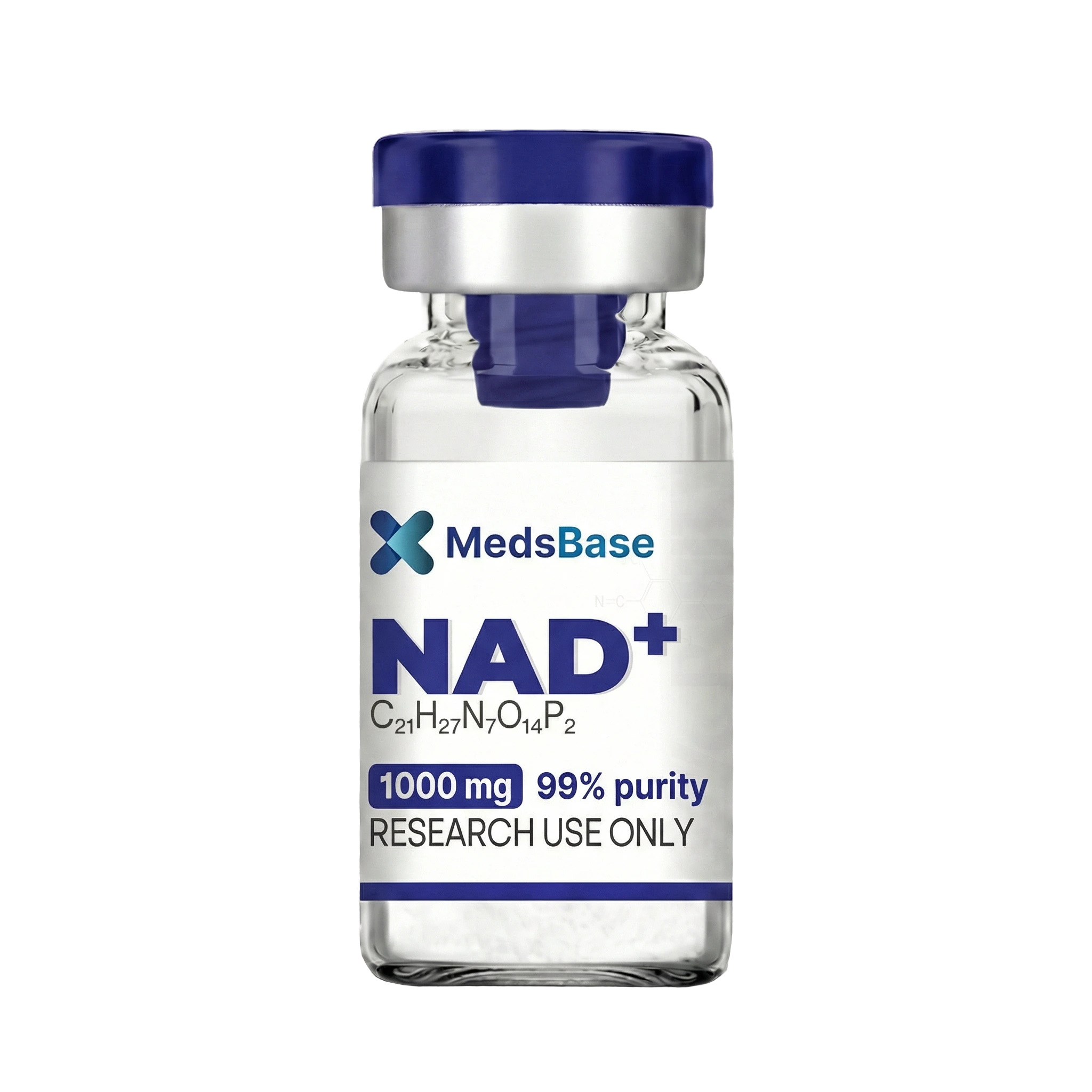
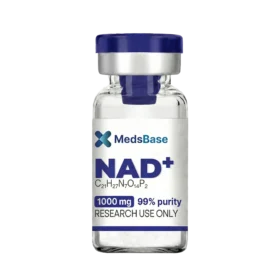
NAD⁺
✅ Verbetert de cellulaire energie
✅ Ondersteunt mitochondriale functie
✅ Bevordert metabole balans
✅ Stimuleert cellulair herstel
✅ Verbeterd vitaliteitsprocessen
NAD⁺ bevat synthetisch peptideverbinding.
✓ Medisch beoordeeld door Morgan Ellis — Apotheekonderzoeker · 8 jaar ervaring · Laatst beoordeeld: mei 2026
Kort antwoord — Wat is NAD+?
NAD+ (nicotinamide adenine dinucleotide) is een fundamenteel co-enzym dat in elke cel aanwezig is, centraal in energiemetabolisme, sirtuin-gerelateerde verouderingsprocessen en PARP-gemedieerd DNA-herstel. Cellulaire NAD+-niveaus nemen aanzienlijk af met de leeftijd, waardoor het een van de meest bestudeerde moleculen in verouderingsonderzoek is. Leverbaar in lyofiliseerde vialen van 100 mg tot 1000 mg uitsluitend voor laboratoriumonderzoek.
📦 Elke bestelling is gedekt door onze Reshipment Assurance-beleid — als uw pakket niet binnen 20 werkdagen arriveert, sturen wij het opnieuw.
| Specificatie | Detail |
|---|---|
| CAS-nummer | 53-84-9 |
| Molecuulformule | C21H27N7O14P2 |
| Moleculair gewicht | 663,43 Da |
| Sequentie | n.v.t. (dinucleotide co-enzym — geen peptide) |
| Form | Lyofiliseerd poeder (of zoals geleverd) |
| Zuiverheid | ≥99% (HPLC geverifieerd, COA op aanvraag) |
| Opslag | Gevriesdroogd: 2–8 °C (koelkast) voor werkvoorraad; −20 °C voor langdurige opslag van ongeopende flesjes. Na reconstitutie: 2–8 °C, binnen ~30 dagen gebruiken. Beschermen tegen licht — NAD+ oxideert gemakkelijk. Niet herhaaldelijk invriezen en ontdooien van de gereconstitueerde oplossing. |
| Oplosbaarheid | Bacteriostatisch water (aanbevolen) of steriel water voor kortere gebruiksperioden |
| Onderzoeksgebruik | Alleen voor laboratoriumonderzoek. Niet voor humaan of veterinair diagnostisch of therapeutisch gebruik. |
Wat Is NAD+?
NAD+ (nicotinamide adenine dinucleotide) is strikt genomen geen peptide — het is een dinucleotide co-enzym dat bestaat uit twee nucleotiden die via hun fosfaatgroepen zijn verbonden. Maar het is het meest onderzochte enkele molecuul in de literatuur over veroudering en cellulair verouderingsonderzoek, en wordt vaak aangeboden door peptide-onderzoeksleveranciers naast peptideverbindingen voor het gemak van onderzoekers die werken aan multifactoriële studies naar cellulair veroudering.
NAD+ komt in elke levende cel voor en fungeert als substraat voor drie belangrijke enzymfamilies: oxidoreductasen (energiemetabolisme), sirtuïnes (longevity signaling, gen silencing), en PARPs (DNA-schadereactie). De NAD+-niveaus in cellen nemen tussen de leeftijd van 30 en 70 jaar in de meeste weefsels met ongeveer 50% af — de “NAD+-afname” — en het herstellen van deze afname is een centrale hypothese in de onderzoeksgemeenschap naar veroudering (Yoshino, Baur & Imai, Cell Metab 2018).
Molecuulgewicht 663,4 Da, empirische formule C21H27N7O14P2. Geleverd als een hoogwaardig gevriesdroogd poeder voor reconstitutie met bacteriostatisch water. NAD+ is uitsluitend voor laboratoriumonderzoek en is niet bedoeld voor menselijke of veterinaire diagnostiek of therapie. Voor dieper inzicht in het mechanisme, context van verouderingsonderzoek en alternatieve precursorverbindingen (NR, NMN), zie onze volledige NAD+ onderzoeksgids.
Werkingsmechanisme — Drie essentiële pathways
NAD+ speelt een rol in de celbiologie via drie mechanistisch verschillende maar onderling afhankelijke enzymfamilies:
- Redox-co-enzym (energiemetabolisme) — NAD+ is de centrale elektronendrager in glycolyse, de citroenzuurcyclus en oxidatieve fosforylering. Elke stap die energie uit voedsel haalt, draagt uiteindelijk elektronen over aan NAD+ (waardoor NADH ontstaat), wat vervolgens de ATP-synthese in mitochondriën aandrijft. Zonder voldoende NAD+ kunnen cellen niet efficiënt energie produceren.
- Sirtuïne-activering (longevity signaling) — de zeven zoogdiersirtuïnes (SIRT1–SIRT7) zijn NAD+-afhankelijke deacetylases die genstilering, stressrespons, mitochondriale biogenese en DNA-reparatie reguleren. Wanneer NAD+-niveaus dalen, neemt de sirtuïne-activiteit af, wat een voorgesteld mechanisme is voor het verband tussen NAD+-afname en verouderingsfenotypes (Rajman, Chwalek & Sinclair, Cell Metab 2018).
- PARP-gemedieerde DNA-reparatie — de poly(ADP-ribose) polymerase (PARP)-enzymfamilie gebruikt NAD+ als substraat voor de DNA-schaderespons. Dalende NAD+-niveaus betekenen minder beschikbaar substraat voor DNA-reparatie, wat een feedbackloop creëert waarbij DNA-schade NAD+ verder uitput.
Omdat deze drie pathways samen het energiemetabolisme, genregulatie en genoomonderhoud beïnvloeden, wordt NAD+-herstel onderzocht in een ongebruikelijk breed scala aan celverouderingsonderzoekscontexten — van metabool syndroom tot neurodegeneratie tot spierfunctie.
Gepubliceerde onderzoeksapplicaties
NAD+ wordt gebruikt in laboratoriumonderzoeken die onderzoeken:
- Onderzoek naar levensduur — activering van het sirtuinpad en biomarkers voor cellulaire veroudering in verouderingsstudies bij knaagdieren (Yoshino et al., Cell Metab 2018)
- Cellulaire energie / mitochondriale functie — ATP-productie en mitochondriale biogenese in onderzoek naar cellulaire stress
- Onderzoek naar neuroprotectie — modellen van cognitieve achteruitgang en neurologische veroudering in studies bij knaagdieren
- Metabole gezondheid — insulinegevoeligheid, glucoseregulatie en onderzoek naar metabool syndroom
- Onderzoek naar DNA-reparatie — PARP-padactiviteit en genoomonderhoud in modellen van DNA-schade
- Onderzoek naar anti-veroudering — samengestelde markers voor cellulaire veroudering in meerdere weefselsystemen
- Vergelijkend onderzoek naar precursors — naast NR (nicotinamide riboside) en NMN (nicotinamide mononucleotide) precursors om het directe NAD+-effect te isoleren
Voor een bredere context over peptiden voor levensduur en cellulaire veroudering, zie peptide stacks voor metabool onderzoek en het volledige onderzoekspeptiden catalogus.
Beschikbare sterktes en concentraties
MedsBase voert NAD+ in de volgende lyofilisatievialen. Elke variant wordt geleverd in verpakkingen van 10, 20 of 30 vialen:
| Vulsterkte | Typisch gebruik | Verpakkingsgroottes |
|---|---|---|
| 100 mg | Pilotdosering of kortdurende protocollen | 10, 20 of 30 vialen |
| 500 mg | Standaard onderzoekssterkte, ondersteunt meerweekse protocollen | 10, 20 of 30 vialen |
| 1000 mg | Uitgebreid onderzoek, IV-protocollen, bulkbereiding | 10, 20 of 30 vialen |
NAD+ vereist grotere absolute doses dan de meeste peptiden (grammen in plaats van microgrammen) omdat het een co-enzym is dat werkt op cellulair niveau, geen signaalmolecuul dat op receptorconcentraties werkt. Geleverd als lyofilisaat met een HPLC-puurheid van 99%+.
Vergelijking — NAD+ vs NR vs NMN
Drie moleculen domineren het NAD+-onderzoeksveld. Elk komt in dezelfde salvage pathway terecht, maar op verschillende punten:
| Criterium | NAD+ | NR (Nicotinamide Riboside) | NMN (Nicotinamide Mononucleotide) |
|---|---|---|---|
| Rol | Eindproduct co-enzym (direct) | Precursor (oraal) | Precursor (oraal of SC) |
| Toedieningsweg | SC, IM, IV in onderzoek | Voornamelijk oraal | Oraal, SC |
| Typische onderzoeksdosis | 50–1000 mg | 250–500 mg oraal | 250–1000 mg oraal/SC |
| Regulatorische status | Alleen voor onderzoeksdoeleinden | FDA GRAS voedingssupplement | Variabel (recente FDA-actie) |
Onderzoekers kiezen meestal voor direct NAD+ in plaats van precursors wanneer ze variabele enzymatische conversiesnelheden willen omzeilen (sommige precursors zetten inefficiënt om in bepaalde weefsels) of wanneer ze een snelle stijging in het plasma nodig hebben. Precursors hebben de voorkeur bij onderzoek met langdurige orale toediening.
Opslag en Reconstituering
Voor reconstituering: Bewaar lyofiliseerde flesjes gekoeld bij 2–8 °C in de originele verpakking, stabiel tot 36 maanden. NAD+ is lichtgevoelig — houd de originele folieverpakking intact.
Reconstitueringsprocedure: Spuit bacteriostatisch water langs de zijkant van het flesje volgens het bovenstaande schema. NAD+-flesjes gebruiken grotere reconstitutievolumes dan peptideflesjes vanwege de grotere absolute dosis. Draai voorzichtig — schud niet — en laat 5–10 minuten staan voor volledige oplossing. niet schudden — en laat 5–10 minuten staan voor volledige oplossing.
Na reconstitutie: bewaar gekoeld bij 2–8 °C, beschermd tegen licht, en gebruik binnen 30 dagen. Gereconstitueerde NAD+ kan sneller afbreken dan peptiden — een verkleuring naar geel-bruin duidt op oxidatie en moet leiden tot weggooien.
Veelgestelde vragen
Waar wordt NAD+ voor gebruikt in onderzoek?
FDA-goedgekeurd voor therapeutisch gebruik en wordt hier strikt verkocht voor laboratoriumonderzoek alleen. niet Door de FDA goedgekeurd voor therapeutisch gebruik en wordt hier strikt verkocht voor laboratoriumonderzoek alleen.
Nee. NAD+ is een dinucleotide co-enzym, geen peptide. Het wordt vaak geleverd via peptide-onderzoeksleveranciers omdat onderzoekers naar veroudering het vaak gebruiken naast peptide-onderzoeksprotocollen, en beide categorieën dezelfde lyofiliseerde-poeder-met-BAC-water-reconstitutie-indeling hebben.
Nee. NAD+ is een dinucleotide co-enzym, geen peptide. Het wordt vaak geleverd via leveranciers van peptide-onderzoek omdat onderzoekers naar veroudering het veelal gebruiken naast peptide-onderzoeksprotocollen, en beide categorieën dezelfde lyofiliseerpoeder-met-BAC-water-reconstitutieformaat delen.
Wat is de gebruikelijke onderzoeksdosis voor NAD+?
Gepubliceerde preklinische protocollen variëren sterk per onderzoekscontext. Gebruikelijke bereiken: 50–100 mg SC/IM dagelijks voor levensduuronderzoek, 250–500 mg voor cellulair-energieonderzoek, en tot 1.000 mg in IV-onderzoeksprotocollen. Een flesje van 500 mg opgelost in 5,0 mL bacteriostatisch water levert 100 mg/mL op — 50 streepjes op een U-100 spuit geven 50 mg af.
Is NAD+ FDA approved?
Nee. NAD+ is geen door de FDA goedgekeurd therapeutisch middel. Het is bestudeerd in klinische contexten (inclusief IV “NAD+ therapie” wellnessklinieken) maar heeft geen FDA-goedkeuring voor een specifieke indicatie. Alle NAD+ die wordt verkocht door leveranciers voor onderzoeksdoeleinden is bedoeld voor laboratoriumonderzoek.
Hoe verschilt NAD+ van NR of NMN?
NR (nicotinamide riboside) en NMN (nicotinamide mononucleotide) zijn precursoren die cellen omzetten in NAD+ via de salvage pathway. Directe NAD+ omzeilt deze omzettingsstap. Onderzoekers kiezen voor directe NAD+ wanneer ze plasmaspiegels precies willen controleren; precursoren worden gebruikt voor onderzoek met langdurige orale dosering waarbij enzymatische omzetting acceptabel is.
Hoe moet NAD+ worden opgeslagen?
Gevriesdroogde flacons: gekoeld bewaren bij 2–8 °C in de originele verpakking, beschermd tegen licht. Houdbaar tot 36 maanden. Oplossing na reconstitutie: gekoeld bewaren bij 2–8 °C, lichtbeschermd, binnen 30 dagen gebruiken. NAD+ is gevoeliger voor licht en oxidatie dan de meeste peptiden.
Hoe reconstitueer ik NAD+?
Volg de bovenstaande reconstitutietabel. Voeg bacteriostatisch water langs de zijkant van het flesje toe, draai voorzichtig en laat 5–10 minuten staan voor volledige oplossing. NAD+ vereist grotere reconstitutievolumes dan peptiden vanwege de grotere absolute dosis. Niet niet schudden.
Kan NAD+ worden gecombineerd met peptiden in onderzoek?
Ja. NAD+ wordt vaak bestudeerd in combinatie met GHK-Cu (onderzoek naar cellulaire energie), ipamorelin (onderzoek naar de metabole as), en andere peptiden voor levensduur. Omdat NAD+ werkt op het niveau van co-enzymen in plaats van receptoren, zijn farmacologische interacties met peptiden minimaal.
Welke sterktes heeft MedsBase op voorraad?
MedsBase voert NAD+ in 100 mg, 500 mg en 1000 mg lyofiliseerde flesjes. Elke sterkte is beschikbaar in verpakkingen van 10, 20 of 30 flesjes. Alle flesjes worden geleverd met een HPLC-puurheid van 99%+ en een certificaat van analyse op verzoek.
Veroorzaakt NAD+ bijwerkingen in onderzoek?
Het meest gerapporteerde effect in onderzoek en klinisch gebruik is een “flush”-gevoel tijdens IV-toediening met snelle infusiesnelheden - vermoedelijk een tijdelijk vasculair effect. Andere ongewenste effecten lijken minimaal bij typische onderzoeksdoseringen. Omdat NAD+ een endogeen co-enzym is, zijn farmacologische zorgen over het algemeen kleiner dan voor exogene xenobiotische verbindingen.
Wat is de biologische halfwaardetijd van NAD+?
Endogeen NAD+ heeft een biologische halfwaardetijd van ongeveer 1-2 uur in de meeste celtypen, met aanzienlijke variatie per weefsel. In preklinisch IV-toedieningsonderzoek wordt exogeen NAD+ snel door weefsels opgenomen en omgezet in downstream metabolieten (NADH, NAAD, ADPR). De lyofiliseerde vorm voor laboratoriumreconstitutie wordt typisch gebruikt in acute suppletie- of celkweekonderzoeksmodellen.
Hoe verhoudt directe NAD+-suppletie zich tot NMN en NR in onderzoek?
NMN (nicotinamide-mononucleotide) en NR (nicotinamide-riboside) zijn NAD+-precursoren die intracellulair worden omgezet in NAD+. Directe NAD+-suppletie wordt bestudeerd voor onderzoeksmodellen waarbij precursorconversie beperkend kan zijn. Alle drie de benaderingen zijn actieve onderzoeksgebieden op het gebied van veroudering en bio-energetica, met verschillende biologische beschikbaarheid en metabolische conversieprofielen.
Kan ik NAD+ bestellen voor internationale verzending?
Ja. MedsBase verzendt NAD+ wereldwijd vanuit ons toegewijde peptide-verzendnetwerk. NAD+-bestellingen komen in aanmerking voor onze zelfstandige peptide-verzendservice. Bestellingen worden verzonden in temperatuurgecontroleerde, lichtbeschermde verpakkingen met volledige tracking.
Andere Peptiden voor Herstel- en Prestatieonderzoek
- BPC-157 — Body Protection Compound — onderzoek naar pees-, ligament- en darmherstel
- TB-500 — Thymosine Beta-4 fragment — onderzoek naar zacht weefsel en vasculair herstel
- Ipamorelin — Selectieve ghreline-agonist — schone GH-puls zonder cortisol/prolactine
- CJC-1295 met DAC — GHRH-analoog met verlengde halfwaardetijd
- GHK-Cu — Koperpeptide — onderzoek naar huid- en bindweefselregeneratie
Verder lezen
📖 Lees meer over het onderzoek achter dit co-enzym
Lees onze volledige evidence-based gids: NAD+ — werkingsmechanisme, onderzoek naar levensduurverlenging & de eerlijke wetenschap. Behandelt sirtuine- en PARP-biologie, de NAD+-afnamehypothese, vergelijking van precursors (NR/NMN), gepubliceerde doseringsbereiken in onderzoek, reconstitutieprotocollen en veiligheidsnotities.
Meer opties in Peptiden
Gerangschikt op recente bestelvolumes van MedsBase — wat andere klanten in deze categorie kiezen.
| Sterkte | 100 mg, 500 mg, 1000 mg |
|---|---|
| Hoeveelheid | 10 flacons, 20 flacons, 30 flacons |
 NAD⁺
NAD⁺
Vragen & antwoorden
NAD⁺
Gerelateerde producten
Beoordelingen
Er zijn nog geen beoordelingen