







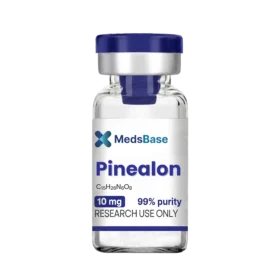
Pinealon
✅ Khavinson kort-peptide bioregulator (tripeptide EDR)
✅ Voorgestelde directe nucleaire toegang + chromatine-niveau signalering
✅ Bestudeerd in modellen van cognitieve veroudering en neuroprotectie
✅ Antioxidant + mitochondriaal-beschermend in neuronale culturen
✅ Verwant aan Epitalon (longevity peptide)
Pinealon bevat synthetisch peptideverbinding.
✓ Medisch beoordeeld door Morgan Ellis — Apotheekonderzoeker · 8 jaar ervaring · Laatst beoordeeld: mei 2026
Kort antwoord — Wat is Pinealon?
Pinealon is een synthetisch tripeptide (sequentie Glu-Asp-Arg, EDR) dat behoort tot de Khavinson kort-peptide bioregulatorenfamilie, ontwikkeld aan het St. Petersburg Instituut voor Bioregulatie en Gerontologie. Oorspronkelijk afgeleid van onderzoek naar extracten van de pijnappelklier van runderen, wordt Pinealon bestudeerd vanwege neuroprotectieve, antioxidant- en cognitieve verouderingseffecten in laboratoriummodellen — met een voorgesteld mechanisme dat directe nucleaire toegang en genexpressieregulatie op chromatineniveau omvat. Zusterpeptide van Epitalon binnen de Khavinson-serie. Leverbaar in 5 mg, 10 mg en 20 mg lyofiliseerbare flesjes voor uitsluitend laboratoriumonderzoek.
📦 Elke bestelling is gedekt door onze Reshipment Assurance-beleid — als uw pakket niet binnen 20 werkdagen arriveert, sturen wij het opnieuw.
| Specificatie | Detail |
|---|---|
| CAS-nummer | 308067-43-8 (veelgenoemd; niet alle peptideleveranciers publiceren een registratienummer) |
| Type | Synthetisch tripeptide bioregulator (Khavinson kort-peptide familie) — ontwikkeld aan het St. Petersburg Instituut voor Bioregulatie en Gerontologie door Vladimir Khavinson; oorspronkelijk gebaseerd op onderzoek naar extracten van de pijnappelklier van runderen. Pinealon is het cognitieve / neuroprotectieve lid van de Khavinson-serie, gepaard met Epitalon (longevity / telomerase) als de twee meest bestudeerde verbindingen. |
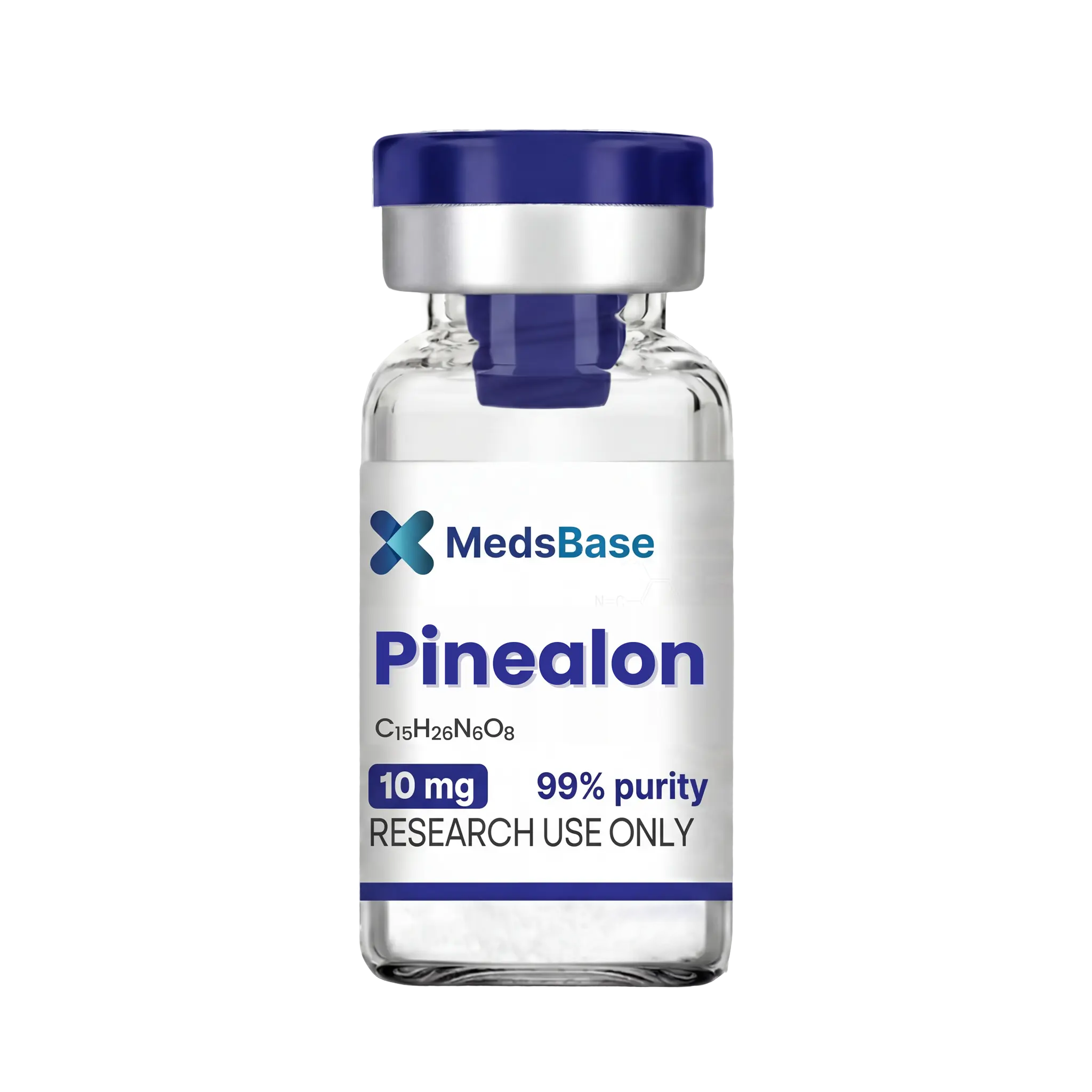
| Molecuulformule | C15H26N6O8 |
| Moleculair gewicht | ~418,4 Da |
| Sequentie | H-Glu-Asp-Arg-OH (EDR) — lineaire 3-residu sequentie. Vrije N- en C-termini; geen disulfidebrug, geen acylering, geen PEGylering. Netto lading +1 bij neutrale pH (één cationisch Arg in evenwicht met de carboxylaatgroepen van Glu/Asp). |
| Form | Lyofiliseerd poeder (wit tot off-white) |
| Zuiverheid | ≥99% (HPLC geverifieerd, COA op aanvraag) |
| Opslag | Gevriesdroogd: 2–8 °C (koelkast) voor werkvoorraad; −20 °C voor langdurige opslag van ongeopende flacons. Gereconstitueerd: 2–8 °C, binnen ~14–28 dagen gebruiken. Beschermen tegen licht. Vermijd herhaalde vries-ontdooicycli van de gereconstitueerde oplossing. |
| Oplosbaarheid | Zeer oplosbaar in bacteriostatisch water of steriel water — korte geladen tripeptiden lossen snel op bij zachtjes zwenken. Geen gespecialiseerde oplosmiddelen nodig. |
| Onderzoeksgebruik | Alleen voor laboratoriumonderzoek. Niet voor humaan of veterinair diagnostisch of therapeutisch gebruik. |
Wat Is Pinealon?
Pinealon is een synthetisch tripeptide bestaande uit L-glutaminezuur, L-asparaginezuur en L-arginine (sequentie Glu-Asp-Arg, eenlettercode EDR). Het is een lid van de Khavinson kort-peptide bioregulatorenfamilie — een groep van 2- tot 4-aminozuurpeptiden ontwikkeld aan het St. Petersburg Instituut voor Bioregulatie en Gerontologie onder Vladimir Khavinson, oorspronkelijk gebaseerd op de fractionering en karakterisering van bioactief materiaal geëxtraheerd uit de pijnappelklier en andere weefsels van runderen. Binnen de Khavinson-serie is Pinealon de verbinding die het meest geassocieerd wordt met cognitieve functie en neuroprotectie in gepubliceerd onderzoek, terwijl zijn zustertetrapeptide Epitalon (Ala-Glu-Asp-Gly, AEDG) de meest bestudeerde verbinding is in de context van longevity / telomerase.
Khavinson kort-peptiden verschillen structureel van de meeste andere onderzoekspeptiden op twee belangrijke manieren: ze zijn extreem kort (Pinealon bestaat uit slechts drie residuen, MW ~418 Da, kleiner dan een typisch kleinmoleculair geneesmiddel) en hun voorgesteld mechanisme richt zich op directe nucleaire toegang in plaats van receptorbinding aan het plasmamembraan. Het gepubliceerde Khavinson-model stelt dat korte geladen peptiden zowel het celmembraan als de nucleaire envelop kunnen passeren, chromatine kunnen bereiken en genexpressie kunnen moduleren via sequentiespecifieke interacties met DNA — een mechanisme dat verschilt van de canonieke receptor-bindende farmacologie van grotere peptiden. Dit model wordt ondersteund door gepubliceerd onderzoek van de Khavinson-groep over meerdere decennia en is het onderwerp van voortdurend mechanistisch onderzoek door onafhankelijke onderzoekers.
Pinealon is onderzocht in laboratoriumonderzoeken gericht op cognitieve veroudering, oxidatieve-stressbescherming van neuronale culturen, cerebrale ischemie-modellen en circadiane/pineale-asonderzoek. Het is niet goedgekeurd door de FDA, EMA, MHRA of enige andere grote regelgever voor humaan therapeutisch gebruik. Het onderzoeksgrade Pinealon dat hier wordt verkocht, wordt geleverd uitsluitend voor laboratoriumonderzoek en is niet bedoeld voor menselijke of veterinaire toediening.
Werkingsmechanisme — Khavinson Kort-Peptide Bioregulatie
Het gepubliceerde mechanistische model voor Khavinson korte peptiden — ondersteund door onderzoek van de Khavinson-groep en getest in onafhankelijke laboratoria — stelt drie hoofdwerkingen voor:
- Directe nucleaire toegang en DNA-bindende regulatie van genexpressie — Khavinson korte peptiden zouden volgens het model het plasmamembraan en de nucleaire envelop kunnen passeren en rechtstreeks chromatine kunnen bereiken. Het gepubliceerde model stelt dat de korte geladen sequenties (meestal combinaties van Glu/Asp/Arg/Lys residuen) sequentiespecifieke contacten kunnen aangaan met de major of minor groove van B-vorm DNA in promoterregio's, waardoor transcriptie van specifieke genpanelen wordt gemoduleerd. Pinealon (Glu-Asp-Arg) is in gepubliceerd werk gekoppeld aan upregulatie van genen betrokken bij antioxidantverdediging, mitochondriale functie en neuronale overleving.
- Antioxidante en mitochondriale beschermende effecten — In neuronale kweken en in-vivo knaagdiermodellen wordt gemeld dat toediening van Pinealon markers van reactieve zuurstofspecies (ROS) vermindert, het mitochondriale membraanpotentieel onder stress behoudt (hyperoxie, hypoxie, glutamaat-excitotoxiciteit) en apoptotische signalering vermindert. Deze effecten zijn het gevolg van genexpressiemodulatie in plaats van directe radicalenvangst.
- Neuroprotectie in cognitieve verouderingsmodellen — Gedragsstudies bij verouderde knaagdieren hebben verbeteringen in ruimtelijk leren en werkgeheugenprestaties gemeld na toediening van Pinealon in vergelijking met leeftijdsgematchte controles. Het mechanisme wordt geïnterpreteerd als een combinatie van antioxidantbescherming van kwetsbare neuronale populaties (hippocampale CA1, corticale laag V) en directe genexpressie-effecten in neuronen die de synaptische plasticiteit ondersteunen.
Khavinson-kortpeptiden hebben zeer korte plasmahalfwaardetijden (minuten), maar voorgestelde effecten houden uren tot dagen aan via downstream genexpressiecascades — een profiel dat breed vergelijkbaar is met andere receptor-geactiveerde peptiden waarbij de duur wordt bepaald door de kinetiek van de signaalcascade in plaats van door aanhoudende plasmaresidentie. Subcutane toediening is de standaardrouteroute in gepubliceerde onderzoeksprotocollen.
Gepubliceerde onderzoeksapplicaties
Pinealon wordt gebruikt in laboratoriumonderzoekcontexten die onderzoeken:
- Onderzoek naar cognitieve veroudering — ruimtelijk leren, werkgeheugen en gedragsprestaties in verouderde knaagdier modellen; de meest bestudeerde onderzoeksapplicatie voor Pinealon
- Oxidatieve stressbescherming van neuronale kweken — bescherming van corticale en hippocampale primaire kweken tegen H2O2, glutamaat-excitotoxiciteit, hyperoxie; ROS en mitochondriale membraanpotentiaalmetingen
- Cerebrale ischemie / beroerte modellen — ischemie-reperfusieletsel in knaagdier modellen van middelste cerebrale arterie-occlusie (MCAO); infarctvolume en gedragsdeficietmetingen
- Neurodegeneratieve ziekte in-vitro onderzoek — Alzheimer-type Aβ-toxiciteit en Parkinson-type α-synucleïne-toxiciteitsmodellen in gekweekte neuronen; gepubliceerd werk in PC12 en SH-SY5Y lijnen
- Hypoxie en hoogteonderzoek — cognitieve en gedragsprestaties onder hypobare / hypoxische omstandigheden
- Pineale-as en circadiane onderzoek — de historische oorsprong van pineale-klier-extracten maakt Pinealon een onderzoeksinstrument voor het bestuderen van pineale-asmodulatie van circadiane genexpressie, hoewel het meeste huidige onderzoek zich richt op neuroprotectie in plaats van circadiane ritmes per se
- Khavinson-peptide vergelijkende farmacologie — een directe vergelijking met Epitalon (AEDG, levensduur / telomerase), Vilon (KE, immuun), en Livagen (KEDA, hepatoprotectie) om de sequentiespecificiteit van korte-peptide-effecten te ontleden
Voor een bredere context over neuroactieve korte peptiden en gerelateerde onderzoeksverbindingen, zie Epitalon (verwante Khavinson-tetrapeptide), Semax (ACTH-afgeleide heptapeptide, cognitieve verbetering), Selank (tuftsine-afgeleide anxiolytische/nootropische), en DSIP (delta-slaap-inducerend peptide). Bekijk het volledige onderzoekspeptiden catalogus voor gerelateerde verbindingen.
Beschikbare sterktes en concentraties
MedsBase stocks Pinealon in three lyophilized vial sizes calibrated to typical research protocol lengths. Each strength is available in 10-vial, 20-vial, or 30-vial pack formats:
| Vulsterkte | Typisch Onderzoeksgebruik | Verpakkingsgroottes |
|---|---|---|
| 5 mg | Pilotdosering — korte cognitieve verouderingsprotocollen, dosis-respons titratie, in-vitro werkzaamheid bij oxidatieve stress | 10, 20 of 30 vialen |
| 10 mg | Standaard onderzoekssterkte — meerweekse cognitieve verouderingsstudies, MCAO-ischemiemodellen, multi-cohort protocollen | 10, 20 of 30 vialen |
| 20 mg | Protocollen voor langdurige cycli — verouderingsstudies met lange duur, gedragsonderzoeken met grote cohorten, laagste kosten per mg | 10, 20 of 30 vialen |
Alle drie de sterktes hebben dezelfde chemische vorm (gevriesdroogd poeder, ≥99% HPLC zuiverheid). Gepubliceerde onderzoeksprotocollen gebruiken een breed dosisbereik afhankelijk van het model en de toedieningsweg — typisch 100 µg–4 mg per kg lichaamsgewicht in knaagdier-modellen. Bepaal dosisbereiken uit peer-reviewed literatuur die passen bij uw specifieke protocol.
Vergelijking — Pinealon versus Epitalon
Pinealon en Epitalon zijn de twee meest bestudeerde verbindingen in de Khavinson kort-peptide familie. Beide zijn korte geladen peptiden ontwikkeld door dezelfde onderzoeksgroep en delen het voorgestelde direct-nucleaire-toegangsmechanisme, maar ze hebben volledig verschillende sequentiespecificiteit en verschillende best bestudeerde onderzoeksapplicaties.
| Criterium | Pinealon | Epitalon |
|---|---|---|
| Sequentie | Glu-Asp-Arg (EDR) | Ala-Glu-Asp-Gly (AEDG) |
| Lengte | 3 aminozuren (tripeptide) | 4 aminozuren (tetrapeptide) |
| Molecuulgewicht | ~418 Da | ~390 Da |
| Nettolading | +1 (Arg balanceert Glu/Asp) | −2 (Glu/Asp domineren; geen kationische residuen) |
| Best-studied research focus | Cognitieve veroudering, neuroprotectie, bescherming tegen oxidatieve stress van neuronale culturen | Telomerase-activering, levensduurverlenging, onderzoek naar levensverlenging |
| Tissue origin (proposed) | Fractionering van extracten uit de pijnappelklier van runderen | Fractionering van extracten uit de pijnappelklier van runderen |
| Proposed mechanism | Directe kernaccess; modulatie van antioxidant- en mitochondriale genexpressie | Directe kernaccess; voorgestelde binding aan telomerase-promotor |
| Plasma-halfwaardetijd | Minuten (effect blijft aanwezig via downstream cascades) | Minuten (effect blijft aanwezig via downstream cascades) |
Voor onderzoek gericht op neuroprotectie, modellen van cognitieve veroudering of bescherming tegen oxidatieve stress van neuronale culturen is Pinealon het meer gerichte Khavinson-peptide. Voor onderzoek gericht op telomerase-activering, omkering van replicatieve veroudering of farmacologie van de levensduuras, Epitalon blijft de meer uitgebreid bestudeerde optie. Sommige onderzoeksprotocollen gebruiken beide verbindingen parallel om de sequentiespecificiteit van Khavinson-korte-peptide-effecten te ontleden.
Opslag en Reconstituering
Voor reconstituering: bewaar lyofiliseerde flesjes gekoeld bij 2–8 °C in de originele verpakking voor kortdurende werkvoorraad. Voor langdurige opslag, vries ongeopende flesjes in bij −20 °C. Lyofiliseerde Pinealon is stabiel onder koeling tot 24 maanden en bij −20 °C tot 36 maanden. Vermijd vries-dooicycli van het lyofiliseerde poeder. Pinealon is een kort, ongemodificeerd tripeptide zonder disulfidebrug of acylketen — de hantering behoort tot de eenvoudigste in de catalogus.
Reconstitueringsprocedure: spuit bacteriostatisch water langs de zijkant van het flesje (niet direct op de lyofiliseerde cake). Voor een flesje van 10 mg levert 2,0 mL bacteriostatisch water een werkconcentratie van 5 mg/mL op; 1,0 mL levert een voorraad van 10 mg/mL. Voor een flesje van 5 mg levert 1,0 mL bacteriostatisch water een werkvoorraad van 5 mg/mL op. Voor een flesje van 20 mg levert 2,0 mL een werkvoorraad van 10 mg/mL op. Draai voorzichtig — schud niet krachtig, omdat schuimen lucht insluit en peptideketens kan verstoren. Laat het poeder volledig oplossen (meestal <1 minuut voor Pinealon) voordat u het terugtrekt. Na reconstitutie bewaart u het flesje bij 2–8 °C en gebruikt u het binnen 14–28 dagen. Bescherm tegen licht. Gooi weg als troebelheid, deeltjes of kleurverandering optreedt.
Veelgestelde vragen
Wat is de Khavinson-korte-peptidefamilie en waarom maakt Pinealon daar deel van uit?
De Khavinson-korte-peptidefamilie is een reeks van 2- tot 4-aminozuurpeptides ontwikkeld aan het St. Petersburg Institute of Bioregulation and Gerontology door Vladimir Khavinson en collega's, beginnend in de jaren 1970. Het oorspronkelijke onderzoek extraheerde bioactief materiaal uit verschillende rundweefsels (pijnappelklier, thymus, prostaat, retina, etc.) en identificeerde korte peptidefragmenten verantwoordelijk voor weefselspecifieke bioregulatoire effecten. Pinealon (Glu-Asp-Arg) is de cognitieve / neuroprotectieve verbinding in deze reeks; Epitalon (Ala-Glu-Asp-Gly) is het levensduur-/telomerase-verbinding; Vilon, Livagen, Thymogen en andere richten zich op andere weefsels.
Hoe verschilt Pinealon van Epitalon?
Beide zijn korte Khavinson-peptiden geëxtraheerd uit onderzoek naar runderpijnklieren, maar ze hebben verschillende sequenties en verschillende best bestudeerde toepassingen. Pinealon (Glu-Asp-Arg, tripeptide, +1 netto lading) wordt bestudeerd voor cognitieve veroudering en neuroprotectie. Epitalon (Ala-Glu-Asp-Gly, tetrapeptide, −2 netto lading) wordt bestudeerd voor telomerase-activering en levensduurverlenging. De tegenovergestelde netto lading is een structurele reden waarom de twee peptiden verschillende genomische loci targeten onder het voorgestelde directe-DNA-bindingsmechanisme.
Wat is het voorgestelde mechanisme van Khavinson korte peptiden?
Het gepubliceerde Khavinson-model stelt dat korte geladen peptiden het celmembraan en nucleaire envelop kunnen passeren, chromatine kunnen bereiken en genexpressie kunnen moduleren via sequentiespecifieke contacten met de DNA-dubbele helix op promoterregio's. Dit verschilt van het canonieke receptor-bindingsmechanisme van grotere peptiden. Het model wordt ondersteund door onderzoek van de Khavinson-groep over meerdere decennia en is het onderwerp van voortdurend mechanistisch onderzoek door onafhankelijke onderzoekers.
Hoe kort kan een peptide zijn en nog steeds biologisch actief?
Pinealon met 3 aminozuren behoort tot de kortste farmacologisch actieve peptiden die bekend zijn. Er bestaan nog kortere voorbeelden (het dipeptide carnosine, de GLP-1-fragmenten, dipeptide HSP-modulatoren), maar de meeste onderzoekspeptiden zijn langer (10–40+ residuen). De Khavinson korte-peptidenreeks is een specifiek onderzoeksgebied juist omdat de zeer korte sequenties snelle synthese, eenvoudige passage van cellulaire barrières en duidelijke structuur-activiteitsrelaties mogelijk maken.
Waarom is de plasma-halfwaardetijd van Pinealon zo kort?
Korte geladen peptiden worden snel geklaard door glomerulaire filtratie en proteolyse. Pinealon heeft een plasma-halfwaardetijd van slechts minuten — toch duren de voorgestelde effecten (genexpressiemodulatie, antioxidantbescherming, gedragsverbetering) uren tot dagen door downstream signaalcascades. Dit profiel is vergelijkbaar met andere receptor-geactiveerde peptiden waar de duur wordt bepaald door signaalcascadekinetiek in plaats van aanhoudende plasmaresidentie.
Wat is de typische onderzoeksdosis van Pinealon in knaagdiermodellen?
Gepubliceerde dosisbereiken in knaagdiermodellen variëren ongeveer van 100 µg–4 mg per kg lichaamsgewicht per dag, afhankelijk van de toedieningsweg (subcutaan het meest gebruikelijk), het model (cognitieve veroudering, MCAO, oxidatieve stress) en de studieduur. Subcutane toediening is de standaard onderzoeksroute. Bepaal dosisbereiken uit peer-reviewed literatuur die passen bij uw specifieke protocol.
Heeft Pinealon effecten buiten het CZS?
Pinealon is het best bestudeerd in CZS-contexten (cognitieve veroudering, neuroprotectie, cerebrale ischemie), maar het voorgestelde mechanisme — directe nucleaire toegang en genexpressiemodulatie — is in principe weefselonafhankelijk. Sommig gepubliceerd onderzoek heeft perifere effecten onderzocht (antioxidant in hepatische en renale modellen, immunomodulatie in gemengde celkweeksystemen), maar het merendeel van de literatuur richt zich op CZS-uitkomsten.
Is er vastgestelde CAS-registratienummerdocumentatie voor Pinealon?
CAS 308067-43-8 is het meest aangehaalde registratienummer in peptide-leverancierscatalogi, maar in tegenstelling tot Epitalon (waarvan een goed gedocumenteerd CAS 307297-39-8 bestaat in grote referentiedatabases), is de CAS-registratie van Pinealon minder autoritair gepubliceerd. Onderzoekers die een regelgevend gezaghebbende referentie nodig hebben, moeten deze verifiëren tegen actuele CAS Registry-bronnen.
Meer opties in Peptiden
Gerangschikt op recente bestelvolumes van MedsBase — wat andere klanten in deze categorie kiezen.
| Sterkte | 5 mg, 10 mg, 20 mg |
|---|---|
| Hoeveelheid | 10 flacons, 20 flacons, 30 flacons |
 Pinealon
Vragen & antwoorden
Pinealon
Gerelateerde producten
Beoordelingen
Er zijn nog geen beoordelingen