







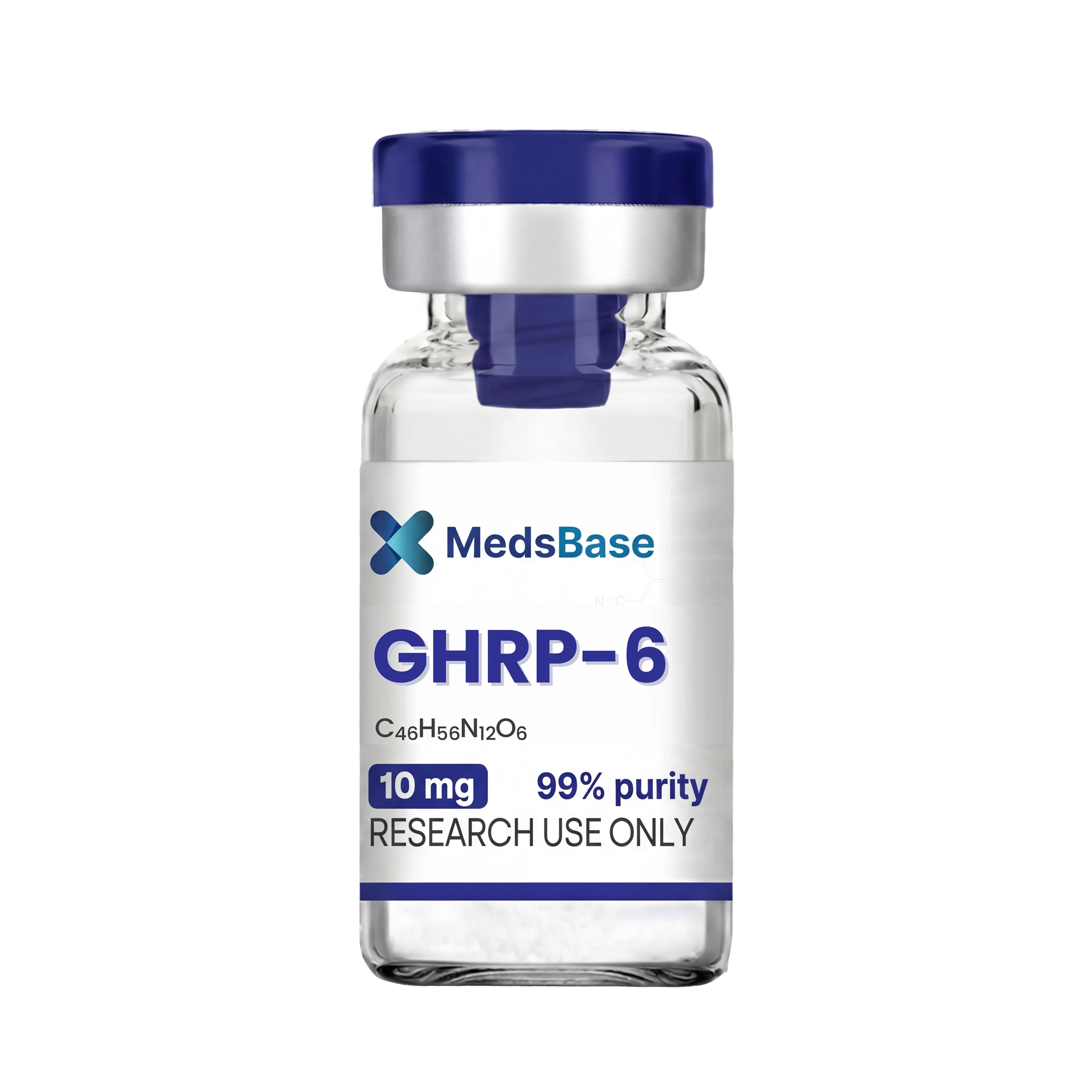
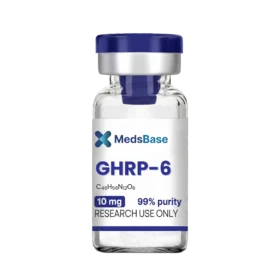
GHRP-6 Acetaat
✅ Eerste generatie GHS-hexapeptide
✅ GHS-R1a/ghreline receptoragonist
✅ Stimuleert pulsatiel GH-vrijkomen
✅ Onderzoek naar ghreline-as en eetlust
✅ Synergistisch met GHRH-analogen
GHRP-6 Acetaat bevat synthetisch peptideverbinding.
✓ Medisch beoordeeld door Morgan Ellis — Apotheekonderzoeker · 8 jaar ervaring · Laatst beoordeeld: mei 2026
Snelle vraag — Wat is GHRP-6 Acetaat?
GHRP-6 Acetaat (Growth Hormone Releasing Peptide 6) is een synthetisch hexapeptide met 6 aminozuren en een van de oorspronkelijke groeihormoonsecretagogen, ontwikkeld door Bowers en collega's als het tweede generatielid van de GHRP-serie. Het werkt in op de groeihormoonsecretagoogreceptor (GHS-R1a) — dezelfde receptor als endogene ghreline — wat leidt tot pulsatiel GH-vrijkomen samen met eetluststimulatie. Leverbaar in 5 mg en 10 mg lyofiliseerbare flesjes uitsluitend voor laboratoriumonderzoek.
📦 Elke bestelling is gedekt door onze Reshipment Assurance-beleid — als uw pakket niet binnen 20 werkdagen arriveert, sturen wij het opnieuw.
| Specificatie | Detail |
|---|---|
| CAS-nummer | 87616-84-0 (GHRP-6 vrije base); geleverd als acetaatzoutvorm |
| Molecuulformule | C46H56N12O6 (vrije base; acetaatzout voegt CH3COOH tegenion toe) |
| Moleculair gewicht | 873,02 Da (vrije base) |
| Sequentie | His-D-Trp-Ala-Trp-D-Phe-Lys-NH2 (HwAWfK-NH2, 6 aminozuren; bevat D-Trp op positie 2 en D-Phe op positie 5 voor proteolytische stabiliteit; C-terminaal geamideerd) |
| Form | Gevriesdroogd acetaatzout (wit tot off-white poeder) |
| Zuiverheid | ≥99% (HPLC geverifieerd, COA op aanvraag) |
| Opslag | Lyofiliseerd: 2–8 °C (koelkast) voor werkvoorraad; −20 °C voor langdurige opslag van ongeopende flesjes. Gereconstitueerd: 2–8 °C, gebruik binnen ~30 dagen. Bescherm tegen licht. Vries de gereconstitueerde oplossing niet in en ontdooi deze niet. |
| Oplosbaarheid | Bacteriostatisch water (aanbevolen) of steriel water voor kortere gebruiksperioden |
| Onderzoeksgebruik | Alleen voor laboratoriumonderzoek. Niet voor humaan of veterinair diagnostisch of therapeutisch gebruik. |
Wat Is GHRP-6 Acetaat?
GHRP-6 (Growth Hormone Releasing Peptide 6) is een synthetisch hexapeptide van 6 aminozuren en een van de klassieke leden van de growth hormone secretagogue (GHS) peptideklasse. Het werd ontwikkeld door Cyril Y. Bowers en collega's aan de Tulane University als onderdeel van een structuur-activiteitsrelatieprogramma gericht op het identificeren van kleine peptiden die in staat zijn pulsatiel groeihormoon vrij te geven uit de hypofysevoorkwab — werk dat uiteindelijk leidde tot de ontdekking van de groeihormoon secretagogue receptor en, indirect, tot de identificatie van endogene ghreline als zijn natuurlijke ligand in 1999 door Kojima et al. (Nature). Het acetaat-tegenion wordt gebruikt in onderzoeksgrade lyofilisatie omdat het de langetermijnstabiliteit en wateroplosbaarheid van het peptide verbetert zonder de farmacologie te veranderen.
De goed gekarakteriseerde sequentie is HwAWfK-NH2 (waarbij kleine letters D-aminozuurresten aangeven), molecuulgewicht 873,02 Da, empirische formule C46H56N12O6. De twee D-aminozuursubstituties (D-Trp op positie 2 en D-Phe op positie 5) verlenen resistentie tegen endogene proteasen en verlengen de in-vivo halfwaardetijd in vergelijking met alle-L-analogen. De C-terminus is geamideerd, wat essentieel is voor receptoractiviteit. GHRP-6 is niet goedgekeurd door de FDA, EMA, MHRA of enige andere grote regelgever voor humaan therapeutisch gebruik. Het onderzoeksgrade GHRP-6 acetaat dat hier wordt verkocht, wordt geleverd uitsluitend voor laboratoriumonderzoek en is niet bedoeld voor menselijke of veterinaire toediening. Voor het nieuwere generatie receptor-selectieve analoog zonder cortisol/prolactine signalering, zie onze Ipamorelin productpagina.
Werkingsmechanisme — GHS-R1a Receptor Agonisme en de GH Puls
Wat GHRP-6 mechanistisch onderscheidend maakt onder groeias-onderzoekspeptiden is zijn selectieve werking op de groeihormoon secretagogue receptor — dezelfde receptor die wordt geactiveerd door endogene ghreline — in plaats van de GHRH-receptor die wordt gebruikt door sermoreline en CJC-1295. Het downstream-effect is een pulsatiel in plaats van een tonisch patroon van GH-vrijgave in gepubliceerd onderzoek:
- GHS-R1a-receptoragonisme op somatotrofen — GHRP-6 bindt aan de groeihormoonsecretagereceptor type 1a (GHS-R1a, ook wel ghreline-receptor genoemd) op somatotrofen in de hypofysevoorkwab. Receptoractivatie koppelt aan Gαq/11 en fosfolipase C, wat intracellulair calcium verhoogt en depolarisatie-gekoppelde exocytose van GH-bevattende vesikels triggert. Het signaal wordt versterkt door onderdrukking van somatostatine-tonus — GHRP-6 werkt zowel op somatotrofen als op hypothalamische somatostatine-neuronen, wat een grotere GH-puls produceert dan directe stimulatie van somatotrofen alleen zou voorspellen.
- Synergie met endogene GHRH — De GHS-R- en GHRH-R-signaalwegen convergeren intracellulair maar gebruiken verschillende tweede-boodschappersystemen (PLC/IP3/Ca2+ vs adenylaatcyclase/cAMP/PKA), waardoor GHRP-6 en GHRH-analogen additieve of synergetische GH-afgifte produceren wanneer gecombineerd. Dit is de reden voor de klassieke “GHRP + GHRH-analoog” onderzoekscombinaties: een GHS zoals GHRP-6 gepaard met een GHRH-analoog zoals Sermorelin of CJC-1295 met DAC. De gecombineerde stimulus produceert GH-pulsen die aanzienlijk groter zijn dan elk afzonderlijk middel.
- Off-target eetluststimulatie en bescheiden cortisol/prolactinesignaal — Omdat GHRP-6 werkt op de ghreline-receptor, erft het ghrelines eetluststimulerende effect — nuttig in cachexie-onderzoek, maar een verstorende factor in zuiverdere GH-as-farmacologie. GHRP-6 veroorzaakt ook een bescheiden toename in cortisol- en prolactinesecretie. De nieuwere generatie selectieve analoog Ipamorelin werd specifiek ontworpen om dit cortisol/prolactinesignaal te elimineren terwijl het GH-effect behouden blijft — zie de vergelijkingssectie hieronder.
GHRP-6 heeft een plasmahalfwaardetijd van ongeveer 30–60 minuten, aanzienlijk langer dan natuurlijke ghreline (~10–30 minuten) vanwege de D-aminozuursubstituties die proteolytische splitsing weerstaan. Subcutane toediening is de meest geciteerde onderzoeksroute in de gepubliceerde literatuur; intraveneuze en intranasale routes zijn ook gedocumenteerd in werkingsmechanisme-studies.
Gepubliceerde onderzoeksapplicaties
GHRP-6 wordt gebruikt in laboratoriumonderzoekcontexten die onderzoeken:
- Farmacologie van de groeihormoonas — pulsatiele GH-dynamiek, somatotrofe responsiviteit, vergelijkend GH-secretagoogonderzoek; benchmark eerste generatie GHS in gepubliceerde GH-pulsarchitectuurstudies (Bowers et al., J Clin Endocrinol Metab; Smith et al., Science 1996)
- Onderzoek naar eetlust en voedingsgedrag — activering van de ghreline-as, voedselinname-assays in knaagdier-modellen, cachexie-modellen bij tumor-dragende dieren; canoniek onderzoeksinstrument voor het scheiden van ghreline-gemedieerde orexigene signalering van andere eetlustwegen
- Onderzoek naar hypofyse-functie — GH-reservetesten in preklinische modellen, somatotrofe hypertrofie/hyperplasie, mechanisme-van-actie-onderzoek voor nieuwe GH-secretagogen
- Onderzoek naar cachexie en wasting-syndroom — cachexie bij tumor-dragende knaagdieren, COPD-gerelateerde wasting-modellen, behoud van vetvrije massa/vetmassa door gecombineerde activering van GH-as en eetlustas
- Vergelijkend GHS-onderzoek — head-to-head benchmarking tegen nieuwere analogen inclusief Ipamorelin (receptor-selectief zonder cortisol/prolactine), hexarelin (gemodificeerde GHRP-6), GHRP-2 (alternatief eerste-generatie analoog), en oraal actieve kleine-molecuul GHS zoals MK-677
- Cardiovasculair onderzoek — GHS-R-expressie op cardiomyocyten; gepubliceerd onderzoek naar cardiale ischemie-reperfusieletsels en hartfunctie in GH-deficiënte modellen
- Gecombineerd GHRP + GHRH-onderzoek — synergetische GH-afgifteprotocollen die GHRP-6 combineren met GHRH-analogen zoals Sermorelin of CJC-1295 met DAC voor maximale pulserende GH-onderzoeksstimulus.
Voor een bredere context over waar GHRP-6 past binnen het groeias-peptidelandschap, zie Ipamorelin als de nieuwere generatie receptor-selectieve analoog, CJC-1295 met DAC voor langwerkend GHRH-as-onderzoek, en Sermorelin voor onderzoek met kortwerkende GHRH. Bekijk het volledige onderzoekspeptiden catalogus voor gerelateerde verbindingen.
Beschikbare sterktes en concentraties
MedsBase stocks GHRP-6 Acetate in two lyophilized vial sizes calibrated to typical research protocol lengths. Each strength is available in 10-vial, 20-vial, or 30-vial pack formats with full reconstitution guidance:
| Vulsterkte | Typisch Onderzoeksgebruik | Verpakkingsgroottes |
|---|---|---|
| 5 mg | Standaard onderzoekssterkte — kortdurende GH-pulsprotocollen, enkelvoudige cohortstudies | 10, 20 of 30 vialen |
| 10 mg | Langdurige protocollen, multi-cohortstudies, laagste kosten per mg | 10, 20 of 30 vialen |
Beide sterktes zijn dezelfde chemische vorm (lyofiliseerd acetaatzoutpoeder, 99%+ HPLC zuiverheid). Vials met hogere mg vereisen kleinere reconstitutievolumes per eenheidsdosis, wat nuttig is wanneer onderzoekers injectievolume willen minimaliseren in knaagdierprotocollen. Omdat GHRP-6 doseringsbereiken in het 50–300 mcg per toedieningsregime liggen, ondersteunt een enkele 5 mg vial vele weken onderzoek bij typische doseringen.
Vergelijking — GHRP-6 vs Ipamorelin
GHRP-6 en Ipamorelin zijn respectievelijk de klassieke eerste- en derdegeneratieleden van de groeihormoonsecretagoogpeptideklasse, en zijn de meest aangehaalde directe vergelijking in gepubliceerd GHS-onderzoek. Ze delen dezelfde receptor (GHS-R1a) en produceren vergelijkbare GH-pulsen, maar verschillen aanzienlijk in receptorselectiviteit en off-target signalering.
| Criterium | GHRP-6 | Ipamorelin |
|---|---|---|
| Lengte | 6 aminozuren (hexapeptide) | 5 aminozuren (pentapeptide) |
| Generatie | Eerste generatie GHS (~1984) | Derde generatie GHS (~1998) |
| Receptor | GHS-R1a (ghreline receptor) | GHS-R1a (ghreline receptor) |
| GH-puls | Sterke pulsatiele GH-afgifte | Sterke pulsatiele GH-afgifte (vergelijkbaar met GHRP-6) |
| Eetlustsignaal | Ja (ghreline-achtig orexigene effect) | Minimaal of afwezig in gepubliceerd onderzoek |
| Cortisol/prolactine | Bescheiden verhogingen (relevant als onderzoeksverstorende factor) | Geen meetbare toename — het belangrijkste selectiviteitsvoordeel |
| Typische onderzoeksdosis | 50–300 mcg, 1–3x daags | 100–300 mcg, 1–3x per dag |
| Plasma-halfwaardetijd | ~30–60 min | ~2 uur |
Voor onderzoek waarbij het eetluststimulerende signaal een kenmerk is (cachexiamodellen, voedselinnameonderzoeken), wordt GHRP-6 de voorkeur gegeven omdat het orexigene effect onderdeel is van het onderzoeksdoel. Voor zuivere GH-as farmacologie waarbij cortisol en prolactine verstorende variabelen zijn, wordt Ipamorelin de voorkeur gegeven omdat de receptorselectiviteitswinst deze off-target signalen elimineert. Beide worden vaak gecombineerd met een GHRH-analoog (zoals CJC-1295 met DAC) voor het canonieke synergetische GH-puls onderzoeksprotocol.
Opslag en Reconstituering
Voor reconstituering: spuit bacteriostatisch water langs de zijkant van het peptideflesje (niet direct op de lyofiliseerde cake). Voor een 5 mg flesje levert 2,0 mL bacteriostatisch water een werkconcentratie van 2,5 mg/mL op — 0,04 mL levert een onderzoeksdosis van 100 mcg; 0,1 mL levert 250 mcg. Draai voorzichtig — doe.
Reconstitueringsprocedure: spuit bacteriostatisch water langs de zijkant van het peptideflesje (niet rechtstreeks op de gevriesdroogde cake). Voor een flesje van 5 mg levert 2,0 mL bacteriostatisch water een werkconcentratie van 2,5 mg/mL op — 0,04 mL levert een onderzoeksdosis van 100 mcg; 0,1 mL levert 250 mcg. Draai voorzichtig — doe niet Schud — en laat 2–5 minuten staan voor volledige oplossing. Een correct gereconstitueerde oplossing moet helder en kleurloos zijn.
Na reconstitutie: Bewaar gekoeld bij 2–8 °C en gebruik binnen 30 dagen voor optimale stabiliteit. Vries de gereconstitueerde oplossing niet in — vries-ontdooicycli tasten de peptide-integriteit aan. Gooi elk flesje weg dat troebelheid, neerslag of verkleuring vertoont.
Veelgestelde vragen
Waar wordt GHRP-6 voor gebruikt in onderzoek?
GHRP-6 wordt gebruikt in laboratoriumonderzoek naar de groeihormoonas, dynamiek van pulsatiele GH-afgifte, responsiviteit van somatotrofen, farmacologie van de ghreline-as, eetlust en voedingsgedrag, cachexie en uitputtingssyndromen, en gecombineerde GHRP + GHRH-synergistische GH-afgifteprotocollen. Het is het klassieke eerstegeneratie-GHS-onderzoekspeptide en het structurele model waarop Ipamorelin en andere latere generatie-analogen zijn gebaseerd. Het hier verkochte onderzoekskwaliteit-GHRP-6 is niet FDA-goedgekeurd en wordt strikt geleverd voor laboratoriumonderzoek alleen.
Hoe verschilt GHRP-6 van Ipamorelin?
Beide werken in op dezelfde receptor (GHS-R1a, de ghreline-receptor) en produceren een vergelijkbare pulserende GH-afgifte, maar ze verschillen aanzienlijk in receptorselectiviteit en off-target signalering. GHRP-6 veroorzaakt ghreline-achtige eetluststimulatie en bescheiden verhogingen van cortisol en prolactine. Ipamorelin is specifiek ontworpen om deze off-target signalen te elimineren terwijl het GH-effect behouden blijft — het produceert minimale eetlustsignalen en geen meetbare toename van cortisol of prolactine in gepubliceerd onderzoek. Voor zuivere GH-as farmacologie heeft Ipamorelin de voorkeur; voor onderzoek waarbij eetlust een doelwit is, blijft GHRP-6 nuttig.
Wat is het verschil tussen GHRP-6 en GHRP-2?
Beide zijn eerstegeneratie hexapeptide groeihormoon secretagogen uit het onderzoeksprogramma van het Bowers laboratorium. GHRP-2 is per mg enigszins krachtiger en geeft iets minder eetlustsignaal dan GHRP-6, maar de kwalitatieve farmacologie is vergelijkbaar - beide verhogen cortisol en prolactine in bescheiden mate. GHRP-6 is van de twee het meest uitgebreid bestudeerd in gepubliceerd onderzoek en blijft het canonieke eerstegeneratie referentiecompound.
Wat is de gebruikelijke onderzoeksdosis voor GHRP-6?
In gepubliceerde preklinische protocollen wordt doorgaans 50–300 mcg per toediening gebruikt, subcutaan toegediend 1–3 keer per dag voor onderzoekscycli van 2–12 weken. Een flesje van 5 mg, gereconstitueerd met 2,0 mL bacteriostatisch water, levert 2,5 mg/mL — 0,04 mL komt overeen met 100 mcg, 0,1 mL komt overeen met 250 mcg.
Is GHRP-6 FDA approved?
Nee. GHRP-6 is niet goedgekeurd door de FDA, EMA, MHRA of enige andere grote regelgevende instantie voor menselijk therapeutisch gebruik. Alle GHRP-6 die wordt verkocht door leveranciers voor onderzoeksdoeleinden is uitsluitend bedoeld voor laboratoriumonderzoek en mag niet aan mensen worden toegediend.
Hoe moet GHRP-6 Acetaat worden opgeslagen?
Gevriesdroogde flesjes: gekoeld bewaren bij 2–8 °C voor kortdurende werkvoorraad, of bij −20 °C voor langdurige opslag van ongeopende flesjes. Gereconstitueerde oplossing: gekoeld bewaren bij 2–8 °C, binnen 30 dagen gebruiken. Bevries de gereconstitueerde oplossing niet — vries-ontdooicycli degraderen het peptide. Bescherm te allen tijde tegen direct licht.
Hoe moet ik GHRP-6 reconstitueren?
Volg de hierboven beschreven reconstitutieprocedure. Voeg bacteriostatisch water toe langs de zijkant van het flesje (niet rechtstreeks op het gevriesdroogde poeder), draai voorzichtig en laat 2–5 minuten staan voor volledige oplossing. Schud niet Schud het flesje. Een correct gereconstitueerde oplossing is helder en kleurloos. Voor een flesje van 5 mg + 2,0 mL verdunningsmiddel is de werkconcentratie 2,5 mg/mL.
Welke sterktes heeft MedsBase op voorraad?
MedsBase carries GHRP-6 Acetate in 5 mg and 10 mg lyophilized vials. Each strength is available in 10-vial, 20-vial, or 30-vial pack sizes. All vials are supplied at 99%+ HPLC purity with a certificate of analysis available on request.
Waarom stimuleert GHRP-6 ook de eetlust?
GHRP-6 bindt zich aan de groeihormoon secretagoog receptor (GHS-R1a) — dezelfde receptor die wordt geactiveerd door endogene ghreline. Omdat ghreline het belangrijkste hongerhormoon is, erft elke agonist van zijn receptor een zekere mate van orexigene (eetluststimulerende) activiteit. Voor eerste generatie GHS zoals GHRP-6 en GHRP-2 is het eetlusteffect aanzienlijk; voor latere generatie receptor-selectieve analogen zoals Ipamorelin werd het orexigene signaal succesvol verminderd door structurele optimalisatie.
Kan GHRP-6 worden gecombineerd met een GHRH-analoog in onderzoek?
Ja — dit is het standaard synergetische GH-puls onderzoeksprotocol. GHRP-6 activeert GHS-R1a (PLC/IP3/Ca2+ Veroorzaakt GHRP-6 bijwerkingen in onderzoek? Sermorelin of CJC-1295 met DAC activeer GHRH-R (adenylyl cyclase/cAMP/PKA-signalering). De twee routes komen samen op somatotrofen maar gebruiken verschillende second messenger-systemen, wat een additieve of synergetische GH-afgifte oplevert wanneer ze gecombineerd worden.
Wat is de halfwaardetijd van GHRP-6?
In preklinisch onderzoek heeft GHRP-6 een plasmahalfwaardetijd van ongeveer 30–60 minuten na subcutane toediening. De verlengde halfwaardetijd in vergelijking met endogene ghreline (~10–30 min) is te wijten aan de twee D-aminozuursubstituties (D-Trp op positie 2 en D-Phe op positie 5) die resistent zijn tegen proteolytische splitsing. De GH-puls duurt langer dan de plasmaclearance omdat desensibilisatie van somatotrofen en receptor-downregulatie langzamere processen zijn.
Wat is de halfwaardetijd van GHRP-6?
In preklinisch onderzoek heeft GHRP-6 een plasmahalfwaardetijd van ongeveer 30–60 minuten na subcutane toediening. De verlengde halfwaardetijd in vergelijking met endogene ghreline (~10–30 min) is te wijten aan de twee D-aminozuur substituties (D-Trp op positie 2 en D-Phe op positie 5) die resistent zijn tegen proteolytische splitsing. De GH-puls duurt langer dan de plasmaclearing omdat desensibilisatie van somatotrofen en receptor-downregulatie langzamere processen zijn.
Hoe lang duurt het voordat GHRP-6 effecten laat zien in preklinisch onderzoek?
Acute GH-pulsen zijn detecteerbaar binnen 15–30 minuten na subcutane toediening en bereiken hun piek binnen 60–90 minuten. De eetluststimulerende effecten op voedselinname zijn meetbaar binnen enkele uren na toediening in rodentmodellen. Downstream-effecten op IGF-1-productie en weefselniveau GH-as-signalering accumuleren over 1–4 weken van regelmatige dosering.
Kan ik GHRP-6 bestellen voor internationale verzending?
Ja. MedsBase verzendt GHRP-6 wereldwijd vanuit ons toegewijde peptide-verzendnetwerk. Bestellingen met alleen peptides komen in aanmerking voor onze standalone peptide-verzendservice. Alle bestellingen worden verzonden in temperatuurgecontroleerde verpakkingen met volledige tracking en zijn gedekt door onze Reshipment Assurance-beleid.
Andere peptides voor groei-as, GH-afgifte en anabool onderzoek
- Ipamorelin — Derdegeneratie selectief GHS-pentapeptide — schone GH-puls zonder cortisol/prolactine
- CJC-1295 met DAC — Langwerkend GHRH-analoog — canoniek GHRH-as-onderzoekscompound
- Sermorelin — Korter werkend GHRH(1-29) analoog — natuurlijk GH-puls onderzoek
- IGF-1 LR3 — Lang-arginine recombinant IGF-1-analoog — downstream van GH/IGF-as
- Tesamorelin — GHRH-analoog — onderzoek naar visceraal vetweefsel
Verder lezen
📖 Verken het GH-as-peptidelandschap
Bekijk het volledige onderzoekspeptiden catalogus, met gerelateerde GH-as-compounds inclusief Ipamorelin voor schoon receptor-selectief GHS-onderzoek, CJC-1295 met DAC voor langwerkend GHRH onderzoek, en Sermorelin voor onderzoek naar natuurlijke GHRH-pulsen.
Meer opties in Peptiden
Gerangschikt op recente bestelvolumes van MedsBase — wat andere klanten in deze categorie kiezen.
| Sterkte | 5 mg, 10 mg |
|---|---|
| Hoeveelheid | 10 flacons, 20 flacons, 30 flacons |
 GHRP-6 Acetaat
Vragen & antwoorden
GHRP-6 Acetaat
Gerelateerde producten
Beoordelingen
Er zijn nog geen beoordelingen