







LL-37 (Cathelicidine Antimicrobieel Peptide)
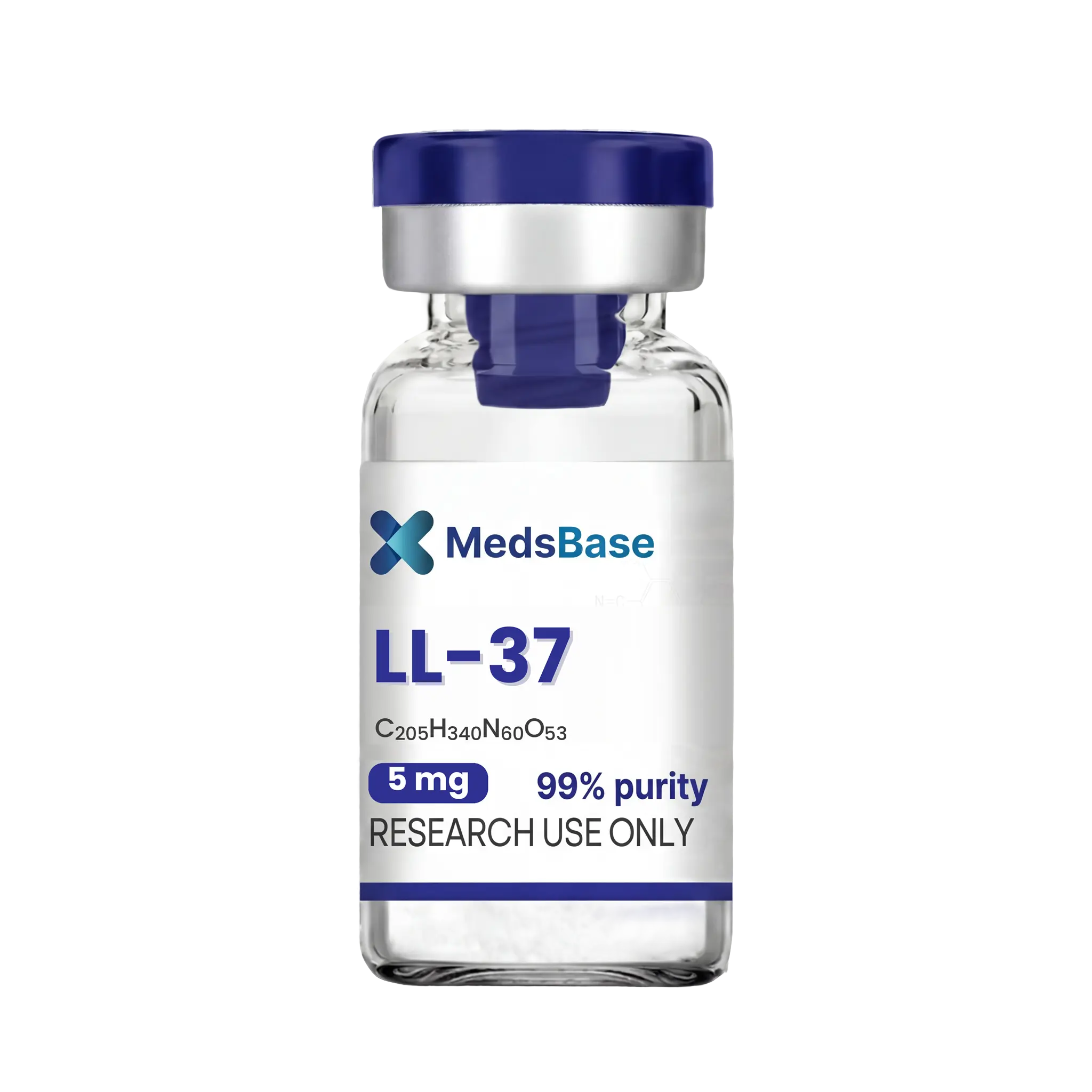
✅ Enkel menselijk cathelicidine antimicrobieel peptide (37 aa)
✅ Amfipathische α-helix; +6 nettolading
✅ Breedspectrum: Gram+, Gram−, omhulde virussen, biofilms
✅ Immunomodulerend via FPRL1 + LPS-neutralisatie
✅ Onderzocht bij antimicrobiële resistentie, wondgenezing, psoriasis, oncologie
LL-37 bevat synthetisch peptideverbinding.
✓ Medisch beoordeeld door Morgan Ellis — Apotheekonderzoeker · 8 jaar ervaring · Laatst beoordeeld: mei 2026
Kort antwoord — Wat is LL-37?
LL-37 (ook wel Cathelicidin Antimicrobial Peptide, CAP-18 of FALL-39 genoemd) is een 37-aminozuur amphipathisch α-helix host-defense peptide — het enige menselijke cathelicidine. Het wordt vrijgegeven door proteïnase-3 splitsing van de inactieve pro-vorm (hCAP-18) en combineert directe breedspectrum antimicrobiële activiteit (tegen bacteriën, schimmels, omhulde virussen en biofilms) met krachtige immunomodulerende effecten: LPS-neutralisatie, chemotaxis van neutrofielen/monocyten/T-cellen, antibiofilmwerking en pro-angiogene wondgenezing signalering. LL-37 wordt onderzocht op het gebied van antimicrobiële resistentie, wondgenezing, atherosclerose, psoriasis pathogenese en oncologie. Leverbaar in 5 mg lyofiliseerde flesjes, uitsluitend voor laboratoriumonderzoek.
📦 Elke bestelling is gedekt door onze Reshipment Assurance-beleid — als uw pakket niet binnen 20 werkdagen arriveert, sturen wij het opnieuw.
| Specificatie | Detail |
|---|---|
| CAS-nummer | 154947-66-7 (LL-37 vrije base) |
| Type | 37-aminozuur amphipathisch α-helix cationisch antimicrobieel host-defense peptide; het enige menselijke cathelicidine (CAMP-genproduct); actief C-terminaal peptide vrijgegeven door proteïnase-3 splitsing van de inactieve pro-vorm hCAP-18; ook wel CAP-18 (C-terminaal Cathelicidin Antimicrobial Peptide van 18 kDa pro-vorm) en FALL-39 (met inbegrip van het N-terminale F-residu uit eerdere sequencing) genoemd |
| Molecuulformule | C205H340N60O53 |
| Moleculair gewicht | ~4,493.3 Da |
| Sequentie | H-Leu-Leu-Gly-Asp-Phe-Phe-Arg-Lys-Ser-Lys-Glu-Lys-Ile-Gly-Lys-Glu-Phe-Lys-Arg-Ile-Val-Gln-Arg-Ile-Lys-Asp-Phe-Leu-Arg-Asn-Leu-Val-Pro-Arg-Thr-Glu-Ser-OH (LLGDFFRKSKEKIGKEFKRIVQRIKDFLRNLVPRTES) — lineair 37-residu cationisch peptide; +6 netto lading bij neutrale pH; vouwt zich in een amphipathische α-helix in lipide/membraan omgevingen. Vrije N- en C-termini; geen disulfidebrug, geen acylering, geen PEGylering. |
| Form | Lyofiliseerd poeder (wit tot off-white) |
| Zuiverheid | ≥99% (HPLC geverifieerd, COA op aanvraag) |
| Opslag | Lyofiliseerd: 2–8 °C (koelkast) voor kortetermijn werkvoorraad; −20 °C voor langdurige opslag van ongeopende flesjes. Gereconstitueerd: 2–8 °C, gebruik binnen ~14–28 dagen. Bescherm tegen licht. Vermijd herhaalde vries-ontdooicycli. Cationische AMP's kunnen aan plastic oppervlakken adsorberen — laagbindende buisjes (gesiliconiseerd of Protein LoBind) worden aanbevolen voor voorraadopslag en verdunning. |
| Oplosbaarheid | Hoog oplosbaar in bacteriostatisch water, steriel water of verdund (0,01–0,1%) azijnzuur. Reconstitueer bij zure tot neutrale pH; vermijd hoogzout of sterk basische buffers voor voorraadoplossingen. De amphipathische α-helix kan bij hoge concentratie aggregeren — bereid werkverdunningen direct voor gebruik. |
| Onderzoeksgebruik | Alleen voor laboratoriumonderzoek. Niet voor humaan of veterinair diagnostisch of therapeutisch gebruik. |
Wat is LL-37?
LL-37 is het actieve C-terminale 37-aminozuurpeptide dat vrijkomt door proteolytische splitsing van het humane cathelicidine antimicrobiële peptide hCAP-18 — het enige cathelicidine-genproduct bij mensen, gecodeerd door het CAMP gen op chromosoom 3. Het peptide ontleent zijn naam aan zijn eerste twee residuen (Leu-Leu) en zijn lengte (37 residuen). Het behoort tot de cathelicidinefamilie van aangeboren-immuniteit gastheer-verdedigingspeptiden die in de meeste gewervelde lijnen voorkomen en vertegenwoordigt het centrale effectormolecuul in de humane cathelicidine-tak van aangeboren immuniteit, naast de defensinefamilie.
De inactieve hCAP-18 pro-vorm wordt geproduceerd in neutrofiele granulen, in epitheeloppervlakken (huidkeratinocyten, respiratoir en darmepitheel), en in lagere hoeveelheden door macrofagen, NK-cellen, mestcellen, B-cellen en γδ T-cellen. Activatie vindt plaats door proteïnase-3 splitsing (in neutrofielen) of door kallikreïne-5/kallikreïne-7 (in de huid), waarbij het bioactieve 37-mer vrijkomt dat een sterk amfipathische α-helicale conformatie aanneemt in membraan-mimetische omgevingen. Het peptide draagt een +6 netto positieve lading bij neutrale pH, met cationische lysine- en arginineresiduen geconcentreerd op één zijde van de helix en hydrofobe leucine-, fenylalanine-, isoleucine- en valineresiduen op de tegenoverliggende zijde — de canonieke “amfipathische α-helix” architectuur die selectieve interactie met negatief geladen microbiële membranen mogelijk maakt.
LL-37 combineert twee verschillende gastheer-verdedigingsmodaliteiten in een enkel peptide. Zijn directe antimicrobiële activiteit omvat Gram-positieve bacteriën (inclusief methicilline-resistente S. aureus, MRSA), Gram-negatieve bacteriën (inclusief E. coli, K. pneumoniae, P. aeruginosa), omhulde virussen (HSV-1, influenza, RSV), schimmels (Candida), en microbiële biofilms. De immunomodulerende activiteit omvat binding en neutralisatie van bacterieel lipopolysaccharide (LPS) en lipoteichoïnezuur, chemotaxis van neutrofielen / monocyten / T-cellen / mestcellen via formylpeptide receptor like-1 (FPRL1/FPR2), modulatie van TLR-signalering, onderdrukking van LPS-geïnduceerde cytokinestormen, inductie van angiogenese via FPRL1-signalering op endotheelcellen, en stimulatie van keratinocytmigratie bij wondherstel. Dysregulatie van LL-37 is betrokken bij de pathogenese van psoriasis (waar excessieve LL-37 complexen vormt met zelf-DNA om plasmoctoïde dendritische cellen te activeren), atherosclerose en bepaalde kankers. LL-37 is niet goedgekeurd door de FDA, EMA, MHRA of enige andere grote regelgever goedgekeurd voor humaan therapeutisch gebruik. De onderzoekskwaliteit LL-37 die hier wordt verkocht, wordt geleverd uitsluitend voor laboratoriumonderzoek en is niet bedoeld voor menselijke of veterinaire toediening.
Werkingsmechanisme — Membraanverstoring + Immunomodulatie
LL-37 werkt via drie hoofdmechanismen die in gepubliceerd onderzoek zijn gedocumenteerd:
- Selectieve verstoring van microbiële membranen via insertie van amfipathische α-helix — In bulkwaterige oplossing is LL-37 grotendeels ongestructureerd, maar bij contact met een negatief geladen microbiële membraan (rijk aan fosfatidylglycerol, cardiolipine, lipoteichoïnezuur of LPS) vouwt het snel in een amfipathische α-helix. Het kationische oppervlak bindt aan het anionische membraanoppervlak; het hydrofobe oppervlak dringt de lipidelaag binnen. Bij drempelwaardeverhoudingen van peptide tot lipide leidt dit tot de vorming van toroïdale poriën of “tapijt”-achtige membraandesintegratie, wat de microbiële cel depolariseert en essentiële transmembraangradiënten verstoort. Zoogdiermembranen worden beschermd door hun zwitterionische buitenlaag (fosfatidylcholine, sfingomyeline) en de aanwezigheid van cholesterol — wat een zekere mate van microbiële selectiviteit biedt die AMP's onderscheidt van breed cytotoxische detergentia.
- LPS-neutralisatie en TLR4-signaleringsmodulatie — LL-37 bindt direct met hoge affiniteit aan bacterieel lipopolysaccharide (LPS) en isoleert het van het TLR4 / MD-2 / CD14-receptorcomplex. Dit blokkeert LPS-gestuurde NF-κB-activering, vermindert de afgifte van downstream TNF-α / IL-6 / IL-1β en beschermt gastweefsel tegen sepsis-achtige cytokinestormen tijdens ernstige Gram-negatieve infecties. Dezelfde eigenschap maakt LL-37 tot een onderzoeksinstrument voor het ontrafelen van LPS-gestuurde signalering.
- Immunomodulatie via FPRL1 (formylpeptide receptor-like 1) en downstream-signalering — LL-37 werkt als een chemoattractant voor neutrofielen, monocyten en T-cellen door binding aan FPRL1 (FPR2), een G-proteïnegekoppelde receptor die breed wordt uitgedrukt op effectorcellen van het aangeboren immuunsysteem. Dezelfde receptor op endotheelcellen bemiddelt het pro-angiogene effect van LL-37 — het stimuleert proliferatie, migratie en buisvorming van endotheelcellen. Keratinocytmigratie tijdens wondre-epithelialisatie is ook FPRL1-afhankelijk. Het peptide engageert bovendien purinerge P2X7-receptoren op macrofagen, wat bijdraagt aan inflammasoommodulatie.
Een kenmerkend aspect van de biologie van LL-37 is de “zwaard versus schild” balans: bij lage concentraties is het peptide voornamelijk immunomodulerend en weefselbeschermend, terwijl bij hoge lokale concentraties de directe membraanverstorende activiteit domineert. Deze concentratieafhankelijke functionele omschakeling is een van de redenen waarom LL-37 therapeutisch onderzoeksinteresse heeft voor zowel antimicrobiële als wondgenezingstoepassingen, en waarom gedetailleerde dosis-responskarakterisering cruciaal is in elk in-vitro of in-vivo protocol.
Gepubliceerde onderzoeksapplicaties
LL-37 wordt gebruikt in laboratoriumonderzoeken die zich richten op:
- Onderzoek naar antimicrobiële resistentie — breedspectrum minimale remmende concentratie (MIC) panels tegen MRSA, ESBL-producerende Enterobacteriaceae, carbapenem-resistente stammen en biofilm-geassocieerde pathogenen; benchmarking van de AMP-ontwikkelingspijplijn
- Biofilmonderzoek — biofilmpreventie-assays, gevestigde biofilmverstoringsassays tegen P. aeruginosa, S. aureus, en K. pneumoniae — belangrijk in onderzoek naar cystische fibrose en chronische wonden
- LPS / sepsisonderzoek — LPS-neutralisatie-assays, TLR4-signaleringsanalyse, modellen van cytokinestorm bij septische shock
- Wondgenezing en huidonderzoek — keratinocytmigratie-assays, modellen voor wondsluiting door dermale fibroblasten en endotheel; een van de belangrijkste onderzoekspeptiden in onderzoek naar cutane wondgenezing
- Onderzoek naar de pathogenese van psoriasis — analyse van de LL-37 / zelf-DNA / plasmacytoïde dendritische cel-as (LL-37 is overgeëxpresseerd in psoriatische huid en vormt complexen met zelf-DNA om tolerantie te doorbreken via TLR9 in pDC's)
- Onderzoek naar atherosclerose — LL-37 in plaque macrofagen, interactie met geoxideerd LDL, modellen van vasculaire ontsteking
- Oncologisch onderzoek — paradoxale pro- en anti-tumoreffecten afhankelijk van het tumortype (LL-37 is pro-proliferatief in sommige kankers via FPRL1, anti-tumor in andere door directe membraanverstoring van tumorcellen)
- Mechanistisch onderzoek naar aangeboren immuniteit — FPRL1-signalering, P2X7-modulatie, biologie van neutrofiele extracellulaire vallen (NET), vitamine-D-gemedieerde CAMP-inductie
Voor een bredere context over onderzoek naar aangeboren immuniteit en host-defense peptiden, zie KPV (α-MSH-afgeleid anti-inflammatoir tripeptide), BPC-157 (multi-pathway weefselherstel pentadecapeptide), en TB-500 (Thymosine Beta-4 fragment, breed weefselherstel). Bekijk het volledige onderzoekspeptiden catalogus voor gerelateerde verbindingen.
Beschikbare sterktes en concentraties
MedsBase stocks LL-37 in 5 mg lyophilized vials. Available in 10-vial, 20-vial, or 30-vial pack formats with full reconstitution guidance:
| Vulsterkte | Typisch Onderzoeksgebruik | Verpakkingsgroottes |
|---|---|---|
| 5 mg | Standaard onderzoekssterkte — multi-week MIC-panels, biofilm-assays, wondgenezingsexperimenten, LPS-neutralisatie-assays, immunomodulatie dosis-responsonderzoek | 10, 20 of 30 vialen |
LL-37 wordt geleverd als de ongemodificeerde lineaire 37-mer vrije-zuurvorm (geen acylering, geen PEGylering, geen disulfidebrug). Het peptide is gevoelig voor adsorptie aan plastic — onderzoekers dienen low-binding buizen te gebruiken voor voorraadopslag en verdunning. Werkconcentraties in gepubliceerde assays variëren van ~0,5 µg/mL in chemotaxis-assays tot ~50 µg/mL in directe antimicrobiële dodingsassays.
Hoe het zich verhoudt — LL-37 vs KPV
LL-37 en KPV worden beide gebruikt in onderzoek naar aangeboren immuniteit, maar werken op volledig verschillende schalen en richten zich op verschillende mechanismen. LL-37 is een volledig 37-residu host-defense peptide dat directe antimicrobiële membraanverstoring combineert met FPRL1-gemedieerde immunomodulatie. KPV (Lysine-Proline-Valine) is een 3-residu C-terminaal fragment van α-melanocytenstimulerend hormoon (α-MSH) dat fungeert als een gericht ontstekingsremmend en bescheiden antimicrobieel peptide via melanocortine-receptor pathway modulatie.
| Criterium | LL-37 | KPV |
|---|---|---|
| Oorsprong | C-terminus van humaan cathelicidine hCAP-18 (CAMP-gen) | C-terminus van α-melanocytenstimulerend hormoon (α-MSH) |
| Lengte | 37 aminozuren | 3 aminozuren |
| Primair werkingsmechanisme | Amfipathische α-helicale membraanverstoring + FPRL1 immunomodulatie | Melanocortine-pathway-gemoduleerde ontstekingsremmende signalering (NF-κB suppressie) |
| Antimicrobieel spectrum | Breed — Gram+, Gram−, omhulde virussen, schimmels, biofilms | Smal — voornamelijk Gram+; zwakker dan LL-37 met ordes van grootte |
| Ontstekingsremmend | Sterk (LPS-neutralisatie, cytokinemodulatie) | Sterk (canoniek ontstekingsremmend onderzoektripeptide) |
| Nettolading | +6 (sterk kationisch) | +1 |
| Structuur in membraan | Amfipatische α-helix | Geen gedefinieerde secundaire structuur (kort lineair motief) |
| Best bestudeerde indicatie | Antimicrobiële resistentie, wondgenezing, psoriasis | IBD/colitis-modellen, darmontsteking, atopische dermatitis |
Voor onderzoek gericht op breedspectrum antimicrobiële activiteit, biofilmverstoring of membraanporiemechanismen is LL-37 het canonieke referentiepeptide. Voor onderzoek gericht op anti-inflammatoire signalering via het melanocortinepad op cellulair niveau, KPV is het selectievere hulpmiddel. Zie ook BPC-157 voor onderzoek gericht op weefselherstel met anti-inflammatoire werking en TB-500 voor brede benchmarking van weefselherstel.
Opslag en Reconstituering
Voor reconstituering: bewaar gevriesdroogde flesjes gekoeld bij 2–8 °C in de originele verpakking voor kortdurende werkvoorraad. Voor langdurige opslag, vries ongeopende flesjes in bij −20 °C. Gefriesdroogd LL-37 is stabiel onder koeling tot 24 maanden en bij −20 °C tot 36 maanden. Vermijd vries-ontdooicycli van het gevriesdroogde poeder. Zoals alle kationische AMP's, is LL-37 gevoelig voor adsorptie aan plastic — zelfs kleine verliezen aan standaard polypropyleen buisjes kunnen dosis-responsdata beïnvloeden. Gebruik low-binding buisjes (gesiliconiseerd glas, Protein LoBind, of met runderserumalbumine voorbehandeld polypropyleen) voor voorraadopslag en seriële verdunningen in assaybuffers met laag eiwitgehalte.
Reconstitueringsprocedure: Spuit bacteriostatisch water langs de zijkant van het flesje (niet direct op de gevriesdroogde cake). Voor een flesje van 5 mg geeft 1,0 mL bacteriostatisch water een werkconcentratie van 5 mg/mL; 2,0 mL geeft een werkvoorraad van 2,5 mg/mL. Draai voorzichtig — niet krachtig vortexen, omdat schuimvorming lucht insluit en de helixvouwing kan verstoren. Laat het poeder volledig oplossen (meestal 1-2 minuten) voordat u het opzuigt. Voor toepassingen die gevoelig zijn voor bacteriostatische middelen (celkweekexperimenten), reconstitueer in steriel water of 0,01% azijnzuur. Na reconstitutie bewaart u het flesje bij 2-8 °C en gebruikt u het binnen 14-28 dagen. Bescherm tegen licht. Gooi weg als troebelheid, deeltjes of kleurverandering optreden.
Veelgestelde vragen
Is LL-37 hetzelfde als cathelicidine?
LL-37 is het actieve C-terminale 37-aminozuurpeptide dat vrijkomt uit humaan cathelicidine (de inactieve pro-vorm hCAP-18, gecodeerd door het CAMP-gen). Cathelicidine is de familienaam en verwijst naar vele gewervelde soorten; LL-37 is de specifieke naam van het actieve humane cathelicidinepeptide. Andere namen die u in de literatuur kunt tegenkomen — CAP-18 en FALL-39 — verwijzen naar hetzelfde molecuul volgens verschillende historische naamgevingsconventies.
Hoe verschilt LL-37 van defensines?
LL-37 en de defensines (α- en β-defensines) zijn de twee belangrijkste families van zoogdierantimicrobiële peptiden. Defensines zijn kleiner, cysteinerijk en nemen β-sheet-structuren aan die gestabiliseerd worden door 3 disulfidebindingen. LL-37 is een langer lineair cationisch peptide dat een amfipathische α-helix aanneemt in membraanomgevingen — zonder disulfidebrug. Beide klassen hebben brede antimicrobiële activiteit en immunomodulerende rollen, maar werken via structureel verschillende mechanismen.
Wat is de typische effectieve concentratie van LL-37 in antimicrobiële assays?
Gepubliceerde minimale remmende concentraties (MIC's) voor LL-37 tegen gevoelige Gram-positieve en Gram-negatieve pathogenen variëren over het algemeen van 1 tot 32 µg/mL, afhankelijk van de stam, de ionsterkte van de assaybuffer en het biofilm versus planktonische formaat. Hogere concentraties (50–100 µg/mL) worden vaak gebruikt voor directe membraanverstoringsstudies en biofilm-uitroeiingsassays. Immunomodulerende uitlezingen (chemotaxis, LPS-neutralisatie, keratinocytmigratie) gebruiken meestal veel lagere concentraties (0,5–10 µg/mL). Bepaal dosisbereiken uit peer-reviewed literatuur die geschikt zijn voor uw specifieke protocol.
Waarom is plasticadsorptie belangrijk voor LL-37?
Cationische AMP's zoals LL-37 kunnen aanzienlijk adsorberen aan standaard polypropyleen en polystyreen labware-oppervlakken, vooral in eiwitarme buffers. Verliezen van 30–80% bij een enkele buisoverdracht zijn gedocumenteerd in de literatuur voor cationische peptiden bij lage concentraties. Dit kan leiden tot een systematische onderschatting van de activiteit, vooral in verdunningsreeksen voor MIC-bepaling. Gebruik laagbindende buizen, pre-coat buizen met BSA, of voeg dragerproteïne toe aan verdunningsbuffers, afhankelijk van de assay-uitlezing.
Hoe onderscheidt LL-37 microbiële van zoogdiermembranen?
De selectiviteit ontstaat door de membraansamenstelling. Microbiële membranen (met name de buitenmembranen van Gram-negatieve bacteriën en de cytoplasmatische membranen van Gram-positieve bacteriën) zijn rijk aan negatief geladen lipiden (fosfatidylglycerol, cardiolipine, LPS, lipoteichoïnezuur). Cytoplasmatische membranen van zoogdieren hebben een zwitterionische buitenlaag (fosfatidylcholine, sfingomyeline) en een hoog cholesterolgehalte dat de dubbele laag stabiliseert. Het kationische oppervlak van LL-37 bindt bij voorkeur aan het negatief geladen microbiële oppervlak; het door cholesterol gestabiliseerde zoogdiermembraan is veel minder vatbaar voor insertie. De selectiviteit is concentratieafhankelijk — bij zeer hoge lokale concentraties kan LL-37 ook cytotoxisch worden voor zoogdiercellen.
Wat is het “zwaard versus schild”-model van LL-37-functie?
Het model beschrijft de concentratieafhankelijke functionele omschakeling van LL-37: bij lage concentraties (20 µg/mL) domineert de directe membraanverstorende antimicrobiële activiteit. Deze duale aard onderbouwt de diverse rollen van LL-37 in de gastheerafweer en is een van de redenen waarom zorgvuldige dosis-responskarakterisering essentieel is in elke in-vitro of in-vivo onderzoekscontext.
Wat is het verband tussen LL-37 en psoriasis?
LL-37 is sterk overgeëxpresseerd in psoriatische huidlaesies en bindt sterk aan zelf-DNA en zelf-RNA dat vrijkomt uit beschadigde keratinocyten. Deze LL-37 / zelf-nucleïnezuurcomplexen activeren plasmacytoïde dendritische cellen via TLR9 (DNA) en TLR7 (RNA), wat leidt tot de IFN-α-rijke auto-immuunachtige ontsteking die kenmerkend is voor psoriasis. Het targeten van de LL-37 / pDC / TLR-as is een actief onderzoeksgebied in de psoriasis-farmacologie.
Waarom zijn sommige kankerstudies pro-tumor terwijl andere anti-tumor zijn?
LL-37 heeft gedocumenteerde contextafhankelijke effecten op kanker. Bij sommige tumortypes (eierstok-, borst-, long-, colorectale kanker) correleert verhoogde LL-37-expressie met een slechtere uitkomst — waarschijnlijk door FPRL1-gemedieerde pro-proliferatieve en pro-angiogene signalering. Bij andere (maagkanker, melanoom in sommige modellen) heeft LL-37 een direct membraanverstorend cytotoxisch effect op tumorcellen met zwakkere anti-tumoractiviteit. Het netto-effect hangt af van het tumortype, de lokale concentratie, FPRL1-expressie en de samenstelling van de tumor-micro-omgeving.
Meer opties in Peptiden
Gerangschikt op recente bestelvolumes van MedsBase — wat andere klanten in deze categorie kiezen.
| Sterkte | 5 mg |
|---|---|
| Hoeveelheid | 10 flacons, 20 flacons, 30 flacons |
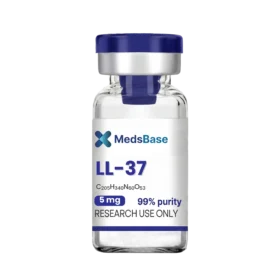 LL-37 (Cathelicidine Antimicrobieel Peptide)
Vragen & antwoorden
LL-37 (Cathelicidine Antimicrobieel Peptide)
Gerelateerde producten
Beoordelingen
Er zijn nog geen beoordelingen