







PT-141
✅ Verhoogt seksueel verlangen en opwinding
✅ Ondersteunt signalering in het centrale zenuwstelsel
✅ Bevordert seksuele motivatie en responsiviteit
✅ Versterkt neurotransmitteractiviteit gerelateerd aan stemming
✅ Verbetert het algehele seksuele welzijn
PT‑141 bevat een synthetische peptideverbinding.
✓ Medisch beoordeeld door Morgan Ellis — Apotheekonderzoeker · 8 jaar ervaring · Laatst beoordeeld: mei 2026
Kort antwoord — Wat is PT-141?
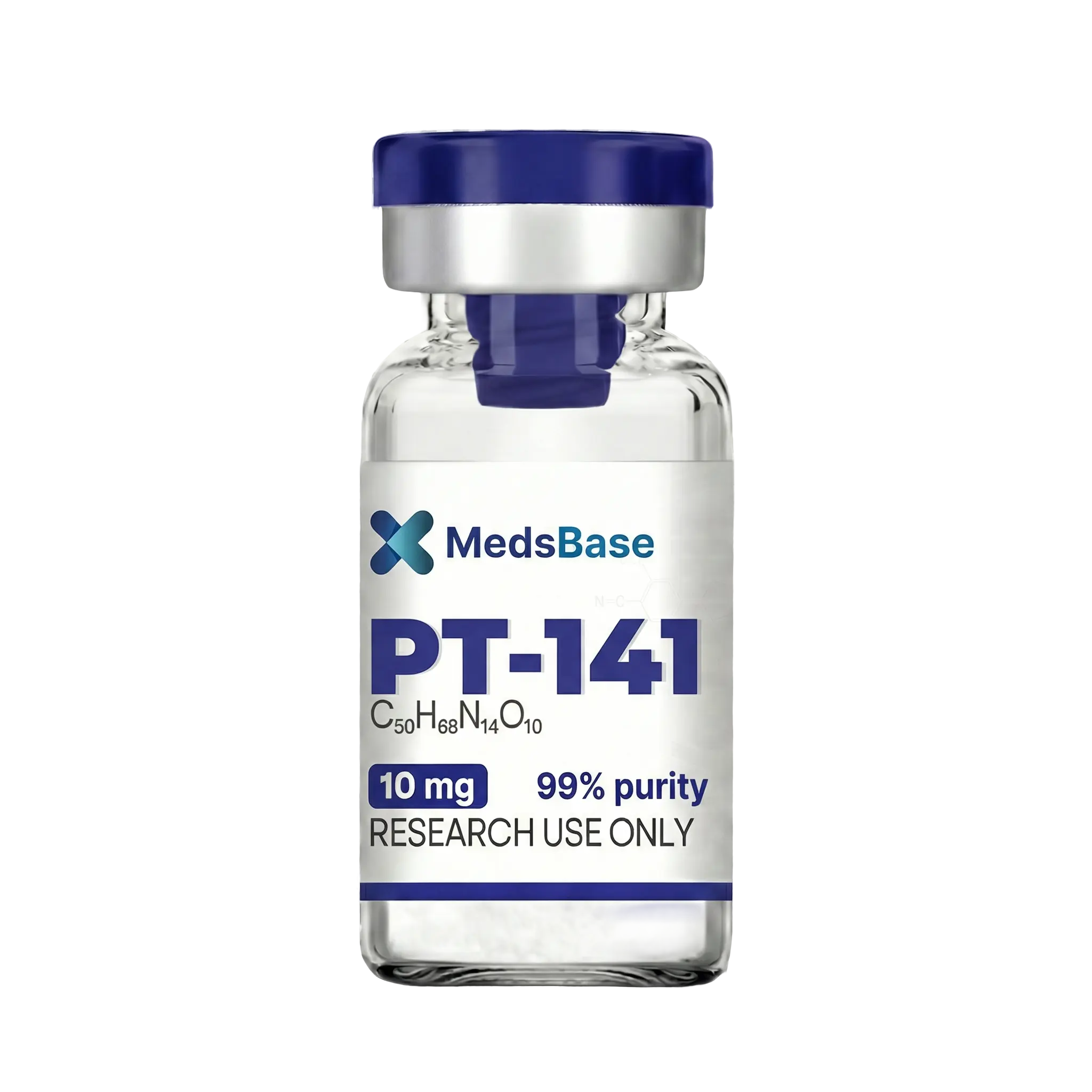
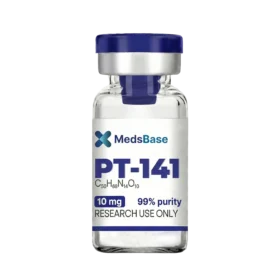
PT-141 (bremelanotide) is een synthetische melanocortinereceptoragonist die werkt op de MC4R in het centrale zenuwstelsel. In tegenstelling tot PDE5-remmers die zich richten op de vasculaire fysiologie, activeert PT-141 opwindingsbanen in het centrale zenuwstelsel via dopamineafgifte in het mediale preoptische gebied. Het is door de FDA goedgekeurd onder de handelsnaam Vyleesi voor vrouwelijke hypoactieve seksuele verlangensstoornis (niet de onderzoeksversie die hier wordt verkocht). Leverbaar in 10 mg lyofiliseerbare flesjes uitsluitend voor laboratoriumonderzoek.
📦 Elke bestelling is gedekt door onze Reshipment Assurance-beleid — als uw pakket niet binnen 20 werkdagen arriveert, sturen wij het opnieuw.
| Specificatie | Detail |
|---|---|
| CAS-nummer | 189691-06-3 |
| Molecuulformule | C50H68N14O10 |
| Moleculair gewicht | 1025.18 Da |
| Sequentie | Ac-Nle-cyclo[Asp-His-D-Phe-Arg-Trp-Lys]-OH |
| Form | Lyofiliseerd poeder (of zoals geleverd) |
| Zuiverheid | ≥99% (HPLC geverifieerd, COA op aanvraag) |
| Opslag | Lyofiliseerd: 2–8 °C (koelkast) voor werkvoorraad; −20 °C voor langdurige opslag van ongeopende flesjes. Gereconstitueerd: 2–8 °C, gebruik binnen ~30 dagen. Bescherm tegen licht. Vries de gereconstitueerde oplossing niet in en ontdooi deze niet. |
| Oplosbaarheid | Bacteriostatisch water (aanbevolen) of steriel water voor kortere gebruiksperioden |
| Onderzoeksgebruik | Alleen voor laboratoriumonderzoek. Niet voor humaan of veterinair diagnostisch of therapeutisch gebruik. |
Wat Is PT-141?
PT-141 (internationale niet-eigendomsnaam: bremelanotide) is een synthetisch zeven-aminozuur cyclisch peptideanaloog van alfa-melanocytstimulerend hormoon (α-MSH). Het behoort tot de melanocortine familie en is oorspronkelijk ontwikkeld uit onderzoek naar Melanotan II, waar onderzoekers onverwachte opwindende effecten als bijwerking opmerkten tijdens onderzoek gerelateerd aan bruinen.
Sequentie (cyclisch): Ac-Nle-cyclo[Asp-His-D-Phe-Arg-Trp-Lys]-OH. Molecuulgewicht ongeveer 1.025 Da. PT-141 bindt zich aan melanocortine-receptoren met voorkeur voor de MC4-receptor (MC4R), met meetbare activiteit bij MC1R, MC3R en MC5R. Het CNS-opwekkingsonderzoekssignaal wordt voornamelijk toegeschreven aan MC4R-activatie in het mediale preoptische gebied van de hypothalamus.
Bremelanotide werd in juni 2019 door de FDA goedgekeurd onder de handelsnaam Vyleesi specifiek voor gegeneraliseerde hypoactieve seksuele verlangensstoornis (HSDD) bij premenopauzale vrouwen. De onderzoeksvorm die alleen voor onderzoek wordt verkocht door peptide-onderzoeksleveranciers is chemisch identiek maar is niet het door de FDA goedgekeurde therapeutische product en is uitsluitend bestemd voor laboratoriumonderzoek. Voor een dieper inzicht in het werkingsmechanisme en gepubliceerde onderzoekscontext, zie onze volledige PT-141 onderzoeksgids.
Werkingsmechanisme — Centraal (niet vasculair) opwekkingspad
Het belangrijkste mechanistische onderscheid van PT-141 is dat het werkt centraal — in de hersenen — in plaats van perifeer op vasculaire gladde spieren. Dit maakt het fundamenteel verschillend van PDE5-remmers (Viagra, Cialis) die gericht zijn op het vasculaire stikstofoxidepad om een erectie te produceren via veranderingen in de bloedstroom:
- MC4-receptoragonisme — PT-141 bindt aan de MC4R in het mediale preoptische gebied (mPOA) van de hypothalamus en de paraventriculaire kern. MC4R-activatie in deze regio's is een erkende upstream regulator van seksuele opwindingpaden bij zowel mannen als vrouwen.
- Dopaminerge signalering — MC4R-activatie in het mPOA veroorzaakt dopamineafgifte in regio's die geassocieerd zijn met appetitief gedrag en opwinding. Dit downstream dopamine-signaal wordt verondersteld de waargenomen gedragseffecten in onderzoek te mediëren.
- Onafhankelijkheid van vasculaire fysiologie — omdat PT-141 in de hersenen werkt in plaats van op het vaatstelsel, zijn de effecten onafhankelijk van de beschikbaarheid van stikstofoxide of endotheelfunctie. Dit is de mechanistische basis voor PT-141-onderzoek bij populaties waar PDE5-remmers niet effectief zijn (seksuele disfunctie van centrale oorsprong, post-SSRI-disfunctie, onderzoek bij ruggenmergletsel).
Omdat melanocortinereceptoren in meerdere weefsels tot expressie komen, heeft PT-141 onderzoeksnut buiten seksuele functiestudies — inclusief onderzoek naar hemorragische shock (MC4R-vasopressoreffecten), neurowetenschappen van appetitief gedrag en vergelijkende melanocortinefarmacologie.
Gepubliceerde onderzoeksapplicaties
PT-141 wordt gebruikt in laboratoriumonderzoekcontexten die onderzoeken:
- Onderzoek naar centrale opwindingpaden — knaagdier- en in-vitro-modellen van CNS-signalering voor seksuele functie (King et al., Pharmacol Biochem Behav 2010)
- Melanocortinereceptorfarmacologie — MC4R-signalering en downstream cAMP/PKA-padonderzoek
- Onderzoek naar hemorragische shock — vasopressor-gerelateerde studies in preklinisch trauma-onderzoek
- Vergelijkende arousal-farmacologie — benchmarking versus PDE5-remmers (vasculair) en andere niet-vasculaire arousal-verbindingen
- Neurowetenschappelijk onderzoek — dopamine mPOA-signalering en onderzoek naar appetitief gedrag in gedragsmodelstudies bij knaagdieren
- Receptorselectiviteitsprofielering — MC3R versus MC4R-selectiviteitsstudies in melanocortine-analogononderzoek
Voor een bredere context over peptiden in het seksuele gezondheidsonderzoek, zie de onderzoekspeptiden catalogus.
Beschikbare sterktes
MedsBase voert PT-141 in een enkele 10 mg lyofilisaatflessterkte, beschikbaar in 10-fles, 20-fles of 30-fles verpakkingen:
| Vulsterkte | Typisch gebruik | Verpakkingsgroottes |
|---|---|---|
| 10 mg | Standaard onderzoekssterkte — ondersteunt ongeveer 6 toedieningen per fles bij de 1,5 mg titratiedosis | 10, 20 of 30 vialen |
Het 10 mg flesformaat komt overeen met typisch onderzoeksprotocolgebruik — 1–2 mg per toediening naar behoefte, waarbij 1,5 mg een veelvoorkomend startpunt is voor titratie in gepubliceerde protocollen. Leverbaar als lyofilisaatpoeder met een HPLC-puurheid van 99%+.
Hoe het zich verhoudt — PT-141 versus PDE5-remmers
PT-141 en PDE5-remmers richten zich via volledig verschillende mechanismen op seksuele functie. Het begrijpen van het verschil is essentieel voor elk vergelijkend onderzoek met PT-141:
| Criterium | PT-141 (Bremelanotide) | PDE5-remmers (sildenafil, tadalafil, etc.) |
|---|---|---|
| Werkingsmechanisme | Centrale (CZS) melanocortine MC4R-activering | Perifere (vasculaire) PDE5-remming |
| Doelweefsel | Hypothalamus (mPOA) | Vasculaire gladde spier |
| Vereist NO-signalering? | Nee — onafhankelijk van vasculaire route | Ja — versterkt endogeen NO |
| Toedieningsweg | Subcutane injectie | Oraal tablet |
| FDA-goedgekeurde indicatie | Vrouwelijke HSDD (Vyleesi, 2019) | Mannelijke ED, PAH |
| Onderzoekspopulaties | Onderzoek naar centrale oorsprong van opwinding, post-SSRI | Onderzoek naar perifere vasculaire / endotheliale functie |
Opslag en Reconstituering
Voor reconstituering: Bewaar lyofiliseerde flesjes gekoeld bij 2–8 °C in de originele verpakking, stabiel tot 36 maanden. Vermijd vries-dooicycli van het poeder.
Reconstitueringsprocedure: Injecteer bacteriostatisch water langs de zijkant van het peptideflesje volgens de bovenstaande tabel. Draai voorzichtig — niet niet schud — en laat 5–10 minuten staan voor volledige oplossing. Een correct gereconstitueerde oplossing moet helder en kleurloos zijn.
Na reconstitutie: Bewaar gekoeld bij 2–8 °C en gebruik binnen 30 dagen. Vries de gereconstitueerde oplossing niet in — vries-dooicycli tasten de peptide-integriteit aan.
Veelgestelde vragen
Waar wordt PT-141 voor gebruikt in onderzoek?
PT-141 wordt gebruikt in laboratoriumonderzoek naar signalering van centrale-opwindingsroutes, melanocortine-receptorfarmacologie (vooral MC4R), vasopressoreffecten bij hemorragische shock, neurowetenschap van appetitief gedrag en vergelijkende opwindingsfarmacologie versus PDE5-remmers. Het wordt hier strikt verkocht voor laboratoriumonderzoek alleen.
Hoe verschilt PT-141 van Viagra of Cialis?
PT-141 werkt centraal, in de hersenen — het bindt aan melanocortine MC4-receptoren in de hypothalamus om opwinding te triggeren via dopamine-signalering. PDE5-remmers (sildenafil / Viagra, tadalafil / Cialis) werken perifeer op vasculaire gladde spieren om de bloedstroom te verbeteren via stikstofoxideversterking. De mechanismen zijn volledig gescheiden, daarom omvat PT-141-onderzoek populaties waarbij PDE5-remmers niet effectief zijn.
Wat is de gebruikelijke onderzoeksdosis van PT-141?
Gepubliceerde preklinische protocollen en het FDA-goedgekeurde Vyleesi-label beschrijven 1,75 mg per toediening naar behoefte, met sommige onderzoeksprotocollen die 1–2 mg titratie gebruiken. Een flesje van 10 mg gereconstitueerd met 2,0 mL bacteriostatisch water levert 5 mg/mL — 30 ticks op een U-100-spuit geeft 1,5 mg.
Is PT-141 goedgekeurd door de FDA?
Bremelanotide (PT-141) is door de FDA goedgekeurd onder de handelsnaam Vyleesi (AMAG Pharmaceuticals, 2019) specifiek voor gegeneraliseerde hypoactieve seksuele verlangensstoornis (HSDD) bij premenopauzale vrouwen. De onderzoeksvorm die door peptideleveranciers wordt verkocht, is chemisch identiek maar is niet niet het goedgekeurde therapeutische product en mag niet worden gebruikt voor therapie.
Hoe moet PT-141 worden opgeslagen?
Gevriesdroogde flesjes: gekoeld bewaren bij 2–8 °C in de originele verpakking, stabiel tot 36 maanden. Oplossing na reconstitutie: gekoeld bewaren bij 2–8 °C, binnen 30 dagen gebruiken. Vries de gereconstitueerde oplossing niet in — vries-ontdooicycli degraderen het peptide.
Hoe moet ik PT-141 reconstitueren?
Volg de bovenstaande reconstructietabel. Voeg bacteriostatisch water langs de zijkant van het flesje toe, draai voorzichtig en laat 5-10 minuten staan voor volledige oplossing. Schud niet het flesje niet. De tabel biedt drie verdunningsopties, afhankelijk van de dosering per toediening die uw onderzoeksprotocol vereist.
Welke sterktes heeft MedsBase op voorraad?
MedsBase voert PT-141 in 10 mg lyofiliseerflesjes, beschikbaar in verpakkingen van 10, 20 of 30 flesjes. Alle flesjes worden geleverd met een HPLC-puurheid van 99%+ en een certificaat van analyse op aanvraag.
Is PT-141 hetzelfde als Melanotan II?
Nee, maar ze delen een voorouder. Beide zijn melanocortine-analogen, en PT-141 is ontwikkeld uit observaties tijdens Melanotan II-onderzoek. Melanotan II is een bredere melanocortine-agonist (MC1R/MC3R/MC4R/MC5R) met significante melanocyt-stimulerende activiteit (bruinend effect). PT-141 is verfijnd om MC1R-activiteit te verminderen (minimaal bruinend effect) terwijl het MC4R-gemedieerde opwindingsonderzoekssignaal behouden blijft.
Veroorzaakt PT-141 bijwerkingen in onderzoek?
Gepubliceerd onderzoek en de Vyleesi klinische trialgegevens melden de meest voorkomende effecten als tijdelijke misselijkheid, opvliegers en milde hoofdpijn na toediening. Tijdelijke verhoging van de bloeddruk is opgemerkt; Vyleesi draagt een voorzorgsmaatregel voor patiënten met ongecontroleerde hypertensie of cardiovasculaire aandoeningen. Een klein deel van de onderzoekssubjecten ervaart tijdelijke focale hyperpigmentatie (gerelateerd aan resterende MC1R-activiteit).
Wanneer wordt PT-141 typisch gebruikt versus PDE5-remmers in onderzoek?
PT-141 onderzoeksprotocollen worden typisch geselecteerd wanneer de onderzoeksvraag centrale oorsprong seksuele dysfunctie (niet vasculair), post-SSRI seksuele dysfunctie, vrouwelijk seksueel verlangen onderzoek of vergelijkende centrale versus perifere farmacologie betreft. PDE5-remmers blijven de referentie voor vasculair-ED onderzoek.
Kan ik PT-141 combineren met andere peptiden in onderzoek?
PT-141 werkt via een aparte receptorfamilie (melanocortine) dan de GHRP/GHRH-peptiden (ipamorelin, CJC-1295), helende peptiden (BPC-157, TB-500), en metabolische peptiden (retatrutide). Farmacologische interacties zijn minimaal, hoewel onderzoeksprotocollen rekening moeten houden met onafhankelijke bijwerkingenprofielen.
Wat is de halfwaardetijd van PT-141?
PT-141 (bremelanotide) heeft een plasmahalfwaardetijd van ongeveer 2,7 uur, gebaseerd op farmacokinetische gegevens uit klinische studies van de goedgekeurde Vyleesi-formulering. Aangelengde oplossingen moeten worden bewaard bij 4 °C en binnen 30 dagen worden gebruikt.
Hoe verschilt PT-141 van Melanotan II?
PT-141 is een metaboliet van Melanotan II met verminderde MC1R-activiteit en relatief meer selectieve MC4R-activiteit — wat het een klinisch ontwikkelpad opleverde gericht op onderzoek naar centrale opwinding dat resulteerde in FDA-goedkeuring (Vyleesi). Melanotan II heeft een bredere melanocortine-receptoractiviteit (MC1R–MC5R) en wordt bestudeerd voor UV-geïnduceerde pigmentatie evenals opwinding. In onderzoekscontexten heeft PT-141 het meer gekarakteriseerde klinische dataset van de twee.
Kan ik PT-141 bestellen voor internationale verzending?
Ja. MedsBase verzendt PT-141 wereldwijd via ons toegewijde peptide-verzendnetwerk. Bestellingen met alleen peptides komen in aanmerking voor onze aparte peptide-verzendservice. Bestellingen worden verzonden in temperatuurgecontroleerde verpakkingen met volledige tracking.
Andere Peptiden voor Herstel- en Prestatieonderzoek
- BPC-157 — Body Protection Compound — onderzoek naar pees-, ligament- en darmherstel
- TB-500 — Thymosine Beta-4 fragment — onderzoek naar zacht weefsel en vasculair herstel
- Ipamorelin — Selectieve ghreline-agonist — schone GH-puls zonder cortisol/prolactine
- CJC-1295 met DAC — GHRH-analoog met verlengde halfwaardetijd
- GHK-Cu — Koperpeptide — onderzoek naar huid- en bindweefselregeneratie
Verder lezen
📖 Lees het onderzoek achter dit peptide
Lees onze volledige evidence-based gids: PT-141 (Bremelanotide) — werkingsmechanisme, geschiedenis van Vyleesi, onderzoeksprotocollen. Behandelt de farmacologie van melanocortinereceptoren, biologie van CNS-opwindingspaden, geschiedenis van FDA-goedkeuring, gepubliceerde onderzoeksdoseringen, reconstitutieprotocollen en veiligheidsnotities.
Meer opties in Peptiden
Gerangschikt op recente bestelvolumes van MedsBase — wat andere klanten in deze categorie kiezen.
| Sterkte | 10 mg |
|---|---|
| Hoeveelheid | 10 flacons, 20 flacons, 30 flacons |
 PT-141
Vragen & antwoorden
PT-141
Gerelateerde producten
Beoordelingen
Er zijn nog geen beoordelingen