







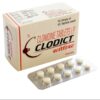

Arkamin-H

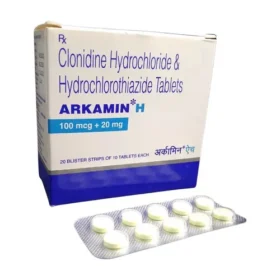
Arkamin-H is Torrent’s vaste dosis combinatie van clonidine 100 mcg + chlorthalidon 20 mg tabletten — combineert centrale sympathische onderdrukking met langwerkende thiazide-achtige natriurese en vasodilatatie. Klinische rol: resistente hypertensie, intolerantie voor RAAS-blokkers, of patiënten die al stabiel zijn op de afzonderlijke componenten. Niet eerste keus. CRITICAL — stop nooit abrupt (clonidine rebound). Houd kalium en natrium in de gaten (chlorthalidon).
✓ Medisch beoordeeld door Morgan Ellis — Apotheekonderzoeker · 8 jaar ervaring · Laatst beoordeeld: mei 2026
⚡ Snelle vraag — Wat is Arkamin-H?
Arkamin-H is een tablet met vaste dosering die combineert clonidine 100 mcg + 20 mg — een centraal werkende alfa-2 adrenerge agonist — met chlorthalidon, een langwerkend thiazide-achtig diureticum, van Torrent Pharma. De combinatie combineert twee complementaire mechanismen voor resistente of matig-ernstige hypertensie: clonidine vermindert de centrale sympathische uitstroom (verlaagt bloeddruk en hartslag), terwijl chlorthalidon langdurige natriurese en vasodilatatie veroorzaakt. Typische dosering: één tablet een of twee keer per dag. Stop Arkamin-H nooit abrupt — het clonidine-component veroorzaakt rebound hypertensie met een sympathische piek binnen 18-36 uur. Afbouwen over 2-4 weken onder medisch toezicht. Houd elektrolyten (chlorthalidon-gerelateerde hypokaliëmie en hyponatriëmie), bloeddruk en hartslag in de gaten bij start en dosisaanpassing. Geen eerstelijns antihypertensivum — reserveer voor resistente of klinisch-specifieke indicaties nadat ACE-remmers/ARB + CCB + thiazide + spironolacton zijn geprobeerd of gecontra-indiceerd zijn.
📦 Elke bestelling is gedekt door onze Reshipment Assurance-beleid — als uw pakket niet binnen 20 werkdagen arriveert, sturen wij het opnieuw.
Waarom bestellen bij MedsBase
Onze generieke medicijnen zijn afkomstig van WHO-GMP gecertificeerde fabrikanten en worden wereldwijd verzonden in discrete, eenvoudige verpakkingen — geen medicijnnaam op de buitenkant van het pakket. Betalingen met kaart worden verwerkt via een gereguleerde processor (betalingsoverzichten vermelden een gereguleerde kaartbetalingprocessor — nooit “MedsBase” of een medicijnnaam). Crypto en SEPA bankoverschrijvingen worden ook geaccepteerd. Elke bestelling wordt ondersteund door ons Reshipment Assurance Policy.
Wat is Arkamin-H?
Arkamin-H is een orale vaste dosis combinatietablet die Clonidine en chlorthalidon in één tablet (typische verhouding 100 mcg clonidine + 20 mg chloortalidon per tablet). Geproduceerd door Torrent Pharma en geleverd in verpakkingen van 30-180 tabletten.
Clonidine werd in 1966 geïntroduceerd door Boehringer Ingelheim als Catapres — de eerste centraal werkende alfa-2-agonist. Chloortalidon is een langwerkend thiazide-achtig diureticum dat in 1960 werd geïntroduceerd door USV/Ciba en werd gevalideerd als eerstelijns antihypertensieve therapie in de ALLHAT-studie (2002). De combinatie werd ontwikkeld om behandelregimes voor resistente hypertensie te vereenvoudigen in het pre-ACEi-tijdperk en blijft een nuttige optie met een dubbel werkingsmechanisme in moderne protocollen voor resistente hypertensie.
Waarom Clonidine Combineren met Chloortalidon?
Resistente hypertensie omvat doorgaans twee fysiologische factoren: geactiveerde sympathische tonus en natriumretentie. Het gelijktijdig aanpakken van beide is effectiever dan elk afzonderlijk.
- Clonidine activeert presynaptische alfa-2-receptoren in de rostroventrolaterale medulla, waardoor de dalende sympathische uitstroom wordt onderdrukt. Perifere noradrenaline daalt met 30-50%; hartslag daalt met 5-15 slagen per minuut; bloeddruk daalt met 10-30 mmHg.
- Chlorthalidon is een thiazide-achtig diureticum met een werkingsduur van 40-60 uur, langer dan hydrochloorthiazide. Het vermindert het plasmavolume in de eerste 1-2 weken en draagt bij aan voortdurende directe vasodilatatie via kaliumkanaaleffecten in gladde spieren.
- Complementaire werkingsmechanismen — clonidine veroorzaakt vaak zout- en waterretentie over maanden (een bekende beperking van centraal werkende middelen in monotherapie); chloortalidon compenseert dit continu.
De klinische rol van Arkamin-H is smaller dan in de jaren 1970 — combinaties van ACEi/ARB + CCB + thiazide + spironolacton dekken de meeste moderne hypertensiepatiënten. Waar het nog steeds past: intolerantie voor RAAS-blokkers (hoest, angio-oedeem, hyperkaliëmie), echt resistente hypertensie ondanks optimale eerstelijnstherapie, of patiënten die al stabiel zijn op individuele clonidine + thiazide en baat hebben bij het gemak van één tablet.
Dosering & Titratie
Standaard dosering: één tablet van 100 mcg + 20 mg eenmaal of tweemaal daags. Neem op hetzelfde tijdstip(en) elke dag. Sommige patiënten krijgen tweemaal daags een dosis om het effect van clonidine te verzachten; anderen kunnen toe met een eenmaal daagse dosis voor het slapengaan.
Titratie:
- Bloeddruk niet onder controle met één tablet per dag: verhoog naar één tablet tweemaal daags of voeg een complementair middel toe (ACEi, ARB, CCB) in plaats van de clonidine-component verder te verhogen.
- Sedatiebeperkt: verplaats de grotere dosis naar het slapengaan.
- Hypokaliëmie door het chloortalidon-component: voeg een ACE-remmer/ARB toe of zet deze voort (vermindert kaliumverlies door thiaziden) of voeg een lage dosis van een kaliumsparend middel toe.
Controleschema:
- Uitgangswaarden: Bloeddruk (liggend en staand), hartslag, ureum, elektrolyten (kalium, natrium), creatinine, eGFR, glucose, serumuraat, ECG indien klinisch geïndiceerd.
- 1-2 weken: Herhaal bloeddruk en elektrolyten. Verwacht milde hypokaliëmie en een lichte stijging van het serumuraat.
- 4-6 weken: Herbeoordeling van het bloeddrukdoel; volledig metabool panel.
- Doorlopend: Jaarlijkse controle van elektrolyten, uraat, glucose, lipidenpanel. Laat de voorraad nooit opraken — reboundhypertensie bij gemiste doses.
- Stop en herbeoordeel bij: kalium 5,5, natrium <130 met symptomen, ernstige sedatie of depressie, syncope, bradycardie <50 bpm of tweede/derdegraads AV-blok, jichtaanval, aanhoudende posturale symptomen.
Bijwerkingen
Vaak (>1%):
- Sedatie, slaperigheid overdag (clonidine-effect)
- Droge mond (clonidine-effect — zeer vaak voorkomend)
- Toegenomen urinelozing in de eerste 1-2 uur na inname (chloortalidon-effect)
- Posturale duizeligheid, orthostatische hypotensie
- Hypokaliëmie, milde hyponatriëmie
- Hyperurikemie en jichtprecipitatie
- Bescheiden verslechtering van glucosetolerantie
- Obstipatie
- Erectiestoornissen, verminderd libido
- Depressie, stemmingsverandering
- Perifeer oedeem
Zeldzaam maar klinisch belangrijk:
- Rebound hypertensieve crisis bij abrupt stoppen — beroerte, myocardinfarct, hypertensieve encefalopathie gemeld
- Ernstige hyponatriëmie — met name bij oudere vrouwen met een zoutarm dieet
- Ernstige bradycardie, hartblok (verergerd door bètablokkers of digoxine)
- Stevens-Johnson-syndroom — zeldzame sulfonamide-klasse reactie op de chloortalidoncomponent
- Pancreatitis (zeldzaam thiazide-klasse effect)
- Acuut glaucoom met gesloten kamerhoek (zeldzame sulfonamide-klasse reactie binnen uren tot dagen na starten)
Contra-indicaties
- Ernstige bradyaritmie, sick-sinussyndroom of tweede/derdegraads AV-blok zonder pacemaker
- Ernstige nierinsufficiëntie (eGFR <30) — chloortalidon verliest effectiviteit
- Anurie
- Sulfonamide-overgevoeligheid (chlorthalidone-component)
- Bekende overgevoeligheid voor clonidine
- Ernstige depressie (clonidine kan depressieve symptomen verergeren)
- Bestaande hypokaliëmie (<3,0 mmol/L) of symptomatische hyponatriëmie (<130 mmol/L)
- Hypercalciëmie
- Ernstige leverfunctiestoornis (Child-Pugh C)
- Gelijktijdig gebruik van andere centrale alfa-2-agonisten (methyldopa, tizanidine, moxonidine)
Zwangerschap: over het algemeen niet als eerste keuze gebruikt. Bij hypertensie tijdens zwangerschap verdient methyldopa, labetalol of nifedipine de voorkeur — alle drie hebben grotere veiligheidsdatabases. Thiaziden tijdens zwangerschap kunnen neonatale geelzucht en trombocytopenie veroorzaken; clonidine passeert de placenta maar is niet duidelijk teratogeen. Alleen gebruiken bij dwingende indicaties onder specialistisch toezicht.
Borstvoeding: beide componenten komen in de moedermelk terecht. Houd de zuigeling in de gaten voor sedatie, bradycardie en slecht drinken; overweeg waar mogelijk alternatieve regimes.
Geneesmiddelinteracties
- Bètablokkers — KRITIEK. Combinatietherapie verergert de rebound bij clonidine-ontwenning en verhoogt het risico op bradycardie. Als beide worden gestopt, stop dan de bètablokker enkele dagen voordat clonidine wordt afgebouwd.
- Lithium — KRITIEK. Chlorthalidone vermindert de klaring van lithium; combinatie kan lithiumtoxiciteit veroorzaken. Controleer de spiegels wekelijks gedurende de eerste maand indien onvermijdelijk; verlaag de lithiumdosis met 25-50%.
- Tricyclische antidepressiva — werken het antihypertensieve effect van clonidine gedeeltelijk tegen en veroorzaken orthostatische hypotensie.
- Andere centrale alfa-2-agonisten (methyldopa, tizanidine, moxonidine) — additieve sedatie en hypotensie; combineer niet.
- NSAID's — verminderen het diuretische en antihypertensieve effect; verhogen het risico op acuut nierfalen aanzienlijk in combinatie met ACE-remmers/ARB's.
- Digoxine — hypokaliëmie versterkt digoxine-toxiciteit; additieve bradycardie. Controleer spiegels.
- Orale corticosteroïden, amfotericine B, laxantia — additieve hypokaliëmie.
- CNS-depressiva (opioïden, benzodiazepinen, alcohol, gabapentinoïden) — additieve sedatie.
- Cholestyramine / colestipol — vermindert de opname van chlorthalidon. Houd een interval van 4 uur aan tussen de doses.
- Orale antidiabetica, insuline — thiaziden verslechteren de glucosetolerantie; mogelijk is dosisaanpassing nodig.
- Alcohol — additief effect op orthostatische hypotensie en sedatie.
Opslag
Bewaar Arkamin-H onder 25°C in de originele blisterverpakking. Buiten bereik van kinderen houden.
Veelgestelde vragen
Waarom zou mijn arts kiezen voor Arkamin-H in plaats van aparte tabletten clonidine en chlorthalidone?
Vaste combinaties in één tablet verbeteren de therapietrouw aanzienlijk — patiënten vergeten minder vaak één pil dan twee, en het verminderen van het aantal pillen is een van de sterkste voorspellers van bloeddrukcontrole. De verhouding 100 mcg + 20 mg in Arkamin-H komt overeen met de proporties die doorgaans in de klinische praktijk worden gebruikt; patiënten die stabiel zijn op de afzonderlijke componenten kunnen één-op-één worden overgezet op de combinatietablet.
Is Arkamin-H een eerstelijns bloeddrukmedicijn?
Nee — moderne richtlijnen beginnen met ACE-remmers, ARB's, calciumantagonisten of thiazide-/thiazide-achtige diuretica als eerstelijns monotherapie of in combinatie, waarna spironolacton als voorkeursvierde middel wordt toegevoegd (PATHWAY-2 bewijs). Clonidine-gebaseerde combinaties zijn typisch voorbehouden aan resistente hypertensie, intolerantie voor RAAS-blokkers of patiënten die al stabiel zijn op clonidine.
Wat gebeurt er als ik een dosis Arkamin-H vergeet in te nemen?
Neem de vergeten dosis zo snel mogelijk in, zelfs als het dicht bij de volgende geplande tijd ligt — clonidine heeft een risico op rebound-hypertensie bij gemiste doses dat andere antihypertensiva niet hebben. Als u het binnen een paar uur beseft, neem dan de dosis; als de volgende dosis binnen 2-3 uur gepland staat, neem dan de volgende dosis op het normale tijdstip maar verdubbel niet. Als u een hele dag heeft overgeslagen en hoofdpijn, hartkloppingen of zweten ervaart, neem dan de dosis en zoek dringend medisch advies. Laat uw voorraad nooit opraken.
Beïnvloedt Arkamin-H mijn kaliumgehalte?
Ja — het chloortalidon-onderdeel verlaagt het kaliumgehalte (en natrium). Controleer het kaliumgehalte bij de start, na 1-2 weken en regelmatig daarna. Het risico wordt geminimaliseerd door combinatie met een ACE-remmer of ARB (die het door thiaziden veroorzaakte kaliumverlies verminderen). Clonidine zelf heeft geen invloed op het kaliumgehalte.
Word ik slaperig?
Ja, vooral in de eerste 2-4 weken — het clonidine-onderdeel veroorzaakt bij de meeste patiënten slaperigheid. Dit verbetert meestal aanzienlijk tegen week 4-6. Neem de grotere dosis voor het slapengaan om de slaperigheid in slaap om te zetten; vermijd alcohol en andere sederende medicijnen; rij niet tot u weet hoe Arkamin-H u beïnvloedt.
Kan ik ibuprofen nemen met Arkamin-H?
Incidenteel kortdurend gebruik is meestal geen probleem. Chronisch dagelijks gebruik van NSAID's vermindert het antihypertensieve effect van Arkamin-H en verhoogt aanzienlijk het risico op acute nierinsufficiëntie in combinatie met een ACE-remmer of ARB (de “triple whammy”). Gebruik bij voorkeur paracetamol voor chronische pijn.
Kan ik Arkamin-H gebruiken tijdens de zwangerschap?
Over het algemeen niet. De voorkeursmiddelen tegen hoge bloeddruk tijdens de zwangerschap zijn methyldopa, labetalol en nifedipine. Thiaziden tijdens de zwangerschap kunnen neonatale geelzucht en trombocytopenie veroorzaken, en clonidine heeft een kleinere veiligheidsdatabase dan de voorkeursmiddelen. Schakel voor de conceptie of zodra de zwangerschap is bevestigd over, onder specialistisch toezicht.
Waar kan ik Arkamin-H online kopen?
U kunt Arkamin-H (100 mcg + 20 mg clonidine + chloortalidon, 30-180 tabletten) kopen bij MedsBase met discrete verpakking en wereldwijde verzending.
Gerelateerde antihypertensiva op MedsBase
- Alphadopa — Methyldopa 250 mg (veilig bij zwangerschap HTN)
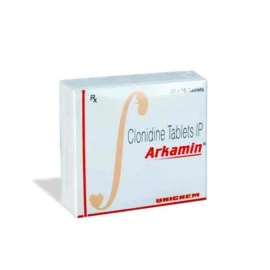
- Arkamin — Clonidine 100 mcg (Torrent)
- Hytrin — Terazosine 1/2/5 mg (AbbVie)
- Prazopill XL — Prazosin ER 5 mg
- Prazopress — Prazosine IR 1 mg (Sun Pharma)
- Prazopress XL — Prazosine ER 2,5/5 mg (Sun Pharma)
- Bekijk alle hoge bloeddruk medicijnen
Gerelateerde alternatieven
Andere producten in Chronische aandoeningen die klanten ook bekijken:
Meer opties in medicatie tegen hoge bloeddruk
Gerangschikt op recente bestelvolumes van MedsBase — wat andere klanten in deze categorie kiezen.
| Sterkte | 100 mcg + 20 mg |
|---|---|
| Hoeveelheid | 30 Tabletten, 60 Tabletten, 90 Tabletten, 180 Tabletten |
 Arkamin-H
Vragen & antwoorden
Arkamin-H
Gerelateerde producten







Beoordelingen
Er zijn nog geen beoordelingen