







Melanotan II
✅ Ondersteunt huidpigmentatie
✅ Verhoogt de melanineproductie
✅ Stimuleert fotoprotectieve processen
✅ Verbetert metabole signalering
✅ Verbeterde cellulaire functie
Melanotan II bevat synthetisch peptideverbinding.
✓ Medisch beoordeeld door Morgan Ellis — Apotheekonderzoeker · 8 jaar ervaring · Laatst beoordeeld: mei 2026
Snelle vraag — Wat is Melanotan II?
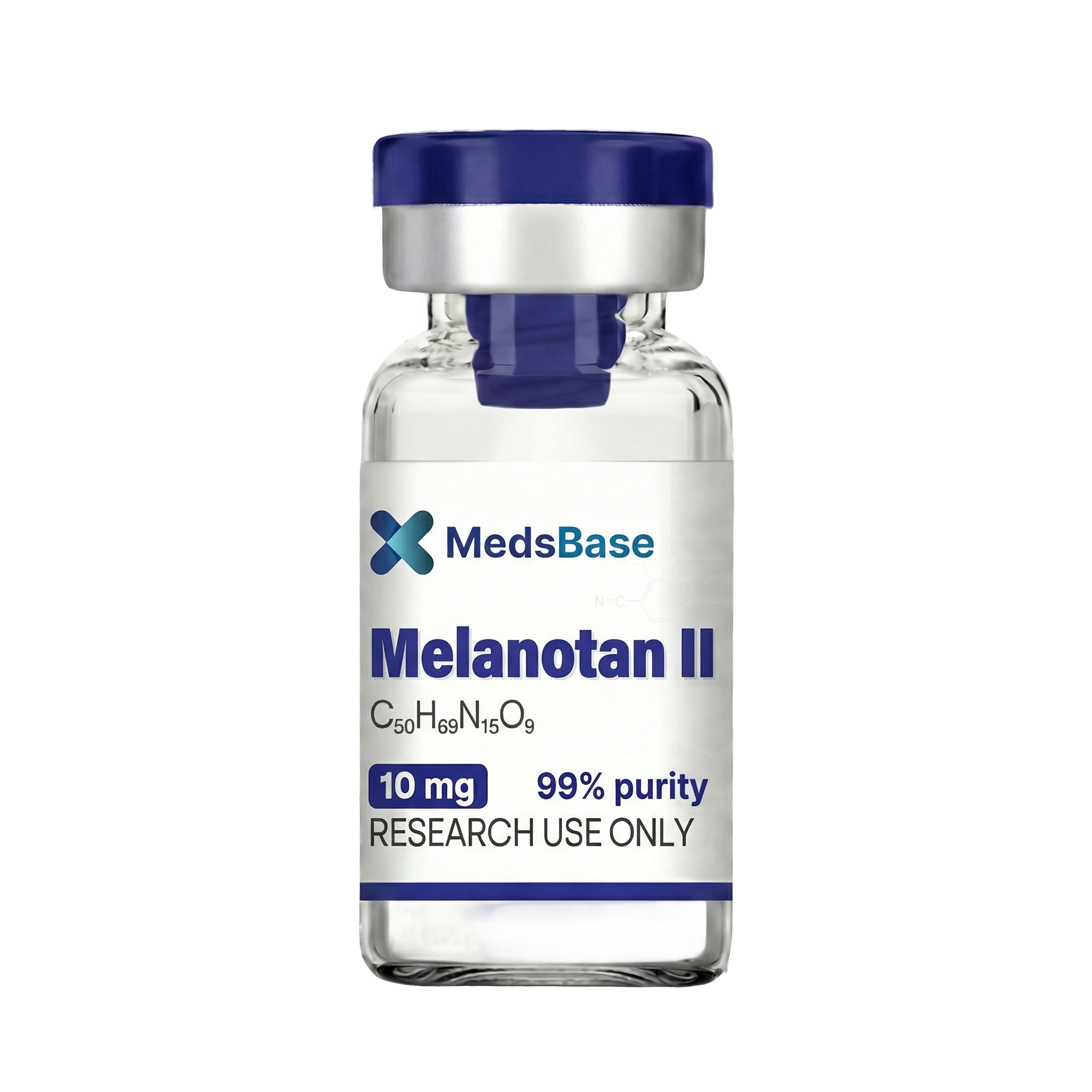
Melanotan II (MTII) is een synthetisch zeven-aminozuur cyclisch analoog van alfa-melanocytenstimulerend hormoon (α-MSH). Het is een brede melanocortine-agonist met activiteit op MC1R, MC3R, MC4R en MC5R — wat het onderscheidt van het meer MC4R-selectieve PT-141. In onderzoek wordt MTII bestudeerd voor melanogenese, fotoprotectie en bredere melanocortine-farmacologie. Verkrijgbaar in 10 mg lyofiliseerbare flesjes uitsluitend voor laboratoriumonderzoek.
📦 Elke bestelling is gedekt door onze Reshipment Assurance-beleid — als uw pakket niet binnen 20 werkdagen arriveert, sturen wij het opnieuw.
| Specificatie | Detail |
|---|---|
| CAS-nummer | 121062-08-6 |
| Molecuulformule | C50H69N15O9 |
| Moleculair gewicht | 1024.18 Da |
| Sequentie | Ac-Nle-cyclo[Asp-His-D-Phe-Arg-Trp-Lys]-NH2 |
| Form | Lyofiliseerd poeder (of zoals geleverd) |
| Zuiverheid | ≥99% (HPLC geverifieerd, COA op aanvraag) |
| Opslag | Lyofiliseerd: 2–8 °C (koelkast) voor werkvoorraad; −20 °C voor langdurige opslag van ongeopende flesjes. Gereconstitueerd: 2–8 °C, gebruik binnen ~30 dagen. Bescherm tegen licht. Vries de gereconstitueerde oplossing niet in en ontdooi deze niet. |
| Oplosbaarheid | Bacteriostatisch water (aanbevolen) of steriel water voor kortere gebruiksperioden |
| Onderzoeksgebruik | Alleen voor laboratoriumonderzoek. Niet voor humaan of veterinair diagnostisch of therapeutisch gebruik. |
Wat Is Melanotan II?
Melanotan II (vaak afgekort als MTII) is een synthetisch cyclisch heptapeptide analoog van alfa-melanocytenstimulerend hormoon (α-MSH). Het werd ontwikkeld in de jaren 1980 aan de Universiteit van Arizona door Hruby en collega's als een analoog ontworpen om enzymatische afbraak te weerstaan en de bloed-hersenbarrière efficiënt te passeren — nuttige hulpmiddelen voor melanocortine-receptorfarmacologieonderzoek.
Sequence (cyclic): Ac-Nle-cyclo[Asp-His-D-Phe-Arg-Trp-Lys]-NH2. Molecuulgewicht ongeveer 1.024,2 Da. In tegenstelling tot PT-141 (bremelanotide), dat is verfijnd uit Melanotan II specifiek om MC1R-activiteit te verminderen (minimaal bruinend effect) terwijl MC4R-gemedieerde onderzoekssignalen behouden blijven, behoudt Melanotan II brede melanocortine-agonisme — activiteit over MC1R, MC3R, MC4R en MC5R.
Dit pan-receptorprofiel is het centrale onderzoekskenmerk van MTII: het stimuleert melanogenese (MC1R) naast eetlustremming (MC4R), signalering van opwindingsroutes (MC4R gedeeld met PT-141) en bredere melanocortine-effecten. Geleverd als een hoogzuiver lyofilisaatpoeder voor reconstitutie met bacteriostatisch water. Melanotan II is uitsluitend voor laboratoriumonderzoek en is niet bedoeld voor menselijke of veterinaire diagnostiek of therapie. De Amerikaanse FDA heeft meerdere openbare waarschuwingen uitgegeven over ongecontroleerd gebruik van Melanotan II — het heeft nooit FDA-goedkeuring gekregen en heeft gedocumenteerde veiligheidsproblemen, waaronder atypische naevusvorming, verhoogde bloeddruk, misselijkheid en focale hyperpigmentatie. Voor een dieper inzicht in het mechanisme en onderzoekscontext, zie onze volledige Melanotan II onderzoeksgids.
Werkingsmechanisme — Breed Melanocortine-Agonisme
De farmacologie van Melanotan II wordt gedefinieerd door zijn activiteit over meerdere melanocortine-receptorsubtypen, elk met een distinct onderzoeksrelevant effect:
- MC1R-agonisme (melanogenese) — MTII bindt aan MC1R op epidermale melanocyten, activeert cyclisch-AMP-signalering die de melaninesynthese omschakelt van feomelanine naar eumelanine. Eumelanine absorbeert UV-straling effectiever dan feomelanine, wat het bruiningsonderzoekssignaal produceert dat MTII onderscheidt van MC1R-selectief-zwakkere analogen zoals PT-141.
- MC4R-signalering (CNS-banen) — MTII activeert MC4R in hypothalamische regio's, inclusief de mPOA en de nucleus arcuatus, wat resulteert in modulatie van eetgedrag, effecten op voedingsgedrag en CNS-opwekkingsbaansignalering die gedeeltelijk overlapt met het primaire onderzoeksgebruik van PT-141.
- MC3R- en MC5R-activiteit — Het bredere receptorprofiel van MTII omvat activiteit bij MC3R (centrale energiehomeostase) en MC5R (effecten op exocriene klieren en perifere weefsels). Deze bredere activiteit draagt bij aan de onderzoeksobservatie dat MTII meer heterogene effecten produceert dan MC4R-selectieve analogen — en aan de bredere veiligheidsprofielzorgen.
Omdat Melanotan II meerdere melanocortinebanen gelijktijdig activeert, is het gebruikt in laboratoriumonderzoek op het gebied van dermatologie, neurowetenschappen, endocrinologie en melanocortinefarmacologie. Het gebrek aan MC-receptorselectiviteit is ook de reden waarom de FDA en dermatologische verenigingen hebben gewaarschuwd voor het ongereguleerde gebruik — off-target-effecten komen vaker voor dan bij selectieve analogen.
Gepubliceerde onderzoeksapplicaties
Melanotan II wordt gebruikt in laboratoriumonderzoekcontexten die onderzoeken:
- Melanogenese-onderzoek — MC1R-gestuurde eumelaninesynthese in gekweekte menselijke melanocyten en knaagdiermodellen voor pigmentatieonderzoek (Dorr et al., Life Sci 1996; Langan et al., Br J Dermatol 2010)
- Fotoprotectieonderzoek — UV-respons- en melanineproductieonderzoek in dermatologiemodellen, met een specifieke onderzoeksfocus op populaties met een hoog risico op huidkanker
- Erytropoëtische protoporfyrie (EPP)-onderzoek — nauw verwant MC1R-agonistonderzoek leidde tot FDA-goedkeuring van afamelanotide (Scenesse) voor EPP — MTII is een van de belangrijkste referentieverbindingen in deze onderzoekslijn
- Melanocortinereceptorfarmacologie — Selectiviteitsprofiling van MC1R/MC3R/MC4R/MC5R in geneesmiddelenonderzoek
- Onderzoek naar CNS-opwekkingspaden — MC4R-gemedieerde CNS-effecten (gedeeltelijke overlap met PT-141 onderzoeksgebied)
- Onderzoek naar eetlust/voedingsgedrag — MC4R-modulatie van voeding in gedragsmodelstudies bij knaagdieren
- Vergelijkend onderzoek naar MC-analogen — naast elkaar met PT-141 (bremelanotide) om MC4R-selectieve versus breedspectrumeffecten te isoleren
Voor een bredere context over MC-familiepeptiden, zie de onderzoekspeptiden catalogus.
Beschikbare sterktes
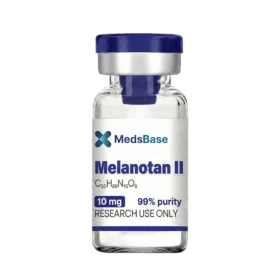
MedsBase voert Melanotan II in een enkele 10 mg lyofilisatieflessterkte, beschikbaar in 10-fles, 20-fles of 30-fles verpakkingsformaten:
| Vulsterkte | Typisch gebruik | Verpakkingsgroottes |
|---|---|---|
| 10 mg | Standaard onderzoekssterkte — ondersteunt ongeveer 40 toedieningen bij een titratiedosis van 250 mcg | 10, 20 of 30 vialen |
Het 10 mg enkelsterkte-formaat voldoet aan typische onderzoeksprotocolvereisten. Gepubliceerde protocollen gebruiken meestal een titratiestrategie (beginnend bij 250 mcg en oplopend tot 500 mcg–1 mg) om het smalle tolerantievenster van MTII te beheren. Geleverd als lyofilisaatpoeder met 99%+ HPLC zuiverheid.
Vergelijking — Melanotan II vs PT-141
MTII en PT-141 zijn de twee meest bestudeerde melanocortine onderzoekspeptiden. PT-141 is ontwikkeld vanuit MTII om het receptorselectiviteitsprofiel te verfijnen en off-target effecten te verminderen — de vergelijking is klinisch en mechanistisch instructief:
| Criterium | Melanotan II | PT-141 (Bremelanotide) |
|---|---|---|
| Receptorselectiviteit | Breed: MC1R, MC3R, MC4R, MC5R | MC4R-voorkeur (verminderde MC1R) |
| Primair onderzoekssignaal | Melanogenese, bruining, eetlust, opwinding | Centraal opwindingspad |
| Regulatorische status | Niet goedgekeurd (FDA-waarschuwingen afgegeven) | FDA-goedgekeurd als Vyleesi (HSDD) |
| Bijwerkingenprofiel | Breder: pigmentveranderingen, misselijkheid, bloeddrukstijgingen, ontwikkeling van moedervlekken | Smaller: misselijkheid, opvliegers, tijdelijke bloeddruk |
| Typische onderzoeksdosis | 250 mcg titratie tot 1 mg | 1–1,75 mg naar behoefte |
In onderzoek waar receptorselectiviteit van belang is (centrale opwinding zonder bruining), wordt PT-141 doorgaans verkozen. In onderzoek waar brede melanocortine-activiteit de variabele van belang is (bijv. dermatologisch onderzoek gericht op melanogenese), blijft MTII het canonieke referentiecompound.
Opslag en Reconstituering
Voor reconstituering: Bewaar lyofiliseerde flesjes gekoeld bij 2–8 °C in de originele verpakking, stabiel tot 36 maanden. Vermijd vries-dooicycli van het poeder.
Reconstitueringsprocedure: injecteer bacteriostatisch water langs de zijkant van het flesje volgens het bovenstaande schema. Draai voorzichtig — niet niet schudden — en laat 5–10 minuten staan voor volledige oplossing. De oplossing moet helder en kleurloos zijn.
Na reconstitutie: bewaar gekoeld bij 2–8 °C en gebruik binnen 30 dagen. Vries de gereconstitueerde oplossing niet in.
Veelgestelde vragen
Waar wordt Melanotan II voor gebruikt in onderzoek?
Melanotan II wordt gebruikt in laboratoriumonderzoek naar melanogenese (MC1R-gestuurde eumelaninesynthese), fotoprotectie, melanocortine-receptorfarmacologie, CNS-opwekkingspaden, onderzoek naar eetgedrag en vergelijkende MC-analoogfarmacologie (met name versus MC4R-selectieve PT-141). Het is niet FDA-goedgekeurd en wordt hier strikt verkocht voor alleen laboratoriumonderzoek.
Hoe verschilt Melanotan II van PT-141?
PT-141 (bremelanotide) is ontwikkeld vanuit Melanotan II specifiek om MC1R-activiteit te verminderen (minimale bruining) en MC4R-gemedieerde opwekkingspadeffecten te versterken. Melanotan II behoudt brede activiteit over MC1R, MC3R, MC4R en MC5R. PT-141 is door de FDA goedgekeurd als Vyleesi voor vrouwelijke HSDD; MTII is niet goedgekeurd en draagt FDA-veiligheidswaarschuwingen over ongecontroleerd gebruik.
Is Melanotan II goedgekeurd door de FDA?
Nee. Melanotan II heeft nooit goedkeuring gekregen van de FDA, EMA of enige andere regelgevende instantie voor welke indicatie dan ook. De Amerikaanse FDA heeft meerdere publieke waarschuwingen uitgegeven over ongecontroleerde Melanotan II-producten vanwege gedocumenteerde veiligheidsproblemen zoals atypische naevus (moedervlek) ontwikkeling, tijdelijke hypertensie, misselijkheid en focale hyperpigmentatie. Alle Melanotan II die wordt verkocht door leveranciers voor onderzoeksgebruik is uitsluitend bestemd voor laboratoriumonderzoek.
Wat is de gebruikelijke onderzoeksdosis van Melanotan II?
Gepubliceerde preklinische protocollen en onderzoeksdoseringstrajecten beginnen meestal bij 250 mcg en worden stapsgewijs verhoogd naar 500 mcg of 1 mg per toediening. Een flesje van 10 mg gereconstitueerd met 2,0 mL bacteriostatisch water levert 5 mg/mL — 5 streepjes op een U-100-spuit geeft 250 mcg. Het doseringstraject is standaard omdat MTII een smalle tolerantiewindow heeft.
Waarom heeft de FDA gewaarschuwd voor Melanotan II?
De FDA en dermatologische verenigingen hebben MTII gemarkeerd omdat ongecontroleerde verkoop voor cosmetische bruining gedocumenteerde veiligheidsproblemen heeft veroorzaakt, waaronder melanoom-geassocieerde atypische naevi, verergering van dysplastisch naevussyndroom, verhoogde bloeddruk, rhabdomyolyse in geïsoleerde gevallen en focale hyperpigmentatie. Omdat levering voor onderzoeksgebruik niet dezelfde kwaliteitscontroles heeft als farmaceutische productie, is ook lot-tot-lot variabiliteit gedocumenteerd. Laboratoriumonderzoek moet MTII met dezelfde voorzichtigheid behandelen als elk niet-goedgekeurd middel.
Hoe moet Melanotan II worden opgeslagen?
Gevriesdroogde flesjes: gekoeld bij 2–8 °C in originele verpakking, stabiel tot 36 maanden. Gereconstitueerde oplossing: gekoeld bij 2–8 °C, gebruik binnen 30 dagen. Vries de gereconstitueerde oplossing niet in.
Hoe moet ik Melanotan II reconstitueren?
Volg de bovenstaande reconstructietabel. Voeg bacteriostatisch water langs de zijkant van het flesje toe, draai voorzichtig en laat 5-10 minuten staan voor volledige oplossing. Schud niet Schudden. Er worden drie verdunningsopties geboden, afhankelijk van het gewenste volume per toediening.
Is Melanotan II gerelateerd aan afamelanotide of Scenesse?
Ja, indirect. Alle drie zijn synthetische α-MSH-analogen in de melanocortinefamilie. Afamelanotide (Scenesse) is het door de FDA goedgekeurde implantaat voor erytropoëtische protoporfyrie (EPP). Melanotan II is een apart onderzoeksanaloog met een andere receptorselectiviteit en toedieningsroute (subcutane injectie versus subcutaan implantaat). Een deel van het mechanistische onderzoek dat voorafging aan de goedkeuring van afamelanotide betrof MTII als referentieverbinding.
Welke sterktes heeft MedsBase op voorraad?
MedsBase voert Melanotan II in 10 mg lyofiliseerde flesjes, beschikbaar in verpakkingen van 10, 20 of 30 flesjes. Alle flesjes worden geleverd met een HPLC-puurheid van 99%+ en een certificaat van analyse op aanvraag.
Veroorzaakt Melanotan II bijwerkingen in onderzoek?
Gerapporteerde effecten in gepubliceerd onderzoek en casusrapportliteratuur zijn onder meer: misselijkheid (vooral aan het begin van de dosering), tijdelijke verhoging van de bloeddruk, gezichtsflush, geeuwen, eetlustremming en focale hyperpigmentatie. Ernstigere zorgen zijn de ontwikkeling van atypische naevi en, in geïsoleerde casusrapporten, associaties met dysplastische naevi of melanoom. Deze zorgen zijn een belangrijke reden voor de FDA-waarschuwingen en waarom onderzoeksprotocollen conservatieve titratie moeten gebruiken.
Wat is de halfwaardetijd van Melanotan II?
Melanotan II heeft een geschatte plasmahalfwaardetijd van ongeveer 33 minuten, met een terminale eliminatiehalfwaardetijd van ongeveer 2 uur op basis van farmacokinetische studies bij mensen. Onderzoeksprotocollen die acute MC1R/MC4R-effecten bestuderen, gebruiken eenmalige toediening, terwijl protocollen die gericht zijn op aanhoudende bruining of andere eindpunten herhaalde doseringsschema's gebruiken.
Hoe verschilt Melanotan II van PT-141?
Melanotan II is een cyclisch α-MSH-analoog met brede melanocortinereceptoractiviteit (MC1R–MC5R), bestudeerd voor UV-geïnduceerde pigmentatie, eetlustremming en opwindingsonderzoek. PT-141 (bremelanotide) is een metaboliet van Melanotan II met verminderde MC1R-activiteit en meer selectieve MC4R-activiteit, en is door de FDA goedgekeurd voor hypoactieve seksuele verlangensstoornis. MT-II veroorzaakt meer uitgesproken pigmentatie-effecten; de centrale opwindings-effecten van PT-141 hebben het meer gekarakteriseerde klinische dataset.
Kan ik Melanotan II bestellen voor internationale verzending?
Ja. MedsBase verzendt Melanotan II wereldwijd vanuit ons toegewijde peptideverzendnetwerk. Bestellingen met alleen peptiden komen in aanmerking voor onze zelfstandige peptideverzendservice. Bestellingen worden verzonden in temperatuurgecontroleerde verpakkingen met volledige tracking.
Andere Peptiden voor Herstel- en Prestatieonderzoek
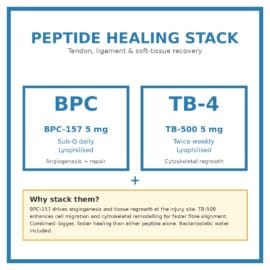
- BPC-157 — Body Protection Compound — onderzoek naar pees-, ligament- en darmherstel
- TB-500 — Thymosine Beta-4 fragment — onderzoek naar zacht weefsel en vasculair herstel
- Ipamorelin — Selectieve ghreline-agonist — schone GH-puls zonder cortisol/prolactine
- CJC-1295 met DAC — GHRH-analoog met verlengde halfwaardetijd
- GHK-Cu — Koperpeptide — onderzoek naar huid- en bindweefselregeneratie
Verder lezen
📖 Lees het onderzoek achter dit peptide
Lees onze volledige evidence-based gids: Melanotan II — mechanisme, melanogenese & eerlijk onderzoek. Behandelt MC-receptorfarmacologie, de MTII-naar-PT-141-lijn, FDA-veiligheids-waarschuwingen, gepubliceerde onderzoeksdoseringen, reconstitutieprotocollen en vergelijkende analoge context.
Meer opties in Peptiden
Gerangschikt op recente bestelvolumes van MedsBase — wat andere klanten in deze categorie kiezen.
| Sterkte | 10 mg |
|---|---|
| Hoeveelheid | 10 flacons, 20 flacons, 30 flacons |
 Melanotan II
Vragen & antwoorden
Melanotan II
Gerelateerde producten

Beoordelingen
Er zijn nog geen beoordelingen