







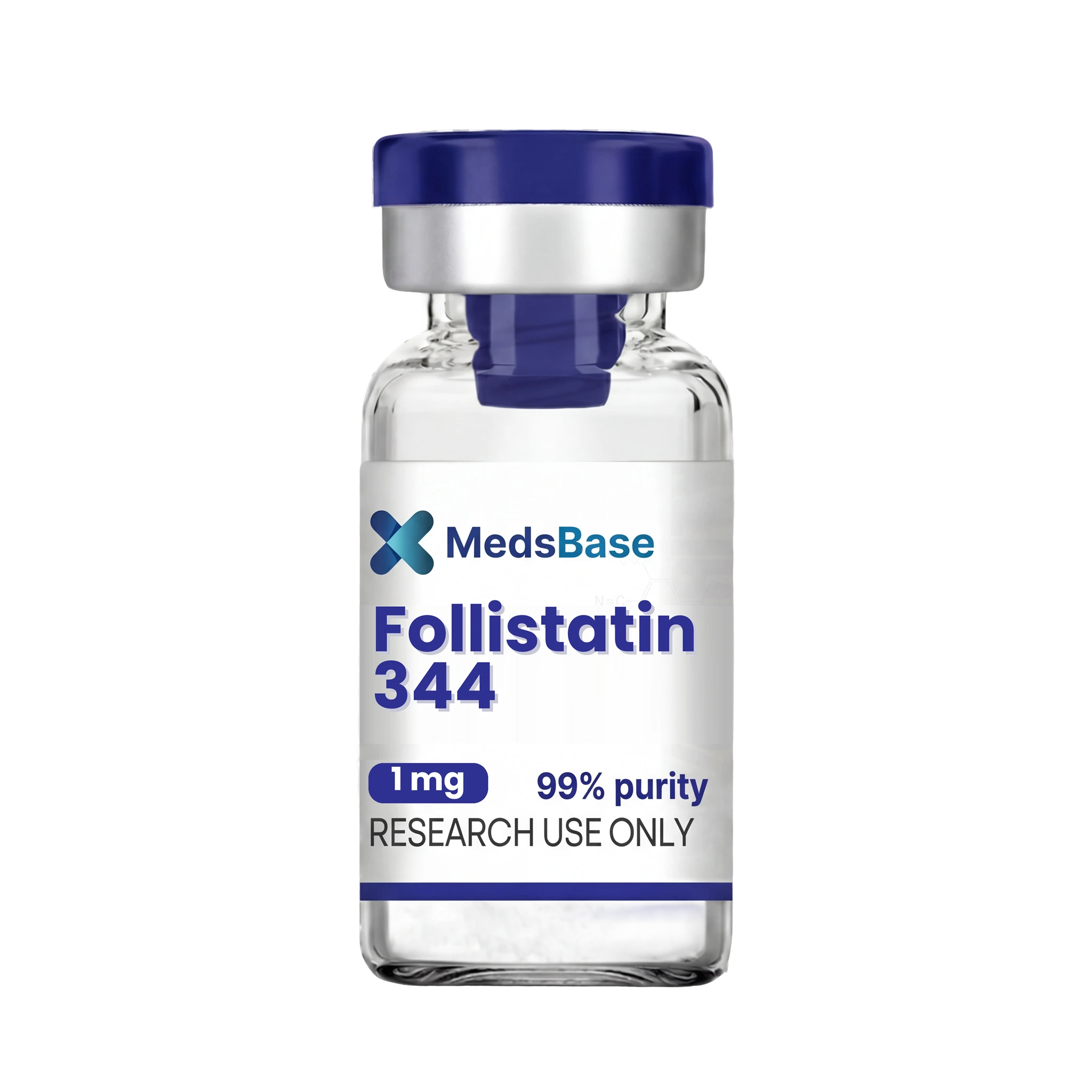
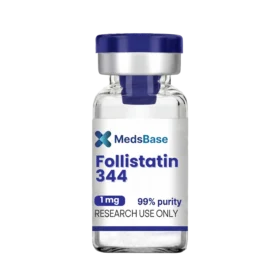
Follistatin 344
✅ 344-aa recombinant glycoproteïne
✅ Myostatine & activine pathway antagonist
✅ Spierhypertrofie onderzoeksverbinding
✅ Preklinische modellen voor spierdystrofie
✅ ≥95% HPLC zuiverheid, COA op aanvraag
Follistatin 344 is een recombinant eiwit.
✓ Medisch beoordeeld door Morgan Ellis — Apotheekonderzoeker · 8 jaar ervaring · Laatst beoordeeld: mei 2026
Snelle vraag — Wat is Follistatin 344?
Follistatin 344 (FST-344) is een 344-aminozuur recombinant glycoproteïne en de langste van de twee belangrijkste splice-isovormen van menselijk follistatin. Het is de canonieke endogene antagonist van myostatine (GDF-8) en activine, gebruikt in gepubliceerd onderzoek naar spierhypertrofie, sarcopenie, preklinische modellen van spierdystrofie en de activine/myostatine-signaleringsas. Levering in 1 mg lyofiliseerbare flesjes uitsluitend voor laboratoriumonderzoek.
📦 Elke bestelling is gedekt door onze Reshipment Assurance-beleid — als uw pakket niet binnen 20 werkdagen arriveert, sturen wij het opnieuw.
| Specificatie | Detail |
|---|---|
| CAS-nummer | 80449-31-6 (follistatin) |
| Type | Recombinant glycoproteïne (344-aminozuur FST-344 splice-isovorm van menselijk follistatin) |
| Moleculair gewicht | ~37 kDa (volwassen geglycosyleerde vorm; ~38–42 kDa waargenomen bereik op SDS-PAGE afhankelijk van glycosyleringsstatus) |
| Structuur | N-terminaal heparine-bindend domein gevolgd door drie follistatin-domeinen (FSD1, FSD2, FSD3) elk met een EGF-achtig en een Kazal-achtig subdomein; cysteïnerijk, meerdere intramoleculaire disulfidebruggen |
| Form | Lyofiliseerbaar recombinant eiwit (wit tot off-white) |
| Zuiverheid | ≥95% (HPLC-geverifieerd, COA op aanvraag) |
| Opslag | Gevriesdroogd: 2–8 °C (koelkast) voor werkvoorraad; −20 °C voor langdurige opslag van ongeopende flesjes. Aangemaakt: 2–8 °C, binnen ~30 dagen gebruiken. Beschermen tegen licht. Niet herhaaldelijk invriezen en ontdooien van de aangemaakte oplossing — recombinante eiwitten zijn bijzonder gevoelig voor denaturatie door vries-ontdooicycli. |
| Oplosbaarheid | Bacteriostatisch water (aanbevolen) of steriel water voor kortere gebruiksperioden. Dragerproteïne (BSA, 0,1%) optioneel voor werkverdunningen om adsorptieverliezen te minimaliseren. |
| Onderzoeksgebruik | Alleen voor laboratoriumonderzoek. Niet voor humaan of veterinair diagnostisch of therapeutisch gebruik. |
Wat Is Follistatin 344?
Follistatin 344 (vaak afgekort als FST-344) is een recombinant glycoproteïne van 344 aminozuren en de langste van de twee belangrijkste fysiologische splice-isovormen van humaan follistatine — de andere is FST-288, een kortere membraangebonden vorm van 288 aminozuren. Endogeen follistatine werd voor het eerst geïsoleerd in 1987 uit varkensovariumfollikelvloeistof door Esch et al. (PNAS) en Robertson et al. (Biochem Biophys Res Commun) als een factor die selectief de afscheiding van follikelstimulerend hormoon (FSH) remt, wat het eiwit zijn naam gaf. De mechanistische rol — hoogaffiniteitsbinding en neutralisatie van activine en myostatine — werd in het daaropvolgende decennium gekarakteriseerd.
FST-344 is een circulerende, uitgescheiden isovorm met een heparine-bindend N-terminaal domein gevolgd door drie cysteïnerijke follistatine-domeinen (FSD1, FSD2, FSD3) die samen het activine- en myostatine-bindend oppervlak vormen. De recombinant keten van 344 residuen heeft een volwassen massa van ongeveer 37 kDa, met een schijnbaar molecuulgewicht op SDS-PAGE variërend tussen 38 en 42 kDa afhankelijk van de glycosyleringsstatus van het recombinant expressiesysteem. CAS-nummer 80449-31-6. Het eiwit wordt geleverd als een hoogzuiver gevriesdroogd poeder voor aanmaak met bacteriostatisch water. Follistatine is niet goedgekeurd door de FDA, EMA, MHRA of enige andere grote regelgever voor humaan therapeutisch gebruik. Het onderzoekskwaliteit follistatin 344 dat hier wordt verkocht, is geleverd uitsluitend voor laboratoriumonderzoek en is niet bedoeld voor menselijke of veterinaire toediening. Voor gerelateerd anabool en groeias-onderzoek, zie onze IGF-1 LR3 productpagina.
Werkingsmechanisme — Myostatine- en Activinewegantagonisme
Wat follistatin 344 mechanistisch uniek maakt onder spieronderzoeksproteïnen is zijn multi-target bindingsprofiel binnen de TGF-β superfamilie — elke ligandbindingsgebeurtenis draagt bij aan het waargenomen hypertrofische en groeimodulerende fenotype in gepubliceerd onderzoek:
- Myostatine (GDF-8) sequestratie — spierhypertrofie-as — Follistatine bindt myostatine (ook wel GDF-8 genoemd) met hoge affiniteit, waardoor de interactie met de activine type II receptor (ActRIIB) sterisch wordt geblokkeerd. Myostatine is de canonieke endogene negatieve regulator van spiergroei: knock-outmuizen ontwikkelen dramatische spierhypertrofie (het “dubbelspier”-fenotype), en van nature myostatine-deficiënte runderrassen (Belgisch Blauw, Piemontees) vertonen hetzelfde effect. Door myostatine te neutraliseren, verwijdert follistatine de rem op spiereiwitsynthese, wat hypertrofie veroorzaakt in onderzoeksmodellen. Dit is het meest aangehaalde mechanisme in de spieronderzoeksliteratuur.
- Activine A en B sequestratie — reproductieve, ovariële en hypofyse-signalering — De oorspronkelijke gekarakteriseerde functie van follistatine was het binden en neutraliseren van activine, een verwant lid van de TGF-β-superfamilie dat de FSH-secretie uit de hypofyse stimuleert, de ontwikkeling van ovariale follikels aanstuurt en fungeert als regulator van vele celtypen. Door activine A, B en AB-heterodimeren te binden, verschuift follistatine de activine/inhibine-balans in onderzoeksmodellen en moduleert het de downstream Smad2/Smad3-signalering.
- GDF-11 en bredere TGF-β-superfamilie-modulatie — Follistatine bindt ook GDF-11 (verwant aan myostatine) met enigszins lagere affiniteit, naast andere leden van de TGF-β-superfamilie. GDF-11 wordt steeds meer bestudeerd in verouderingsonderzoek omdat de endogene niveaus ervan afnemen met de leeftijd en de modulatie ervan betrokken is bij leeftijdsgerelateerde cardiale en CNS-fenotypen. Follistatine 344 is een van de belangrijkste onderzoeksinstrumenten voor het onderzoeken van deze as.
De drie follistatine-domeinen (FSD1, FSD2, FSD3) dragen elk bij aan het bindingsprofiel: FSD1 bevat het belangrijkste myostatine-bindende oppervlak, FSD2 het belangrijkste activine-bindende oppervlak en FSD3 draagt bij aan zowel bindingsaffiniteit als structurele stabiliteit. Het heparine-bindende N-terminale domein onderscheidt de splice-varianten — FST-288 bindt sterk aan heparansulfaat en is grotendeels membraan-verankerd, terwijl FST-344 (deze isoform) vrijer circuleert. Dit onderscheid is mechanistisch relevant in onderzoeksmodellen die systemische versus lokale follistatine-effecten bestuderen.
Gepubliceerde onderzoeksapplicaties
Follistatine 344 wordt gebruikt in laboratoriumonderzoeken die zich richten op:
- Onderzoek naar spierhypertrofie en eiwitsynthese — muis- en rat-hypertrofiemodellen inclusief AAV-follistatine-genafleveringsstudies (Kota et al., Sci Transl Med 2009); vezeltype-specifiek dwarsdoorsnedeoppervlak, spiernatgewicht, krachtgeneratie
- Preklinische modellen van spierdystrofie — mdx-muismodel van Duchenne-spierdystrofie; functionele capaciteit, vezelregeneratie, dystrofine-onafhankelijke spierbehoud
- Sarcopenie en leeftijdsgerelateerd spierverlies — verouderde muisspierfenotypen, anabole resistentie, vezeltype-verschuivingsonderzoek
- Onderzoek naar kanker cachexie — cachexiemodellen in tumordragende muizen, behoud van lichaamssamenstelling, verhouding vetvrije massa/vetmassa
- Onderzoek naar reproductieve endocrinologie — FSH-onderdrukking, ontwikkeling van ovariale follikels, granulosa-celbiologie, onderzoek naar de hypofyse-gonadale as
- Onderzoek naar de Activine-signaalroute — Smad2/Smad3-signalering, EMT in kankermodellen, onderzoek naar fibrose, leverregeneratie
- Onderzoek naar veroudering en de GDF-11-as — cardiale en CZS-verouderingsfenotypen, parabiosis-gerelateerd onderzoek, GDF-11/myostatinebalans bij veroudering
- Vergelijkend anabool onderzoek — directe vergelijking met IGF-1 LR3 (parallel anabole route via IGF-1-receptor) voor gecombineerd of vergelijkend hypertrofieonderzoek.
Voor een bredere context over de plaats van follistatine 344 binnen het anabole en groei-as onderzoekslandschap, zie IGF-1 LR3 als de canonieke IGF-as vergelijker, CJC-1295 met DAC voor GHRH-as groeionderzoek, en Sermorelin voor onderzoek met kortwerkende GHRH. Bekijk het volledige onderzoekspeptiden catalogus voor gerelateerde verbindingen.
Beschikbare sterktes en concentraties
MedsBase stocks Follistatin 344 in 1 mg lyophilized vials. The vial is available in 10-vial, 20-vial, or 30-vial pack formats with full reconstitution guidance:
| Vulsterkte | Typisch Onderzoeksgebruik | Verpakkingsgroottes |
|---|---|---|
| 1 mg | Standaard onderzoekssterkte - onderzoek naar spierhypertrofie en de activine/myostatine-as | 10, 20 of 30 vialen |
Follistatin 344 is een 37 kDa recombinant glycoproteïne met een HPLC-puurheid van ≥95%. Het 1 mg vial-formaat is de standaard onderzoekssterkte voor in vivo en in vitro werk - één vial gereconstitueerd met 1,0 mL bacteriostatisch water levert een werkconcentratie van 1 mg/mL op, voldoende voor vele weken celkweekprotocollen of meerdere injecties in knaagdierprotocollen.
Vergelijking - Follistatin 344 vs IGF-1 LR3
Follistatin 344 en IGF-1 LR3 zijn de twee meest geciteerde recombinant anabole eiwitten in huidig hypertrofieonderzoek. Ze werken via volledig verschillende pathways - follistatin door het wegnemen van de myostatine-rem op spiergroei, IGF-1 LR3 door directe stimulatie van de IGF-1-receptor en downstream Akt/mTOR eiwitsynthese - wat ze mechanistisch complementair maakt in onderzoeksprotocollen.
| Criterium | Follistatin 344 | IGF-1 LR3 |
|---|---|---|
| Lengte | 344 aminozuren (recombinant glycoproteïne) | 83 aminozuren (gemodificeerd IGF-1) |
| Molecuulgewicht | ~37 kDa | ~9 kDa |
| Primair werkingsmechanisme | Myostatine/activine sequestratie | IGF-1 receptor agonisme → Akt/mTOR |
| Werkingsmechanisme | Disinhibitie (verwijdert de groeirem) | Directe anabole stimulatie |
| Typische onderzoeksdosis | 10–100 mcg, 1–3x per week | 20–60 mcg, dagelijks |
| Sterkste onderzoekssignaal | Hypertrofie van hele spieren, dystrofiemodellen | Lokale hypertrofie, regeneratief anabool onderzoek |
| Stacking | Wordt vaak samen toegediend met IGF-1 LR3 in hypertrofieonderzoek | Wordt vaak samen toegediend met follistatine 344 |
Omdat de twee eiwitten fundamenteel verschillende anabole assen beïnvloeden — follistatine verwijdert de myostatinerem terwijl IGF-1 LR3 direct de eiwitsynthese stimuleert — wordt gecombineerde toediening vaak gebruikt in onderzoeksmodellen die de maximale hypertrofische respons onderzoeken. Voor onderzoek dat specifiek gericht is op de myostatineweg, is follistatine 344 de eerste keuze; voor IGF/Akt/mTOR-anabool onderzoek is IGF-1 LR3 het standaard onderzoeksinstrument.
Opslag en Reconstituering
Voor reconstituering: Bewaar lyofiliseerde flesjes gekoeld bij 2–8 °C in de originele verpakking voor kortdurende voorraad. Voor ongebruikte langdurige opslag, vries in bij −20 °C. Lyofiliseerde follistatine 344 is stabiel onder koeling tot 12 maanden en bij −20 °C tot 24 maanden — iets korter dan kleine synthetische peptiden omdat het grotere recombinante glycoproteïne gevoeliger is voor deaminering en oxidatie over tijd. Vermijd vries-ontdooicycli van het lyofiliseerde poeder.
Reconstitueringsprocedure: spuit bacteriostatisch water langs de zijwand van het peptideflesje (niet direct op het gevriesdroogde cake). Voor een flesje van 1 mg levert 1,0 mL bacteriostatisch water een werkconcentratie van 1 mg/mL op. Draai voorzichtig — doe niet Bewaar gekoeld bij 2–8 °C en gebruik binnen 30 dagen voor optimale stabiliteit. Vries de gereconstitueerde oplossing niet in — recombinante glycoproteïnen zijn bijzonder gevoelig voor denaturatie door vries-ontdooicycli, wat aggregatie en activiteitsverlies veroorzaakt. Gooi elk flesje weg dat troebelheid, neerslag of verkleuring vertoont.
Na reconstitutie: Bewaar gekoeld bij 2–8 °C en gebruik binnen 30 dagen voor optimale stabiliteit. Vries de gereconstitueerde oplossing niet in — recombinante glycoproteïnen zijn bijzonder gevoelig voor denaturatie door vries-dooicycli, wat aggregatie en verlies van activiteit veroorzaakt. Gooi elke fles weg die troebelheid, neerslag of verkleuring vertoont.
Veelgestelde vragen
Waar wordt Follistatin 344 voor gebruikt in onderzoek?
Follistatin 344 wordt gebruikt in laboratoriumonderzoek naar spierhypertrofie, preklinische modellen van spierdystrofie, sarcopenie, kanker cachexie, de activine/myostatine/GDF-11-signaleringsas, reproductieve endocrinologie (FSH-onderdrukking, ontwikkeling van ovariële follikels) en verouderingsgerelateerde fenotypen. Het is het standaard onderzoeksinstrument voor myostatineweg-antagonisme. De onderzoekskwaliteit follistatin 344 die hier wordt verkocht is niet FDA-goedgekeurd en wordt strikt geleverd voor laboratoriumonderzoek alleen.
Wat is het verschil tussen Follistatin 344 en Follistatin 315?
FST-344 is het genproduct van de 344-aminozuur isovorm inclusief het signaalpeptide; FST-315 is hetzelfde eiwit na de splitsing van het signaalpeptide tijdens secretie (dus FST-315 is de volwassen circulerende vorm van FST-344). Beide nomenclatuursystemen komen in de literatuur voor en verwijzen naar dezelfde biologische isovorm. Beide verschillen aanzienlijk van FST-288, een kortere alternatief gespliceerde isovorm met sterkere heparansulfaatbinding en voornamelijk membraangebonden lokalisatie.
Hoe verschilt Follistatin 344 van IGF-1 LR3?
Beide zijn recombinante anabole eiwitten die worden gebruikt in onderzoek naar spierhypertrofie, maar ze richten zich op verschillende pathways. Follistatin 344 is een 344-aminozuur glycoproteïne dat myostatine en activine bindt en afschermt — het werkt door het endogene remmechanisme op spiergroei te verwijderen. IGF-1 LR3 is een 83-aminozuur gemodificeerd IGF-1-analoog dat direct de IGF-1-receptor activeert en de Akt/mTOR-eiwitsynthese stimuleert. De twee zijn mechanistisch complementair en worden vaak samen toegediend in onderzoek.
Wat is de gebruikelijke onderzoeksdosis voor Follistatin 344?
Gepubliceerde preklinische protocollen gebruiken typisch 10–100 mcg per toediening in knaagdier modellen, gegeven 1–3 keer per week voor cycli van 4–12 weken. Genafgifteonderzoek met AAV-follistatin produceert weefsellokale concentraties die moeilijk direct te vergelijken zijn met systemische eiwitdosering. Een 1 mg vial gereconstitueerd met 1,0 mL bacteriostatisch water levert 1 mg/mL — 0,01 mL komt overeen met 10 mcg, 0,1 mL komt overeen met 100 mcg.
Is Follistatin 344 goedgekeurd door de FDA?
Nee. Follistatin 344 is niet goedgekeurd door de FDA, EMA, MHRA of enige andere grote regelgever voor humaan therapeutisch gebruik. AAV-follistatin gentherapie is onderzocht in klinische onderzoeken voor spierdystrofie (bijv. Becker spierdystrofie, inclusion body myositis) maar is niet FDA-goedgekeurd. Alle follistatin 344 verkocht door leveranciers voor onderzoeksgebruik is bedoeld voor laboratoriumonderzoek en mag niet aan mensen worden toegediend.
Hoe moet Follistatin 344 worden opgeslagen?
Lyofiliseerde vials: gekoeld bij 2–8 °C voor kortetermijn werkvoorraad, of −20 °C voor langdurige opslag van ongeopende vials. Gereconstitueerde oplossing: gekoeld bij 2–8 °C, gebruik binnen 30 dagen. Vries gereconstitueerde oplossing niet in — recombinante glycoproteïnen zijn bijzonder gevoelig voor denaturatie door vries-dooicycli. Bescherm te allen tijde tegen direct licht. Dragerproteïne (BSA bij 0,1%) wordt aanbevolen voor werkverdunningen onder 100 mcg/mL.
Hoe moet ik Follistatin 344 reconstitueren?
Volg de bovenstaande reconstitueringsprocedure. Voeg bacteriostatisch water langs de zijkant van het flesje toe (niet direct op het lyofilisatiepoeder), draai voorzichtig en laat het 5–10 minuten staan voor volledige oplossing. Schud niet het flesje niet — krachtig schudden kan recombinante eiwitten denatureren en aggregatie veroorzaken. Een correct gereconstitueerde oplossing is helder en kleurloos. Voor een flesje van 1 mg + 1,0 mL verdunningsmiddel is de werkconcentratie 1 mg/mL.
Waarom is de zuiverheidsspecificatie 95% in plaats van 99%?
Recombinante glycoproteïnen zoals follistatin 344 kunnen niet voldoen aan de ≥99% HPLC-zuiverheidsstandaard die typisch is voor kleine synthetische peptiden vanwege de inherente heterogeniteit van glycosylering in elk recombinant expressiesysteem — verschillende glycoformen verschijnen als gerelateerde pieken op HPLC die geen onzuiverheden zijn maar isoformen van het doelwit-eiwit. ≥95% HPLC-zuiverheid is de standaard onderzoeksspecificatie voor follistatin 344 en vergelijkbare recombinante glycoproteïnen. SDS-PAGE toont typisch één band met de verwachte schijnbare massa van 38–42 kDa.
Welke sterktes heeft MedsBase op voorraad?
MedsBase carries Follistatin 344 in 1 mg lyophilized vials. The vial is available in 10-vial, 20-vial, or 30-vial pack sizes. All vials are supplied at ≥95% HPLC purity with a certificate of analysis available on request.
Kunnen Follistatin 344 en IGF-1 LR3 in onderzoek worden gecombineerd?
Ja. Follistatin 344 en IGF-1 LR3 werken in op fundamenteel verschillende anabole assen (myostatine-antagonisme versus IGF-1-receptoragonisme) en worden vaak samen toegediend in onderzoeksmodellen die maximale hypertrofische respons onderzoeken. De twee zijn mechanistisch complementair in plaats van redundant, en literatuur over gecombineerde protocollen beschrijft additieve of synergetische effecten op de dwarsdoorsnede van spiervezels.
Veroorzaakt Follistatin 344 bijwerkingen in onderzoek?
Gepubliceerd preklinisch onderzoek heeft een goede verdraagbaarheid aangetoond bij typische onderzoeksdoseringen, waarbij het belangrijkste doelwiteffect spierhypertrofie is. Off-target bevindingen omvatten modulatie van FSH en ovariële functie (omdat activine-signalering wordt onderdrukt) en potentiële effecten op leverregeneratie en hypofyseregulatie vanwege de rol van follistatin in bredere TGF-β-superfamiliesignalering. Systemische toediening van follistatin-eiwit heeft andere blootstellingskenmerken dan weefselgelokaliseerde AAV-genafgiftemethoden.
Wat is de halfwaardetijd van Follistatin 344?
In preklinisch onderzoek heeft recombinant follistatin 344 een plasmahalfwaardetijd van ongeveer 1–3 uur na intraveneuze toediening, wat overeenkomt met zijn grootte (37 kDa, boven de renale filtratiedrempel) en binding aan circulerende liganden. De halfwaardetijd in weefsel is aanzienlijk langer omdat follistatin gebonden blijft aan zijn gevangen myostatine- en activinedoelen, waardoor ze weggehouden worden van receptoren. Genafgiftemethoden zorgen voor een veel langere effectieve werkingsduur omdat weefselexpressie weken tot maanden aanhoudt.
Hoe lang duurt het voordat Follistatin 344 effecten laat zien in preklinisch onderzoek?
Spierhypertrofie-effecten in muis- en ratprotocollen met eiwitinjecties worden doorgaans statistisch significant na 2–4 weken van wekelijkse toediening en blijven toenemen tot 8–12 weken. Effecten op de activine/FSH-as voor reproductieve eindpunten kunnen al binnen enkele dagen na toediening worden gedetecteerd. Genafgifteprotocollen (AAV-follistatin) tonen meetbare spierhypertrofie 4–6 weken na injectie en blijven zich over maanden ontwikkelen.
Kan ik Follistatin 344 bestellen voor internationale verzending?
Ja. MedsBase verzendt Follistatin 344 wereldwijd vanuit ons toegewijde peptide-verzendnetwerk. Bestellingen met alleen peptides komen in aanmerking voor onze standalone peptide-verzendservice. Alle bestellingen worden verzonden in temperatuurgecontroleerde verpakkingen met volledige tracking en vallen onder onze Reshipment Assurance-beleid.
Andere peptiden voor anabool, groei-as en spieronderzoek
- IGF-1 LR3 — Lang-arginine recombinant IGF-1 analoog — directe IGF-1R agonist voor Akt/mTOR-onderzoek
- CJC-1295 met DAC — Langwerkend GHRH analoog — groeihormoon-as onderzoek
- Sermorelin — Korter werkend GHRH(1-29) analoog — natuurlijk GH-puls onderzoek
- Ipamorelin — Selectieve ghreline-agonist — schone GH-puls zonder cortisol/prolactine
- TB-500 (Thymosin Beta-4) — Systemisch herstelfragment — spier- en hartherstel onderzoek
Verder lezen
📖 Verken anabole en groei-as onderzoekspeptiden
Bekijk het volledige onderzoekspeptiden catalogus, met verwante verbindingen inclusief IGF-1 LR3 voor direct IGF-receptor anabool onderzoek, CJC-1295 met DAC voor langwerkend GHRH onderzoek, en TB-500 voor systemisch spier- en weefselherstel onderzoek.
Meer opties in Peptiden
Gerangschikt op recente bestelvolumes van MedsBase — wat andere klanten in deze categorie kiezen.
| Sterkte | 1 mg |
|---|---|
| Hoeveelheid | 10 flacons, 20 flacons, 30 flacons |
 Follistatin 344
Vragen & antwoorden
Follistatin 344
Gerelateerde producten

Beoordelingen
Er zijn nog geen beoordelingen