







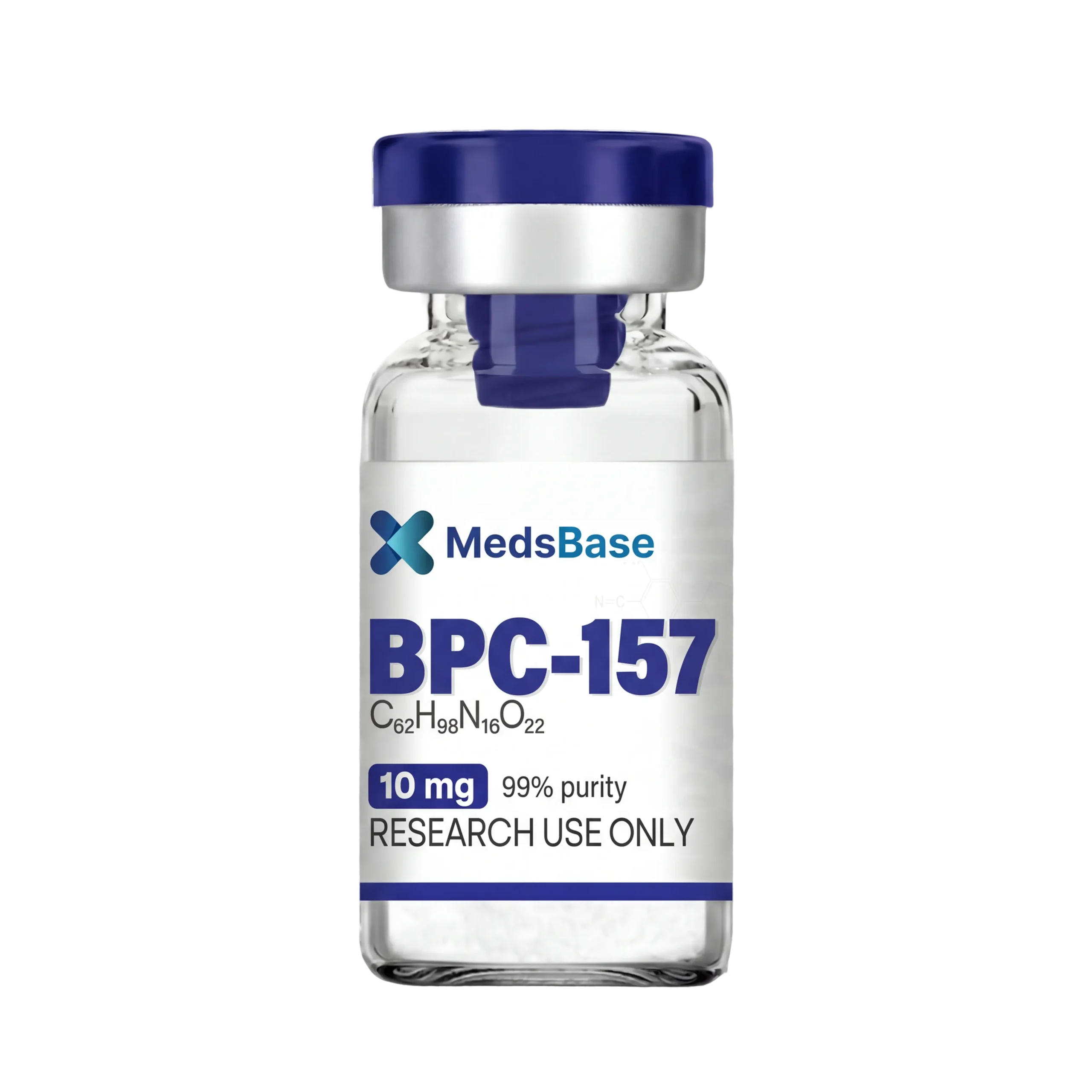
BPC-157
✅ Ondersteunt celregeneratie
✅ Verbetert weefselmodellering
✅ Bevordert fibroblastenactiviteit
✅ Stimuleert angiogene signalering
✅ Verbetert de stabiliteit van de extracellulaire matrix
BPC-157 bevat synthetisch peptideverbinding.
✓ Medisch beoordeeld door Morgan Ellis — Apotheekonderzoeker · 8 jaar ervaring · Laatst beoordeeld: mei 2026
Snelle vraag — Wat is BPC-157?
BPC-157 (Body Protection Compound 157) is een synthetisch pentadecapeptide bestaande uit 15 aminozuren, afgeleid van een beschermend maageiwit. In gepubliceerd preklinisch onderzoek heeft het consistente effecten laten zien op het herstel van pees-, ligament-, darm-, spier- en vaatweefsel via VEGF, stikstofoxide en groeihormoonreceptorsignalering. Leverbaar in lyofilisatievials van 2 mg tot 10 mg, uitsluitend voor laboratoriumonderzoek.
📦 Elke bestelling is gedekt door onze Reshipment Assurance-beleid — als uw pakket niet binnen 20 werkdagen arriveert, sturen wij het opnieuw.
| Specificatie | Detail |
|---|---|
| CAS-nummer | 137525-51-0 |
| Molecuulformule | C62H98N16O22 |
| Moleculair gewicht | 1419.55 Da |
| Sequentie | Gly-Glu-Pro-Pro-Pro-Gly-Lys-Pro-Ala-Asp-Asp-Ala-Gly-Leu-Val (GEPPPGKPADDAGLV) |
| Form | Lyofiliseerd poeder (of zoals geleverd) |
| Zuiverheid | ≥99% (HPLC geverifieerd, COA op aanvraag) |
| Opslag | Lyofiliseerd: 2–8 °C (koelkast) voor werkvoorraad; −20 °C voor langdurige opslag van ongeopende flesjes. Gereconstitueerd: 2–8 °C, gebruik binnen ~30 dagen. Bescherm tegen licht. Vries de gereconstitueerde oplossing niet in en ontdooi deze niet. |
| Oplosbaarheid | Bacteriostatisch water (aanbevolen) of steriel water voor kortere gebruiksperioden |
| Onderzoeksgebruik | Alleen voor laboratoriumonderzoek. Niet voor humaan of veterinair diagnostisch of therapeutisch gebruik. |
Wat is BPC-157?
BPC-157 is de afkorting van Body Protection Compound 157, een synthetisch pentadecapeptide van 15 aminozuren dat oorspronkelijk werd geïsoleerd als een fragment van een groter beschermend eiwit dat wordt aangetroffen in menselijk maagsap. In tegenstelling tot de meeste peptiden is het stabiel in maagzuur, wat het een veelvoorkomend onderwerp van onderzoek naar orale toediening in knaagdier-modellen heeft gemaakt, naast de meer gebruikelijke subcutane route. BPC-157 is een van de meest bestudeerde peptiden in het preklinische onderzoek naar genezing, met gepubliceerd werk dat pezen, ligamenten, darmbarrière, skeletspieren, bot en vasculair weefsel omvat.
De peptidevolgorde is GEPPPGKPADDAGLV, molecuulgewicht ongeveer 1.419 Da, empirische formule C62H98N16O22. Het wordt geleverd als een hoogzuiver lyofiliseerbaar poeder voor reconstitutie met bacteriostatisch water. BPC-157 is uitsluitend voor laboratoriumonderzoek en is niet bedoeld voor menselijke of veterinaire diagnose of therapie. Voor een diepgaande analyse van het werkingsmechanisme, gepubliceerde proefdetails en overwegingen voor onderzoeksdoseringen, zie ons volledige BPC-157 onderzoeksgids.
Werkingsmechanisme — Drie Overlappende Genezingsroutes
Wat BPC-157 onderscheidt van enkelvoudige route-peptiden is zijn gelijktijdige activiteit via drie verschillende signaalroutes, die elk bijdragen aan het waargenomen weefselherstel-fenotype in gepubliceerd onderzoek:
- Angiogenese / VEGF-upregulatie — BPC-157 reguleert de expressie van vasculair endotheliale groeifactor receptor 2 (VEGFR2) op in beschadigd weefsel, wat de vorming van nieuwe haarvaten bevordert. Dit verbetert de lokale perfusie op herstelplaatsen, de beperkende stap in de genezing van pezen, ligamenten en spieren.
- Stikstofmonoxide (NO)-route — BPC-157 verhoogt de activiteit van endotheliale stikstofmonoxide-synthase (eNOS) en beschermt het vasculaire endotheel tegen oxidatieve schade. In diermodellen van portale hypertensie, systemische vasoconstrictie en maagzweren is dit effect essentieel voor de beschermende werking van de stof.
- Opregulatie van groeihormoonreceptoren — BPC-157 verhoogt de expressie van groeihormoonreceptoren (GHR) op fibroblasten en tenocyten, wat de synthese van collageen type I bevordert. Dit mechanisme wordt verondersteld ten grondslag te liggen aan de waargenomen verbeteringen in peessterkte in modellen van Achillespees- en mediale-collaterale-ligamentdoorsnijdingen.
Omdat deze drie routes samenkomen in beschadigd weefsel, zorgt BPC-157 voor een snellere en volledigere herstel dan interventies die slechts één route targeten in dezelfde modellen. Het wordt ook opmerkelijk goed verdragen binnen het bereik van gepubliceerde doseringen, met minimale off-target signalering gerapporteerd in toxicologisch onderzoek.
Gepubliceerde onderzoeksapplicaties
BPC-157 wordt gebruikt in laboratoriumonderzoeken die zich richten op:
- Herstel van pees- en ligamentblessures — Achillespeesdoorsnijding, ruptuur van het mediale collaterale ligament, rotator-cuff scheur diermodellen (Chang et al., J Appl Physiol 2011; Staresinic et al., J Orthop Res 2003)
- Onderzoek naar darmbarrière-integriteit en zweren — maagzweer, colitis en inflammatoire-darmziekte modellen; de maag-afkomstige oorsprong van BPC-157 is hier mechanistisch relevant (Sikiric et al., Curr Med Chem 2011)
- Regeneratie van skeletspieren — onderzoek naar herstelkinetiek na blessures, proliferatie van myoblasten en vorming van myotuben
- Onderzoek naar gewrichten en kraakbeen — osteoartritis diermodellen, samenstelling van kraakbeenmatrix, synoviale ontsteking
- Vasculaire angiogenese — vorming van nieuwe haarvaten en perfusie op plaatsen van weefselbeschadiging
- Botgenezing — vorming van fractuurcallus in osteotomie- en botdefectonderzoeksmodellen
- Vergelijkend herstelonderzoek — benchmarking tegen andere helende peptiden, met name TB-500 (Thymosin Beta-4) als de canonieke systemische herstelvergelijker. Zie de BPC-157 vs TB-500 vergelijking voor een volledige vergelijking.
Voor een bredere context over waar BPC-157 past binnen het landschap van helende peptiden, zie de beste peptiden voor spierherstel clusterartikel en GHK-Cu koperpeptide als een complementair anti-verouderingsonderzoekscompound. Bekijk het volledige onderzoekspeptiden catalogus voor gerelateerde verbindingen.
Beschikbare sterktes en concentraties
MedsBase heeft BPC-157 in de volgende lyofilisatievialformaten. Elke variant wordt geleverd in verpakkingen van 10, 20 en 30 vialen met volledige reconsitutiehandleiding:
| Vulsterkte | Typisch gebruik | Verpakkingsgroottes |
|---|---|---|
| 2 mg | Korte onderzoeksprotocollen, pilotdosering, titratie | 10, 20 of 30 vialen |
| 5 mg | Standaard onderzoekssterkte, meest besteld | 10, 20 of 30 vialen |
| 10 mg | Uitgebreide onderzoeksprotocollen, laagste kosten per mg | 10, 20 of 30 vialen |
Alle drie de sterktes hebben dezelfde chemische vorm (gevriesdroogd poeder, 99%+ HPLC zuiverheid). Hogere mg-flacons vereisen kleinere reconstitutievolumes per eenheidsdosis, wat nuttig is wanneer onderzoekers het injectievolume in knaagdiermodellen willen minimaliseren.
Vergelijking — BPC-157 versus TB-500
BPC-157 en TB-500 zijn de twee meest geciteerde helende onderzoekspeptiden. Ze worden vaak parallel bestudeerd omdat ze via complementaire, grotendeels niet-overlappende mechanismen werken. Veel preklinische protocollen combineren ze in plaats van ze afzonderlijk te gebruiken.
| Criterium | BPC-157 | TB-500 (Thymosin Beta-4) |
|---|---|---|
| Lengte | 15 aminozuren (pentadecapeptide) | 43 aminozuren (thymuspeptide) |
| Primair werkingsmechanisme | VEGF + NO + GH-receptor upregulatie | G-actine sequestratie, celmigratie |
| Distributie | Meer gelokaliseerd op de injectieplaats | Systemisch, verspreidt zich breed |
| Typische onderzoeksdosis | 250–500 mcg, 1–2x per dag | 2–2,5 mg, 2x per week |
| Sterkste onderzoekssignaal | Pezen, ligamenten, darmbarrière | Cardiaal, systemische spieren, vasculair |
| Stacking | Wordt in onderzoek vaak samen toegediend met TB-500 | Wordt in onderzoek vaak samen toegediend met BPC-157 |
Voor een volledige methodologische vergelijking inclusief doseringsprotocollen en wanneer onderzoekers de ene boven de andere kiezen, lees BPC-157 vs TB-500: welk herstelpeptide voor jouw hersteldoel.
Opslag en Reconstituering
Voor reconstituering: bewaar lyofiliseerde flesjes gekoeld bij 2–8 °C in de originele verpakking. Lyofiliseerde BPC-157 is onder deze omstandigheden stabiel tot 36 maanden. Vermijd vries-dooicycli van het poeder.
Reconstitueringsprocedure: spuit bacteriostatisch water langs de zijkant van het peptideflesje (niet direct op de lyofiliseerde cake) volgens de bovenstaande verdunningstabel. Draai voorzichtig — doe niet Schud — en laat 2–5 minuten staan voor volledige oplossing. Een correct gereconstitueerde oplossing moet helder en kleurloos zijn.
Na reconstitutie: bewaar gekoeld bij 2–8 °C en gebruik binnen 30 dagen voor optimale stabiliteit. Vries de gereconstitueerde oplossing niet in — vries-dooicycli tasten de peptide-integriteit aan. Gooi elk flesje weg dat troebelheid, neerslag of verkleuring vertoont.
Veelgestelde vragen
Waar wordt BPC-157 voor gebruikt in onderzoek?
BPC-157 wordt gebruikt in laboratoriumonderzoek naar genezing van pezen en ligamenten, integriteit van de darmbarrière, herstel van skeletspieren, vasculaire angiogenese, ontstekingsremmende signalering en botgenezing. Het is niet FDA-goedgekeurd en wordt hier strikt verkocht voor alleen laboratoriumonderzoek.
Hoe verschilt BPC-157 van TB-500?
BPC-157 is een pentadecapeptide van 15 aminozuren afgeleid van maagsap, dat voornamelijk lokaal werkt via VEGF, stikstofoxide en groeihormoonreceptorroutes. TB-500 is een thymuspeptide van 43 aminozuren dat systemisch werkt via G-actinebinding en celmigratie. De twee worden vaak samen toegediend in onderzoek omdat hun mechanismen complementair zijn in plaats van overlappend.
Wat is de typische onderzoeksdosis van BPC-157?
Gepubliceerde preklinische protocollen gebruiken typisch 250–500 mcg per toediening, een of twee keer per dag gedurende cycli van 4–8 weken. Een flesje van 5 mg gereconstitueerd met 2,0 mL bacteriostatisch water levert 2,5 mg/mL — 10 streepjes op een U-100-spuit is gelijk aan 250 mcg.
Is BPC-157 FDA-goedgekeurd?
Nee. BPC-157 is niet goedgekeurd door de FDA, EMA, MHRA of enige andere regelgevende instantie voor menselijk therapeutisch gebruik. Alle BPC-157 die wordt verkocht door leveranciers voor onderzoeksgebruik is bedoeld voor laboratoriumonderzoek en mag niet aan mensen worden toegediend.
Hoe moet BPC-157 worden opgeslagen?
Gevriesdroogde flesjes: gekoeld bewaren bij 2–8 °C in de originele verpakking, stabiel tot 36 maanden. Oplossing na reconstitutie: gekoeld bewaren bij 2–8 °C, binnen 30 dagen gebruiken. Vries de gereconstitueerde oplossing niet in — vries-ontdooicycli degraderen het peptide.
Hoe reconstitueer ik BPC-157?
Volg de bovenstaande referentietabel voor reconstitutie. Voeg bacteriostatisch water toe langs de zijkant van het flesje (niet op de lyofilisatietablet), draai voorzichtig en laat 2–5 minuten staan voor volledige oplossing. Schud niet het flesje niet.
Welke sterktes heeft MedsBase op voorraad?
MedsBase voert BPC-157 in lyofilisatieflesjes van 2 mg, 5 mg en 10 mg. Elke sterkte is beschikbaar in verpakkingen van 10, 20 of 30 flesjes. Alle flesjes worden geleverd met een HPLC-puurheid van 99%+ en een analysecertificaat op aanvraag.
Kunnen BPC-157 en TB-500 worden gecombineerd in onderzoek?
Ja. BPC-157 en TB-500 worden vaak samen toegediend in preklinisch onderzoek omdat hun mechanismen complementair zijn. BPC-157 werkt voornamelijk lokaal via upregulatie van groeifactoren; TB-500 werkt systemisch via G-actinebinding en celmigratie. Gecombineerde protocollen worden beschreven in onze vergelijkingsgids.
Veroorzaakt BPC-157 bijwerkingen in onderzoek?
Gepubliceerd preklinisch onderzoek bij verschillende knaagdiersoorten heeft een opmerkelijk schoon veiligheidsprofiel gemeld bij typische onderzoeksdoseringen, zonder consistente off-target signalen en met een goede verdraagbaarheid. Langetermijngegevens over menselijke veiligheid zijn niet beschikbaar omdat humane onderzoeken nog niet zijn afgerond.
Wat is het verschil tussen orale en injecteerbare BPC-157 in onderzoek?
BPC-157 is ongebruikelijk stabiel in maagzuur vanwege zijn oorsprong uit maagsap, waardoor orale toediening haalbaar is in knaagdierprotocollen (in tegenstelling tot de meeste peptiden). Subcutane injectie blijft de meest voorkomende onderzoeksroute in de literatuur omdat het meer reproduceerbare plasmaconcentraties oplevert.
Wat is de halfwaardetijd van BPC-157?
In preklinisch onderzoek heeft BPC-157 een geschatte plasmahalfwaardetijd van ongeveer 4 uur na subcutane toediening. Studies met orale toediening in knaagdier modellen suggereren een kortere systemische klaring maar aanhoudende lokale effecten in het maag-darmkanaal, toegeschreven aan de ongebruikelijke zuurstabiliteit van het peptide.
Hoe lang duurt het voordat BPC-157 effecten laat zien in preklinisch onderzoek?
De meeste preklinische studies met BPC-157 in modellen van pees-, ligament- en darmblessures melden meetbare weefselveranderingen binnen 7–14 dagen. Het tijdsverloop varieert afhankelijk van het onderzoeksmodel, de ernst van het letsel, de toedieningsroute en de gebruikte dosis in het onderzoeksontwerp.
Kan ik BPC-157 bestellen voor internationale verzending?
Ja. MedsBase verzendt BPC-157 wereldwijd via ons toegewijde peptide-verzendnetwerk. Bestellingen met alleen peptides komen in aanmerking voor onze zelfstandige peptide-verzendservice. Alle bestellingen worden verzonden in temperatuurgecontroleerde verpakkingen met volledige tracking.
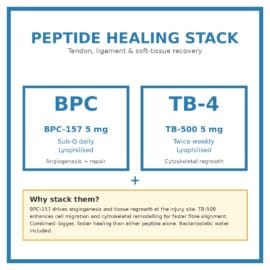
BPC-157-protocollen voor pees-, ligament- en zachtweefselherstel combineren het meestal met TB-500 voor synergetische angiogene + cytoskeletale effecten; voor het gebundelde regime zie onze Peptide Healing Stack (BPC-157 5 mg + TB-500 5 mg + bacteriostatisch water) met zowel lyofiliseerde flesjes als reconstitutiewater in één pakket tegen $0 peptide-verzendtarief.
Andere Peptiden voor Herstel- en Prestatieonderzoek
- TB-500 — Thymosine Beta-4 fragment — onderzoek naar zacht weefsel en vasculair herstel
- Ipamorelin — Selectieve ghreline-agonist — schone GH-puls zonder cortisol/prolactine
- CJC-1295 met DAC — GHRH-analoog met verlengde halfwaardetijd
- GHK-Cu — Koperpeptide — onderzoek naar huid- en bindweefselregeneratie
- IGF-1 LR3 — Long-R3 IGF-1-analoog — anabool / regeneratief onderzoek
Verder lezen
📖 Lees het onderzoek achter dit peptide
Lees onze volledige evidence-based gids: BPC-157 — werkingsmechanisme, proefgegevens & vooruitzichten. Behandelt het werkingsmechanisme, gepubliceerde onderzoeksgegevens, typische onderzoeksdoseringen, reconstitutieprotocollen, stapeloverwegingen en veiligheids-/contra-indicatie notities.
Meer opties in Peptiden
Gerangschikt op recente bestelvolumes van MedsBase — wat andere klanten in deze categorie kiezen.
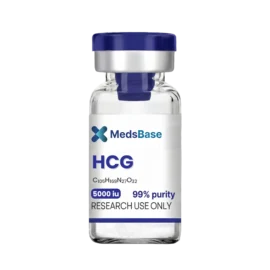
| Sterkte | 2 mg, 5 mg, 10 mg |
|---|---|
| Hoeveelheid | 10 flacons, 20 flacons, 30 flacons |
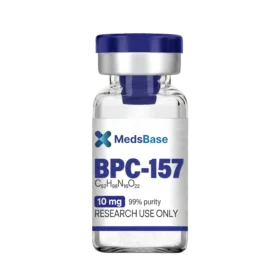 BPC-157
Vragen & antwoorden
BPC-157
Gerelateerde producten
Beoordelingen
Er zijn nog geen beoordelingen