







IGF-1 LR3
✅ Ondersteunt cellulaire groei
✅ Verbetert de eiwitsynthese
✅ Bevordert metabole signalering
✅ Verbeterd weefselregeneratie
✅ Stimuleert cellulair herstel
IGF-1 LR3 bevat synthetisch peptideverbinding.
✓ Medisch beoordeeld door Morgan Ellis — Apotheekonderzoeker · 8 jaar ervaring · Laatst beoordeeld: mei 2026
Kort antwoord — Wat is IGF-1 LR3?
IGF-1 LR3 is een onderzoekspeptide geleverd als een lyofiliseerd poeder voor reconstitutie. Het wordt uitsluitend verkocht voor laboratorium- en onderzoeksdoeleinden en is niet goedgekeurd voor therapeutisch gebruik bij mensen door de FDA, EMA, MHRA of andere belangrijke geneesmiddelenregulators. De informatie op deze pagina beschrijft gepubliceerde preklinische en vroege klinische literatuur; het is geen medisch advies of doseringsrichtlijn. Lees onze gelinkte onderzoeksgids voor het volledige bewijsoverzicht.
IGF-1 LR3 Peptide
IGF-1 LR3 (Insulin-Like Growth Factor-1 Long R3) is een gemodificeerd analoog van insulineachtige groeifactor-1, ontworpen voor onderzoek naar cellulaire groeisignalering, anabole pathways en metabole regulatie. Deze verlengde variant bevat structurele modificaties die de stabiliteit verhogen en de biologische activiteit verlengen in vergelijking met standaard IGF-1, waardoor onderzoekers langdurige IGF-1 receptoractivatie kunnen bestuderen in laboratoriummodellen. IGF-1 LR3 interageert met IGF-1 receptoren die betrokken zijn bij cellulaire proliferatie, eiwitsynthese en nutriëntgebruik. Door de verlengde halfwaardetijd en verminderde binding aan IGF-bindende eiwitten, biedt het een nuttig kader voor het onderzoeken van mechanismen gerelateerd aan weefselgroei, metabole efficiëntie en cellulaire herstelprocessen. Onderzoek suggereert dat IGF-1 LR3 pathways kan ondersteunen die geassocieerd zijn met spiercelgroei, verbeterde eiwitsynthese, sneller herstel van fysieke stress en regulatie van glucosemetabolisme. De activiteit maakt het ook waardevol voor onderzoek naar regeneratieve signalering, cellulaire differentiatie en anabole reacties in gecontroleerde experimentele omgevingen.
Productoverzicht
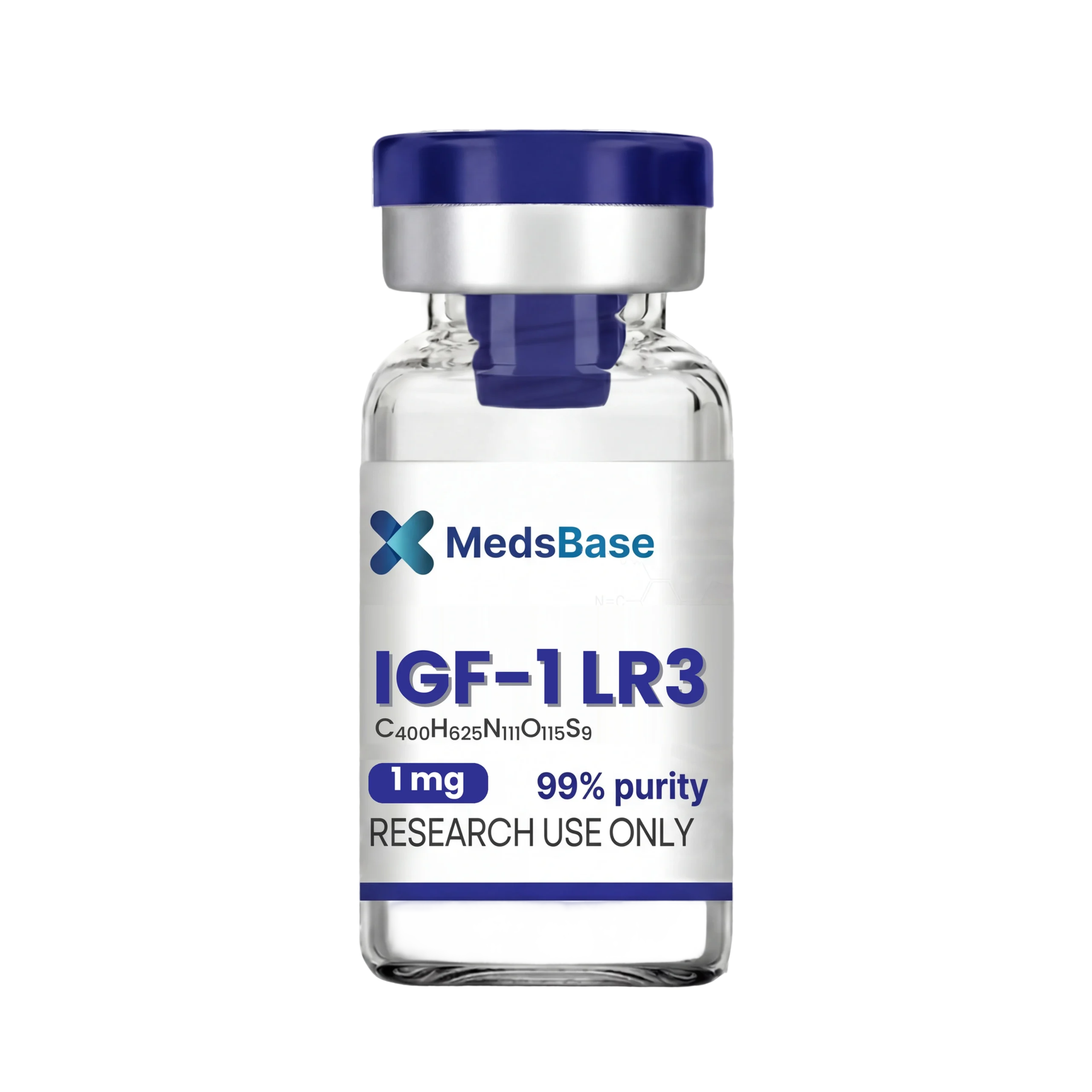
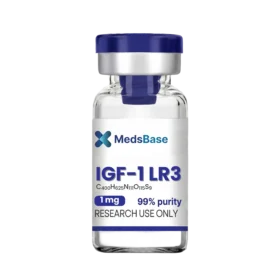
IGF-1 LR3 is een synthetisch onderzoekspeptide geclassificeerd als een gemodificeerd insulineachtige groeifactor analoog, ontworpen om de biologische stabiliteit en receptorinteractieduur in laboratoriummodellen te verlengen. Met de moleculaire formule C400H625N111O115S9 en een molmassa van 9117.60 g/mol wordt IGF-1 LR3 peptide veel bestudeerd in experimentele onderzoekssettings gericht op cellulaire groeipathways en metabole signalering. Elke fles bevat 0.1 mg of 1 mg lyofilized IGF-1 LR3 in hoogzuivere lyofilized vorm, ontworpen voor laboratoriumonderzoek. Het peptide wordt gewaardeerd om zijn structurele modificaties die de binding aan IGF-bindende eiwitten verminderen en de receptoractiviteit verlengen in gecontroleerde onderzoeksomgevingen. Voorbeeld van alt-tekst voor afbeelding: “lyofilized IGF-1 LR3 peptide fles voor laboratoriumonderzoek.” IGF-1 LR3 voor onderzoek behoudt stabiliteit onder juiste opslagomstandigheden met een houdbaarheid van ongeveer 36 maanden en is strikt bedoeld voor onderzoeks- en laboratoriumgebruik.
Onderzoeksapplicaties
Het IGF-1 LR3-peptide wordt vaak gebruikt in laboratoriumonderzoek naar cellulaire groeistimulering en activiteit van anabole pathways. In vitro-onderzoeken bestuderen vaak IGF-1-receptoractivatie en downstream intracellulaire signaleringsmechanismen die verband houden met eiwitsynthese en nutriëntenbenutting. Preklinische modellen gebruiken IGF-1 LR3 voor onderzoek naar celproliferatiepatronen en metabole regulatieresponsen. Onderzoekers onderzoeken ook weefselkweekomgevingen waar groeifactorsignalering onder gecontroleerde experimentele omstandigheden kan worden gemeten. IGF-1 LR3 ondersteunt onderzoek naar cellulaire differentiatie, metabole signaleringscascades en anabole response pathways. Deze toepassingen bieden waardevolle inzichten in mechanismen die verband houden met groeistimuleringsnetwerken in experimentele onderzoekssettings.
Reconstitutie en hantering
Lyofiliseerd IGF-1 LR3 moet worden gereconstitueerd met bacteriostatisch water in een steriele laboratoriumomgeving. Onderzoekers moeten strikte aseptische technieken toepassen bij het toevoegen van oplosmiddel aan het flesje om de peptide-integriteit en experimentele nauwkeurigheid te behouden. Spuit de oplossing langzaam langs de binnenwand van het flesje in om destabilisatie van de peptide te voorkomen. Vermijd schudden van het flesje; draai het in plaats daarvan zachtjes tot het lyofiliseerde IGF-1 LR3-poeder volledig is opgelost. Na reconstitutie dient de oplossing bij 2–8°C te worden bewaard in een gecontroleerde laboratoriumomgeving. Correcte handelingsprocedures helpen de stabiliteit van het IGF-1 LR3-peptide te behouden voor consistente experimentele resultaten.
Werkingsmechanisme
Het IGF-1 LR3-peptide interageert voornamelijk met insulineachtige groeifactorreceptoren die betrokken zijn bij cellulaire groei en metabole signalering. In experimentele onderzoekssettings stimuleert deze interactie intracellulaire pathways gerelateerd aan eiwitsynthese, nutriëntenopname en celproliferatiemarkers. De structurele modificatie van IGF-1 LR3 vermindert de affiniteit voor IGF-bindende eiwitten, wat langdurige receptoractivatie in laboratoriummodellen mogelijk maakt. In vitro-studies geven aan dat deze langdurige signalering pathways kan beïnvloeden die verband houden met anabole cellulaire responsen. Onderzoekers gebruiken IGF-1 LR3 voor onderzoek naar receptoractivatiedynamiek en downstream moleculaire cascades. Deze mechanismen geven inzicht in regulerende processen die verband houden met cellulaire groei en metabole aanpassing.
Onderzoeksdoseringrichtlijnen
Alleen voor onderzoeksreferentie – niet voor menselijk gebruik. Onderzoeksdoseringen zoals gerapporteerd in gepubliceerde experimentele literatuur variëren afhankelijk van het modelsysteem en assay-ontwerp. In vitro-onderzoeken gebruiken vaak IGF-1 LR3-peptideconcentraties gemeten in nanomolaire tot micromolaire bereiken, afhankelijk van de gevoeligheid van de cellijn. Preklinische experimentele modellen kunnen concentratieparameters aanpassen om receptor signaleringsresponsen en metabole activiteitsmarkers te evalueren. Onderzoekers moeten optimale concentratiebereiken bepalen via voorafgaande assayvalidatie. Lyofiliseerd IGF-1 LR3 moet zorgvuldig worden bereid en gemeten om experimentele consistentie te behouden.
Mogelijke onderzoeksvoordelen
- Cellulaire responsmarkers gerelateerd aan groeifactorsignalering
- Waarnemingen van anabole pathway-activatie in weefselkweek
- Stabiliteit van signaleringsactiviteit in gesimuleerde metabole omgevingen
- Receptorinteractiepotentieel met IGF-1-signaleringspathways
- Angiogene en proliferatieve pathway-signaleringsmarkers
Experimentele observaties
Laboratoriumonderzoeken met IGF-1 LR3-peptide observeren vaak verhoogde signaleringsactiviteit binnen IGF-1-receptorpathways onder gecontroleerde experimentele omstandigheden. In vitro-celkweekmodellen tonen meetbare veranderingen in celproliferatiemarkers en eiwitsynthese-indicatoren. Onderzoekers die metabole signalering bestuderen, documenteren vaak veranderingen in nutriëntenopnamepathways wanneer IGF-1 LR3 wordt geïntroduceerd in experimentele systemen. Preklinische modellen hebben ook IGF-1 LR3 onderzocht in relatie tot differentiatiesignalering en cellulaire ontwikkelingspatronen. Deze waarnemingen dragen bij aan het begrip van hoe langdurige receptoractivatie complexe cellulaire netwerken beïnvloedt. IGF-1 LR3 voor onderzoek biedt daarom een reproduceerbaar kader voor het bestuderen van anabole signaleringspathways in experimentele onderzoekssettings.
Onderzoeksoverwegingen
Onderzoekers die met IGF-1 LR3 werken, moeten ervoor zorgen dat strikte laboratoriumprotocollen worden gevolgd om peptide-stabiliteit en experimentele validiteit te behouden. Omgevingsfactoren zoals temperatuur, oplosmiddelcompatibiliteit en assay-gevoeligheid kunnen peptidegedrag in vitro-studies beïnvloeden. Zorgvuldige calibratie van concentraties wordt aanbevolen voordat uitgebreid laboratoriumonderzoek wordt gestart. IGF-1 LR3-peptide kan interageren met andere groeifactoren of signaleringsmoleculen binnen complexe experimentele systemen. Documentatie van handelingsprocedures en experimentele parameters is essentieel voor reproduceerbaarheid. Alle werkzaamheden met IGF-1 LR3 moeten binnen goedgekeurde onderzoeks- en laboratoriumgebruiksrichtlijnen blijven.
Veiligheidsmededeling
IGF-1 LR3-peptide moet worden gehanteerd met standaard laboratoriumveiligheidsprotocollen, inclusief beschermende uitrusting en geschikte containmentprocedures. Onderzoekers moeten ervoor zorgen dat de verbinding wordt opgeslagen, gehanteerd en afgevoerd volgens institutionele laboratoriumveiligheidsrichtlijnen. Directe blootstelling moet worden geminimaliseerd en laboratorium-grade hulpmiddelen moeten worden gebruikt bij het bereiden van experimentele oplossingen. Dit peptide is uitsluitend bedoeld voor wetenschappelijk onderzoek en mag niet buiten gecontroleerde onderzoeksomgevingen worden gebruikt. IGF-1 LR3 is niet goedgekeurd voor menselijk of veterinair gebruik en mag alleen in professionele onderzoeksfaciliteiten worden gebruikt.
Disclaimer: Dit product is strikt bedoeld voor laboratoriumonderzoeksdoeleinden en is niet voor menselijk of diergeneeskundig gebruik. De verstrekte informatie is voor educatieve en wetenschappelijke referentie en mag niet worden geïnterpreteerd als medisch advies of als een aanbeveling voor enige vorm van toediening. Onderzoekers moeten alle toepasselijke voorschriften en institutionele richtlijnen volgen bij het hanteren van dit materiaal.
Bewaarinformatie
Bewaar lyofiliseerd IGF-1 LR3 bij −20°C voor langdurige opslag om peptide-stabiliteit en structurele integriteit te behouden. Voor kortdurend laboratoriumgebruik kan het peptide bij 2–8°C worden bewaard onder gecontroleerde koelomstandigheden. Bescherm IGF-1 LR3 tegen directe lichtblootstelling om degradatie van de peptidestructuur te voorkomen. Vermijd herhaalde vries-dooicycli, omdat deze de peptide-stabiliteit kunnen verminderen en de experimentele reproduceerbaarheid kunnen beïnvloeden. Bij correcte opslag behoudt IGF-1 LR3 een houdbaarheid van ongeveer 36 maanden. Juiste opslag zorgt voor betrouwbare laboratoriumprestaties van lyofiliseerd IGF-1 LR3 voor onderzoek.
Zuiverheid & Kwaliteit
Alle IGF-1 LR3-flesjes die door MedsBase worden geleverd, hebben een HPLC-puurheid van 99%+ in lyofiliseerde vorm. Een certificaat van analyse (COA) is op verzoek beschikbaar — neem contact op met ons ondersteuningsteam na het plaatsen van uw bestelling en wij sturen de batch-specifieke COA voor de ontvangen flesjes door.
Veelgestelde vragen
Wat is de regelgevende status van IGF-1 LR3?
IGF-1 LR3 is niet goedgekeurd voor therapeutisch gebruik bij mensen in de Verenigde Staten, Europese Unie, Verenigd Koninkrijk, Canada of Australië. Het wordt alleen verkocht voor onderzoeksdoeleinden. Sommige peptiden in deze klasse zijn gebruikt in vroege klinische onderzoeken, maar geen belangrijke regelgever heeft een marktvergunning afgegeven voor de indicaties die in de populaire literatuur worden besproken.
Hoe wordt IGF-1 LR3 gereconstitueerd?
Gevriesdroogde peptiden worden meestal gereconstitueerd met bacteriostatisch water of steriel water voor injectie (BWFI/SWFI) in een concentratie die geschikt is voor de geplande dosering. Voeg het oplosmiddel langzaam toe langs de binnenwand van het flesje — injecteer de stroom niet direct in het poeder of schud krachtig, omdat beide het peptide denatureren. Draai voorzichtig tot het volledig is opgelost. Gereconstitueerde peptiden worden meestal gekoeld bewaard bij 2–8°C.
Hoe moet IGF-1 LR3 worden opgeslagen?
Gevriesdroogde flesjes zijn langdurig stabiel wanneer ze worden bewaard bij −20°C of gekoeld bij 2–8°C, weg van direct licht. Na reconstitutie zijn de meeste peptiden 14–30 dagen stabiel in de koelkast, afhankelijk van de buffer en het specifieke peptide. Lees altijd het analyse-certificaat dat bij het flesje wordt geleverd voor de door de leverancier aanbevolen opslag- en stabiliteitsgegevens.
Wat laat het gepubliceerde onderzoek zien?
De gepubliceerde literatuur over IGF-1 LR3 is samengevat in onze gelinkte onderzoeksgids. We onderscheiden preklinische (knaagdier-/celkweek) gegevens, waar deze consistent en reproduceerbaar zijn, van klinische onderzoeksgegevens, waar het bewijs meestal beperkter is. We geven ook aan waar populaire online beweringen verder gaan dan de gepubliceerde gegevens.
Is IGF-1 LR3 legaal om internationaal te bestellen?
Onderzoekspeptiden bevinden zich in een grijs regelgevingsgebied. Importregels variëren per land en zijn in verschillende rechtsgebieden de afgelopen jaren veranderd. Het is de verantwoordelijkheid van de koper om de importlegaliteit in het bestemmingsland te bevestigen voordat hij bestelt. MedsBase verzendt peptiden wereldwijd via onze speciale peptidekoerier; bestellingen die in strijd zijn met de importregels van het bestemmingsland kunnen door de douane worden tegengehouden.
Wat is de halfwaardetijd van IGF-1 LR3?
IGF-1 LR3 heeft een geschatte halfwaardetijd van 20–30 uur in preklinisch onderzoek — aanzienlijk langer dan natuurlijk IGF-1 (ongeveer 6–8 uur). De LR3-modificatie vermindert de affiniteit voor IGF-bindende eiwitten (IGFBPs), wat de vrije (biobeschikbare) IGF-1-fractie in de circulatie verhoogt en de actieve duur verlengt.
Hoe verschilt IGF-1 LR3 van natuurlijk IGF-1?
IGF-1 LR3 is een 83-aminozuur analoog van het natuurlijk voorkomende 70-aminozuur IGF-1. De LR3-modificatie vermindert aanzienlijk de binding aan de zes bekende IGF-bindende eiwitten (IGFBPs), die normaal gesproken ~98% van het endogene IGF-1 opslaan. Dit resulteert in een aanzienlijk hogere vrije-peptidefractie en een verlengde halfwaardetijd, waardoor IGF-1 LR3 een voorkeursverbinding is in onderzoek waarbij langdurige IGF-1-receptoractivatie vereist is.
Kan ik IGF-1 LR3 naast andere peptiden bestellen?
Ja. Peptidebestellingen worden gebundeld en samen verzonden via onze peptide-specifieke koeriersdienst. Lyofiliseerde flesjes zijn temperatuurstabiel gedurende de standaard internationale verzending. Zie onze peptidecategoriepagina voor het volledige assortiment en de “Beste Peptiden voor Herstel” vergelijkingsgids voor stapeloverwegingen uit de gepubliceerde literatuur.
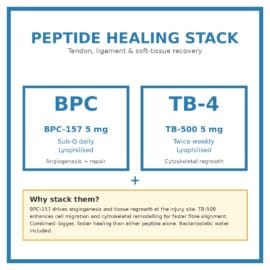
IGF-1 LR3-protocollen omvatten vaak BPC-157 en TB-500 voor gewrichts- en peesondersteuning tijdens de IGF-gestuurde anabole fase; onze Peptide Healing Stack (BPC-157 5 mg + TB-500 5 mg + bacteriostatisch water) bundels bevatten zowel lyofiliseerde flesjes als reconstitutiewater tegen $0 peptide-verzendkosten.
Andere Peptiden voor Herstel- en Prestatieonderzoek
- BPC-157 — Body Protection Compound — onderzoek naar pees-, ligament- en darmherstel
- TB-500 — Thymosine Beta-4 fragment — onderzoek naar zacht weefsel en vasculair herstel
- Ipamorelin — Selectieve ghreline-agonist — schone GH-puls zonder cortisol/prolactine
- CJC-1295 met DAC — GHRH-analoog met verlengde halfwaardetijd
- GHK-Cu — Koperpeptide — onderzoek naar huid- en bindweefselregeneratie
Verder lezen
📖 Lees het onderzoek achter dit peptide
Lees onze volledige evidence-based gids: IGF-1 LR3 — eerlijke wetenschap, dosering & veiligheid. Behandelt het werkingsmechanisme, gepubliceerde onderzoeksgegevens, typische onderzoeksdoseringen, reconstitutieprotocollen, stapeloverwegingen en veiligheids-/contra-indicatie notities.
📦 Elke bestelling is gedekt door onze Reshipment Assurance-beleid — als uw pakket niet binnen 20 werkdagen arriveert, sturen wij het opnieuw.
| Specificatie | Detail |
|---|---|
| CAS-nummer | 946870-92-4 |
| Molecuulformule | C400H625N111O120S9 |
| Moleculair gewicht | ~9117.4 Da |
| Sequentie | Long R3 IGF-1 (83 aminozuren; N-terminaal MFPAMPLSSLFVNGPRTLCGAELVDALQFVCGDRGFYFNKPTGYGSSSRRAPQTGIVDECCFRSCDLRRLEMYCAPLKPAKSA) |
| Form | Lyofiliseerd poeder (of zoals geleverd) |
| Zuiverheid | ≥99% (HPLC geverifieerd, COA op aanvraag) |
| Opslag | Lyofilisatie: 2–8 °C (koelkast) voor werkvoorraad; −20 °C voor langdurige opslag van ongeopende flacons. Gereconstitueerd: 2–8 °C, binnen ~30 dagen gebruiken. Vermijd krachtig schudden; grote peptiden denatureren door schudden. Vries de gereconstitueerde oplossing niet in en ontdooi deze niet. |
| Oplosbaarheid | Bacteriostatisch water (aanbevolen) of steriel water voor kortere gebruiksperioden |
| Onderzoeksgebruik | Alleen voor laboratoriumonderzoek. Niet voor humaan of veterinair diagnostisch of therapeutisch gebruik. |
Meer opties in Peptiden
Gerangschikt op recente bestelvolumes van MedsBase — wat andere klanten in deze categorie kiezen.
| Sterkte | 0.1 mg, 1 mg |
|---|---|
| Hoeveelheid | 10 flacons, 20 flacons, 30 flacons |
 IGF-1 LR3
Vragen & antwoorden
IGF-1 LR3
Gerelateerde producten
Beoordelingen
Er zijn nog geen beoordelingen