







GHK-Cu
✅ Bevordert huidvernieuwing
✅ Verbetert de collageensynthese
✅ Ondersteunt de gezondheid van haarzakjes
✅ Verbeterde huidelasticiteit
✅ Stimuleert weefselherstel
GHK-Cu bevat synthetisch peptideverbinding.
✓ Medisch beoordeeld door Morgan Ellis — Apotheekonderzoeker · 8 jaar ervaring · Laatst beoordeeld: mei 2026
Kort antwoord — Wat is GHK-Cu?
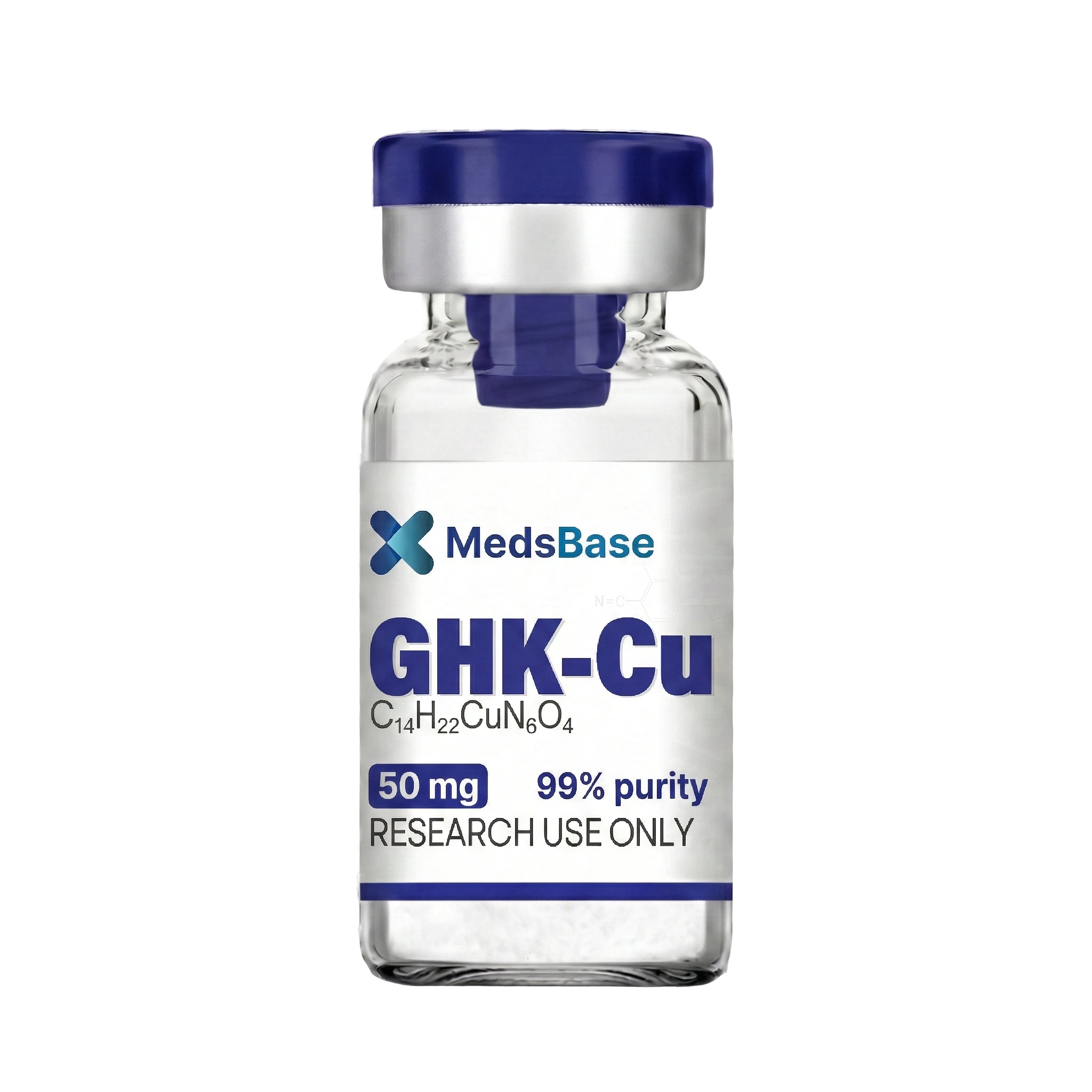
GHK-Cu is een van nature voorkomend tripeptide (glycyl-L-histidyl-L-lysine) gebonden aan koper (Cu2+). Volgens gepubliceerd onderzoek stimuleert het de collageensynthese, activeert het fibroblasten, bevordert het wondgenezing en moduleert het ongeveer 4.000 menselijke genen naar een jonger expressieprofiel. Levering in lyofilisatieflacons van 50 mg uitsluitend voor laboratoriumonderzoek.
📦 Elke bestelling is gedekt door onze Reshipment Assurance-beleid — als uw pakket niet binnen 20 werkdagen arriveert, sturen wij het opnieuw.
| Specificatie | Detail |
|---|---|
| CAS-nummer | 49557-75-7 (GHK vrij) · 89030-95-5 (Cu²⁺ complex) |
| Molecuulformule | GHK: C14H24N6O4 · GHK-Cu: C14H22CuN6O4 |
| Moleculair gewicht | GHK: 340,38 Da · GHK-Cu complex: 403,92 Da |
| Sequentie | Gly-His-Lys (gecheleerd aan Cu²⁺) |
| Form | Lyofiliseerd poeder (of zoals geleverd) |
| Zuiverheid | ≥99% (HPLC geverifieerd, COA op aanvraag) |
| Opslag | Lyofiliseerd: 2–8 °C (koelkast) voor werkvoorraad; −20 °C voor langdurige opslag van ongeopende flesjes. Gereconstitueerd: 2–8 °C, gebruik binnen ~30 dagen. Bescherm tegen licht. Vries de gereconstitueerde oplossing niet in en ontdooi deze niet. |
| Oplosbaarheid | Bacteriostatisch water (aanbevolen) of steriel water voor kortere gebruiksperioden |
| Onderzoeksgebruik | Alleen voor laboratoriumonderzoek. Niet voor humaan of veterinair diagnostisch of therapeutisch gebruik. |
Wat Is GHK-Cu?
GHK-Cu is een van nature voorkomend tripeptide-kopercomplex, ontdekt door Loren Pickart in 1973 tijdens onderzoek naar de anti-verouderingsfactor in menselijk plasma. De drie-aminozuursequentie glycyl-L-histidyl-L-lysine (GHK) heeft een hoge affiniteit voor koperionen (Cu2+), en het resulterende GHK-Cu complex is de biologisch actieve vorm die wordt aangetroffen in plasma, speeksel en urine — dalend van gemiddeld 200 ng/mL op 20-jarige leeftijd tot onder 80 ng/mL tegen 60 jaar.
Het peptide heeft een molecuulgewicht van ongeveer 340 Da (vrij GHK) of 402 Da als kopercomplex, met empirische formule C14H23CuN6O4. Het wordt geleverd als een hoogzuur lyofilisaat met de karakteristieke lichtblauwe kleur van het kopercomplex. GHK-Cu is uitsluitend voor laboratoriumonderzoek en is niet bedoeld voor menselijke of veterinaire diagnostiek of therapie. Voor het werkingsmechanisme, genomische analyse en samenvattingen van gepubliceerd onderzoek, zie onze volledige GHK-Cu onderzoeksgids.
Werkingsmechanisme — Koperdrager en Genregulator
Het werkingsmechanisme van GHK-Cu is bijzonder breed omdat het tripeptide zowel functioneert als een koperdrager (transport van Cu2+ naar cellen) en als een genexpressieregulator die inwerkt op duizenden doelen. Drie mechanismen domineren de gepubliceerde literatuur:
- Kopertransport — GHK bindt Cu2+ met hoge affiniteit en transporteert het door celmembranen. Koper is een cofactor voor lysyloxidase (het enzym dat collageen en elastine crosslinkt), superoxidedismutase en cytochroom C-oxidase. Het koperafgiftemechanisme is het unieke kenmerk dat GHK-Cu onderscheidt van niet-koperhoudende peptiden.
- Activatie van fibroblasten en collageensynthese — GHK-Cu reguleert collageen type I en III, decorine en glycosaminoglycanen opwaarts in onderzoek met dermale fibroblasten. Dit vormt de mechanistische basis voor het onderzoek naar huid, wondgenezing en bindweefsel.
- Modulatie van genexpressie — Pickarts genomische analyse uit 2010 identificeerde GHK als een modulator van ongeveer 4.000 menselijke genen, met een netto-effect van verschuiving naar een meer jeugdig expressieprofiel. Beïnvloede gengroepen omvatten DNA-herstel, antioxidantverdediging en stressresponspaden.
Omdat deze drie mechanismen in veel weefseltypen werkzaam zijn, is GHK-Cu onderzocht in onderzoekscontexten variërend van dermatologie en wondgenezing tot genexpressiebiologie en onderzoek naar neuronale overleving. Het wordt opmerkelijk goed verdragen bij typische onderzoeksdoseringen.
Gepubliceerde onderzoeksapplicaties
GHK-Cu wordt gebruikt in laboratoriumonderzoeken die zich richten op:
- Huidregeneratie en foto-veroudering — synthese van collageen type I en III, onderzoek naar dermale dikte en rimpeldiepte in menselijke en knaagdier modellen (Pickart, J Biomater Sci Polym 2008)
- Onderzoek naar haarzakjes — activering van folliculaire stamcellen en onderzoek naar de haargroeicyclus in knaagdier modellen
- Wondgenezing — dermaal herstel, onderzoek naar chronische wonden en diabetische wonden (Pickart et al., Biomed Res Int 2015)
- Onderzoek naar antioxidanten en ijzerchelatie — vermindering van ROS, bescherming tegen lipidperoxidatie in cellulaire oxidatieve-stressmodellen
- Onderzoek naar genexpressie — whole-transcriptome analyses tonen modulatie van ~4.000 menselijke genen
- Neuronaal onderzoek — onderzoek naar neurietuitgroei en neuroprotectie in CNS-celmodellen
- Stacking onderzoek — vaak gecombineerd met BPC-157 en TB-500 in onderzoek naar herstel van bindweefsel. Zie de beste peptiden voor spierherstel voor clustercontext.
Beschikbare sterktes
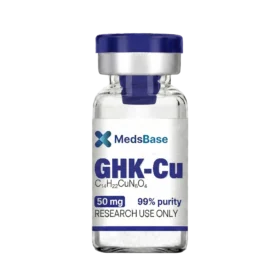
MedsBase heeft GHK-Cu in stock in een enkele 50 mg lyofiliseerde vial sterkte. Elke variant wordt geleverd in 10-vial, 20-vial of 30-vial verpakkingen met volledige reconstitueringshandleiding:
| Vulsterkte | Typisch gebruik | Verpakkingsgroottes |
|---|---|---|
| 50 mg | Standaard onderzoekssterkte — ondersteunt protocollen van 1–3 mg dagelijks gedurende 2–4 weken per vial | 10, 20 of 30 vialen |
De 50 mg vial grootte sluit aan bij typisch onderzoeksprotocol gebruik — 1–3 mg per toediening, 1–2x daags of 3–5x per week. Een enkele 50 mg vial ondersteunt ongeveer 16–50 toedieningen afhankelijk van het protocol. Geleverd als lyofiliseerd poeder met 99%+ HPLC zuiverheid.
Vergelijking — GHK-Cu versus Andere Helende Peptiden
GHK-Cu, BPC-157, en TB-500 zijn de drie meest aangehaalde helende onderzoekspeptiden. Elk werkt via verschillende mechanismen, daarom worden ze vaak gecombineerd in plaats van vervangen:
| Criterium | GHK-Cu | BPC-157 | TB-500 |
|---|---|---|---|
| Lengte | 3 aminozuren + koper | 15 aminozuren | 43 aminozuren |
| Primair werkingsmechanisme | Kopertransport + genregulatie | VEGF + NO + GH-receptor | G-actinebinding, angiogenese |
| Sterkste onderzoekssignaal | Huid, haar, collageen, genexpressie | Pezen, ligamenten, darmbarrière | Cardiaal, systemische spieren, vasculair |
| Typische onderzoeksdosis | 1–3 mg dagelijks of 3–5x per week | 250–500 mcg 1–2x per dag | 2–2,5 mg tweemaal per week |
Voor een bredere context over het peptidelandschap, zie de onderzoekspeptiden catalogus.
Opslag en Reconstituering
Voor reconstituering: bewaar lyofilisatieflessen gekoeld bij 2–8 °C in de originele verpakking. Houdbaar tot 36 maanden. Het lyofiliseerde GHK-Cu heeft een karakteristieke lichtblauwe kleur door het kopercomplex.
Reconstitueringsprocedure: spuit bacteriostatisch water langs de zijkant van het peptideflesje. De oplossing moet helder lichtblauw zijn — de kleur van het Cu2+ complex. Draai voorzichtig — niet niet schudden — en laat 2–5 minuten staan voor volledige oplossing.
Na reconstitutie: bewaar gekoeld bij 2–8 °C en gebruik binnen 30 dagen. De lichtblauwe kleur moet behouden blijven; verlies van kleur kan wijzen op dissociatie van het koperpeptide. Gooi weg als het troebel of verkleurd is (bruin/groen).
Veelgestelde vragen
Waar wordt GHK-Cu voor gebruikt in onderzoek?
GHK-Cu wordt gebruikt in laboratoriumonderzoek naar huidregeneratie, haarfollikelbiologie, wondgenezing, collageensynthese, genexpressiemodulatie en antioxidantroutes. Het is niet FDA-goedgekeurd en wordt hier strikt verkocht voor alleen laboratoriumonderzoek.
Waarom ziet GHK-Cu er blauw uit?
De blauwe kleur is het kenmerk van het koper(II)-GHK-complex. De Cu2+ Het ion coördineert met de histidine-imidazoolring en de gedeprotoneerde amide-stikstofatomen van het tripeptide, wat het karakteristieke lichtblauwe absorptiespectrum veroorzaakt. Een goed gereconstitueerde GHK-Cu-oplossing moet helder en lichtblauw zijn.
Wat is de gebruikelijke onderzoeksdosis voor GHK-Cu?
In gepubliceerde preklinische protocollen wordt doorgaans 1–3 mg per toediening gebruikt, eenmaal daags of 3–5 keer per week gedurende cycli van 4–8 weken. Een flesje van 50 mg, gereconstitueerd met 5,0 mL bacteriostatisch water, levert 10 mg/mL op — 10 streepjes op een U-100-spuit geven 1 mg af.
Nee. GHK-Cu is niet goedgekeurd door de FDA, EMA of enige andere regelgevende instantie voor therapeutisch gebruik. Het wordt veel gebruikt als ingrediënt in cosmetische huidverzorgingsproducten, maar de injecteerbare onderzoeksvorm die hier wordt verkocht, is uitsluitend bedoeld voor laboratoriumonderzoek.
Nee. GHK-Cu is niet goedgekeurd door de FDA, EMA of enige andere regelgevende instantie voor therapeutisch gebruik. Het wordt veel gebruikt als ingrediënt in cosmetische huidverzorgingsproducten, maar de injecteerbare onderzoeksvorm die hier wordt verkocht, is uitsluitend bestemd voor laboratoriumonderzoek.
Hoe moet GHK-Cu worden bewaard?
Lyofiliseerde flacons: gekoeld bewaren bij 2–8 °C in de originele verpakking, stabiel tot 36 maanden. Heropgeloste oplossing: gekoeld bewaren bij 2–8 °C, binnen 30 dagen gebruiken. De blauwe kleur moet tijdens de opslag behouden blijven — verlies van kleur kan wijzen op peptide-koper dissociatie.
Hoe moet ik GHK-Cu reconstitueren?
Volg de bovenstaande reconstitueringshandleiding. Voeg bacteriostatisch water langs de zijkant van het flesje toe, draai voorzichtig en laat 2–5 minuten staan voor volledige oplossing. De oplossing moet helder lichtblauw zijn. niet het flesje niet.
Kan GHK-Cu gecombineerd worden met BPC-157 of TB-500?
Ja. GHK-Cu wordt vaak samen toegediend met BPC-157 en/of TB-500 in onderzoek naar bindweefsel, wondgenezing en huidregeneratie omdat hun mechanismen complementair zijn. GHK-Cu levert koper en genexpressiesignalering; BPC-157 zorgt voor upregulatie van groeifactoren; TB-500 zorgt voor systemische angiogenese.
Is injecteerbare GHK-Cu anders dan cosmetische GHK-Cu voor topisch gebruik?
Het peptide zelf is hetzelfde molecuul. Cosmetische formuleringen richten zich op huidabsorptie bij lage concentraties (meestal 0,1–1%); injecteerbare onderzoeksvormen leveren veel hogere doses systemisch via SC-injectie voor laboratoriumonderzoek. Ons product is de injecteerbare onderzoeksvorm, geen cosmetisch product.
Welke sterktes heeft MedsBase op voorraad?
MedsBase voert GHK-Cu in 50 mg lyofiliseerde flacons, beschikbaar in verpakkingen van 10, 20 of 30 flacons. Alle flacons worden geleverd met een HPLC-puurheid van 99%+ en een certificaat van analyse is op aanvraag beschikbaar.
Veroorzaakt GHK-Cu bijwerkingen in onderzoek?
Gepubliceerd preklinisch onderzoek heeft een schoon veiligheidsprofiel gemeld bij typische onderzoeksdoseringen. Koperafgifte wordt strak gereguleerd door de endogene transportproteïnen van het lichaam, wat waarschijnlijk bijdraagt aan het lage off-target signaal. Langetermijnveiligheidsgegevens bij mensen zijn niet beschikbaar.
Wat is de halfwaardetijd van GHK-Cu?
GHK-Cu is een klein tripeptide-kopercomplex met een geschatte vrije peptide plasmahalfwaardetijd van minder dan 30 minuten. GHK vertoont echter een sterke affiniteit voor collageen, fibronectine en andere extracellulaire matrixproteïnen, wat de lokale weefselverblijftijd aanzienlijk verlengt voorbij plasmahalfwaardetijdmetingen.
Hoe werkt GHK-Cu anders dan groeihormoon secretagogue peptiden?
In tegenstelling tot GHRPs of GHRH-analogen werkt GHK-Cu voornamelijk via genexpressiemodulatie. Microarray-onderzoeken hebben aangetoond dat GHK meer dan 4.000 menselijke genen activeert of onderdrukt, inclusief diegenen die collageensynthese, antioxidantafweer, zenuwregeneratie en ontstekingsremmende pathways reguleren. Deze brede genomische werking onderscheidt het van receptor-specifieke peptiden zoals BPC-157 of Ipamorelin.
Kan ik GHK-Cu bestellen voor internationale verzending?
Ja. MedsBase verzendt GHK-Cu wereldwijd vanuit ons toegewijde peptide-verzendnetwerk. Bestellingen met alleen peptiden komen in aanmerking voor onze standalone peptide-verzendservice. Bestellingen worden verzonden in temperatuurgecontroleerde verpakkingen met volledige tracking.
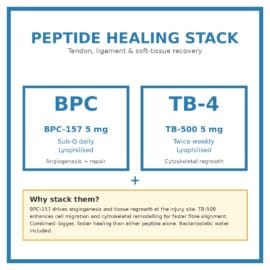
GHK-Cu wordt meestal gebruikt naast toegewijde weefselherstelpeptiden voor het werk in diepere weefsels; combineer met onze Peptide Healing Stack (BPC-157 5 mg + TB-500 5 mg + bacteriostatisch water) voor de angiogenese + cytoskeletlaag die de collageen- en antioxidanteffecten van GHK-Cu aanvult.
Andere Peptiden voor Herstel- en Prestatieonderzoek
- BPC-157 — Body Protection Compound — onderzoek naar pees-, ligament- en darmherstel
- TB-500 — Thymosine Beta-4 fragment — onderzoek naar zacht weefsel en vasculair herstel
- Ipamorelin — Selectieve ghreline-agonist — schone GH-puls zonder cortisol/prolactine
- CJC-1295 met DAC — GHRH-analoog met verlengde halfwaardetijd
- IGF-1 LR3 — Long-R3 IGF-1-analoog — anabool / regeneratief onderzoek
Verder lezen
📖 Lees het onderzoek achter dit peptide
Lees onze volledige evidence-based gids: GHK-Cu — werkingsmechanisme, genomische analyse & vooruitzichten. Behandelt koperchemie, Pickarts genexpressiestudies, typische onderzoeksdoseringen, reconstitutieprotocollen, stapeloverwegingen en veiligheidsnotities.
Meer opties in Peptiden
Gerangschikt op recente bestelvolumes van MedsBase — wat andere klanten in deze categorie kiezen.
| Sterkte | 50 mg |
|---|---|
| Hoeveelheid | 10 flacons, 20 flacons, 30 flacons |
 GHK-Cu
Vragen & antwoorden
GHK-Cu
Gerelateerde producten
Beoordelingen
Er zijn nog geen beoordelingen