







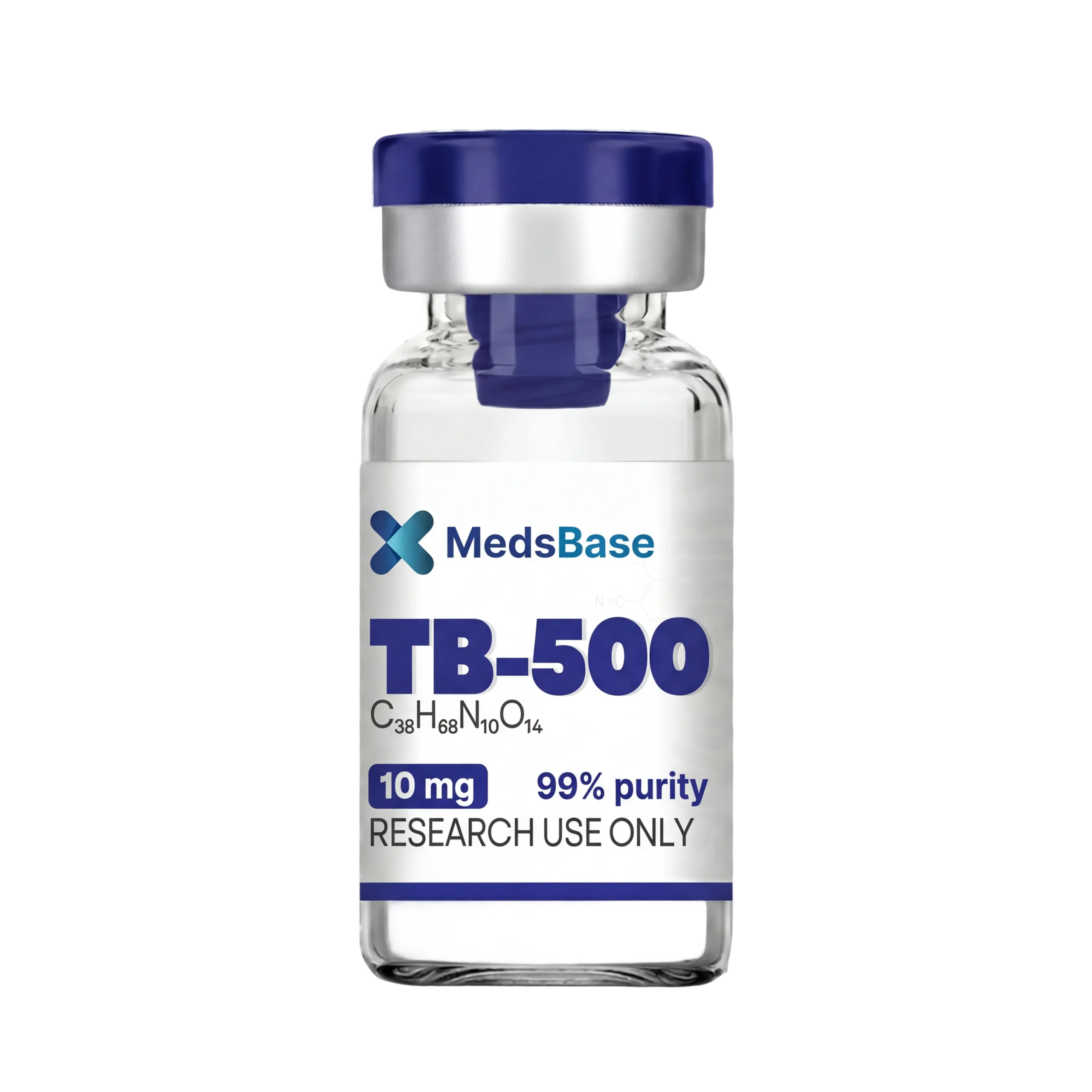
TB-500 (Thymosin Beta-4)
✅ Ondersteunt celregeneratie
✅ Verbetert weefselmodellering
✅ Bevordert fibroblastenactiviteit
✅ Stimuleert angiogene signalering
✅ Verbetert de stabiliteit van de extracellulaire matrix
TB-500 bevat synthetisch peptideverbinding.
✓ Medisch beoordeeld door Morgan Ellis — Apotheekonderzoeker · 8 jaar ervaring · Laatst beoordeeld: mei 2026
Kort antwoord — Wat is TB-500?
TB-500 is een synthetisch analogon van Thymosine Bèta-4, een van nature voorkomend 43-aminozuur peptide met systemische helende activiteit. In gepubliceerd preklinisch onderzoek bindt het G-actine, stimuleert het angiogenese via het VEGF/KDR-pad en moduleert het TGF-beta ontstekingssignalisering. Wordt geleverd in 2 mg tot 10 mg lyofilisatieflacons uitsluitend voor laboratoriumonderzoek.
📦 Elke bestelling is gedekt door onze Reshipment Assurance-beleid — als uw pakket niet binnen 20 werkdagen arriveert, sturen wij het opnieuw.
| Specificatie | Detail |
|---|---|
| CAS-nummer | 77591-33-4 |
| Molecuulformule | C212H350N56O78S |
| Moleculair gewicht | ~4963 Da (N-acetyl Thymosine β-4 (1–43)) |
| Sequentie | Ac-SDKPDMAEIEKFDKSKLKKTETQEKNPLPSKETIEQEKQAGES |
| Form | Lyofiliseerd poeder (of zoals geleverd) |
| Zuiverheid | ≥99% (HPLC geverifieerd, COA op aanvraag) |
| Opslag | Lyofilisatie: 2–8 °C (koelkast) voor werkvoorraad; −20 °C voor langdurige opslag van ongeopende flacons. Gereconstitueerd: 2–8 °C, binnen ~30 dagen gebruiken. Vermijd krachtig schudden; grote peptiden denatureren door schudden. Vries de gereconstitueerde oplossing niet in en ontdooi deze niet. |
| Oplosbaarheid | Bacteriostatisch water (aanbevolen) of steriel water voor kortere gebruiksperioden |
| Onderzoeksgebruik | Alleen voor laboratoriumonderzoek. Niet voor humaan of veterinair diagnostisch of therapeutisch gebruik. |
Wat Is TB-500?
TB-500 is de laboratoriumaanduiding voor een synthetisch analoog van Thymosin Beta-4 (TB4), een van nature voorkomend 43-aminozuur peptidehormoon dat in bijna elke cel van het menselijk lichaam wordt aangetroffen. TB4 komt het meest voor in bloedplaatjes en wordt vrijgegeven op plaatsen van weefselschade, waar het celmigratie, angiogenese en ontstekingsremmende signalering coördineert. De synthetische onderzoeksvorm — TB-500 — reproduceert de biologische activiteit van TB4 en is de meest bestudeerde onderzoeksstof in deze klasse.
De TB4-sequentie is Ac-SDKPDMAEIEKFDKSKLKKTETQEKNPLPSKETIEQEKQAGES, molecuulgewicht ongeveer 4.963 Da. Het wordt geleverd als een hoogzuiver lyofilisatiepoeder voor reconstitutie met bacteriostatisch water. TB-500 is uitsluitend voor laboratoriumonderzoek en is niet bedoeld voor menselijke of veterinaire diagnostiek of therapie. Voor werkingsmechanisme, gepubliceerde proefdetails en onderzoeksdoseringsoverwegingen, zie onze volledige TB-500 onderzoeksgids.
Werkingsmechanisme — Systemisch Herstel via Drie Paden
TB-500 onderscheidt zich van de meeste peptiden door zijn systemische distributie en lange circulerende halfwaardetijd, die het mogelijk maken dat een enkele toediening herstelprocessen in meerdere weefsels tegelijk beïnvloedt. De drie primaire mechanismische paden in gepubliceerd onderzoek:
- G-actine sequestratie — TB-500 bindt monomere actine (G-actine) via een centraal actine-bindend motief (LKKTETQ). Dit behoudt het cytoskeletale reservoir dat cellen nodig hebben om pseudopodia uit te strekken, naar blessureplaatsen te migreren en zich na schade te hermodelleren. Celmigratietests in wondrandonderzoek tonen consistent verhoogde migratiesnelheden aan in TB4-behandelde cellen.
- Angiogenese via VEGF/KDR-signalering — TB-500 stimuleert vasculaire endotheelmigratie en capillaire vorming via de VEGF-receptor 2 (KDR)-route. In ischemie-reperfusie- en wondgenezingonderzoek vertaalt dit zich naar een snellere herstel van perfusie op herstelplaatsen.
- Anti-inflammatoire signalering via TGF-beta-modulatie — TB-500 vermindert de afgifte van pro-inflammatoire cytokinen en versnelt de resolutie van de inflammatoire fase van genezing. In cardiale ischemieonderzoek is dit in verband gebracht met een verkleind infarctvolume en behoud van cardiomyocytfunctie.
Omdat deze drie mechanismen zich door het hele lichaam verspreiden, produceert TB-500 effecten in weefsels die ver van de injectieplaats verwijderd zijn — het kenmerk dat het onderscheidt van meer gelokaliseerde helende peptiden zoals BPC-157. Het praktische gevolg: TB-500-onderzoeksprotocollen worden tweemaal per week gedoseerd in plaats van dagelijks.
Gepubliceerde onderzoeksapplicaties
TB-500 wordt gebruikt in laboratoriumonderzoekcontexten die onderzoeken:
- Herstel van skeletspieren — systemisch herstelkinetiek in knaagdier-modellen van crush, verrekking en inactiviteitsatrofie
- Onderzoek naar hartherstel — overleving van cardiomyocyten, infarctgrootte en vasculaire remodeling na ischemie (Smart et al., Nature 2011; Bock-Marquette et al., Nature 2004)
- Genezing van pezen en ligamenten — alleen of in combinatie met BPC-157 in onderzoek naar bindweefselherstel
- Systemisch wondherstel — onderzoek naar dermale en corneale wondgenezing, vooral wanneer meerdere weefseltypen zijn aangedaan
- Onderzoek naar haargroeicyclus — folliculaire angiogenese en faseovergangen van haargroei in knaagdier-onderzoeksmodellen
- Vasculair herstel — endotheelcelmigratie, capillaire vorming en ischemie-onderzoek
- Vergelijkend peptide-onderzoek — benchmarken tegen BPC-157 als de canonieke lokale genezingsvergelijker, of met IGF-1 LR3 en Ipamorelin/CJC-1295 in onderzoek naar groeifactoren. Zie onze BPC-157 vs TB-500 vergelijking voor de vergelijking.
Voor een bredere context over waar TB-500 past binnen het landschap van helende peptiden, zie de beste peptiden voor spierherstel clusterartikel en aanvullende onderzoeksverbindingen in de peptiden catalogus.
Beschikbare sterktes en concentraties
MedsBase heeft TB-500 (synthetisch Thymosine Beta-4) op voorraad in de volgende lyofilisatievial-groottes. Elke variant wordt geleverd in verpakkingen van 10, 20 of 30 vialen met volledige reconsititutie-instructies:
| Vulsterkte | Typisch gebruik | Verpakkingsgroottes |
|---|---|---|
| 2 mg | Pilotonderzoek, titratie of korte protocollen | 10, 20 of 30 vialen |
| 5 mg | Standaard onderzoekssterkte, komt overeen met veelvoorkomende protocollen van 2–2,5 mg per toediening | 10, 20 of 30 vialen |
| 10 mg | Uitgebreid onderzoek, bulkvoorbereiding, laagste kosten per mg | 10, 20 of 30 vialen |
Alle drie de sterktes hebben dezelfde chemische vorm (lyofiliseerpoeder, 99%+ HPLC zuiverheid). Vialen met hogere mg bieden lagere kosten per mg en worden over het algemeen verkozen wanneer onderzoekers het 2–2,5 mg per toedieningsdosering modelleren dat in de meeste gepubliceerde TB-500 protocollen wordt gebruikt.
Hoe het zich verhoudt — TB-500 vs BPC-157
TB-500 en BPC-157 zijn de twee meest aangehaalde helende onderzoekspeptiden. Ze worden vaak samen bestudeerd omdat hun mechanismen complementair zijn in plaats van overlappend — BPC-157 werkt lokaal via upregulatie van groeifactoren, TB-500 werkt systemisch via actine- en angiogenese paden.
| Criterium | TB-500 (Thymosin Beta-4) | BPC-157 |
|---|---|---|
| Lengte | 43 aminozuren (~4.963 Da) | 15 aminozuren (~1.419 Da) |
| Primair werkingsmechanisme | G-actine sequestratie, angiogenese, TGF-beta | VEGF + NO + GH-receptor upregulatie |
| Distributie | Systemisch, verspreidt zich breed | Meer gelokaliseerd op de injectieplaats |
| Typische onderzoeksdosis | 2–2,5 mg tweemaal per week, 4–6 weken oplaaddosis | 250–500 mcg, 1–2x per dag |
| Sterkste onderzoekssignaal | Cardiaal, systemische spieren, vasculair, haar | Pezen, ligamenten, darmbarrière |
| Stacking | Vaak gecombineerd toegediend met BPC-157 | Vaak gecombineerd toegediend met TB-500 |
Voor de volledige methodologische vergelijking en wanneer onderzoekers de ene boven de andere verkiezen, lees BPC-157 vs TB-500: welk herstelpeptide voor jouw hersteldoel.
Opslag en Reconstituering
Voor reconstituering: bewaar lyofiliseerde flacons gekoeld bij 2–8 °C in de originele verpakking. Lyofiliseerde TB-500 is onder deze omstandigheden tot 36 maanden stabiel. Vermijd vries-ontdooicycli van het poeder.
Reconstitueringsprocedure: spuit bacteriostatisch water langs de zijkant van het peptideflesje (niet direct op de lyofiliseerde cake) volgens de bovenstaande verdunningstabel. Draai voorzichtig — doe niet schud — en laat 5–10 minuten staan voor volledige oplossing. Een correct gereconstitueerde oplossing moet helder en kleurloos zijn.
Na reconstitutie: bewaar gekoeld bij 2–8 °C en gebruik binnen 30 dagen voor optimale stabiliteit. Vries de gereconstitueerde oplossing niet in — vries-dooicycli tasten de peptide-integriteit aan. Gooi elk flesje weg dat troebelheid, neerslag of verkleuring vertoont.
Veelgestelde vragen
Waar wordt TB-500 voor gebruikt in onderzoek?
TB-500 wordt gebruikt in laboratoriumonderzoek naar skeletspierherstel, hartherstel, pees- en ligamentgenezing, wondherstel, haarcyclusonderzoek, vaatherstel en systemische weefselregeneratie. Het is niet FDA-goedgekeurd en wordt hier strikt verkocht voor alleen laboratoriumonderzoek.
Hoe verschilt TB-500 van BPC-157?
TB-500 is een synthetisch analoog van 43 aminozuren van Thymosine Beta-4 dat systemisch werkt via G-actinebinding, angiogenese en TGF-beta-signalering. BPC-157 is een pentadecapeptide van 15 aminozuren dat voornamelijk lokaal werkt via VEGF, stikstofoxide en groeihormoonreceptorroutes. De twee worden vaak samen toegediend in onderzoek omdat hun mechanismen complementair zijn.
Wat is de gebruikelijke onderzoeksdosis van TB-500?
Gepubliceerde preklinische protocollen gebruiken typisch 2–2,5 mg per toediening, tweemaal per week gedurende een laadfase van 4–6 weken, gevolgd door een wekelijkse onderhoudsfase. Een flesje van 5 mg gereconstitueerd met 2,0 mL bacteriostatisch water levert 2,5 mg/mL — 80 ticks op een U-100-spuit geeft 2 mg.
Is TB-500 goedgekeurd door de FDA?
Nee. TB-500 (synthetische Thymosine Beta-4) is niet goedgekeurd door de FDA, EMA, MHRA of enige andere regelgever voor menselijk therapeutisch gebruik. Alle TB-500 die wordt verkocht door leveranciers voor onderzoeksgebruik alleen, is bedoeld voor laboratoriumonderzoek en mag niet aan mensen worden toegediend.
Hoe moet TB-500 worden opgeslagen?
Gevriesdroogde flesjes: gekoeld bewaren bij 2–8 °C in de originele verpakking, stabiel tot 36 maanden. Oplossing na reconstitutie: gekoeld bewaren bij 2–8 °C, binnen 30 dagen gebruiken. Vries de gereconstitueerde oplossing niet in — vries-ontdooicycli degraderen het peptide.
Hoe reconstitueer ik TB-500?
Volg de bovenstaande referentietabel voor reconstitutie. Voeg bacteriostatisch water toe langs de zijkant van het flesje (niet op de lyofiliseerde cake), draai voorzichtig en laat 5–10 minuten staan voor volledige oplossing. Doe niet het flesje niet.
Welke sterktes heeft MedsBase op voorraad?
MedsBase voert TB-500 in lyofiliseerde flesjes van 2 mg, 5 mg en 10 mg. Elke sterkte is beschikbaar in verpakkingen van 10, 20 of 30 flesjes. Alle flesjes hebben een HPLC-puurheid van 99%+ en een certificaat van analyse is op aanvraag beschikbaar.
Kunnen TB-500 en BPC-157 worden gecombineerd in onderzoek?
Ja. TB-500 en BPC-157 behoren tot de meest voorkomende peptiden die samen worden toegediend in preklinisch onderzoek. Hun mechanismen zijn complementair (systemisch vs lokaal, actinebinding vs opregulatie van groeifactoren), en gecombineerde protocollen komen vaak voor in onderzoek naar bindweefsel- en spierherstel. Zie onze vergelijkingsgids.
Waarom wordt TB-500 minder vaak gedoseerd dan BPC-157?
TB-500 heeft een langere circulerende halfwaardetijd en verspreidt zich systemisch, dus gepubliceerde onderzoeksprotocollen doseren typisch tweemaal per week. BPC-157 is meer gelokaliseerd en wordt vaak een- of tweemaal daags gedoseerd in hetzelfde type letselmodelonderzoek.
Veroorzaakt TB-500 bijwerkingen in onderzoek?
Gepubliceerd preklinisch onderzoek heeft een redelijk veiligheidsprofiel gemeld bij typische onderzoeksdoseringen. Langetermijngegevens over menselijke veiligheid zijn niet beschikbaar omdat TB-500 niet is goedgekeurd voor menselijk gebruik en alleen voor onderzoek wordt verkocht. Gepubliceerd toxicologisch werk heeft geen off-target signalen geïdentificeerd bij standaard onderzoeksdoseringen.
Is TB-500 hetzelfde als volledig Thymosine Beta-4?
TB-500 wordt op de markt gebracht als een synthetische vorm van Thymosine Beta-4 (TB4). In commerciële onderzoeksvoorraden is wat wordt verkocht als “TB-500” typisch het volledige 43-aminozuur TB4-molecuul dat chemisch is gesynthetiseerd. Sommige literatuur verwijst naar kortere actine-bindende fragmenten (LKKTETQ) als functionele TB4-analogen in specifieke onderzoekscontexten, maar de volledige lengte TB4 is de dominante onderzoeksvorm.
Wat is de halfwaardetijd van TB-500?
TB-500 (synthetische Thymosine Beta-4) heeft een geschatte serumhalfwaardetijd van enkele dagen in preklinisch onderzoek — aanzienlijk langer dan de meeste GHRPs en plaatspecifieke helende peptiden zoals BPC-157. Deze verlengde halfwaardetijd ondersteunt de minder frequente doseringsschema's die typisch worden gebruikt in Tβ4-onderzoeksprotocollen.
Hoe lang duurt het voordat TB-500 effecten laat zien in preklinisch onderzoek?
Preklinische studies met Thymosine Beta-4 in cardiale, skeletspier- en bindweefselmodellen observeren typisch meetbare effecten over onderzoekscycli van 2–4 weken. De systemische distributie en langere halfwaardetijd in vergelijking met plaatsgerichte peptiden betekenen dat TB-500-onderzoeksperiodes over het algemeen verlengd zijn.
Kan ik TB-500 bestellen voor internationale verzending?
Ja. MedsBase verzendt TB-500 wereldwijd vanuit ons toegewijde peptide-verzendnetwerk. Bestellingen met alleen peptiden komen in aanmerking voor onze standalone peptide-verzendservice. Alle bestellingen worden verzonden in temperatuurgecontroleerde verpakkingen met volledige tracking.
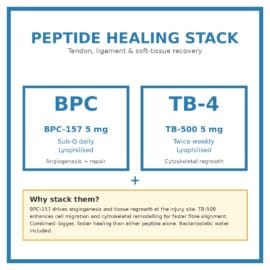
TB-500 wordt meestal samen gebruikt met BPC-157 — angiogenese (BPC-157) plus cytoskeletreparatie (TB-500) zorgt voor een snellere en volledigere herstel van zachte weefsels dan elk peptide afzonderlijk; onze Peptide Healing Stack (BPC-157 5 mg + TB-500 5 mg + bacteriostatisch water) verzendt het bijbehorende protocol in één pakket.
Andere Peptiden voor Herstel- en Prestatieonderzoek
- BPC-157 — Body Protection Compound — onderzoek naar pees-, ligament- en darmherstel
- Ipamorelin — Selectieve ghreline-agonist — schone GH-puls zonder cortisol/prolactine
- CJC-1295 met DAC — GHRH-analoog met verlengde halfwaardetijd
- GHK-Cu — Koperpeptide — onderzoek naar huid- en bindweefselregeneratie
- IGF-1 LR3 — Long-R3 IGF-1-analoog — anabool / regeneratief onderzoek
Verder lezen
📖 Lees het onderzoek achter dit peptide
Lees onze volledige evidence-based gids: TB-500 — werkingsmechanisme, proefgegevens & vooruitzichten. Behandelt het werkingsmechanisme, gepubliceerde onderzoeksgegevens, typische onderzoeksdoseringen, reconstitutieprotocollen, stapeloverwegingen en veiligheids-/contra-indicatie notities.
Meer opties in Peptiden
Gerangschikt op recente bestelvolumes van MedsBase — wat andere klanten in deze categorie kiezen.
| Sterkte | 2 mg, 5 mg, 10 mg |
|---|---|
| Hoeveelheid | 10 flacons, 20 flacons, 30 flacons |
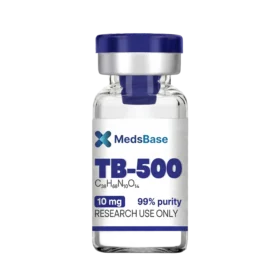 TB-500 (Thymosin Beta-4)
Vragen & antwoorden
TB-500 (Thymosin Beta-4)
Gerelateerde producten
Beoordelingen
Er zijn nog geen beoordelingen