








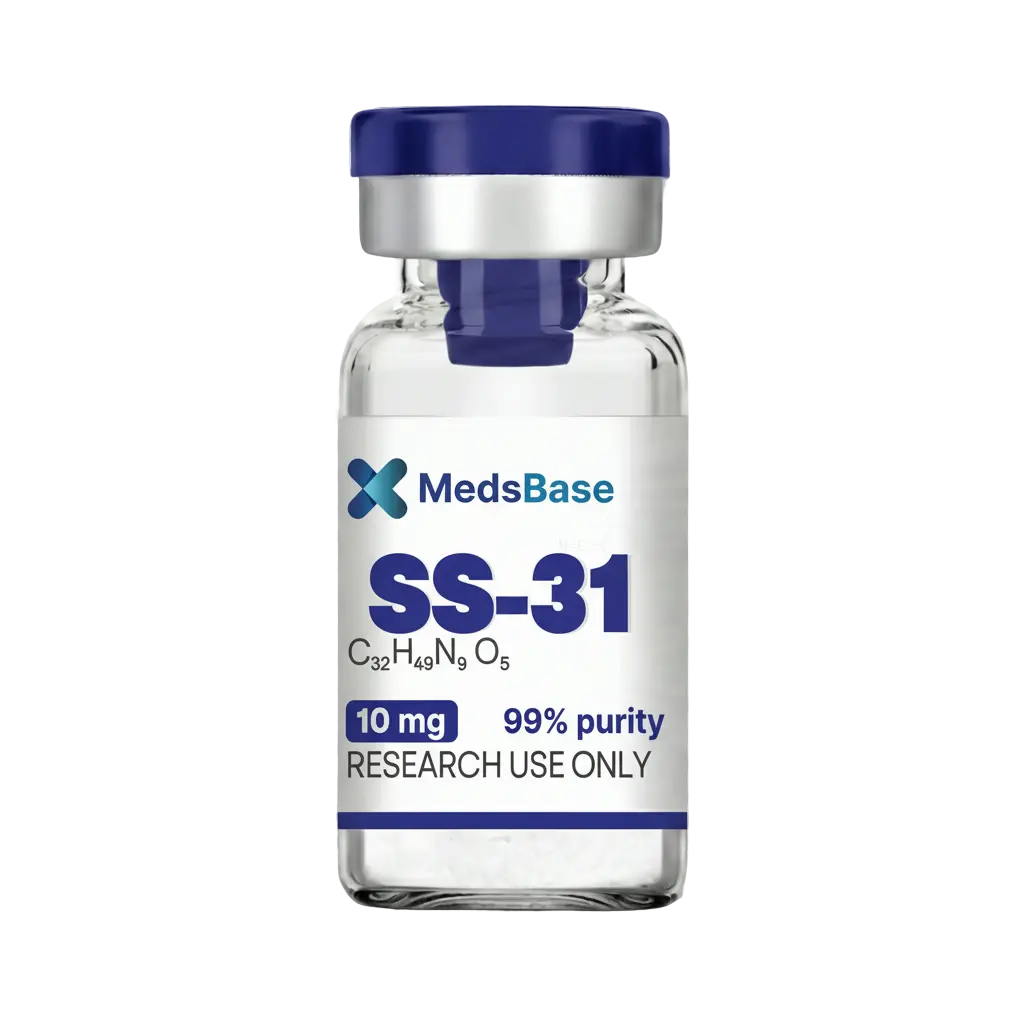
SS-31 (Elamipretide)
✅ Verbetert de cellulaire energie
✅ Ondersteunt mitochondriale functie
✅ Vermindert oxidatieve stress
✅ Verbetert weefselresistentie
✅ Bevordert metabolische efficiëntie
SS-31 bevat synthetisch peptideverbinding.
✓ Medisch beoordeeld door Morgan Ellis — Apotheekonderzoeker · 8 jaar ervaring · Laatst beoordeeld: mei 2026
Kort antwoord — Wat is SS-31 (Elamipretide)?
SS-31 (ook wel genoemd Elamipretide of Bendavia) is een synthetisch tetrapeptide dat selectief bindt aan cardiolipine op het binnenste mitochondriale membraan, waardoor mitochondriale functie onder stress wordt gestabiliseerd. Ontwikkeld door het Szeto-Schiller lab en nu in een laat stadium van klinische ontwikkeling door Stealth BioTherapeutics met FDA orphan-drug-aanduiding voor zeldzame mitochondriale ziekten. Leverbaar in 5 mg tot 50 mg lyofilisatievials uitsluitend voor laboratoriumonderzoek.
📦 Elke bestelling is gedekt door onze Reshipment Assurance-beleid — als uw pakket niet binnen 20 werkdagen arriveert, sturen wij het opnieuw.
| Specificatie | Detail |
|---|---|
| CAS-nummer | 736992-21-5 |
| Molecuulformule | C32H49N9O5 |
| Moleculair gewicht | 639.80 Da |
| Sequentie | D-Arg-2′,6′-Dmt-Lys-Phe-NH2 (Bendavia, MTP-131) |
| Form | Lyofiliseerd poeder (of zoals geleverd) |
| Zuiverheid | ≥99% (HPLC geverifieerd, COA op aanvraag) |
| Opslag | Lyofiliseerd: 2–8 °C (koelkast) voor werkvoorraad; −20 °C voor langdurige opslag van ongeopende flesjes. Gereconstitueerd: 2–8 °C, gebruik binnen ~30 dagen. Bescherm tegen licht. Vries de gereconstitueerde oplossing niet in en ontdooi deze niet. |
| Oplosbaarheid | Bacteriostatisch water (aanbevolen) of steriel water voor kortere gebruiksperioden |
| Onderzoeksgebruik | Alleen voor laboratoriumonderzoek. Niet voor humaan of veterinair diagnostisch of therapeutisch gebruik. |
Wat is SS-31 (Elamipretide)?
SS-31 is een synthetisch, celpermeabel tetrapeptide (D-Arg-2’6′-dimethyl-L-Tyr-L-Lys-L-Phe, ook afgekort als Szeto-Schiller 31) ontwikkeld door Hazel Szeto en Peter Schiller aan Cornell’s Weill Medical College vanaf de jaren 90. Het staat ook bekend onder zijn farmaceutische ontwikkelingsnamen Elamipretide en Bendavia, en wordt klinisch ontwikkeld door Stealth BioTherapeutics.
In tegenstelling tot de meeste onderzoekspeptiden die zich binden aan celoppervlakreceptoren, is SS-31 een mitochondriaal gericht middel dat cel- en organelmembranen passeert om het binnenste mitochondriale membraan te bereiken, waar het zich bindt cardiolipine — een fosfolipide die uniek is voor die locatie. Deze selectieve lipidebinding ondersteunt het werkingsmechanisme en onderscheidt SS-31 van vrijwel elk ander onderzoekspeptide.
Molecuulgewicht ongeveer 640 Da. SS-31 heeft FDA-weesgeneesmiddelstatus voor primaire mitochondriale myopathie en is het onderwerp geweest van meerdere humane klinische onderzoeken — wat het verder in de klinische ontwikkelingspijplijn plaatst dan de meeste onderzoekspeptiden. Het wordt hier geleverd als een hoogzuiver lyofilisaat uitsluitend voor laboratoriumonderzoek (het klinische product van Stealth is een apart gereguleerd therapeutisch middel). Voor een dieper inzicht in het mechanisme, de onderzoeksgeschiedenis van het Szeto-lab en de klinische onderzoekscontext, zie onze SS-31 onderzoeksgids.
Werkingsmechanisme — Cardiolipine-Gerichte Mitochondriële Stabilisatie
Het mechanisme van SS-31 is uniek onder onderzoekspeptiden omdat het doelwit een fosfolipide is, geen receptorproteïne. Drie onderling verbonden effecten definiëren de farmacologie:
- Cardiolipinebinding — SS-31 bindt selectief aan cardiolipine op het binnenste mitochondriale membraan. Cardiolipine is een kenmerkend lipide dat vrijwel uitsluitend op deze locatie wordt aangetroffen en essentieel is voor de architectuur van de cristae (het gevouwen binnenmembraanoppervlak waar elektronentransportketencomplexen clusteren). SS-31-binding stabiliseert de cristae-morfologie tijdens stress die anders zou leiden tot verstoring van de cristae en mitochondriale dysfunctie.
- Vermindering van ROS en behoud van ETC — door de architectuur van de cristae te behouden, handhaaft SS-31 de juiste organisatie van de elektronentransportketencomplexen, wat de ATP-synthese behoudt en de “lekkage” van elektronen die reactieve zuurstofspecies genereert vermindert. In ischemie-reperfusie onderzoeksmodellen vertaalt dit zich naar verminderde oxidatieve schade en behouden mitochondriale functie.
- Preventie van cytochroom c-vrijgave — mitochondriale apoptose begint met de vrijgave van cytochroom c vanuit de intermembraanruimte naar het cytoplasma. Door de cristaestructuur te behouden, behoudt SS-31 de lokalisatie van cytochroom c en blokkeert het een kritische apoptotische trigger. Dit is centraal in het onderzoekssignaal voor cardiale ischemie-reperfusie.
De praktische onderzoeksimplicatie: SS-31 is het referentiepeptide voor mitochondriaal gericht onderzoek. Waar andere peptiden werken op celoppervlakreceptoren, werkt SS-31 in het organel, waarbij het de mitochondriale functie behoudt in onderzoeksmodellen van metabole stress, ischemie en veroudering.
Gepubliceerde onderzoeksapplicaties
SS-31 wordt gebruikt in laboratoriumonderzoeken die zich richten op:
- Onderzoek naar primaire mitochondriale ziekten — zeldzaam onderzoek naar mitochondriale myopathieën, waaronder het Barth-syndroom; SS-31 heeft een FDA-orphan-drug-aanduiding voor deze indicatie
- Cardiologisch onderzoek — onderzoek naar hartfalen, ischemie-reperfusie, cardiomyopathie en cardiotoxiciteitsredding (Szeto, AAPS J 2014)
- Nieronderzoek — onderzoek naar acuut nierletsel, ischemie-reperfusie en chronische nierziekte (Birk et al., J Am Soc Nephrol 2013)
- Verouderingsonderzoek — leeftijdsgerelateerde mitochondriale dysfunctie, veroudering van skeletspieren (sarcopenie) en algemene markers voor cellulaire veroudering
- Onderzoek naar neuroprotectie — onderzoek naar ischemische beroerte en neurodegeneratie waarbij mitochondriale dysfunctie een drijvende factor is
- Onderzoek naar sarcopenie — onderzoek naar mitochondriale functie in skeletspieren en leeftijdsgerelateerd spierverlies
- Vergelijkend onderzoek naar mitochondriale middelen — naast elkaar met NAD+ (mitochondriaal co-enzym) en MitoQ (een andere mitochondriaal gerichte antioxidant) om het mechanisme te isoleren
Voor een bredere context over levensduur en mitochondriale onderzoeksverbindingen, zie de onderzoekspeptiden catalogus.
Beschikbare sterktes en concentraties
MedsBase heeft SS-31 (Elamipretide) in de volgende lyofilisatievialen:
| Vulsterkte | Typisch gebruik | Verpakkingsgroottes |
|---|---|---|
| 5 mg | Korte onderzoeksprotocollen, laaggedoseerd knaagdieronderzoek | 10, 20 of 30 vialen |
| 10 mg | Standaard onderzoekssterkte, uitgebreide knaagdierstudies | 10, 20 of 30 vialen |
| 50 mg | Grootschalig onderzoek, klinische-studie-afgestemde doseringen (40 mg/dag), laagste kosten per mg | 10, 20 of 30 vialen |
De 50 mg vialgrootte komt overeen met de klinische-studiedosis van 40 mg/dag die werd gebruikt in het menselijk onderzoek van Stealth BioTherapeutics. Preklinisch knaagdieronderzoek gebruikt typisch kleinere vials afgestemd op 1–5 mg/kg lichaamsgewicht. Alle sterktes worden geleverd als lyofiliseerpoeder met een HPLC-puurheid van 99%+.
Hoe het zich verhoudt — SS-31 versus andere mitochondriale/longevity-verbindingen
SS-31 maakt deel uit van een kleine maar groeiende klasse van mitochondriaal gerichte onderzoeksstoffen. Belangrijke vergelijkingen:
| Criterium | SS-31 (Elamipretide) | NAD+ | Epitalon |
|---|---|---|---|
| Primair doelwit | Cardiolipine (binnenste mitochondriale membraanlipide) | Sirtuïnen, PARP-enzymen, ETC | Genexpressie, pijnappelklier-signalering |
| Mechanistisch bewijs | Sterk (meerdere labs, klinische onderzoeken) | Zeer sterk (goed gekarakteriseerde biochemie) | Beperkte groep (Khavinson) |
| Klinische status | FDA-weesgeneesmiddel, fase 3 (Barth-syndroom) | Niet goedgekeurd (IV-therapiegebruik) | Niet goedgekeurd |
| Sterkste onderzoekssignaal | Cardiale ischemie, nier, sarcopenie | Longevity, energie, DNA-repair | Telomeer, circadiaan |
| Typische onderzoeksdosis | 5–40 mg per dag (klinisch); 1–5 mg/kg (preklinisch) | 50–100 mg dagelijks | 5–10 mg SC per dag |
SS-31 is uniek omdat het het enige onderzoekspeptide is dat direct op een mitochondriale lipid richt. Onderzoekers bestuderen het vaak in combinatie met NAD+ (voor aanvullende dekking van het sirtuinpad) en Epitalon in onderzoeksprotocollen voor levensduurverlenging via meerdere pathways.
Opslag en Reconstituering
Voor reconstituering: Bewaar lyofiliseerde flesjes gekoeld bij 2–8 °C in de originele verpakking, stabiel tot 36 maanden. Vermijd vries-dooicycli van het poeder.
Reconstitueringsprocedure: Injecteer bacteriostatisch water langs de zijkant van het peptideflesje volgens de bovenstaande tabel. Draai voorzichtig — niet niet schudden — en laat 5–10 minuten staan voor volledige oplossing. De oplossing moet helder en kleurloos zijn.
Na reconstitutie: bewaar gekoeld bij 2–8 °C en gebruik binnen 30 dagen. Vries de gereconstitueerde oplossing niet in.
Veelgestelde vragen
Waar wordt SS-31 voor gebruikt in onderzoek?
SS-31 (Elamipretide) wordt gebruikt in laboratoriumonderzoek naar mitochondriale ziekten (inclusief Barth-syndroom), cardiale ischemie-reperfusie, hartfalen, acuut nierletsel, chronische nierziekte, leeftijdsgerelateerde mitochondriale dysfunctie, sarcopenie en neuroprotectie. Het heeft een FDA-weesgeneesmiddelstatus, maar is niet nog niet door de FDA goedgekeurd voor therapeutisch gebruik. Hier uitsluitend verkrijgbaar voor laboratoriumonderzoek.
Hoe verschilt SS-31 van andere onderzoekspeptiden?
SS-31 is uniek omdat het zich richt op cardiolipine — een fosfolipide op het binnenste mitochondriale membraan — en niet op een celoppervlakreceptor. Het is celpermeabel en bereikt de mitochondriale matrix om de cristae-architectuur te stabiliseren en de functie van de elektronentransportketen te behouden. Vrijwel alle andere onderzoekspeptiden binden aan receptoren op het celoppervlak.
Wat is de typische onderzoeksdosis van SS-31?
Stealth BioTherapeutics’ klinische onderzoeken hebben 40 mg SC per dag gebruikt. Preklinisch onderzoek bij knaagdieren gebruikt typisch 1–5 mg/kg lichaamsgewicht per dag. Een flesje van 10 mg gereconstitueerd met 2,0 mL bacteriostatisch water levert 5,0 mg/mL op — 100 ticks op een U-100 spuit geven 5 mg af.
Is SS-31 goedgekeurd door de FDA?
SS-31 (Elamipretide) heeft door de FDA de weesgeneesmiddelstatus gekregen voor primaire mitochondriale myopathie en bevindt zich in een laat stadium van klinische ontwikkeling door Stealth BioTherapeutics. Het is niet nog niet volledig door de FDA goedgekeurd. Alle SS-31 die door leveranciers voor onderzoeksdoeleinden wordt verkocht, is bedoeld voor laboratoriumonderzoek, niet voor het therapeutische product voor klinische onderzoeken.
Wat betekent de afkorting “SS-31”?
Szeto-Schiller verbinding 31 , naar de Cornell-onderzoekers Hazel Szeto en Peter Schiller die in de jaren 1990 en 2000 de SS-serie van mitochondria-gerichte peptiden ontwikkelden. Het "31" is simpelweg het verbindingsnummer in hun synthesereeks. De verbinding werd later gelicentieerd aan Stealth BioTherapeutics en hernoemd tot Elamipretide (en Bendavia) voor klinische ontwikkeling., vernoemd naar de Cornell-onderzoekers Hazel Szeto en Peter Schiller die in de jaren 90 en 2000 de SS-serie van mitochondriaal gerichte peptiden ontwikkelden. Het “31” is simpelweg het compoundnummer in hun synthesereeks. De stof werd later in licentie gegeven aan Stealth BioTherapeutics en hernoemd tot Elamipretide (en Bendavia) voor klinische ontwikkeling.
Hoe moet ik SS-31 reconstitueren?
Gevriesdroogde flesjes: gekoeld bij 2–8 °C in originele verpakking, stabiel tot 36 maanden. Gereconstitueerde oplossing: gekoeld bij 2–8 °C, gebruik binnen 30 dagen. Vries de gereconstitueerde oplossing niet in.
Kan SS-31 in onderzoek worden gecombineerd met NAD+?
Volg de bovenstaande reconstructietabel. Voeg bacteriostatisch water langs de zijkant van het flesje toe, draai voorzichtig en laat 5-10 minuten staan voor volledige oplossing. Schud niet schudden.
Kan SS-31 gecombineerd worden met NAD+ in onderzoek?
Ja — dit is een veelgebruikte combinatie voor mitochondriaal onderzoek via meerdere routes. SS-31 stabiliseert de cristae-architectuur en de cardiolipine-afhankelijke ETC-functie; NAD+ MedsBase voert SS-31 (Elamipretide) in lyofilisatieflacons van 5 mg, 10 mg en 50 mg. Elke sterkte is beschikbaar in verpakkingen van 10 of 20 flacons. Alle flacons worden geleverd met een HPLC-puurheid van 99%+ en een certificaat van analyse op aanvraag.
Welke sterktes heeft MedsBase op voorraad?
MedsBase carries SS-31 (Elamipretide) in 5 mg, 10 mg, and 50 mg lyophilized vials. Each strength is available in 10-vial, 20-vial, or 30-vial pack sizes. All vials are supplied at 99%+ HPLC purity with a certificate of analysis on request.
Veroorzaakt SS-31 bijwerkingen in onderzoek?
Gepubliceerd preklinisch en klinisch onderzoek heeft een gunstig veiligheidsprofiel gerapporteerd. De meest gerapporteerde effecten in de klinische literatuur zijn injectieplaatsreacties. Omdat SS-31 in meerdere humane onderzoeken (fase 2 en fase 3) is bestudeerd, is het veiligheidsprofiel beter gekarakteriseerd dan bij de meeste onderzoekspeptiden.
Is SS-31 hetzelfde als Bendavia of Elamipretide?
Ja. Dezelfde verbinding draagt drie namen: SS-31 (oorspronkelijke Szeto-Schiller onderzoeksaanduiding), Bendavia (Stealth BioTherapeutics vroege ontwikkelingsnaam), en Elamipretide (internationale niet-propriëtaire naam / INN). Onderzoeksliteratuur gebruikt voornamelijk SS-31; klinische literatuur gebruikt Elamipretide of Bendavia.
Wat is de halfwaardetijd van SS-31?
SS-31 (elamipretide) heeft een korte plasmahalfwaardetijd van ongeveer 30–60 minuten na subcutane toediening, maar vertoont langdurige mitochondriale accumulatie vanwege zijn affiniteit voor cardiolipine in het binnenste mitochondriale membraan. De weefselhalfwaardetijd in mitochondriënrijke organen zoals hart- en skeletspier wordt geschat op enkele uren na plasmaclearing.
Hoe richt SS-31 zich specifiek op mitochondriën?
SS-31 is een Szeto-Schiller-peptide met een afwisselende aromatisch-kationische structuur (D-Arg-dimethyl-Tyr-Lys-Phe-NH₂). Deze sequentie zorgt voor een accumulatie in het binnenste mitochondriale membraan die ongeveer 1.000 keer hoger is dan cytoplasmatische niveaus, gemedieerd door elektrostatische aantrekking tot het negatief geladen cardiolipine fosfolipide. Cardiolipinebinding stabiliseert elektronentransportketencomplexen en vermindert de productie van reactieve zuurstofspecies (ROS).
Kan ik SS-31 bestellen voor internationale verzending?
Ja. MedsBase verzendt SS-31 wereldwijd vanuit ons toegewijde peptideverzendnetwerk. Bestellingen met alleen peptiden komen in aanmerking voor onze standalone peptideverzendservice. Bestellingen worden verzonden in temperatuurgecontroleerde verpakking met volledige tracking.
Andere Peptiden voor Herstel- en Prestatieonderzoek
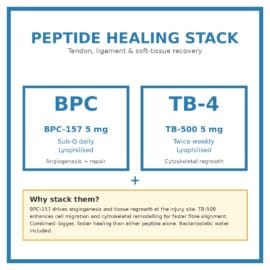
- BPC-157 — Body Protection Compound — onderzoek naar pees-, ligament- en darmherstel
- TB-500 — Thymosine Beta-4 fragment — onderzoek naar zacht weefsel en vasculair herstel
- Ipamorelin — Selectieve ghreline-agonist — schone GH-puls zonder cortisol/prolactine
- CJC-1295 met DAC — GHRH-analoog met verlengde halfwaardetijd
- GHK-Cu — Koperpeptide — onderzoek naar huid- en bindweefselregeneratie
Verder lezen
📖 Lees het onderzoek achter dit peptide
Lees onze volledige evidence-based gids: SS-31 (Elamipretide) — cardiolipine targeting, mitochondriaal onderzoek & klinische onderzoeken. Behandelt Szeto-Schiller mechanismeonderzoek, Stealth BioTherapeutics klinische ontwikkeling, cardiale/renale/neurologische toepassingen en realistische onderzoekscontext.
Meer opties in Peptiden
Gerangschikt op recente bestelvolumes van MedsBase — wat andere klanten in deze categorie kiezen.
| Sterkte | 5 mg, 10 mg, 50 mg |
|---|---|
| Hoeveelheid | 10 flacons, 20 flacons, 30 flacons |
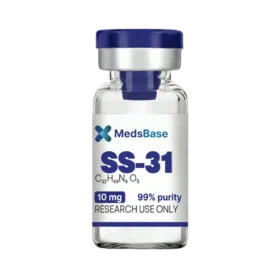 SS-31 (Elamipretide)
Vragen & antwoorden
SS-31 (Elamipretide)
Gerelateerde producten

Beoordelingen
Er zijn nog geen beoordelingen