







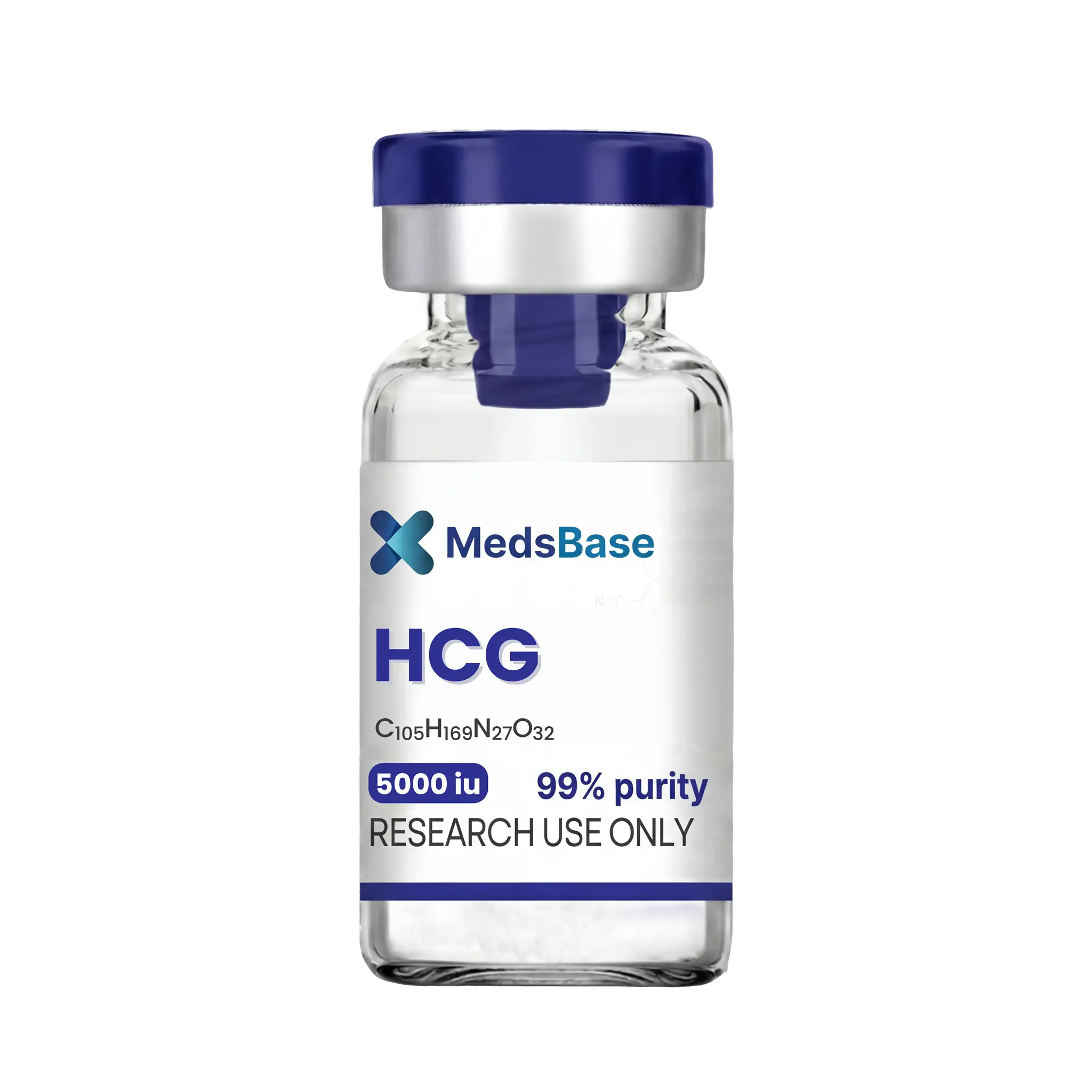
HCG (Humaan Choriongonadotrofine) — Onderzoekskwaliteit
✅ Heterodimeer glycoproteïnehormoon — α + β subunit (~244 aa, ~36.7 kDa)
✅ Canonical LH/CG-receptor (LHCGR) agonist — stimuleert de steroïdogenese in Leydig-cellen
✅ Lange plasmahalfwaardetijd (33–37 uur) vs LH (~20 min) — sialinezuur-gestuurd
✅ Urine-geëxtraheerde glyco-vorm (uHCG, CAS 9002-61-3), ≥99% HPLC, WHO 5th IS-gebioassayeerd
✅ Alleen voor laboratoriumonderzoek — verschillend van merkgebonden klinische preparaten
HCG (Onderzoekskwaliteit) bevat urine-geëxtraheerd Humaan Choriongonadotrofine.
✓ Medisch beoordeeld door Morgan Ellis — Apotheekonderzoeker · 8 jaar ervaring · Laatst beoordeeld: mei 2026
Kort antwoord — Wat is HCG (onderzoekskwaliteit)?
HCG (Humaan Choriongonadotrofine) is een glycoproteïnehormoon dat bestaat uit twee niet-covalent gebonden subeenheden (α, 92 aminozuren — gedeeld met LH/FSH/TSH; β, 145 aminozuren — uniek voor HCG), met een geschat gecombineerd molecuulgewicht van ~36,7 kDa. Het is het canonieke farmacologische hulpmiddel voor activering van de LH/CG-receptor (LHCGR) op Leydig-cellen (stimuleert testosteronproductie in mannelijke onderzoeksmodellen) en ovariële theca-/granulosacellen (stimuleert folliculaire rijping en ovulatie in vrouwelijk voortplantingsonderzoek). Het onderzoeksmateriaal dat hier wordt geleverd is de urine-geëxtraheerde glyco-vorm (CAS 9002-61-3) met ≥99% HPLC zuiverheid, gevriesdroogd in flesjes van 5.000 IE of 10.000 IE. Het is functioneel verschillend van het recombinante rHCG (choriogonadotropine alfa, CAS 56832-30-5) dat in sommige klinische preparaten wordt gebruikt. Uitsluitend geleverd voor laboratoriumonderzoek.
📦 Elke bestelling is gedekt door onze Reshipment Assurance-beleid — als uw pakket niet binnen 20 werkdagen arriveert, sturen wij het opnieuw.
| Specificatie | Detail |
|---|---|
| Compound Class | Heterodimeer glycoproteïne hormoon (α + β subeenheden); LH/CG receptor (LHCGR) agonist; peptidehormoon |
| Chemical Name | Humaan Choriongonadotropine (urine-geëxtraheerde glycovorm; uHCG) |
| CAS-nummer | 9002-61-3 (urine HCG); 56832-30-5 (recombinant choriogonadotropine alfa — niet de hier geleverde vorm) |
| Subeenheidstructuur | Heterodimeer van twee niet-covalent geassocieerde subeenheden: α-subeenheid (92 aminozuren, gedeeld met LH/FSH/TSH) en β-subeenheid (145 aminozuren, uniek voor HCG). Beide subeenheden zijn uitgebreid N- en O-glycosyleerd — het hoge siaalzuurgehalte van de β-subeenheid is verantwoordelijk voor de uitzonderlijk lange plasma-halfwaardetijd van HCG ten opzichte van LH. |
| Moleculair gewicht | ~36.700 Da (~36,7 kDa) gecombineerd heterodimeer; α-subeenheid ~14 kDa, β-subeenheid ~22 kDa (zwaar geglycosyleerd) |
| Molecuulformule | Heterodimeer glycoproteïne — α-subeenheid (92 aa, gedeeld met LH/FSH/TSH) + β-subeenheid (145 aa, hCG-specifiek). Zware sialylering (~30% w/w koolhydraat) geeft 33–37 uur plasma-halfwaardetijd. Geen enkele moleculaire formule vanwege variabele glycovorm samenstelling; alleen-eiwit MW ~25 kDa, volledig geglycosyleerd MW ~36,7 kDa. |
| Werkingsmechanisme | Bindt en activeert de LH/CG receptor (LHCGR) — een Gs-gekoppelde GPCR uitgedrukt op Leydig-cellen (testis) en ovarium theca/granulosa-cellen. Receptoractivatie drijft adenylaatcyclase aan, verhoogt intracellulair cAMP, activeert PKA en induceert de steroïdogene enzymen (StAR, CYP17A1, CYP11A1) die de novo testosteronbiosynthese (mannelijk) of oestrogeen/progesteronbiosynthese (vrouwelijk) aansturen. HCG en LH delen dezelfde receptor en dezelfde downstream cascade. |
| IU-naar-mg conversie | ~9.300 IU per mg hooggezuiverd materiaal (WHO 5e Internationale Standaard referentie). 1 IU is daarom ongeveer 108 ng van puur peptide. Een flesje van 5.000 IU bevat ~0,54 mg peptide; een flesje van 10.000 IU bevat ~1,08 mg. |
| Plasma Half-Life | Bifasische eliminatie — initiële fase ~6 uur, terminale fase 33–37 uur. Aanzienlijk langer dan LH (~20 min) — veroorzaakt door het hoge siaalzuurgehalte van de β-subeenheid-glycanen, wat de hepatische klaring vermindert. |
| Form | Gevriesdroogd wit tot off-wit amorfe poeder; eenmalig gebruik onderzoeksflesjes. Wordt geleverd met een aparte stopverzegelde gevriesdroogde cake (geen verdunningsmiddel in het flesje). |
| Zuiverheid | ≥99% (HPLC-geverifieerd); WHO-bioassay bevestigt LHCGR-bindingspotentie consistent met de 5e Internationale Standaard. COA op aanvraag verkrijgbaar. |
| Oplosbaarheid | Reconstitueer in bacteriostatisch water (het standaard onderzoeksverdunningsmiddel) met 1,0 mL per 5.000 IE (→ 5.000 IE/mL werkvoorraad) of 2,0 mL per 10.000 IE (→ 5.000 IE/mL); andere verdunningen volgens protocol. Mannitol-gebaseerde gevriesdroogde cake lost snel op met zacht zwenken — niet schudden. Vermijd vortexen (hoge schuifkracht kan het α/β-heterodimeer dissociëren). |
| Opslag | Gevriesdroogd: 2–8 °C ongeopend voor kortetermijnwerkvoorraad; −20 °C voor langdurige opslag (stabiel ≥36 maanden bij −20 °C; ≥18 maanden bij 2–8 °C). Gereconstitueerd: 2–8 °C, gebruik binnen ~30 dagen. Beschermen tegen licht. Vries gereconstitueerd materiaal niet in — vries-ontdooicycli dissociëren het α/β-heterodimeer en vernietigen de bioactiviteit. |
| Onderzoeksgebruik | Alleen voor laboratoriumonderzoek. Niet voor menselijke of veterinaire diagnostische of therapeutische toepassingen. HCG staat op de Verboden Lijst van het Wereldantidopingagentschap (WADA) (klasse S2, Peptidehormonen, Groeifactoren en Verwante Stoffen) en is te allen tijde verboden voor mannelijke atleten (de uitzondering voor vrouwelijke atleten weerspiegelt de rol van HCG als een natuurlijk zwangerschapshormoon). Onderzoekers in menselijke onderzoekscontexten moeten zich bewust zijn van deze regelgevende status. |
Wat Is HCG?
HCG (Humaan Choriongonadotrofine, CAS 9002-61-3) is een glycoproteïne peptidehormoon uit dezelfde gonadotropinefamilie als luteïniserend hormoon (LH), follikelstimulerend hormoon (FSH) en thyreoïdstimulerend hormoon (TSH). Net als de andere drie is het een heterodimeer van een α-subunit (92 aminozuren, identiek in alle vier hormonen) en een β-subunit (145 aminozuren, uniek voor HCG). De α- en β-subunits zijn niet-covalent gebonden en beide zijn uitgebreid geglycosyleerd — de β-subunit alleen al draagt vier N-gebonden en vier O-gebonden glycanten, en het hoge siaalzuurgehalte van deze glycanten is verantwoordelijk voor de uitzonderlijk lange plasmahalfwaardetijd van HCG in vergelijking met LH (33–37 uur terminal, versus ~20 minuten voor LH).
Endogeen HCG wordt geproduceerd door de syncytiotrofoblast van de ontwikkelende placenta tijdens de zwangerschap, waar het het corpus luteum en de progesteronproductie handhaaft gedurende de eerste ~10 weken van de zwangerschap. Buiten de zwangerschap is het normaal gesproken niet detecteerbaar aanwezig; het verschijnen in serum of urine vormt daarom de basis van zwangerschapstests. De farmacologische toepassing van HCG in onderzoek heeft echter niets te maken met deze fysiologische rol en alles met het feit dat HCG dezelfde LH/CG-receptor (LHCGR) bindt en activeert als endogeen LH — maar met een veel langere werkingsduur. HCG is daarom het standaard farmacologische hulpmiddel voor langdurige LHCGR-activatie in onderzoek naar Leydig-celfunctie, gonadale steroïdogenese, spermatogenese, folliculaire ontwikkeling, ovulatie en de HPG-as in brede zin.
Er bestaan twee moleculaire vormen van HCG in de handel: de uit urine geëxtraheerde vorm (uHCG, CAS 9002-61-3), gezuiverd uit de urine van zwangere vrouwen, wat wij leveren; en de gerecombineerde vorm (rHCG of choriogonadotrofine alfa, CAS 56832-30-5), geproduceerd in CHO-cellen en gebruikt in sommige klinische preparaten (Ovidrel / Ovitrelle). De twee vormen hebben dezelfde aminozuursequentie en hetzelfde LHCGR-bindingsprofiel, maar de glycosyleringspatronen verschillen licht tussen urine-extractie en CHO-cel expressie — gepubliceerde bioassay-vergelijkingen melden grofweg equivalente in-vivo potentie.
Werkingsmechanisme — LH/CG-receptoractivatie en steroïdogenese
Het werkingsmechanisme van HCG behoort tot de best gekarakteriseerde in de endocriene farmacologie:
- LH/CG-receptor (LHCGR) binding — HCG bindt de LHCGR (een klasse-A Gs-gekoppelde GPCR met een groot extracellulair leucine-rich-repeat domein), met hoge affiniteit en dezelfde bindingsplaats als endogeen LH. Receptorverdeling is beperkt tot gonadale weefsels: Leydig-cellen van de testis (mannen), en ovariële theca-cellen, muraal granulosa-cellen en geluteïniseerde granulosa-cellen (vrouwen). De LHCGR wordt ook in lagere niveaus tot expressie gebracht op corpus luteum-cellen, waar HCG de progesteronproductie handhaaft tijdens de vroege zwangerschap.
- Gs-cAMP-PKA signaalcascade — Geactiveerde LHCGR koppelt aan Gαs, verhoogt intracellulair cyclisch AMP, activeert PKA en drijft fosforylering van CREB en andere downstream transcriptiefactoren aan. cAMP activeert ook EPAC voor sommige downstream-effecten. PKA-activatie in steroïdogene cellen reguleert specifiek het StAR-eiwit (steroidogenic acute regulatory protein) op, dat cholesterol over het mitochondriale buitenmembraan transporteert — de snelheidsbepalende stap in de novo steroïdogenese.
- Inductie van steroïdogene enzymen — Langdurige LHCGR-activatie door HCG drijft transcriptie-opregulatie aan van de steroïdogene enzymcascade: CYP11A1 (cholesterol side-chain cleavage), CYP17A1 (17α-hydroxylase / 17,20-lyase), 3β-HSD en 17β-HSD. Het nettoresultaat in Leydig-cellen is langdurige de novo testosteronbiosynthese; in ovariële theca-cellen produceert dezelfde cascade androstenedion (dat granulosa-cellen omzetten naar oestradiol via CYP19A1 / aromatase onder FSH-stimulatie).
- Functionele duur en tachyfylaxie — Een enkele HCG-bolus veroorzaakt een langdurige LHCGR-activering van 5–7 dagen in onderzoeksmodellen, vanwege de lange plasma-halfwaardetijd van HCG (33–37 uur) en de trage internalisatiekinetiek van de LHCGR. Herhaalde hoge doses HCG kunnen LHCGR-desensibilisatie (tachyfylaxie) veroorzaken — een goed gedocumenteerd fenomeen in gepubliceerd Leydig-celonderzoek dat relevant is voor chronische doseringsprotocollen.
- Hypothalamus-hypofyse-feedback — Net als endogeen testosteron, remt HCG-gestuurde testosteronproductie de hypothalamus en hypofyse om GnRH en LH/FSH-secretie te onderdrukken. In de context van onderdrukt-HPG-onderzoek (testosteronsuppletie, AAS-blootstelling of farmacologische HPG-onderdrukking), omzeilt HCG de hypothalamus-hypofyse blokkade door direct in te werken op de Leydig-cel LHCGR — daarom is HCG het standaardinstrument voor het onderzoeken van Leydig-celfunctie onder HPG-onderdrukking.
HCG en LH activeren dezelfde receptor via dezelfde cascade, maar met twee praktische verschillen: HCG produceert langere, meer aanhoudende signalering per dosis (vanwege de langere halfwaardetijd), en HCG wordt exogeen toegediend terwijl endogeen LH pulsatiel en centraal gereguleerd is. Onderzoeksprotocollen die langdurige, controleerbare LHCGR-activering nodig hebben, gebruiken HCG; protocollen die pulsatiele, fysiologische LHCGR-activering nodig hebben, gebruiken recombinant LH of GnRH-gestuurd endogeen LH.
Gepubliceerde onderzoeksapplicaties
HCG wordt gebruikt in laboratoriumonderzoeken die zich richten op:
- LHCGR-farmacologie — de standaard referentie-agonist — verreweg de meest geciteerde LH/CG-receptoractivator in de gepubliceerde literatuur; standaard toolverbinding voor receptor-internalisatiekinetiek, signaalbiasstudies en de ontwikkeling van nieuwere LHCGR-gerichte kleine-molecuulmodulatoren
- Leydig-celbiologie en gonadale steroïdogenese — HCG is de standaard farmacologische stimulus voor de-novo testosteronbiosynthese in primaire Leydig-celkweek en ex-vivo testisweefselpreparaten; veel gebruikt in onderzoek naar Leydig-celfunctie, mitochondriaal cholesteroltransport, StAR-regulatie en steroïdogene-enzymcascadekinetiek
- Onderzoek naar onderdrukking en herstel van de HPG-as — in onderzoeksmodellen waar endogeen LH/FSH is onderdrukt (door exogene testosterontoediening, anabole-androgene-steroïdeblootstelling of farmacologische GnRH-antagonisme), werkt HCG direct in op de Leydig-cel LHCGR om testosteronproductie te handhaven en Leydig-celfunctie te behouden; het standaardinstrument voor het ontrafelen van de HPG-as onderdrukking-hersteldynamiek
- Spermatogeneseonderzoek — gebruikt in combinatie met FSH of FSH-analogen in gepubliceerd Sertoli-cel / spermatogoniale-stamcelonderzoek; handhaaft het hoge intratesticulaire testosteronmicro-omgeving dat nodig is voor spermatogenese, zelfs bij onderdrukte circulerende LH
- Ovarieel folliculaire ontwikkeling en ovulatieonderzoek — in vrouwelijk voortplantingsonderzoek wordt HCG gebruikt om de LH-piek na te bootsen die de uiteindelijke follikelrijping, de hervatting van de meiose van de eicel en de follikelruptuur triggert; standaardinstrument in gepubliceerde ovulatie-triggerprotocollen, eicelrijpingsstudies en luteïniseringsonderzoek
- Corpus luteum-biologie — HCG ondersteunt de functie van het corpus luteum en de progesteronproductie door directe LHCGR-activering op luteale cellen; gebruikt in gepubliceerd onderzoek naar de luteale fase en de luteo-placentale overgang
- Receptorfarmacologie en biased agonisme — de LHCGR vertoont cAMP-versus-arrestine biased signalering, en HCG is de referentie volledige agonist waartegen biased liganden (kleine molecuul LHCGR-allosterische modulatoren, ORG-43553 en andere) worden afgemeten
- Vergelijkende farmacologie versus LH en recombinant choriogonadotropine alfa — gepubliceerd onderzoek heeft urine-geëxtraheerd HCG (uHCG, wat wij leveren), recombinant HCG (rHCG / choriogonadotropine alfa) en recombinant LH (Luveris) rechtstreeks vergeleken voor receptorbinding, cAMP-signalering en in-vivo testosteronproductie-eindpunten
Voor bredere context over HPG-as- en voortplantingssysteem-onderzoekspeptiden in deze catalogus, zie Kisspeptine-10 (de upstream hypothalamische regulator van GnRH — het meest directe HPG-as-peptidecomplement voor HCG), PT-141 (Bremelanotide) (melanocortinereceptorfarmacologie — seksuele functieonderzoek), Oxytocine Acetaat (het hypothalamische posterior-hypofyse peptidehormoon — reproductief / sociaal-bindingsonderzoek), en Tesamorelin (GHRH-analoog — een andere endocriene as maar vaak samen bestudeerd). Bekijk het volledige onderzoekspeptiden & verbindingen catalogus.
Beschikbare sterktes en concentraties
MedsBase stocks HCG (urinary-extracted glycoform) in two lyophilized vial sizes calibrated to typical research-protocol dose ranges. Each strength is available in 10-vial, 20-vial, or 30-vial pack formats:
| Vulsterkte | Typisch Onderzoeksgebruik | Verpakkingsgroottes |
|---|---|---|
| 5.000 IE | Standaard onderzoekssterkte — enkelvoudige dosis Leydig-celstimulatie, individuele dier HPG-onderdrukkingsherstelprotocollen, ovulatie-triggeronderzoek (HCG 5.000 IE is de historisch canonieke ovulatie-inductiedosis); in-vitro receptorfarmacologie bij bekende IE-tot-receptor stoichiometrie | 10, 20 of 30 vialen |
| 10.000 IE | Hoge sterkte onderzoeksfles — langdurige doseringsprotocollen, multi-dier cohortwerk, hooggedoseerde Leydig-celstimulatieonderzoek, meerweekse chronische doseringsstudies; laagste kosten per IE | 10, 20 of 30 vialen |
Beide sterktes zijn dezelfde chemische entiteit (lyofiliseerd urine-geëxtraheerd HCG, ≥99% HPLC zuiverheid, WHO 5e Internationale Standaard bioassay-bevestigde potentie). De 10.000 IE fles biedt de laagste kosten per IE voor groot-cohort of chronisch doseringsonderzoek; de 5.000 IE fles is handig voor enkelvoudige dosis stimulatie-experimenten of kleiner-cohortwerk waarbij fles-tot-fles doseringsnauwkeurigheid belangrijker is dan kosten per IE. Onderzoekers moeten specifieke doseringsbereiken bepalen uit peer-reviewed literatuur passend bij het protocol.
Vergelijking — HCG vs Kisspeptine-10
HCG en Kisspeptine-10 zijn de twee HPG-as peptidehulpmiddelen in deze catalogus, en ze richten zich op volledig verschillende lagen van dezelfde as. HCG werkt stroomafwaarts, op de Leydig-cel / theca-cel LH/CG-receptor, en bootst de LH-piek direct na — nuttig wanneer het doel is om Leydig-cel steroïdogenese aan te sturen of ovulatie te triggeren ongeacht de stroomopwaartse HPG-status. Kisspeptine-10 werkt stroomopwaarts, op hypothalamische Kiss1R-exprimerende GnRH-neuronen, en bootst het kisspeptinesignaal na dat endogene pulsatiele GnRH en stroomafwaartse LH/FSH-afgifte aanstuurt — nuttig wanneer het doel is om de fysiologische HPG-as cascade end-to-end te onderzoeken. De twee verbindingen zijn mechanistisch complementair, en onderzoeksprotocollen combineren ze soms om stroomopwaartse-hypothalamische versus stroomafwaartse-gonadale bijdragen aan reproductieve endocriene output te ontleden.
| Criterium | HCG | Kisspeptine-10 |
|---|---|---|
| Chemische klasse | Heterodimeer glycoproteïne hormoon (α + β subeenheden, ~244 aa totaal, zwaar geglycosyleerd) | Lineair 10-residu peptide (het bioactieve C-terminale fragment van volledige kisspeptine-54) |
| Molecuulgewicht | ~36,7 kDa | 1,302 Da |
| Receptor | LH/CG receptor (LHCGR, Gs-gekoppelde GPCR) op Leydig-/theca-/granulosacellen | Kiss1R (GPR54, Gq-gekoppelde GPCR) op hypothalamische GnRH-neuronen |
| Interventiepunt in de HPG-as | Downstream — gonadale (omzeilt hypothalamus en hypofyse volledig) | Upstream — hypothalamische (activeert de fysiologische cascade GnRH → LH/FSH → gonadale steroïden) |
| Best-studied research focus | Leydig-celfunctie, gonadale steroïdogenese, herstel van HPG-onderdrukking, ovulatietrigger, corpus luteum-biologie, LHCGR-farmacologie | GnRH-neuronbiologie, integratie van de HPG-as, onderzoek naar puberteit/fertiliteit, hypothalamisch kisspeptine/NKB/dynorfine-netwerk |
| Plasma-halfwaardetijd | Lang — 33–37 uur terminale halfwaardetijd (gedreven door sialylering) | Kort — minuten (klein peptide, geen glycoprotectie) |
| Typische onderzoeksdosis | 500–5.000 IE SC/IM bij knaagdieren (enkele bolus); 250–500 IE/dag bij chronische protocollen | 10–100 µg SC bij knaagdieren; pulsatiele toediening bij chronische protocollen |
| WADA-status | Te allen tijde verboden voor mannelijke atleten (S2 — Peptide Hormonen); uitzondering voor vrouwelijke atleten | Momenteel niet op de WADA Verboden Lijst |
Voor onderzoek gericht op directe steroïdogenese in gonadecellen, het triggeren van ovulatie of downstream LHCGR-farmacologie is HCG de canonieke referentieverbinding. Voor onderzoek gericht op hypothalamische GnRH-neuronbiologie, HPG-asintegratie of upstream reproductief-endocriene signalering, Kisspeptine-10 is het meer gerichte hulpmiddel. Zie ook PT-141 (Bremelanotide) voor melanocortine-receptorfarmacologie en onderzoek naar seksuele functie, en Oxytocine Acetaat voor onderzoek naar peptidehormonen van de achterste hypofyse.
Opslag en Reconstituering
Voor reconstituering: bewaar lyofiliseerde flacons gekoeld bij 2–8 °C in de originele verpakking voor kortdurende werkvoorraad. Voor langdurige opslag, vries ongeopende flacons in bij −20 °C (stabiel ≥36 maanden bij −20 °C; ≥18 maanden bij 2–8 °C). Lyofiliseerd HCG is redelijk stabiel omdat de α- en β-subeenheden bij elkaar worden gehouden door hydrofobe en waterstofgebonden interacties die niet worden verstoord in de gevriesdroogde toestand, maar het eiwit is gevoelig voor blootstelling aan vocht en thermische cycli.
Reconstitueringsprocedure: voor de 5.000 IE-fles, injecteer 1,0 mL bacteriostatisch water langs de zijwand van de fles (niet direct op de lyofiliseerde cake) — dit resulteert in een werkvoorraad van 5.000 IE/mL. Voor de 10.000 IE-fles, injecteer 2,0 mL bacteriostatisch water voor dezelfde werkvoorraad van 5.000 IE/mL, of 1,0 mL voor een hooggeconcentreerde voorraad van 10.000 IE/mL. Draai voorzichtig om op te lossen — niet schudden, niet vortexen. Hoog-schuurmenging dissocieert het α/β-heterodimeer en vernietigt de LHCGR-bindende bioactiviteit. De op mannitol gebaseerde lyofilisatiecake lost meestal binnen 30–60 seconden op bij voorzichtig draaien.
Kritieke opslagregels voor gereconstitueerd materiaal: na reconstitutie, bewaar bij 2–8 °C en gebruik binnen 30 dagen. Vries gereconstitueerd HCG niet in — vries-dooicycli dissociëren het heterodimeer en vernietigen onomkeerbaar de bioactiviteit. Bescherm tegen licht. Gooi weg als troebelheid, deeltjes of een duidelijke kleurverandering optreedt. Voor onderzoeksprotocollen die meerdere aliquoten vereisen, bereid de aliquoten voor op het moment van reconstituering en bewaar ze apart bij 2–8 °C in plaats van ze in te vriezen — kortdurende koeling behoudt de bioactiviteit beter dan zelfs enkele vries-dooicycli.
Veelgestelde vragen
Wat is het verschil tussen urine-geëxtraheerd HCG (uHCG) en recombinant HCG (rHCG / choriogonadotropine alfa)?
Urine-geëxtraheerd HCG (wat wij leveren, CAS 9002-61-3) wordt gezuiverd uit de verzamelde urine van zwangere vrouwen met behulp van ionenuitwisselings- en gel-filtratiechromatografie. Recombinant HCG (choriogonadotropine alfa, CAS 56832-30-5; klinische preparaten Ovidrel / Ovitrelle) wordt geproduceerd in CHO-cellen uit gekloonde HCG α- en β-subeenheid cDNA's. De twee vormen hebben dezelfde aminozuursequentie en binden met dezelfde affiniteit aan de LHCGR, maar de glycosyleringspatronen verschillen licht tussen urine-afgeleid en CHO-cel-geëxpresseerd materiaal. Gepubliceerde head-to-head bioassay-vergelijkingen rapporteren grofweg equivalente in-vivo potentie, waarbij rHCG iets consistentere batch-tot-batch glycosyleringspatronen vertoont en uHCG het iets hogere siaalzuurgehalte heeft dat typisch is voor placentaire glycosylering.
Hoeveel IE is 1 mg HCG?
Het WHO 5th International Standard referentiemateriaal definieert de HCG-potentie op ongeveer 9.300 IE per mg zuiver peptide. Praktisch: een flesje van 5.000 IE bevat ~0,54 mg peptide; een flesje van 10.000 IE bevat ~1,08 mg. De IE is een bioassay-gedefinieerde eenheid die de LHCGR-bindingspotentie weerspiegelt in plaats van massa, en de IE/mg-ratio varieert licht tussen glycoformen en tussen batches — daarom wordt farmaceutische HCG gelabeld in IE in plaats van in mg.
Welke gepubliceerde doseringsbereiken zijn gebruikt in onderzoek met knaagdieren?
Enkele-bolus protocollen voor knaagdieren gebruiken typisch 50–250 IE SC of IM voor cAMP / receptor-internalisatiestudies, en 500–5.000 IE SC voor protocollen met aanhoudende testosteronproductie (3–7 dagen werkingsduur per bolus). Chronische protocollen gebruiken 100–500 IE/dag gedurende 2–4 weken. De gepubliceerde ovulatie-triggerdosis bij knaagdieren is typisch 5–10 IE per muis of 10–50 IE per rat IP. In-vitro Leydig-celstimulatieprotocollen gebruiken typisch 0,1–10 IE/mL in kweekmedium. Onderzoekers moeten primaire literatuur raadplegen die past bij de soort, het model en het eindpunt van belang.
Waarom heeft HCG een veel langere halfwaardetijd dan LH?
De β-subeenheid van HCG draagt vier N-gebonden glycannen en vier O-gebonden glycannen, met een uitzonderlijk hoog siaalzuur (NeuAc)-gehalte op de terminale posities van deze glycannen. De asialoglycoproteïnereceptor (ASGR) op hepatocyten is de belangrijkste route waarmee gonadotropine-familiehormonen uit de circulatie worden verwijderd — ASGR herkent terminale galactose / N-acetylgalactosamineresten die worden blootgesteld na siaalzuurverwijdering door sialidase. Omdat de β-subeenheid van HCG zo zwaar en terminaal gesialyleerd is, is de ASGR-gemedieerde klaring door de lever veel langzamer dan voor de minder zwaar gesialyleerde LH β-subeenheid, wat resulteert in het dramatische verschil in halfwaardetijd (HCG 33–37 uur vs LH ~20 minuten).
Waarom kan gereconstitueerd HCG niet worden ingevroren?
HCG is een heterodimeer van twee niet-covalent geassocieerde subeenheden. De α/β-interactie is stabiel in de gevriesdroogde cake (omdat er geen water is waarin de subeenheden uit elkaar kunnen drijven) en stabiel in gekoelde waterige oplossing bij 2–8 °C (omdat de kinetiek van dissociatie bij lage temperatuur langzaam is). Maar de ijskristalvorming tijdens het invriezen trekt de subeenheden fysiek uit elkaar, en eenmaal gedissocieerd associëren ze bij ontdooien slechts inefficiënt weer. Het resultaat is dat ingevroren en ontdooid HCG een groot deel van de immunoreactiviteit behoudt (de β-subeenheid is nog detecteerbaar door antilichamen) maar een groot deel van de bioactiviteit verliest (de gedissocieerde subeenheden binden niet effectief aan de LHCGR). Gefriesdroogd HCG kan worden ingevroren en is stabiel bij −20 °C; gereconstitueerd HCG kan dit niet.
Wat is de WADA-regelgevingsstatus van HCG?
HCG staat op de verboden lijst van het Wereld Anti-Doping Agentschap (WADA) onder klasse S2 (peptidehormonen, groeifactoren, verwante stoffen en mimetics). Het is te allen tijde verboden — zowel in- als buiten competitie — voor alleen mannelijke atleten. Vrouwelijke atleten zijn uitgezonderd omdat HCG een natuurlijk zwangerschapshormoon is en daarom detecteerbaar is bij elke zwangere vrouw, ongeacht toediening. Onderzoekers die menselijk onderzoek met HCG uitvoeren, moeten zich bewust zijn van deze regelgevende status. Voor laboratorium in-vitro en knaagdier in-vivo onderzoek is de WADA-status slechts informatief.
Kan HCG worden gecombineerd met Kisspeptin-10, FSH of testosteron in onderzoeksprotocollen?
Ja — deze verbindingen richten zich op verschillende lagen van de HPG-as (upstream, midden, downstream) en worden vaak gecombineerd in onderzoek dat gericht is op het ontrafelen van asintegratie. De meest gepubliceerde combinaties zijn HCG met FSH (of FSH-analogen) voor spermatogenese- of folliculaire-ontwikkelingsonderzoek; HCG met Kisspeptine-10 voor upstream-vs-downstream ontleding; HCG met exogeen testosteron (voor HPG-onderdrukkingsherstelonderzoek, waarbij het testosteron LH onderdrukt en HCG de onderdrukking omzeilt). Los elk apart op en volg de specifieke opslagregels van elke verbinding — HCG mag in het bijzonder niet bevroren worden na reconstitutie (zie boven).
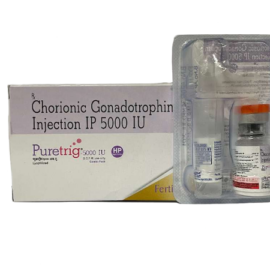
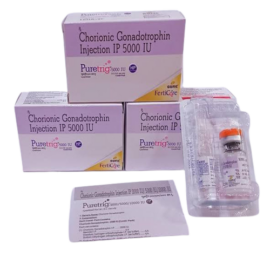
Hoe verhoudt dit onderzoeks-HCG zich tot de merkgebonden klinische preparaten (Eutrig, HUCOG, ZyHCG, Pregnyl, Ovidrel)?
De merkgebonden klinische preparaten zijn urine-geëxtraheerd HCG (Eutrig HP, HUCOG, ZyHCG, Pregnyl) of recombinant HCG (Ovidrel / Ovitrelle) verpakt onder verschillende fabrikant-SKU's voor klinisch gebruik in vruchtbaarheids- en reproductieve geneeskunde. Het hier geleverde onderzoeks-HCG is dezelfde urine-geëxtraheerde glyco-vorm (uHCG, CAS 9002-61-3) met ≥99% HPLC zuiverheid, geleverd zonder klinisch gebruikslabel en bedoeld voor laboratoriumonderzoek alleen. Onderzoekers die HCG voor klinisch gebruik zoeken, moeten dit via een klinische toeleveringsketen verkrijgen; onderzoekers die onderzoeksmateriaal zoeken voor in-vitro receptorfarmacologie, knaagdier in-vivo werk of andere laboratoriumtoepassingen kunnen het hier geleverde materiaal gebruiken.
Andere onderzoekspeptiden voor HPG-as en voortplantingsonderzoek
- Kisspeptine-10 — Hypothalamische Kiss1R-agonist — upstream HPG-as regulator, stimuleert GnRH-pulsatie
- PT-141 (Bremelanotide) — Melanocortine-4 receptoragonist — onderzoek naar seksuele functie
- Oxytocine Acetaat — Posterior hypofyse nonapeptide — onderzoek naar voortplanting en sociale binding
- Tesamorelin — GHRH-analoog — verschillende endocriene as, vaak samen onderzocht
- Sermorelin — GHRH 1-29 analoog — hypofyse GH-as onderzoek
- BAC Water (Bacteriostatisch Water) — Benodigd voor het reconstitueren van elk lyofiliseerd flesje — steriel, 0,9% benzylalcohol-geconserveerd oplosmiddel
Meer opties in Peptiden
Gerangschikt op recente bestelvolumes van MedsBase — wat andere klanten in deze categorie kiezen.
| Sterkte | 5,000 IE, 10,000 IE |
|---|---|
| Hoeveelheid | 10 flacons, 20 flacons, 30 flacons |
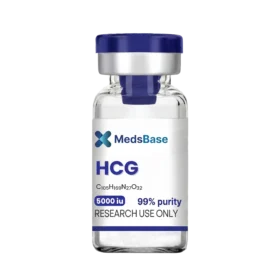 HCG (Humaan Choriongonadotrofine) — Onderzoekskwaliteit
Vragen & antwoorden
HCG (Humaan Choriongonadotrofine) — Onderzoekskwaliteit
Gerelateerde producten
Beoordelingen
Er zijn nog geen beoordelingen