







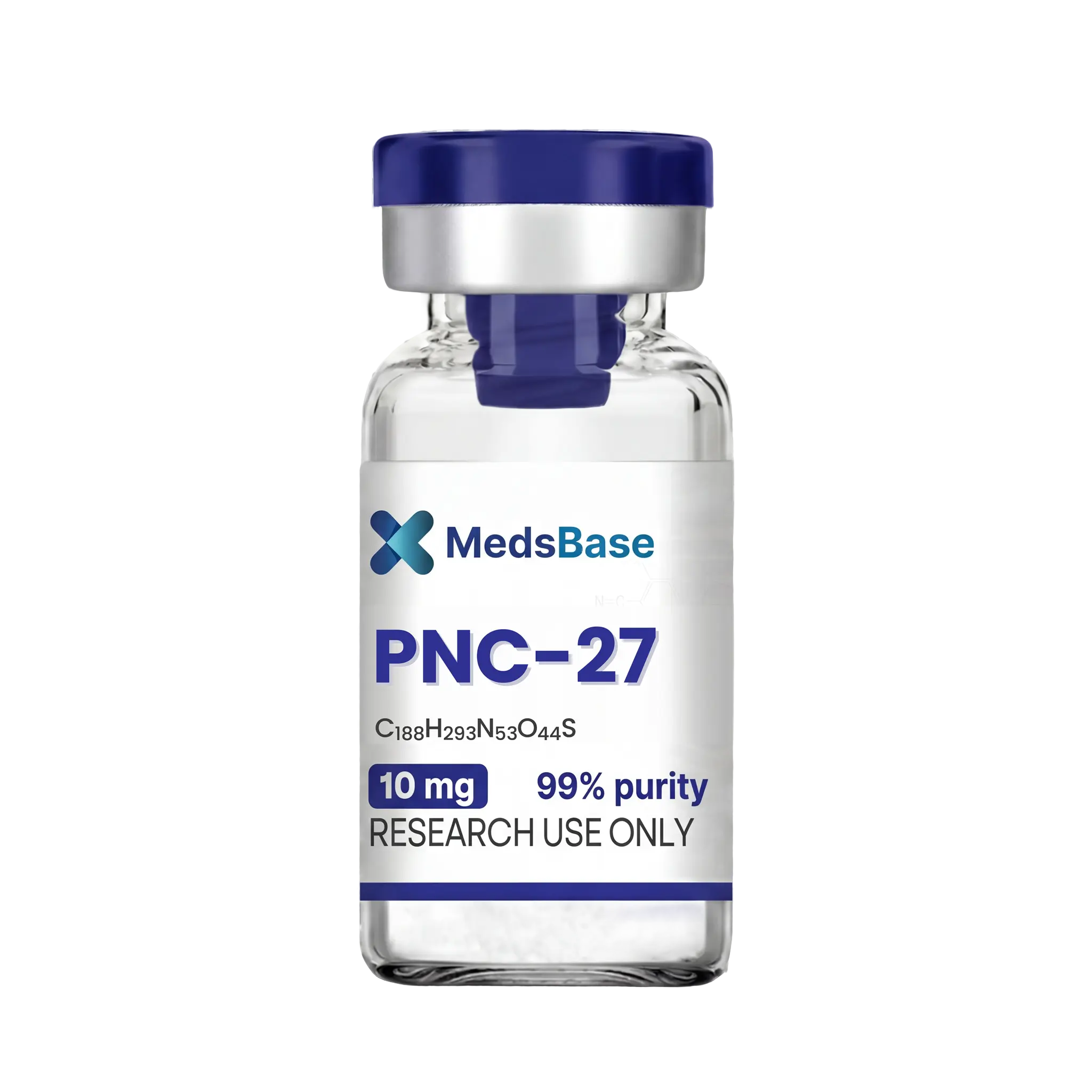
PNC-27 (p53-HDM2 membraangericht chimeer peptide)
✅ ~32-aa chimeer peptide — p53(12-26) HDM2-bindende helix + membraanresistentiepeptide
✅ Bindt aan afwijkende HDM2 op kankerceloppervlak → membraanlyse (geen klassieke apoptose)
✅ Selectieve necrotische doding van tumorcellen; spaart normale cellen (geen oppervlakte-HDM2)
✅ Actief in p53-gemuteerde tumoren waar nutline-type remmers falen
✅ Bowne/Pinto/Michl Albert Einstein chimeer peptide-ontwerp; MW ~3.800 Da
PNC-27 bevat synthetisch p53-HDM2 chimeer onderzoekspeptide.
✓ Medisch beoordeeld door Morgan Ellis — Apotheekonderzoeker · 8 jaar ervaring · Laatst beoordeeld: mei 2026
Snelle vraag — Wat is PNC-27?
PNC-27 is een synthetisch chimeer peptide (~32 aminozuren) ontwikkeld aan het Albert Einstein College of Medicine (Bowne, Pinto, Michl, Rauschmayer, Brower et al.) dat twee functionele domeinen combineert: een HDM2-bindende helix afgeleid van p53 transactivatiedomein residuen 12–26 (sequentie PPLSQETFSDLWKLL) en een membraan-residentie peptide (MRP) gekoppeld om te verankeren en de plasmamembranen van kankercellen te verstoren. Het mechanistische uitgangspunt is dat HDM2 (het menselijke homoloog van MDM2) abnormaal tot expressie komt op het oppervlak van het plasmamembraan van kankercellen — niet alleen in de kern waar het normaal gesproken p53 afbreekt. PNC-27 bindt aan het oppervlakte-blootgestelde HDM2, het MRP-domein verstoort vervolgens de lipidelaag, en kankercellen ondergaan snelle membraanlyse en necrotische celdood. Gepubliceerd in pancreaskanker-, leukemie-, borstkanker- en andere tumormodellen. Alleen voor laboratoriumonderzoek. Tumorgerichte membraanverstorende chimeer peptide.
📦 Elke bestelling is gedekt door onze Reshipment Assurance-beleid — als uw pakket niet binnen 20 werkdagen arriveert, sturen wij het opnieuw.
| Specificatie | Detail |
|---|---|
| Compound Class | Synthetisch ~32-aa chimeer peptide; tumorgerichte membraanverstorende therapeutische peptide; HDM2-bindende helix + membrane-residency peptide (MRP) chimeer |
| Chemical Name | PNC-27 (Peptide Nuclear Construct 27; synoniemen: p53-MRP chimeer, p53(12-26)-MRP construct) |
| CAS-nummer | Onderzoekskwaliteit chimeer peptide — geen enkel canoniek CAS; identificatie via gepubliceerde sequentie en leveranciers-COA |
| Sequentie | N-terminale HDM2-bindende helix (p53 transactiveresiduen 12–26): PPLSQETFSDLWKLL; linker; C-terminal membraanresistentiepeptide (MRP, sequentie varieert licht tussen gepubliceerde referenties — onderzoekers dienen de COA te raadplegen voor de exacte batchsequentie). Totaal ~32 aminozuren. |
| Moleculair gewicht | ~3.800 Da (afhankelijk van de exacte MRP-sequentie) |
| Molecuulformule | ~32-residu chimeer peptide — sequentie-afgeleide geschatte MF C173H278N52O43S; gepubliceerd MW ~3.800 Da (afhankelijk van de exacte membraanresistentiepeptide-linker; raadpleeg batch COA). |
| Werkingsmechanisme | Tumorcel-selectieve membraanlyse. (1) PNC-27 bindt HDM2 op het plasmamembraan van kankercellen. Normale cellen exprimeren HDM2 alleen in de kern (waar het p53 ubiquitineert en afbreekt om p53-niveaus te reguleren); kankercellen exprimeren HDM2 afwijkend op het celoppervlak — een tumorspecifieke marker. (2) Eenmaal gebonden, insert het membraanresistentiepeptide (MRP)-domein in de lipidelaag. (3) Multimerisatie van gebonden PNC-27-moleculen creëert membraanporiën → snelle necrotische celdood binnen minuten tot uren. Het mechanisme is necrotische membraanlyse (NIET klassieke apoptose) — wat PNC-27 onderscheidt van caspase-pathway antikankerpeptiden. |
| Tumorcelselectiviteit | Gepubliceerd onderzoek heeft selectieve kankerceldoding aangetoond in pancreascarcinoom, AML- en ALL-leukemie, borstkanker, prostaatkanker, melanoom en andere tumormodellen — met behoud van gematchte normale celcontroles die geen oppervlakte-HDM2-expressie hebben. |
| Form | Gevriesdroogd wit tot off-white poeder; eenmalig gebruik onderzoeksvials |
| Zuiverheid | ≥99% (HPLC-geverifieerd, COA op aanvraag); MALDI-TOF massa-bevestigd op het chimeerspecifieke MW |
| Opslag | Gevriesdroogd: 2–8 °C kortdurend, −20 °C langdurig. Aangemaakt: 2–8 °C, gebruik binnen 30 dagen. Vermijd herhaald invriezen-ontdooien. |
| Onderzoeksgebruik | Alleen voor laboratoriumonderzoek. Niet voor humaan of veterinair diagnostisch of therapeutisch gebruik. PNC-27 is een preklinisch onderzoeksmiddel dat niet in formele klinische ontwikkeling is gekomen. Niet op de WADA Verboden Lijst. |
Werkingsmechanisme — HDM2-gerichte membraanlyse
PNC-27 werd ontwikkeld door de Bowne / Pinto / Michl / Rauschmayer-groep aan het Albert Einstein College of Medicine als een voorbeeld van chimere peptide-geneesmiddelontwerp toegepast in de oncologie — het combineren van een tumordomein (het p53-afgeleide HDM2-bindende helix) met een generiek dodend domein (het membraanresiderende peptide). De ontwerplogica:
- HDM2 als tumorspecifieke oppervlaktemarker — Bowne, Michl et al. ontdekten dat HDM2 (het humane MDM2-homoloog, normaal een nucleaire E3-ligase die p53 ubiquitineert voor afbraak) abnormaal tot expressie komt op het plasmamembraanoppervlak van vrijwel alle kankercellijnen die ze testten, maar niet op gematchte normale cellen. Dit maakt membraan-HDM2 een bijna universele oppervlaktemarker voor kankercellen.
- p53(12-26)-helix als HDM2-bindend ligand — Residuen 12–26 van het p53-transactivatiedomein (PPLSQETFSDLWKLL) vormen een α-helix die de natuurlijke HDM2-bindingsinterface is; HDM2 vangt normaal gesproken deze helix om p53 te ubiquitineren. PNC-27 leent deze helix als het homing-domein. Het peptide bindt HDM2 op dezelfde plek waar kleine molecuul HDM2-remmers zoals nutlin op richten, maar met de natuurlijke p53-helixgeometrie.
- Membraanresiderend peptide (MRP) als dodend domein — Eenmaal verankerd aan oppervlakte-HDM2, dringt het C-terminale MRP-domein de lipide dubbellaag binnen. De amfipathische geometrie van het MRP, plus oligomerisatie van gebonden PNC-27-moleculen op het kankerceloppervlak, veroorzaakt binnen minuten transmembraanporiën.
- Necrotische celdood — Porievorming leidt tot snel verlies van membraanintegriteit, osmotische lyse en necrotische celdood — anders dan de trage apoptotische cascade die wordt geactiveerd door klassieke kleine molecuul HDM2-remmers (die werken door p53 te stabiliseren voor downstream p53-gemedieerde apoptose). Het necrotische mechanisme van PNC-27 is snel (minuten tot uren) en hangt niet af van functioneel p53 in de tumorcel — wat het potentieel nuttig maakt in p53-gemuteerde tumoren waar nutlin-type remmers inactief zijn.
- Sparing van normale cellen — Normale cellen hebben geen oppervlakte-HDM2 (HDM2 is normaal alleen nucleair), dus PNC-27 heeft geen verankeringsplek op normale cellen en veroorzaakt geen significante membraanlyse. Gepubliceerd onderzoek heeft deze selectiviteit aangetoond in gematchte kanker-vs-normale celpaarvergelijkingen over meerdere tumortypen.
Gepubliceerde onderzoeksapplicaties
- Chimeer peptide oncologie-geneesmiddelontwerp — canoniek voorbeeld van homing-domein + dodend-domein chimeer toegepast op kanker (naast Adipotide / FTPP in hetzelfde paradigma)
- Onderzoek naar pancreaskanker — meest gepubliceerde tumortype voor PNC-27 werkzaamheidsonderzoek (pancreasadenocarcinoom is HDM2-hoog en conventioneel moeilijk te behandelen)
- Onderzoek naar leukemie — AML- en ALL-celonderzoek; combinatie met conventionele chemotherapeutica
- Onderzoek naar p53-gemuteerde kanker — in tegenstelling tot nutline-type kleine-molecuul HDM2-remmers (die functioneel p53 vereisen), is PNC-27 mechanistisch actief in p53-gemuteerde tumoren — nuttig hulpmiddel voor die subset
- Onderzoek naar HDM2-biologie aan het oppervlak — PNC-27-binding is een van de standaard assays voor detectie van HDM2 aan het oppervlak in kanker celbiologie
- Necrotische versus apoptotische celdoodfarmacologie — nuttige referentieverbinding voor membraanlyse versus caspase-cascade-ontleding in celsterfteonderzoek
Voor een bredere context over tumorgerichte membraanverstorende chimerische peptiden, zie Adipotide / FTPP (vasculair gerichte apoptose vetverlies chimera — hetzelfde homing+killersysteem toegepast op vetweefsel). Zie ook BPC-157 (herstelpeptide), TB-500 (herstelpeptide), en het volledige peptiden catalogus.
Beschikbare sterktes
| Vulsterkte | Verpakkingsgroottes |
|---|---|
| 5 mg — onderzoeksprotocollen voor invoer, dosistitratie in tumorcelkweek | 10, 20 of 30 vialen |
| 10 mg — uitgebreide protocollen, grootschalig muizenxenograftonderzoek; laagste kosten per mg | 10, 20 of 30 vialen |
Opslag en Reconstituering
Bewaar lyofiliseerde flesjes bij 2–8 °C; vries ongebruikte flesjes in bij −20 °C voor langdurige opslag. Reconstitueer met bacteriostatisch water (1,0 mL per 5 mg flesje → 5 mg/mL; 1,0 mL per 10 mg flesje → 10 mg/mL). Draai voorzichtig rond. Bewaar gereconstitueerde oplossing bij 2–8 °C en gebruik binnen 30 dagen. Vermijd herhaald invriezen en ontdooien. Het amfipatische MRP-domein kan bij eerste reconstitutie tijdelijk schuimen — laat bezinken voor gebruik.
FAQ
Hoe verschilt PNC-27 van kleine molecuul HDM2-remmers zoals nutlin?
Kleine molecuul HDM2-remmers (nutlin-3, idasanutlin, MI-77301) concurreren met p53 voor dezelfde nucleaire HDM2-bindingsplaats — waardoor p53 wordt gestabiliseerd voor downstream apoptose. Ze vereisen functioneel p53 in de tumor om te werken. PNC-27 werkt volledig anders: het bindt oppervlak HDM2 (afwijkend tot expressie gebracht op kankercellen) en veroorzaakt necrotische membraanlyse zonder functioneel p53 te vereisen. PNC-27 is daarom actief in p53-gemuteerde tumoren waar nutlin-type remmers niet werken.
Welke gepubliceerde doseringsbereiken zijn gebruikt in onderzoek?
In-vitro tumorcelcytotoxiciteitsassays gebruiken typisch 1–50 µM PNC-27 in kweekmedium. Muizenxenograftonderzoek heeft 5–20 mg/kg intraperitoneaal gebruikt, dagelijks of om de dag, gedurende 2–4 weken. Onderzoekers moeten gepubliceerd werk van Bowne, Pinto, Michl, Rauschmayer raadplegen voor protocolspecifieke richtlijnen.
Is PNC-27 in klinische onderzoeken?
PNC-27 blijft een preklinisch onderzoeksmiddel; er zijn tot op heden geen formele fase I/II/III klinische onderzoeken bij mensen voltooid. Het wordt nog steeds aangehaald als het klassieke voorbeeld van HDM2-oppervlaktegerichte chimerische peptide-geneesmiddelontwerp.
Kan PNC-27 worden gecombineerd met chemotherapie in onderzoek?
Ja — gepubliceerd onderzoek heeft PNC-27 onderzocht in combinatie met gemcitabine (alvleesklierkanker), cytarabine (AML) en andere conventionele chemotherapeutica, met over het algemeen additieve of super-additieve cytotoxiciteit gerapporteerd.
Andere Chimerische / Gerichte Onderzoekspeptiden
- Adipotide / FTPP — Vasculair-gerichte apoptose chimera (vetweefsel-homing + D(KLAKLAK)₂ killer) — hetzelfde homing+killer paradigma
- BPC-157 — Herstel- en weefselherstel pentadecapeptide
- TB-500 — Thymosine Beta-4 fragment, zacht weefselherstel
- GHK-Cu — Koper-bindend tripeptide, huid- en bindweefselonderzoek
- Volledige peptidecatalogus
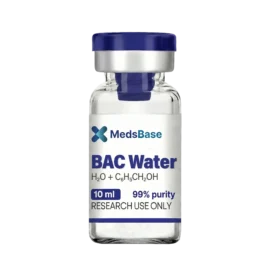
- BAC Water (Bacteriostatisch Water) — Benodigd voor het reconstitueren van elk lyofiliseerd flesje — steriel, 0,9% benzylalcohol-geconserveerd oplosmiddel
Meer opties in Peptiden
Gerangschikt op recente bestelvolumes van MedsBase — wat andere klanten in deze categorie kiezen.
| Sterkte | 5 mg, 10 mg |
|---|---|
| Hoeveelheid | 10 flacons, 20 flacons, 30 flacons |
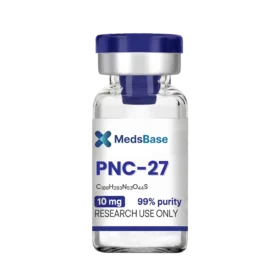 PNC-27 (p53-HDM2 membraangericht chimeer peptide)
Vragen & antwoorden
PNC-27 (p53-HDM2 membraangericht chimeer peptide)
Gerelateerde producten

Beoordelingen
Er zijn nog geen beoordelingen