







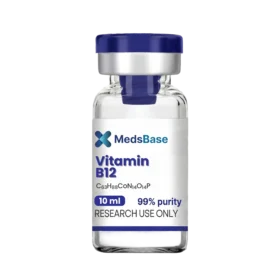
Vitamine B12 (Cyanocobalamine) Injecteerbaar — Onderzoekskwaliteit
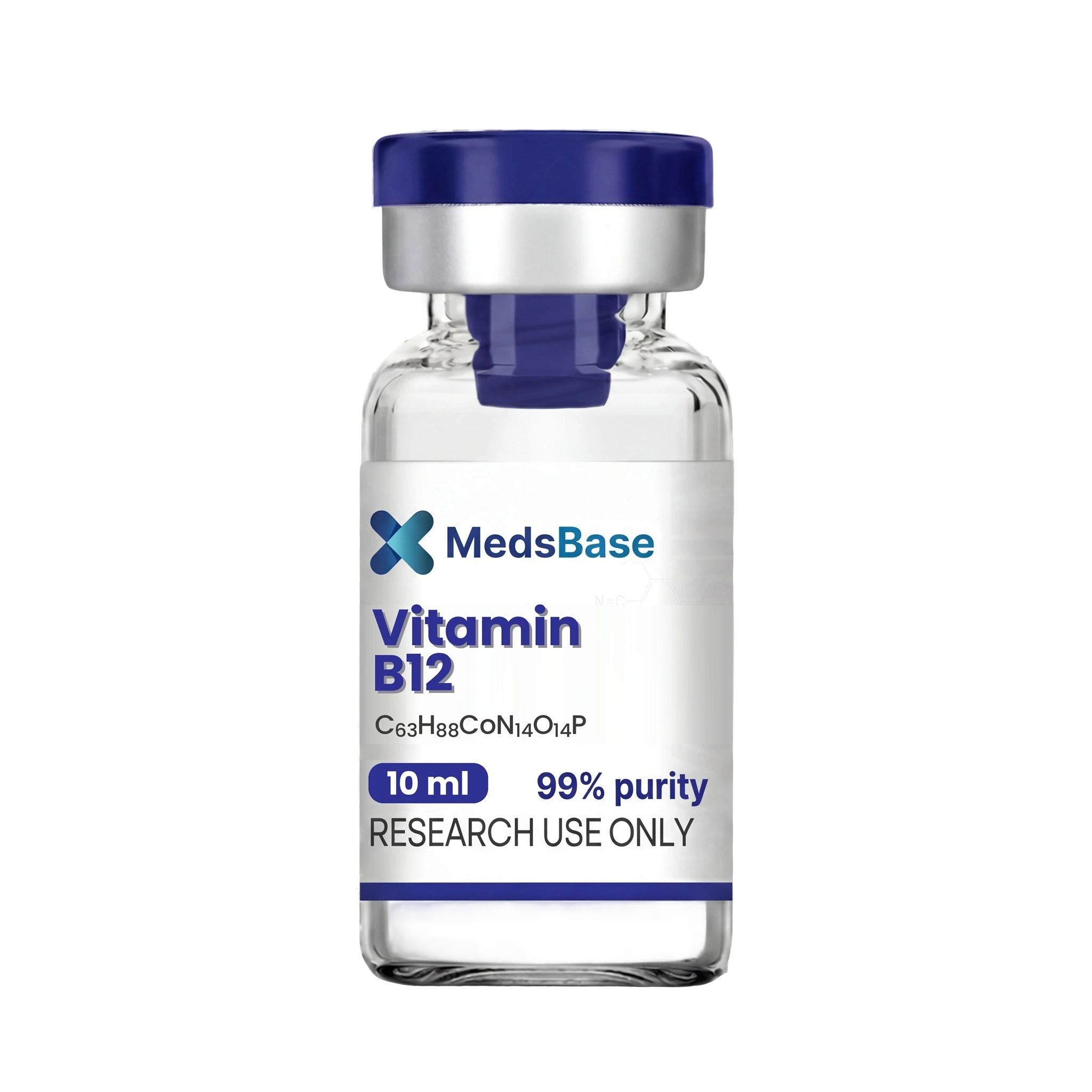
✅ Kobalt-gecentreerd corrinoïd co-enzym — vitamine B12-familie (CAS 68-19-9)
✅ Vooraf geformuleerde steriele waterige oplossing (geen reconstitutie nodig)
✅ 1 mg/mL × 10 mL multi-dose onderzoeksflesje (totaal 10 mg cyanocobalamine)
✅ Cofactor voor cellulair methioninesynthase + methylmalonyl-CoA mutase
✅ Kleinmoleculaire onderzoeksbegeleidende verbinding (MW 1355.37, USP-kwaliteit)
Vitamine B12 (Cyanocobalamine) Injecteerbaar bevat 1 mg/mL × 10 mL steriele cyanocobalamine-oplossing.
✓ Medisch beoordeeld door Morgan Ellis — Apotheekonderzoeker · 8 jaar ervaring · Laatst beoordeeld: mei 2026
Kort antwoord — Wat is B12 (Cyanocobalamine) injecteerbaar?
Vitamine B12 (Cyanocobalamine) is de synthetische cyano-gecoördineerde vorm van de cobalamine co-enzymfamilie (CAS 68-19-9, MF C63H88CoN14O14P, MW 1355.37 g/mol). Hier geleverd als een 10 mg per 10 mL multi-dose injecteerbare fles (1 mg/mL vooraf geformuleerde steriele waterige oplossing — geen reconstitutie nodig) voor onderzoek en gebruik in begeleidende protocollen naast de peptidecatalogus. Cyanocobalamine is de meest aangehaalde B12-vorm in gepubliceerd onderzoek omdat het de meest chemisch stabiele is: cellen nemen het op via het transcobalamine-II / cubiline pathway en zetten het intracellulair om in de twee biologisch actieve cobalaminevormen — methylcobalamine (cofactor voor methionine synthase / SAM-cyclus / éénkoolstofmetabolisme) en adenosylcobalamine (cofactor voor methylmalonyl-CoA mutase / metabolisme van vetzuren met oneven keten / TCA-ingang). Alleen voor laboratoriumonderzoek. Geen peptide — klein molecuul met een kobaltcentrum corrinoïde co-enzym.
📦 Elke bestelling is gedekt door onze Reshipment Assurance-beleid — als uw pakket niet binnen 20 werkdagen arriveert, sturen wij het opnieuw.
| Specificatie | Detail |
|---|---|
| Compound Class | Kobaltcentrum corrinoïde co-enzym; vitamine B12-familie; klein molecuul cofactor; geen peptide |
| Chemical Name | Cyanocobalamin (synoniemen: Vitamine B12, cobalamine (cyano-vorm), CN-B12; de cyano-gereguleerde synthetische stabilisatievorm van de cobalaminefamilie) |
| CAS-nummer | 68-19-9 (cyanocobalamine); gerelateerde cobalamine CAS — methylcobalamine 13422-55-4, hydroxocobalamine 13422-51-0, adenosylcobalamine 13870-90-1 (hier niet geleverd) |
| Molecuulformule | C63H88CoN14O14P |
| Moleculair gewicht | 1355.37 g/mol |
| Werkingsmechanisme | Cyanocobalamine komt cellen binnen via de receptor-gemedieerde transcobalamine-II → cubiline route en wordt intracellulair omgezet door methionine synthase reductase (MTRR) en methylmalonacidurie cblA-type eiwit (MMAA) in de twee biologisch actieve cobalamine co-enzymen — methylcobalamine (cytosolisch cofactor voor methionine synthase) en adenosylcobalamine (mitochondriaal cofactor voor methylmalonyl-CoA mutase). Beide co-enzymen zijn essentieel voor één-koolstof / methylering en propionyl-CoA / oneven-keten vetzuren metabolisme respectievelijk. |
| Sequentie | n.v.t. (klein molecuul corrinoïde co-enzym — geen peptide) |
| Vorm & Concentratie | Vooraf geformuleerde steriele waterige oplossing — 1 mg/mL cyanocobalamine in fysiologisch gebufferde basis, 10 mL multi-dose onderzoeksflesje (10 mg totaal cyanocobalamine per flesje). Kenmerkende dieprode kleur van het kobalt-corrine chromofoor. Geen reconstituering nodig — aseptisch onttrekken met een steriele spuit. |
| Zuiverheid | ≥99% (HPLC-geverifieerd); USP-grade cyanocobalamine referentiestandaard. COA op aanvraag beschikbaar. |
| Oplosbaarheid | Zeer wateroplosbaar (~12,5 mg/mL oplosbaarheidslimiet bij 25 °C); de vooraf geformuleerde oplossing ligt ver onder de verzadiging. Stabiel in waterige buffer bij pH 4–7. Vermijd alkalische omstandigheden (snelle vorming van hydroxocobalamine) en sterk reducerende omstandigheden (vorming van cob(II)alamine). |
| Opslag | Koel bewaren bij 2–8 °C; beschermen tegen licht (cyanocobalamine is lichtgevoelig — UV/blauw licht katalyseert de cyano-naar-hydroxo omzetting). Gebruik de multi-dose fles binnen 60 dagen na eerste punctie. Niet invriezen (ijskristalvorming kan het glazen flesje breken en riskeert fotolytische degradatie bij langdurige bevroren opslag). Gebruik binnen de op het flesetiket vermelde vervaldatum (meestal 24 maanden na productie). |
| Onderzoeksgebruik | Alleen voor laboratoriumonderzoek. Niet voor menselijke of veterinaire diagnostische of therapeutische toepassingen. Cyanocobalamine is door de FDA goedgekeurd als een injecteerbaar vitaminesupplement onder de naam Cyanokit (ook als tegengif voor cyanidevergiftiging in de hydroxocobalaminevorm), maar het hier geleverde onderzoeksmateriaal is uitsluitend bedoeld voor laboratoriumgebruik. Niet op de WADA Verboden Lijst. |
Wat Is Vitamine B12 (Cyanocobalamine)?
Cyanocobalamine (CAS 68-19-9) is de synthetische, cyano-gecoördineerde vorm van de vitamine B12-familie van cobalamine co-enzymen. Structureel is het een complex kobalt-gecentreerd corrinoïde: een 19-atomen macrocyclische ring (de corrinring, vergelijkbaar in geometrie met de porfyrinering van hemoglobine maar verschillend in samenstelling) coördineert een centraal kobaltion in zijn 3+ oxidatietoestand, met een dimethylbenzimidazole nucleotide staart die onder de ring hangt en een cyano (-CN) groep die de bovenste axiale coördinatiepositie bezet. Molecuulformule C63H88CoN14O14P, molecuulgewicht 1355,37 g/mol. Het molecuul is intens rood — zijn absorptie in het zichtbare spectrum (λmax ~360, ~520, ~550 nm) is wat B12-oplossingen hun karakteristieke diepe roze-rode kleur geeft.
De “cyano” vorm is een synthetische stabilisatiekeuze in plaats van een biologisch significante soort in vivo. Cobalaminen in cellen bestaan voornamelijk als methylcobalamine (een methylgroep op de bovenste axiale positie — het cytosolische cofactor voor methionine synthase) en adenosylcobalamine (een 5′-deoxyadenosylgroep op de bovenste axiale positie — het mitochondriale cofactor voor methylmalonyl-CoA mutase). Deze twee actieve vormen worden onderling omgezet door gespecialiseerde cellulaire enzymen en zijn niet commercieel verkrijgbaar in stabiele injecteerbare vorm vanwege hun lichtgevoeligheid. Cyanocobalamine wordt in plaats daarvan geleverd omdat de cyanogroep fotochemisch en thermisch stabiel is, en cellen zetten cyanocobalamine intracellulair om in de methyl- en adenosylvormen via methionine synthase reductase (MTRR) en het methylmalonacidurie cblA-type eiwit (MMAA), respectievelijk.
In de onderzoeks- en klinische context zijn injecteerbare preparaten van cyanocobalamine de standaard supplementvorm. Het 10 mL multi-dose vial formaat (1 mg/mL × 10 mL = 10 mg per vial) dat hier wordt geleverd, komt overeen met het standaard farmaceutische preparatiepatroon. MedsBase voert dit formaat in de peptide-onderzoekscatalogus als een kleine molecuul begeleidende verbinding die wordt gebruikt in protocollen die peptideonderzoek combineren met cobalamine-as biologie — herstelonderzoek, methylatiecyclusonderzoek, hematologie, cognitief onderzoek met nootropische peptiden en energiemetabolisme panels waar de SAM-cyclus betrokken is.
Werkingsmechanisme — Twee Cobalamine-Coënzym Reacties
B12 / cyanocobalamine’s biologische mechanisme is de som van de twee enzymatische reacties gekatalyseerd door de actieve cobalamine coënzymen die ervan afgeleid zijn:
- Cellulaire opname via transcobalamine-II → cubilin / megalin — Vrij cyanocobalamine in extracellulaire vloeistof wordt gebonden door transcobalamine-II (TCII), en het TCII-B12 complex wordt opgenomen door het cubilin / megalin receptorsysteem op celoppervlakken. Intracellulaire vrijgave in het lysosoom wordt gevolgd door transport naar het cytosol via het LMBRD1 / ABCD4 effluxcomplex.
- Intracellulaire omzetting naar actieve coënzymen — In het cytosol reduceert en methyleert methionine synthase reductase (MTRR) cyanocobalamine tot methylcobalamine (de actieve cytosolische vorm), waarbij de cyanogroep als cyanide verloren gaat (dat vervolgens wordt ontgift door het rhodanese / thiosulfaat systeem bij de zeer lage hoeveelheden die worden gegenereerd). In de mitochondrion zet het methylmalonacidurie cblA-type eiwit (MMAA) plus methionine synthase reductase cyanocobalamine om in adenosylcobalamine (de actieve mitochondriale vorm).
- Methylcobalamine → methionine synthase (cytosolisch, één-koolstof / SAM-cyclus) — Methionine synthase katalyseert de overdracht van een methylgroep van 5-methyl-tetrahydrofolaat naar homocysteïne, waarbij methionine en tetrahydrofolaat worden geregenereerd. Dit is de kritieke schakel tussen B12, folaat en de methionine / SAM-cyclus. SAM (S-adenosyl-methionine, gegenereerd uit methionine + ATP) is de universele cellulaire methyldonor voor de honderden cellulaire methylatiereacties — DNA-methylatie, histonmethylatie, fosfolipidemethylatie, neurotransmittermethylatie (catecholamines, melatonine), creatinebiosynthese. B12-deficiëntie verstoort daarom het gehele methylatieprogramma van de cel en is de moleculaire basis voor de hematologische (megaloblastaire anemie door verstoorde DNA-methylatie-afhankelijke thymidinesynthese) en neurologische (demyelinatie door verstoorde fosfolipidemethylatie) gevolgen van klinische B12-deficiëntie.
- Adenosylcobalamine → methylmalonyl-CoA mutase (mitochondriaal, propionyl-CoA / TCA-invoer) — Methylmalonyl-CoA mutase katalyseert de intramoleculaire herschikking van (R)-methylmalonyl-CoA naar succinyl-CoA. Dit is het metabolische invoerpunt voor propionyl-CoA-genererende substraten — oneven-keten vetzuren, vertakte-keten aminozuren (valine, isoleucine, methionine), cholesterol zijketen. Adenosylcobalamine-deficiëntie veroorzaakt ophoping van methylmalonaat (de diagnostische biomarker van klinische B12-deficiëntie) en belemmert propionyl-CoA / oneven-keten vetoxidatie.
- Verbinding met NAD-as en één-koolstof metabolisme crossover — De B12/methionine-synthase-reactie bevindt zich op hetzelfde metabolische knooppunt als de SAM-verbruikende methyleringsreacties die worden gekatalyseerd door honderden cellulaire methyltransferasen, waaronder NNMT (nicotinamide N-methyltransferase) — het doelwit van 5-Amino-1MQ. NNMT verbruikt SAM om nicotinamide te methyleren; een verstoorde B12/methionine-synthase-functie vermindert de cellulaire beschikbaarheid van SAM en verlaagt daardoor indirect de NNMT-activiteit. Onderzoek dat de kruising van de NAD-as/éénkoolstofmetabolisme onderzoekt, geeft vaak tegelijkertijd B12 en NNMT-pathway-gereedschappen om deze verbonden biochemische processen te ontrafelen.
Het farmacokinetische profiel van injecteerbaar cyanocobalamine is goed gekarakteriseerd: intramusculaire of subcutane toediening resulteert in snelle systemische absorptie met piek plasmaconcentraties na 1–2 uur; substantiële dosisafhankelijke renale klaring (de nier raakt verzadigd en elimineert overtollig cyanocobalamine boven de draagcapaciteit van transcobalamine-II); cellulaire opname vindt vervolgens plaats over uren tot dagen; omzetting naar actieve co-enzymen gebeurt continu daarna; en de zeer lage dagelijkse behoefte aan cobalamine co-enzymen (~2 µg/d in de menselijke fysiologie) zorgt ervoor dat enkele hoge-dosis injecties wekenlang effecten op weefselniveau behouden. Het 1 mg/mL × 10 mL multi-dose formaat ondersteunt typische onderzoeksprotocollen variërend van eenmalige hoge-dosis toediening tot wekelijkse of dagelijkse lagere-dosis chronische toediening.
Gepubliceerde onderzoeksapplicaties
B12 \/ cyanocobalamin wordt gebruikt in laboratoriumonderzoek naar:
- Eénkoolstofmetabolisme en SAM-cyclusonderzoek — het canonieke kleine-molecuul cofactor voor methioninesynthase; standaard referentieverbinding voor elk onderzoek dat de foliumzuur/B12/methionine/SAM-as onderzoekt; veel gebruikt in DNA-methylatie- en histonmethylatiefarmacologieonderzoek
- — methionine synthase-deficiëntie/stoornis veroorzaakt homocysteïne-ophoping; cyanocobalamine-suppletie is de standaardinterventie in gepubliceerde onderzoeksmodellen van hyperhomocysteïnemie en cardiovasculair risico — een tekort of verminderde werking van methioninesynthase leidt tot ophoping van homocysteïne; suppletie met cyanocobalamine is de standaardinterventie in gepubliceerde onderzoeksmodellen van hyperhomocysteïnemie en cardiovasculair risico
- Hematologie en erytropoëse onderzoek — Een B12-tekort veroorzaakt megaloblastaire anemie door verstoorde DNA-methylatie-afhankelijke thymidinesynthese; gepubliceerd onderzoek gebruikt cyanocobalamine in modellen van erytropoëse bij vitaminegebrek, beenmergcultuurstudies en onderzoek naar reticulocytenrespons
- Onderzoek naar perifere neuropathie en demyelinisatie — B12-tekort veroorzaakt perifere neuropathie en subacute gecombineerde degeneratie van het ruggenmerg door verstoorde fosfolipidenmethylering in myelinescheden; gepubliceerd onderzoek gebruikt cyanocobalamine-suppletie in demyelinisatie-/remyelinisatiemodelsystemen
- Onderzoek naar NAD-as/methylatie-overgang — gecombineerd met 5-Amino-1MQ (NNMT-remmer) of NAD⁺ in gepubliceerd onderzoek dat de SAM-cyclus/nicotinamide-methylatie-node onderzoekt
- Toepassingen in herstel- en sportonderzoek (gecombineerd met peptideprotocollen) — vaak opgenomen als begeleidende verbinding in onderzoeksprotocollen die peptide-therapeutica (BPC-157, TB-500, GH-peptiden) combineren met cofactor/vitamine-ondersteuning; de klassieke kleine-molecuulbegeleider bij peptide-as-herstelonderzoek
- Cognitieve en nootropische onderzoeksapplicaties — gecombineerd met cognitieve peptiden (Selank, Semax, DSIP) in onderzoek naar de cognitieve gevolgen van B12-tekort en de cobalamine-as in CNS-functie
- Vergelijkend onderzoek cyanocobalamine vs methylcobalamine vs hydroxocobalamine — gepubliceerd onderzoek heeft de vier cobalaminevormen direct vergeleken op biologische beschikbaarheid, intracellulaire conversiekinetiek en weefselretentieprofielen; cyanocobalamine is de klassieke referentieverbinding waartegen de anderen worden afgemeten
Voor bredere context over kleine-molecuul cofactor/co-enzym onderzoeksverbindingen in deze catalogus, zie L-Carnitine (de meest vergelijkbare kleine-molecuul onderzoeksbegeleider — mitochondriële langeketen-vetzuren-shuttle), NAD⁺ (geoxideerd dinucleotide co-enzym — directe NAD-pool aanvulling), 5-Amino-1MQ (NNMT-remmer — verbindt B12/methioninecyclus met NAD-as), en MOTS-c (mitochondriaal afgeleid metabolisch peptide). Bekijk de volledige onderzoekspeptiden & verbindingen catalogus.
Beschikbare verpakkingsgroottes
MedsBase heeft Vitamine B12 (Cyanocobalamine) injecteerbaar op voorraad in een enkele concentratie/vorm met drie verpakkingsopties:
| Verpakkingsgrootte | Typisch Onderzoeksgebruik | Totaal materiaal |
|---|---|---|
| 1 flesje | Enkelvoudig experiment, dosistitratie of kortdurend in-vivo onderzoek — 10 mg totaal cyanocobalamine in 10 mL multi-dose formaat dekt 4–8 weken van typische onderzoeksprotocoldosering bij knaagdieren of kleinschalige celkweekexperimenten | 10 mg / 10 mL |
| 5 flesjes | Meervoudige cohorten of langdurig onderzoek — typische midden-schaal onderzoeksprotocollen waarbij B12 als begeleidende stof wordt gebruikt naast peptideonderzoek; per-fles economie verbetert aanzienlijk ten opzichte van enkele flesaankoop | 50 mg / 50 mL |
| 10 Flesjes | Grootschalige cohorten of langetermijnonderzoeksprotocollen — chronische dosering als begeleidende voorraad bij langdurige peptideprotocollen; laagste kosten per mg; dekt onderzoek met meerdere dieren zonder herhaalde aankoop | 100 mg / 100 mL |
De enkele 1-fles verpakking is handig voor enkelvoudige experimenten of titratiewerk; de 5-fles en 10-fles verpakkingen bieden aanzienlijke besparingen per fles voor chronische protocollen of meervoudig cohortonderzoek. Het 1 mg/mL × 10 mL multi-dose formaat komt overeen met het standaard farmaceutische injecteerbare cyanocobalaminepatroon en is goed geschikt voor typische onderzoeksprotocoldosering — IM, SC of IV toediening van 100 µg tot 1 mg per dosis (equivalent aan 0,1–1 mL van de geleverde oplossing) dekt vrijwel alle gepubliceerde onderzoeksdoseringen.
Vergelijking — B12 (Cyanocobalamine) vs L-Carnitine
B12 en L-Carnitine zijn de twee best gekarakteriseerde kleine molecuul begeleidende onderzoeksstoffen in deze catalogus. Beide fungeren als cofactor/transportstof in mitochondriaal en metabolisch onderzoek, beide worden geleverd in multi-dose injecteerbare formaten geschikt voor onderzoeksprotocollen naast de peptidecatalogus, en beide zijn mechanistisch verschillend van de peptideonderzoeksstoffen. De vergelijking illustreert de twee klassieke “kleine molecuul onderzoeksbegeleidende” stoffen die onderzoekers toevoegen aan peptideprotocollen.
| Criterium | B12 (Cyanocobalamine) | L-Carnitine |
|---|---|---|
| Chemische klasse | Kobaltcentraal corrinoïde co-enzym (enkel klein molecuul) | Quaternaire ammonium aminozuurderivaat (enkel zwitterion) |
| Molecuulgewicht | 1355.37 g/mol | 161.20 g/mol |
| Cellulaire rol | Cofactor — methioninesynthase (cytosolisch, SAM-cyclus) + methylmalonyl-CoA-mutase (mitochondriaal, propionyl-CoA → TCA) | Substraatdrager — transport van langeketenvetzuren over het binnenste mitochondriale membraan (ingang β-oxidatie) |
| Beste onderzoeksfocus | Eénkoolstof-/methylering, homocysteïne-as, megaloblastaire erytropoëse, demyelinatieonderzoek, cognitief/nootropisch crossover | Vetoxidatie, mitochondriale bio-energetica, insulinegevoeligheid, zaadcelmotiliteit, cardiovasculair metabool onderzoek |
| FDA-goedkeuring | Ja — cyanocobalamine-injectie goedgekeurd voor vitamine B12-tekort; hydroxocobalamine goedgekeurd als Cyanokit (antidotum voor cyanide) | Ja — levocarnitine goedgekeurd voor primair/secundair carnitinetekort (oraal en intraveneus) |
| Dagelijkse behoefte aan turnover | Zeer laag (~2 µg/d in humane fysiologie) — enkele hoge doses injecties houden weefselniveaus wekenlang op peil | Hoog — endogeen carnitinepool ~25 g; dagelijkse vervangingsbehoefte bij deficiëntie is aanzienlijk |
| Leveringsvorm | Vooraf geformuleerde steriele waterige oplossing (1 mg/mL × 10 mL multi-dose) | Gevriesdroogd poeder (reconstitueer met BAC-water) |
| Typische onderzoeksdosis | 100 µg tot 1 mg per dosis (0,1–1 mL van de geleverde oplossing), IM / SC / IV | Honderden mg tot gramniveau per dosis (knaagdier-/groot-dierprotocollen) |
Voor onderzoek gericht op één-koolstofmetabolisme, SAM-cyclus, homocysteïne-as of megaloblastaire erytropoëse, is B12 / cyanocobalamine het klassieke kleine molecuul onderzoekscompanion. Voor onderzoek gericht op oxidatie van langeketenvetzuren, mitochondriale bio-energetica of insulinegevoeligheid, L-Carnitine is het meer gerichte hulpmiddel. De twee verbindingen worden vaak samen toegediend als onderdeel van bredere peptide-onderzoeksprotocollen die baat hebben bij zowel methylatiecyclus- als vetzuuroxidatie-cofactorondersteuning.
Opslag en hantering
Vooraf geformuleerde oplossing — geen reconstitutie nodig. In tegenstelling tot de gevriesdroogde peptideproducten in deze catalogus, wordt injecteerbaar cyanocobalamine geleverd als een kant-en-klare steriele waterige oplossing. Trek aseptisch op met een steriele spuit bij elk gebruik; breng geen verontreinigingen in de multi-dose fles aan.
Opslag: Koel bij 2–8 °C in originele verpakking. Bescherm te allen tijde tegen licht — cyanocobalamine is lichtgevoelig (UV- en kortgolvig zichtbaar licht katalyseert cyano-naar-hydroxo en cyano-naar-cob(II)alamine fotoproducten). Bewaar de fles in de originele lichtbeschermende doos of wikkel in folie indien verwijderd. Vermijd langdurige blootstelling aan laboratoriumomgevingslicht tijdens hantering.
Niet invriezen. IJskristalvorming kan het glazen flesje breken, en bevroren opslag biedt geen stabiliteitsvoordeel boven koeling voor een reeds geformuleerde waterige oplossing. De oplossing is stabiel bij 2–8 °C gedurende minimaal 24 maanden vanaf de fabricagedatum in ongeopende staat.
Na eerste punctie: gebruik de multi-dose fles binnen 60 dagen. De vooraf geformuleerde buffer bevat conserveermiddelen (meestal benzylalcohol of fenol in farmaceutische concentraties) die de steriliteit tijdens multi-dose gebruik behouden, maar opeenvolgende septumdoorprikkingen kunnen uiteindelijk microbiële besmetting veroorzaken. Gooi weg als troebelheid, deeltjes, duidelijke kleurverandering (vooral verbleking van het kenmerkende dieprood — wijst op fotodegradatie) of neerslag zichtbaar wordt.
Veelgestelde vragen
Waarom heeft de geleverde B12-oplossing een dieprode kleur?
De kobalt-centrale corrinring van cobalaminen is een sterke chromofoor in het zichtbare spectrum — de λmax absorptiebanden van cyanocobalamine bij ~360 nm (UV), ~520 nm (groen) en ~550 nm (geelgroen) produceren de karakteristieke roze-rode transmissiekleur. Elke cyanocobalamine-oplossing zou intens rood moeten zijn; verbleking naar geel of bruin duidt op fotodegradatie (cyano-naar-hydroxo conversie of verdere reductie naar cob(II)alamin) en de fles moet worden weggegooid.
Waarom gebruikt dit B12-product de cyano-vorm in plaats van methyl- of hydroxocobalamine?
Cyanocobalamine is de standaardvorm die als injecteerbare B12 wordt geleverd omdat het fotochemisch en thermisch de meest stabiele van de cobalaminevormen is — de cyanogroep weerstaat de fotolytische degradatie die methyl-, hydroxo- en adenosylcobalamine in oplossing beïnvloedt. Eenmaal in de cellen zetten intracellulaire enzymen (MTRR, MMAA) het om in de biologisch actieve methylcobalamine- en adenosylcobalaminevormen. Voor de meeste onderzoeksapplicaties is cyanocobalamine daarom de praktische keuze. Onderzoekers die specifiek methylcobalamine- of hydroxocobalaminefarmacologie bestuderen (bijv. differentiële cel-opnamekinetiek, lichtdegradatiepaden of cyanide-antidoottoepassingen) hebben die specifieke vormen apart nodig.
Is dit B12-product een peptide?
Nee. Cyanocobalamine is een klein molecuul met een kobalt-centraal corrinoïd co-enzym (MW 1355,37 g/mol), niet een peptide. We hebben het in ons peptide-onderzoekscatalogus als het canonieke kleine-molecuul begeleidende verbinding gebruikt in protocollen die peptideonderzoek combineren met cobalamine-as biologie. De spec tabel Sequentieregel is om deze reden gemarkeerd als “n.v.t.”. Andere kleine-molecuul onderzoeksbegeleiders in deze catalogus omvatten L-Carnitine, NAD⁺, 5-Amino-1MQ, en AICAR.
Welke gepubliceerde doseringsbereiken zijn gebruikt in onderzoek?
Injecteerbare cyanocobalamine gepubliceerde dosering in menselijk-klinisch en knaagdier in-vivo werk gebruikt typisch 100–1000 µg per dosis (0,1–1,0 mL van de geleverde 1 mg/mL oplossing), IM of SC, dagelijks voor de eerste week en daarna wekelijks of maandelijks voor chronische protocollen. De 1000 µg enkele bolus is de canonieke “laaddosis” in klinisch-translationeel onderzoek. In-vitro celkweekprotocollen gebruiken typisch nanomolaire tot micromolaire concentraties. Onderzoekers moeten primaire literatuur raadplegen die geschikt is voor de specifieke toepassing (hematologie, neuropathie, cardiovasculair, één-koolstofmetabolisme, etc.).
Kan B12 gecombineerd worden met peptiden zoals Selank, Semax of DSIP in onderzoeksprotocollen?
Ja — B12 wordt vaak gecombineerd met nootrope peptiden (Selank, Semax, DSIP) in onderzoek naar de cognitieve gevolgen van cobalaminedeficiëntie en de bredere bijdrage van de cobalamine-as aan CNS-functie. B12 wordt ook vaak samen toegediend met herstelpeptiden (BPC-157, TB-500), groeihormoonpeptiden (Sermorelin, Tesamorelin), en metabolische peptiden (MOTS-c) als een begeleidend cofactor. De vooraf geformuleerde waterige vorm betekent dat het vers in een aparte spuit kan worden opgezogen voor elke toediening — meng niet met andere peptideoplossingen in dezelfde spuit, omdat het kobalt-corrinechromofoor kan interageren met thiolbevattende peptiden en kleine fotoredoxeffecten kan induceren.
Waarom wordt cyanocobalamine soms in verband gebracht met cyanide?
De cyanogroep op cyanocobalamine is een zeer kleine hoeveelheid gebonden cyanide — wanneer intracellulaire enzymen cyanocobalamine omzetten in de actieve methyl/adenosylvormen, wordt er een stoichiometrische hoeveelheid vrij cyanide vrijgegeven, maar de hoeveelheid is zeer klein (~25 µg cyanide per 1 mg cyanocobalamine) en wordt ontgift door het cellulaire rhodanese/thiosulfaatsysteem zonder klinische betekenis. De omgekeerde reactie — cobalamine dat cyanide opvangt — is de basis van hydroxocobalamine’s goedgekeurde gebruik als cyanide-antidotum (Cyanokit), waarbij hoge doses hydroxocobalamine circulerend cyanide sequesteren als cyanocobalamine voor renale excretie. Onderzoekers in cyanide-antidotumonderzoek hebben specifiek hydroxocobalamine nodig, niet cyanocobalamine.
Hoe verhoudt dit onderzoeksgrade B12 zich tot de bestaande merkgebonden B12-producten op MedsBase?
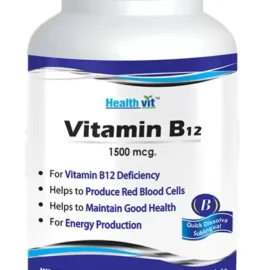
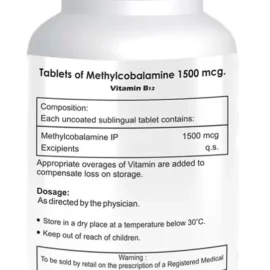
De bestaande merkgebonden B12-producten op MedsBase (bijv., Vitamin B12 1500 mcg Tablets) zijn klinisch-farmaceutisch grade B12 verpakt in tabletvorm voor oraal/sublinguaal gebruik, gepositioneerd in de zenuwgezondheid/energiesupplementcategorie. Het hier geleverde onderzoeksgrade B12 is de injecteerbare cyanocobalamine-vorm in 10 mL multi-dose flesjes, gepositioneerd in de peptide-onderzoekscatalogus als een kleinmoleculaire onderzoeksbegeleider naast de peptideverbindingen. Onderzoekers die een oraal/sublinguaal B12-supplement nodig hebben, moeten de tabletproducten gebruiken; onderzoekers die injecteerbare cyanocobalamine nodig hebben voor in-vivo of celkweekwerk naast peptideprotocollen kunnen het hier geleverde materiaal gebruiken.
Staat B12 op de WADA Verboden Lijst?
Nee. Vitamine B12/cyanocobalamine staat niet op de WADA Verboden Lijst. Het is een vitamine/cofactorverbinding die zowel klinisch (voor B12-deficiëntiebehandeling) als toegestaan supplement in atletische contexten wordt gebruikt. Er zijn geen atletische-prestatie-regelgevende beperkingen voor cyanocobalamine of andere cobalaminevormen.
Andere Kleinmoleculaire Onderzoeksbegeleidende Verbindingen
- L-Carnitine — Mitochondriële vetzuurshuttle — dichtstbijzijnde kleinmoleculaire onderzoeksbegeleidende analoog
- NAD⁺ — Geoxideerd dinucleotide co-enzym — directe NAD-pool supplementatie onderzoek
- 5-Amino-1MQ — NNMT-remmer — verbindt B12/methioninecyclus met NAD-as-methylering
- AICAR — Canonieke kleinmoleculaire AMPK-activator — begeleidende metabolische onderzoeksverbinding
- MOTS-c — Mitochondriaal afgeleid metabolisch peptide — onderzoek naar alternatieve-mechanisme cofactoren
- BAC Water (Bacteriostatisch Water) — Benodigd voor het reconstitueren van elk lyofiliseerd flesje — steriel, 0,9% benzylalcohol-geconserveerd oplosmiddel
Meer opties in Peptiden
Gerangschikt op recente bestelvolumes van MedsBase — wat andere klanten in deze categorie kiezen.
| Sterkte | 10 mg / 10 mL |
|---|---|
| Hoeveelheid | 1 Flesje, 5 Flesjes, 10 Flesjes, 30 Flesjes |
 Vitamine B12 (Cyanocobalamine) Injecteerbaar — Onderzoekskwaliteit
Vragen & antwoorden
Vitamine B12 (Cyanocobalamine) Injecteerbaar — Onderzoekskwaliteit
Gerelateerde producten
Beoordelingen
Er zijn nog geen beoordelingen