







AICAR (Acadesine / AICA-Riboside)
✅ Canoniek klein molecuul AMPK activator (celdoorlaatbare AMP-mimetisch via ZMP)
✅ Bevordert insuline-onafhankelijke glucoseopname in skeletspieren
✅ Onderdrukt hepatische gluconeogenese, de-novo lipogenese, cholesterol synthese
✅ Gepubliceerd ‘exercise mimetic’-fenotype (Narkar et al. 2008, Cell)
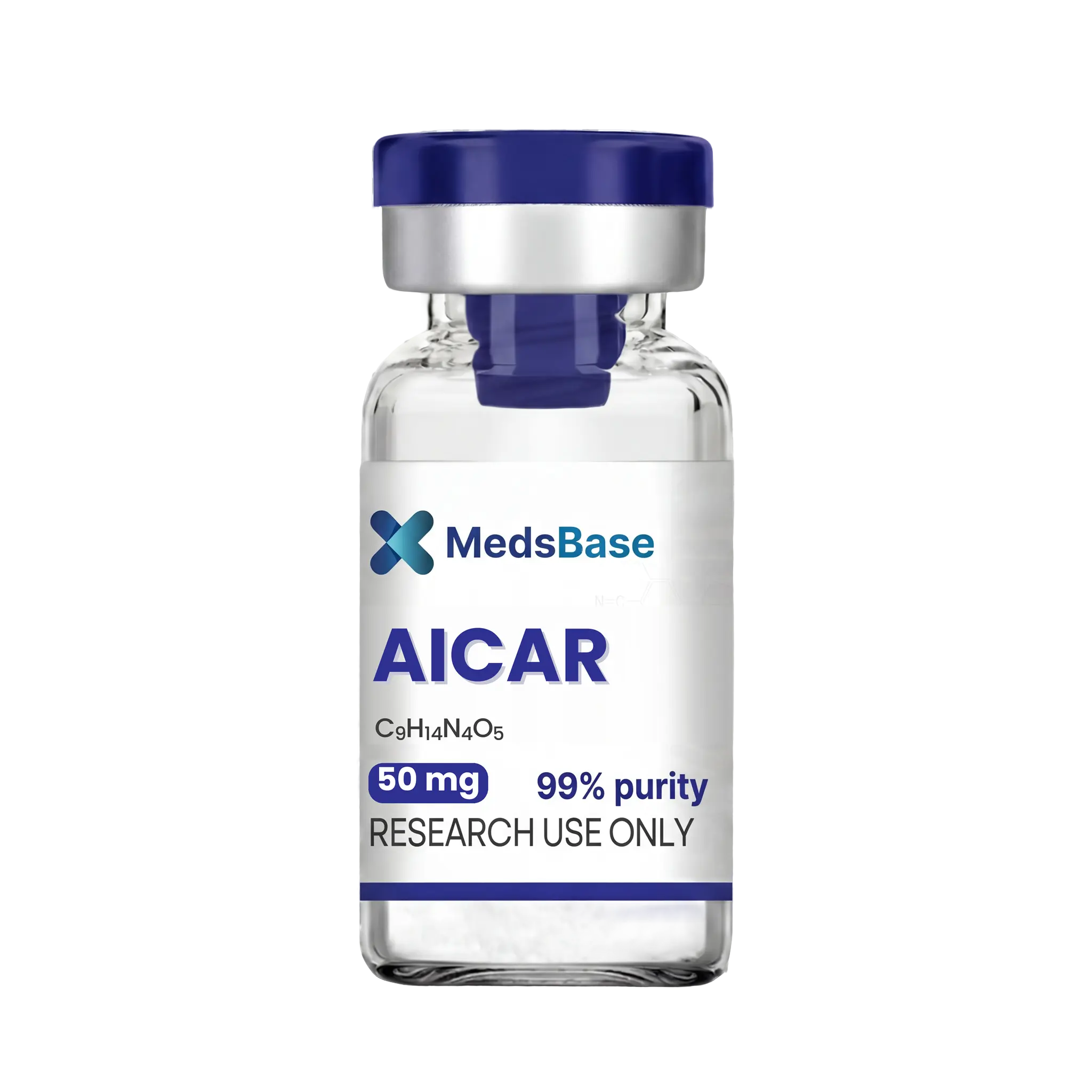
✅ Referentieverbinding voor AMPK-farmacologie — MW 258.23, CAS 2627-69-2
AICAR bevat 5-aminoimidazole-4-carboxamide-1-β-D-ribofuranoside onderzoeksverbinding.
✓ Medisch beoordeeld door Morgan Ellis — Apotheekonderzoeker · 8 jaar ervaring · Laatst beoordeeld: mei 2026
Kort antwoord — Wat is AICAR?
AICAR (Acadesine / AICA-Riboside / 5-aminoimidazole-4-carboxamide-1-β-D-ribofuranoside, CAS 2627-69-2) is de canonieke kleine molecule AMPK (AMP-geactiveerd proteïnekinase) activator gebruikt in metabool, bewegingsfysiologie, spier- en kankeronderzoek. AICAR is de celpermeabele riboside; eenmaal in cellen wordt het gefosforyleerd door adenosinekinase tot het actieve nucleotide ZMP (5-aminoimidazol-4-carboxamide ribonucleotide), een AMP-mimeticum dat allosterisch AMPK activeert. Geactiveerde AMPK stimuleert insuline-onafhankelijke glucoseopname in skeletspieren, verhoogt vetzuuroxidatie, onderdrukt hepatische gluconeogenese en de-novo lipogenese, en remt mTORC1 — de klassieke “exercise-in-a-pill”-farmacologie. Leverbaar als lyofiliseerd poeder (≥99% HPLC) uitsluitend voor laboratoriumonderzoek. Geen peptide.
📦 Elke bestelling is gedekt door onze Reshipment Assurance-beleid — als uw pakket niet binnen 20 werkdagen arriveert, sturen wij het opnieuw.
| Specificatie | Detail |
|---|---|
| Compound Class | Kleine-molecuul purine-nucleoside analoog; celpermeabel AMP-mimeticum; AMPK-activator; geen peptide |
| Chemical Name | 5-Aminoimidazol-4-carboxamide-1-β-D-ribofuranoside (synoniemen: Acadesine, AICA-Riboside, NSC 105823, Z-Riboside) |
| CAS-nummer | 2627-69-2 |
| Molecuulformule | C9H14N4O5 |
| Moleculair gewicht | 258,23 g/mol |
| Werkingsmechanisme | Celpermeabele AICA-riboside wordt opgenomen via adenosinetransporters en gefosforyleerd door adenosinekinase tot het actieve intracellulaire monofosfaat ZMP (5-aminoimidazol-4-carboxamide ribonucleotide). ZMP imiteert AMP op het AMPK γ-subunit Bateman-domein, wat leidt tot allosterische activering van AMPK onafhankelijk van veranderingen in de cellulaire AMP:ATP-ratio. Geactiveerde AMPK stimuleert vervolgens het downstream metabole-switch-programma (katabolisme ↑, anabolisme ↓). |
| Sequentie | n.v.t. (kleine-molecuul purine ribonucleoside — geen peptide) |
| Form | Lyofiliseerd wit tot off-wit kristallijn poeder; onderzoeksflesjes voor eenmalig gebruik |
| Zuiverheid | ≥99% (HPLC geverifieerd, COA op aanvraag) |
| Oplosbaarheid | Oplosbaar in water (~50 mg/mL bij voorzichtig verwarmen en zwenken), PBS en DMSO (≥100 mM voorraadoplossing). Waterige oplossingen kunnen kort verwarming tot 37 °C nodig hebben voor volledige oplossing. Werkoplossingen voor celkweek worden typisch bereid op 0,5–2 mM in groeimedium. |
| Opslag | Lyofiliseerd: 2–8 °C voor kortetermijnwerkvoorraad; −20 °C voor langdurige opslag van ongeopende flesjes (stabiel ≥36 maanden bij −20 °C). Aangemaakte waterige oplossingen: 2–8 °C, gebruik binnen ~30 dagen. DMSO-voorraden: −20 °C, eenmalig ontdooien. Beschermen tegen langdurige blootstelling aan licht. Vermijd herhaald invriezen/ontdooien van werkoplossingen. |
| Onderzoeksgebruik | Uitsluitend voor laboratoriumonderzoek. Niet voor humaan of veterinair diagnostisch of therapeutisch gebruik. AICAR/Acadesine staat op de Verboden Lijst van het Wereldantidopingagentschap (WADA) (klasse S4.5, Metabole Modulatoren) en is te allen tijde verboden in de sport — onderzoekers in humane onderzoekscontexten moeten zich bewust zijn van deze regelgevende status. |
Wat Is AICAR?
AICAR (5-Aminoimidazol-4-carboxamide-1-β-D-ribofuranoside, ook bekend als Acadesine, AICA-Riboside, NSC 105823 of Z-Riboside; CAS 2627-69-2) is een kleine-molecuul purine ribonucleoside analoog en het meest geciteerde farmacologische hulpmiddel voor activering van AMP-geactiveerd proteïnekinase (AMPK) in celkweek-, primaire-cel- en knaagdier in-vivo-onderzoek. Het is geen peptide — het is een synthetisch ribonucleoside met de molecuulformule C9H14N4O5 en een molecuulgewicht van 258,23 g/mol. MedsBase heeft het in hetzelfde lyofiliseerbare-vialformaat als onze onderzoekspeptidecatalogus voor het gemak van reconstitutie en dosering in gemengde-protocol AMPK / metabolisch / mitochondriaal onderzoek.
AICAR werd oorspronkelijk in de jaren 90 ontwikkeld door Acadesine Inc. (later Schering-Plough) als een kandidaat cardioprotectief middel voor coronaire bypasschirurgie — de verbinding voltooide fase III-onderzoeken maar kreeg geen goedkeuring van de regelgevende instanties. De farmacologische toepassing ervan is echter alleen maar uitgebreid: AICAR is nu de standaardreferentieverbinding voor AMPK-activering in gepubliceerd onderzoek, en het AMPK-pathway dat het activeert, is betrokken bij bijna elk belangrijk gebied van de metabole biologie — insulinegevoeligheid, type-2 diabetes, vetzuuroxidatie, inspanningsfysiologie, spierhypertrofie / atrofie, mitochondriale biogenese, kankermetabolisme, autofagie en veroudering.
In gepubliceerd onderzoek wordt AICAR beschreven als een “oefeningsmimeticum” omdat chronische toediening bij sedentaire muizen een skeletspier-genexpressiesignatuur, mitochondriale-biogeneseprogramma en uithoudingsvermogen-fenotype heeft laten zien die in grote lijnen de effecten van vrijwillig hardlopen nabootsen — de oorspronkelijke publicatie uit 2008 van Narkar et al. in Cel (“AMPK en PPARδ-agonisten zijn oefeningsmimeticum”) is het meest geciteerde artikel op dit gebied. AICAR staat ook op de WADA Verboden Lijst (klasse S4.5, Metabole Modulatoren) en is vanwege dit prestatiebevorderende potentieel altijd verboden in de sport.
Werkingsmechanisme — Cellulaire activering van AMPK via ZMP
Het werkingsmechanisme van AICAR is het best gekarakteriseerd van alle farmacologische AMPK-activatoren:
- Celopname via adenosinetransporters — AICAR (het riboside) is zelf biologisch inert. Het wordt opgenomen in cellen via dezelfde equilibratieve en concentratieve adenosinetransporters (ENT1, ENT2, CNT2, CNT3) die endogeen adenosine en andere purinenucleosiden over het plasmamembraan transporteren. Weefseldistributie en concentratiekinetiek in vivo worden bepaald door deze transporters.
- Intracellulaire fosforylering naar ZMP door adenosinekinase — Eenmaal intracellulair wordt AICAR gefosforyleerd door adenosinekinase (AK) op zijn 5′-hydroxylgroep, wat het actieve metaboliet ZMP (5-aminoimidazol-4-carboxamide ribonucleotide) genereert. ZMP is het directe AMP-analoog en is de soort die daadwerkelijk AMPK activeert. Adenosinekinase-activiteit is daarom de beperkende stap voor de farmacologie van AICAR in een bepaald weefsel — onderzoeksprotocollen die AK-deficiënte cellen of AK-remmers gebruiken, bevestigen dat ZMP, niet AICAR zelf, de actieve soort is.
- Allosterische activering van AMPK op de γ-subeenheid — ZMP bindt aan dezelfde Bateman-domein CBS-plaatsen op de AMPK γ-subeenheid die endogeen AMP bezet onder energiearme omstandigheden. ZMP-binding produceert drie convergente allosterische effecten op AMPK: (1) allosterische stimulatie van de katalytische activiteit, (2) bescherming van Thr172-fosforylering op de AMPK α-subeenheid tegen PP2C-dephosphorylering, en (3) versterkte fosforylering van Thr172 door upstream kinases LKB1 en CaMKK2. Het nettoresultaat is een aanhoudende, hoogwaardige AMPK-activering die onafhankelijk is van veranderingen in de werkelijke cellulaire AMP:ATP-verhouding.
- Downstream metabole switch — katabole upregulatie — Geactiveerde AMPK fosforyleert een grote set van metabole effectoren die het katabole / energiegenererende programma aansturen: ACC (acetyl-CoA carboxylase, op Ser79 en Ser212) — waardoor malonyl-CoA-remming van CPT-I wordt opgeheven en langeketen vetzuren de mitochondriën kunnen binnendringen voor β-oxidatie; HSL (hormoongevoelige lipase) — wat adipocytenlipolyse verhoogt; TBC1D1 — wat insuline-onafhankelijke GLUT4-translocatie en glucoseopname in skeletspieren stimuleert; PGC-1α — wat mitochondriale biogenese aanstuurt. Het effect op glucoseopname in skeletspieren is de meest geciteerde functionele uitkomst in AMPK-onderzoek.
- Downstream metabole switch — anabole suppressie — Geactiveerde AMPK onderdrukt tegelijkertijd anabole / energieverbruikende pathways: fosforylering van TSC2 en Raptor remt mTORC1, wat eiwitsynthese onderdrukt en autofagie triggert; fosforylering van HMG-CoA-reductase onderdrukt cholesterol synthese; fosforylering van SREBP1c onderdrukt hepatische de-novo lipogenese; fosforylering van PFKFB3 en ACC onderdrukt glycogeen- en vetzuren synthese. De gecombineerde katabole-up / anabole-down switch is de canonieke AMPK-farmacologie.
Het farmacokinetische profiel van AICAR is over het algemeen gunstig voor onderzoeksgebruik — de orale biologische beschikbaarheid is bescheiden maar werkbaar, intraperitoneale toediening bij knaagdieren zorgt voor betrouwbare systemische blootstelling binnen 30 minuten, en de plasma-halfwaardetijd van het ouderriboside is ongeveer 90 minuten (de halfwaardetijd van het intracellulaire ZMP-metaboliet is langer, wat AMPK-activering gedurende enkele uren na een enkele bolusdosis in stand houdt). Typische in-vivo knaagdierprotocollen gebruiken 250–500 mg/kg dagelijks intraperitoneaal toegediend; hoge doses (1 g/kg) zijn gebruikt in sommige gepubliceerde spierfysiologie-onderzoeken. In-vitro celkweekwerk gebruikt typisch 0,5–2 mM in groeimedium.
Gepubliceerde onderzoeksapplicaties
AICAR wordt gebruikt in laboratoriumonderzoekcontexten die onderzoeken:
- AMPK-farmacologie — de canonieke referentie-activator — verreweg de meest geciteerde kleine-molecuul AMPK-activator in de gepubliceerde literatuur; standaard referentieverbinding voor elk nieuw AMPK-pathway onderzoek; referentieverbinding waartegen alle nieuwere directe AMPK-activatoren (A769662, MK-8722, PF-739, O304, de metformineklasse) worden afgezet
- Insulinegevoeligheid en skeletspier-glucoseopname — AICAR stimuleert insuline-onafhankelijke GLUT4-translocatie en glucoseopname in skeletspieren via de AMPK-TBC1D1-as; veel gebruikt in onderzoek naar type-2 diabetes, insulineresistentie-omkering en skeletspier-metabole flexibiliteit
- Oefening-mimetisch en uithoudingsonderzoek — het Narkar et al. (2008,) “AMPK en PPARδ-agonisten zijn oefening-mimetica” raamwerk blijft het meest geciteerde artikel over AICAR; gepubliceerde knaagdierprotocollen documenteren verhoogd uithoudingsvermogen, slow-twitch (Type I) vezelconversie en verbeterde oxidatieve capaciteit na 4 weken AICAR-dosering bij sedentaire muizen, Cel) Het “AMPK en PPARδ-agonisten zijn oefeningsmimetics” raamwerk blijft het meest geciteerde artikel over AICAR; gepubliceerde knaagdiermodellen documenteren verhoogd uithoudingsvermogen, langzame spiervezel (Type I) conversie en verbeterde oxidatieve capaciteit na 4 weken AICAR-dosering bij sedentaire muizen
- Onderdrukking van hepatische gluconeogenese en lipogenese — AICAR onderdrukt de hepatische glucoseproductie via AMPK-gemedieerde fosforylering van transcriptionele co-activatoren (CRTC2, HNF4α); onderdrukt ook hepatische de-novo lipogenese via SREBP1c-fosforylering; gebruikt in preklinisch onderzoek naar niet-alcoholische leververvetting (NAFLD) en metabole-dysfunctie-geassocieerde steatohepatitis (MASH)
- — AICAR fosforyleert ACC, verlicht malonyl-CoA-remming van CPT-I en drijft langeketen vetzuren de mitochondriën in voor β-oxidatie; de canonieke farmacologische interventie voor het opreguleren van vetzuuroxidatie in primaire hepatocyten, cardiomyocyten en skeletspier-myotuben — AICAR fosforyleert ACC, verlicht malonyl-CoA-remming van CPT-I en transporteert langketenvetzuren naar de mitochondriën voor β-oxidatie; de klassieke farmacologische interventie voor het opreguleren van vetzuuroxidatie in primaire hepatocyten, cardiomyocyten en skeletspier-myotuben
- — veel kankercellen vertonen verhoogde lipogenese (via SREBP1c) en verhoogde mTORC1-signalering; AICAR onderdrukt beide via AMPK-activatie en is onderzocht in gepubliceerd onderzoek naar acute lymfatische leukemie (de historische oorspronkelijke indicatie voor Acadesine), prostaatkanker, borstkanker en andere tumormodellen — veel kankercellen vertonen een verhoogde lipogenese (via SREBP1c) en verhoogde mTORC1-signalering; AICAR onderdrukt beide via AMPK-activatie en is onderzocht in gepubliceerd onderzoek naar acute lymfatische leukemie (de historische oorspronkelijke indicatie voor Acadesine), prostaatkanker, borstkanker en andere tumormodellen
- Onderzoek naar autofagie en mTORC1-remming — AICAR activeert autofagie via dubbele fosforylering van TSC2 (Ser1387) en Raptor (Ser792), die beide mTORC1 remmen; wordt gebruikt als farmacologische interventie in onderzoek naar autofagie-inductie naast rapamycine en uithongeringsmodellen
- Onderzoek naar mitochondriale biogenese — AICAR stimuleert PGC-1α-expressie en -activiteit, wat de mitochondriële biogenese in skeletspieren en bruin vetweefsel verhoogt; complementair aan MOTS-c (mitochondriaal afgeleid AMPK-activerend peptide) in protocollen die redundantie van de AMPK-route onderzoeken
- Cardioprotection research — de oorspronkelijke klinische indicatie; AICAR is gebruikt in ischemie-reperfusieletselmodellen en het cardioprotectieparadigma voor hartchirurgie; preklinisch onderzoek gaat door ondanks dat fase III geen goedkeuring heeft gekregen
Voor een bredere context over AMPK / NAD+ / metabolische-as onderzoeksverbindingen in deze catalogus, zie MOTS-c (mitochondriaal afgeleid peptide AMPK-activator — het meest vergelijkbare peptide-analoog), 5-Amino-1MQ (NNMT-remmer; complementaire NAD+-precursor-besparende aanpak), NAD+ (geoxideerd dinucleotide co-enzym, centraal elektronentransportsubstraat), en L-Carnitine (mitochondriale langeketen-vetzuurshuttle). Bekijk het volledige onderzoekspeptiden & verbindingen catalogus voor gerelateerde verbindingen, of zie de samengestelde hubs voor onderzoek naar levensduurverlengende verbindingen en peptiden voor vetverliesonderzoek .
Beschikbare sterktes en concentraties
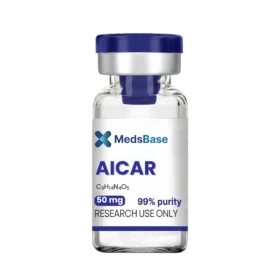
MedsBase stocks AICAR in a single lyophilized vial size calibrated to typical in-vivo and high-throughput in-vitro research protocols. The vial is available in 10-vial, 20-vial, or 30-vial pack formats:
| Vulsterkte | Typisch Onderzoeksgebruik | Verpakkingsgroottes |
|---|---|---|
| 50 mg | Standaard onderzoekssterkte — enkele cohort in-vivo knaagdierdosering (250–500 mg/kg IP dagelijks gedurende 2–4 weken dekt een cohort van 30-g muizen met één 50 mg fles per ~2–3 doses), high-throughput in-vitro AMPK-activeringspanels (0,5–2 mM werkconcentraties), reconstitutie- en dosetitratiewerk, primaire hepatocyten-/myotube vetzuuroxidatiepanels | 10, 20 of 30 vialen |
The 50 mg vial format provides a convenient dosing unit for most published in-vivo rodent protocols and supports the 0.5–2 mM working concentrations used in cell-culture AMPK-activation research. The 30-vial pack is the more economical purchase per-mg for extended-cycle or large-cohort protocols (4–8 week chronic dosing, multi-cohort exercise-mimetic studies). Researchers should determine specific dose ranges from peer-reviewed literature appropriate to the protocol.
Hoe het zich verhoudt — AICAR vs MOTS-c
AICAR en MOTS-c zijn de twee meest bestudeerde AMPK-activerende onderzoeksverbindingen in deze catalogus, en ze richten zich op het AMPK-pad via mechanistisch verschillende routes. AICAR is een klein molecuul dat celpermeabel is en AMP nabootst, wat AMPK-activering direct bij de γ-subeenheid veroorzaakt. MOTS-c is een mitochondriaal afgeleid 16-aminozuur peptide dat onder metabolische stress naar de kern translokeert en AMPK indirect activeert via een foliumzuurpad/methioninecyclus intermediair (AICAR-achtige toename van cellulaire AICAR/ZMP-niveaus). De twee verbindingen zijn mechanistisch complementair in gepubliceerd combinatieonderzoek, en de vergelijking illustreert een van de meest bestudeerde “klein molecuul vs peptide”-dyaden in de AMPK-biologie.
| Criterium | AICAR | MOTS-c |
|---|---|---|
| Chemische klasse | Klein molecuul purine ribonucleoside (celpermeabel AMP-mimetic) | Mitochondriaal afgeleid 16-residu peptide (MTHFD2L-pad/AICAR-achtige opbouwmechanisme) |
| Molecuulgewicht | 258,23 g/mol | ~2.174 g/mol (16-residu peptide) |
| Route naar AMPK | Direct — gefosforyleerd tot ZMP intracellulair, bindt aan AMPK γ-subeenheid Bateman-domein (AMP-mimetic) | Indirect — verstoort foliumzuur/methioninecyclus, verhoogt cellulaire AICAR/ZMP, activeert AMPK via dezelfde allosterische γ-subeenheidplaats |
| Best-studied research focus | Bewegingsmimetisch, insulinegevoeligheid, hepatische gluconeogenese, kankermetabolisme, autofagie, mitochondriale biogenese | Insulinegevoeligheid, mitochondriale biologie, leeftijdsgerelateerde metabole achteruitgang, levensduur, peptide-as farmacologie |
| Plasmastabiliteit | ~90 min plasma half-life (moedermolecuul riboside); intracellulair ZMP handhaaft effect gedurende enkele uren per bolusdosis | Kort — minuten plasma half-life onbeschermd; ondersteunt IP / SC dosering in onderzoek |
| Typische onderzoeksdosis | 250–500 mg/kg IP dagelijks bij knaagdieren (af en toe 1 g/kg in spierfysiologieprotocollen); 0,5–2 mM in celkweek | 0,5–5 mg/kg IP / SC bij knaagdieren |
| Selectiviteit / off-target profiel | Niet puur selectief — ZMP beïnvloedt ook adenosinesignalering, fructose-1,6-bisfosfatase en AMP-deaminase bij hoge doses | Peptideklasse selectiviteit — minder gedocumenteerde off-target kleine-molecuul receptor effecten, maar de receptoridentiteit blijft onder onderzoek |
| Regulatorische status | Geen klinische goedkeuring (Acadesine Fase III voor CABG kreeg geen goedkeuring); WADA Verboden Lijst S4.5 (altijd verboden in sport) | Geen klinische goedkeuring; alleen voor onderzoek peptide |
Voor onderzoek gericht op directe, hoogwaardige AMPK-activering met het standaard kleine-molecuul referentiemiddel, is AICAR de standaardverbinding. Voor onderzoek gericht op peptideklasse AMPK-activering, mitochondriaal-afgeleide signalering of longevity-axis peptidefarmacologie, MOTS-c is het meer gerichte hulpmiddel. Zie ook 5-Amino-1MQ voor NAD-as precursorbesparend onderzoek, SS-31 (Elamipretide) voor cardiolipine-bindend mitochondriaal-gericht onderzoek, en NAD+ voor directe NAD-pool suppletie.
Opslag en Reconstituering
Voor reconstituering: bewaar lyofiliseerde flesjes gekoeld bij 2–8 °C in originele verpakking voor kortdurende werkvoorraad. Voor langdurige opslag, vries ongeopende flesjes in bij −20 °C (stabiel ≥36 maanden bij −20 °C; ≥12 maanden bij 2–8 °C). Lyofiliseerd AICAR is aanzienlijk stabieler dan de meeste lyofiliseerde peptiden omdat het kleine-molecuul ribonucleoside geen amidebindingen of disulfidebruggen heeft die kunnen hydrolyseren. Bescherm tegen langdurige blootstelling aan direct licht.
Reconstitueringsprocedure: voor het 50 mg flesje, injecteer 1,0 mL bacteriostatisch water, steriel water of steriele PBS langs de zijkant van het flesje — dit levert een 50 mg/mL werkvoorraad (~193 mM). Voor meer verdunde werkvoorraden, 2,5 mL levert 20 mg/mL (~77 mM), en 5,0 mL levert een 10 mg/mL (~39 mM) werkvoorraad. AICAR lost snel op met zachtjes zwenken bij kamertemperatuur; kort opwarmen tot 37 °C versnelt de oplossing als er restkristallen van koude opslag aanwezig zijn. Voor in-vitro celkweekwerk is DMSO ook een geschikt oplosmiddel voor reconstitutie (voorraad tot 200 mM); verdun werkoplossingen in waterig medium net voor gebruik, met als doel 0,5–2 mM eindconcentratie in groeimedium. Eenmaal gereconstitueerd in waterige buffer, bewaar het flesje bij 2–8 °C en gebruik binnen 30 dagen. Bescherm tegen licht. Gooi weg als troebelheid, deeltjes of duidelijke kleurverandering optreedt.
Veelgestelde vragen
Is AICAR een peptide?
Nee. AICAR is een klein molecuul purine ribonucleoside analoog (MW 258,23 g/mol), niet een peptide. We voeren het in ons onderzoekspeptidecatalogus naast 5-Amino-1MQ, NAD+ en L-Carnitine omdat het een aanvullende rol speelt in mitochondriaal / metabolisch / AMPK-as onderzoek en in hetzelfde lyofiliseervialformaat wordt geleverd. De Sequence rij in de specificatietabel is daarom gemarkeerd als “n/v”.
Wat is het verschil tussen AICAR, Acadesine, AICA-Riboside en ZMP?
AICAR, Acadesine, AICA-Riboside, NSC 105823 en Z-Riboside zijn allemaal dezelfde verbinding — vijf verschillende namen voor 5-aminoimidazol-4-carboxamide-1-β-D-ribofuranoside, de celpermeabele riboside (CAS 2627-69-2). ZMP is een andere verbinding — het intracellulaire monofosfaat (5-aminoimidazol-4-carboxamide ribonucleotide), gegenereerd door adenosine kinase uit de riboside zodra deze de cel is binnengedrongen. ZMP is het daadwerkelijke AMP-mimetikum dat AMPK activeert; de riboside zelf (AICAR) is het celpermeabele pro-drug. Onderzoeksleveranciers verkopen de riboside omdat deze celpermeabel is; het monofosfaat (ZMP) passeert het plasmamembraan niet.
Waarom wordt AICAR een “oefeningsmimeticum” genoemd?
De Narkar et al. (2008) Cel Het artikel “AMPK en PPARδ-agonisten zijn oefeningsmimetics” meldde dat 4 weken AICAR-toediening aan sedentaire muizen (500 mg/kg/d intraperitoneaal) een skeletspier-genexpressiesignatuur, mitochondriale-biogenese-profiel, vezeltype-verschuiving naar langzame (Type I) oxidatieve vezels en een uithoudingsvermogen-fenotype opleverde dat in grote lijnen de effecten van vrijwillig loopradgebruik bij onbehandelde muizen nabootste. Het “oefening in een pil”-concept komt uit dit artikel. AICAR staat op de WADA-verboden lijst deels vanwege deze prestatiebevorderende bevindingen.
Welke gepubliceerde doseringsbereiken zijn gebruikt in muis- en ratonderzoek?
De meest geciteerde muisprotocol-dosis is 250–500 mg/kg intraperitoneaal dagelijks, toegediend gedurende 2–4 weken. Het uithoudingsvermogen-fenotypeprotocol van Narkar et al. gebruikte 500 mg/kg/d intraperitoneaal gedurende 4 weken. Hogere doses (tot 1 g/kg) zijn gebruikt in sommig spierfysiologieonderzoek. Ratprotocols zijn vergelijkbaar (250–500 mg/kg intraperitoneaal). In-vitro celkweekwerk gebruikt typisch 0,5–2 mM AICAR in groeimedium. Onderzoekers moeten primaire literatuur raadplegen (Narkar et al. 2008; Corton et al. 1995 origineel AMPK-activeringsartikel; Merrill et al. 1997 skeletspier-glucoseopnameartikel) voor soort-, model- en eindpunt-specifieke doseringsrichtlijnen.
Wat is de WADA-regulatorische status van AICAR?
AICAR / Acadesine staat op de Wereld Anti-Doping Agentschap (WADA) Verboden Lijst onder klasse S4.5 (Hormoon- en Metabole Modulatoren) en is te allen tijde verboden in sport — zowel in- als buiten competitie. De basis is de oefeningsmimetische uithoudingsvermogen-fenotypebevinding. Onderzoekers die menselijk onderzoek met AICAR uitvoeren, moeten zich bewust zijn van deze status (naast regelgevende vereisten voor elk niet-goedgekeurd medicijn). Voor laboratorium in-vitro en knaagdier in-vivo onderzoek is de WADA-status slechts informatief.
Hoe verhoudt AICAR zich tot metformine als een AMPK-activator?
Zowel AICAR als metformine activeren AMPK, maar via volledig verschillende upstream routes. AICAR (na intracellulaire omzetting naar ZMP) is een direct AMP-mimetisch middel dat bindt aan het AMPK γ-subeenheid Bateman-domein. Metformine is een indirecte AMPK-activator — het remt mitochondriële complex I, wat ATP verlaagt en de AMP:ATP-ratio verhoogt, wat secundair AMPK activeert via het natuurlijke AMP-bindingsmechanisme. De twee verbindingen onderzoeken daarom verschillende lagen van het AMPK-pad: AICAR/ZMP omzeilt de vereiste voor daadwerkelijke energiestress, terwijl metformine de natuurlijke energie-sensingtak activeert. Nieuwere directe AMPK-activatoren (A769662, MK-8722, PF-739, O304) binden een derde site (het ADaM / β-subeenheid allosterische zak) en bieden betere isovormselectiviteit dan zowel AICAR als metformine.
Kan AICAR gecombineerd worden met MOTS-c, NAD+, of 5-Amino-1MQ in onderzoeksprotocollen?
Ja — de vier verbindingen richten zich op overlappende maar mechanistisch verschillende knooppunten van mitochondriale / AMPK / NAD-as-biologie en worden vaak gecombineerd in onderzoek dat directe AMPK-activering (AICAR) wil onderscheiden van peptideklasse AMPK-activering (MOTS-c), van NAD-precursor-besparing (5-Amino-1MQ), van directe NAD-pool suppletie (NAD+). Reconstitueer elk afzonderlijk eerst om stabiliteit en concentratienauwkeurigheid vast te stellen, combineer ze dan direct voor gebruik in plaats van gereconstitueerde flacons samen op te slaan. De meest gepubliceerde combinaties zijn AICAR + metformine (dubbele AMPK-activering, verschillende upstream takken) en AICAR + rapamycine (dubbele mTORC1-remming, verschillende mechanismen).
Waarom kreeg Acadesine geen klinische goedkeuring?
Acadesine (de klinische-studienaam voor AICAR) voltooide in de jaren 90 twee grote fase III-onderzoeken voor cardioprotectie bij coronaire bypass-chirurgie (CABG). De onderzoeken toonden geen statistisch significante verminderingen in het primaire samengestelde eindpunt (myocardinfarct, beroerte, cardiovasculaire dood) aan, en het ontwikkelingsprogramma werd stopgezet. AICAR blijft een onderzoekscompound in plaats van een goedgekeurd geneesmiddel, hoewel verschillende academische groepen het cardioprotectieparadigma en de bredere AMPK-routefarmacologie blijven onderzoeken.
Andere onderzoekscompounds voor AMPK en metabool onderzoek
- MOTS-c — Mitochondriaal afgeleid peptide AMPK-activator — meest mechanistische peptide-analoog
- 5-Amino-1MQ — Selectieve NNMT-remmer — complementaire NAD-precursorbesparende aanpak
- NAD⁺ — Geoxideerd dinucleotide co-enzym — directe NAD-pool supplementatie onderzoek
- SS-31 (Elamipretide) — Cardiolipine-bindend mitochondriaal-gericht peptide
- L-Carnitine — Mitochondriale langeketen vetzuren shuttle — begeleidend klein molecuul
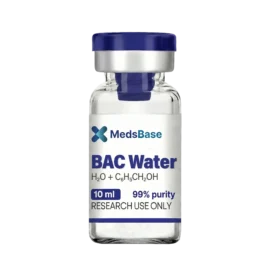
- BAC Water (Bacteriostatisch Water) — Benodigd voor het reconstitueren van elk lyofiliseerd flesje — steriel, 0,9% benzylalcohol-geconserveerd oplosmiddel
Meer opties in Peptiden
Gerangschikt op recente bestelvolumes van MedsBase — wat andere klanten in deze categorie kiezen.
| Sterkte | 50 mg |
|---|---|
| Hoeveelheid | 10 flacons, 20 flacons, 30 flacons |
 AICAR (Acadesine / AICA-Riboside)
Vragen & antwoorden
AICAR (Acadesine / AICA-Riboside)
Gerelateerde producten
Beoordelingen
Er zijn nog geen beoordelingen